What each seed label means, and what it does for a container gardener
| Label | How it was bred | Saved seed grows | Typical strength | Typical weakness |
|---|---|---|---|---|
| F1 hybrid | Controlled cross of two chosen parent lines | Often different from the parent plant | Uniform plants and, often, built-in disease resistance | Saved seed does not come true, so you buy new seed each year |
| Open-pollinated | Plants allowed to pollinate freely within the variety | Relatively true to type if no new pollen is introduced | Seed you can save; more genetic diversity | Resistance varies by variety; check the packet codes |
| Heirloom | An open-pollinated variety preserved over many generations | Relatively true to type, with minor variability | Color, shape, texture and flavor; seed you can save | Many have little disease resistance and crack more |
| Organic | Seed grown under organic practices; a separate label | Depends on whether it is also hybrid or open-pollinated | Seed harvested from plants grown under organic practices; cannot be GM (Utah State) | Says nothing about vigor, resistance or seed saving |
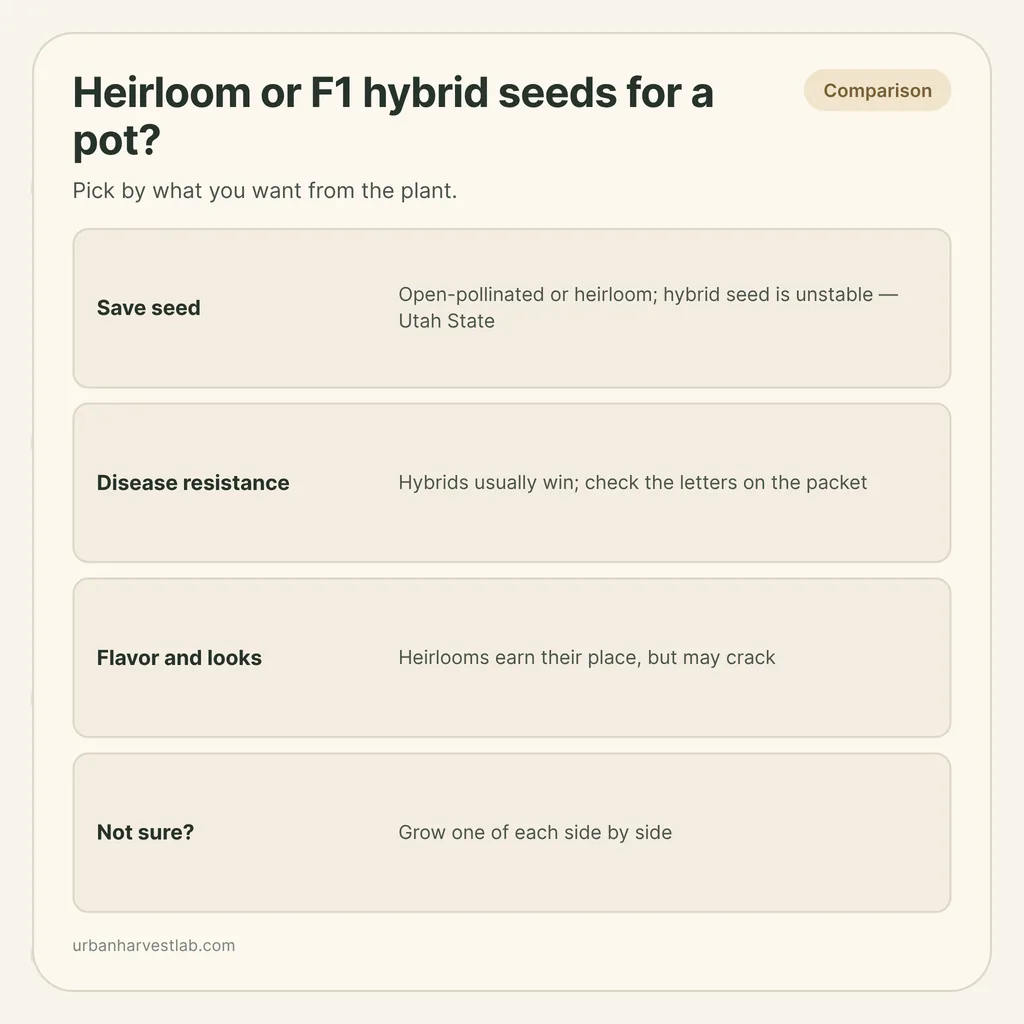
Choose an F1 hybrid when you want the most reliable, disease-resistant plant, and an heirloom when flavor, color or seed you can save matter more to you. Both are ordinary vegetables. The labels describe how a variety was bred, and that decides three things you will notice in a pot: whether saved seed grows into the same plant, how much built-in disease resistance it carries, and how much character the fruit has.
What the three words mean
Utah State University Extension lists the labels you will meet on a packet as heirloom, open-pollinated, hybrid, genetically modified or organic. They overlap, so it helps to see how.
Open-pollinated varieties are pollinated freely within the variety. Utah State says that as long as no new pollen is introduced, the resulting seeds and plants are relatively true to type, meaning similar to the parent plants.
Heirloom is a subset of that group. Utah State calls heirlooms old varieties selected and preserved from historic seed lines over many generations, says they are generally open-pollinated, and says not every open-pollinated variety is an heirloom. How old a variety must be to qualify is debated, so one catalog’s “heirloom” is not guaranteed to match another’s. University of Illinois Extension adds that even inside one named heirloom there is some minor variability: you get a beefsteak from ‘Mortgage Lifter’, but plants differ a little from one to the next.
Hybrid means a controlled cross. Utah State says the specific parents are kept going to produce the hybrid again each year. A packet marked F1 holds first-generation seed from that cross. University of Illinois Extension describes it as a first-generation cross of two known parent plants, and says an F1 hybrid can be a better performer, with higher yield and more disease resistance or tolerance than either parent. Its Extension educator adds that hybrids are bred for traits such as uniformity, disease resistance and enhanced flavor.
Organic is a different question. Utah State says organic varieties can be heirlooms, open-pollinated or hybrids, because the label depends on how the seed was grown. An organic hybrid and a conventional heirloom are both possible.
If you are puzzled by other words on the same packet, such as patio or determinate, those describe plant size and habit, not breeding. What ‘patio’, ‘bush’, ‘dwarf’ and ‘determinate’ mean covers them.
Saved seed: the clearest difference
This is the one place where the labels give a firm answer. Utah State says hybrid seeds tend to be unstable: if you save seed from them, the resulting plants are often different from the hybrid and may be less vigorous and productive. University of Illinois Extension says the offspring of hybrid plants will not necessarily carry the desirable traits forward, and that keeping those traits requires highly controlled seed production. Open-pollinated vegetables, by contrast, have traits that reliably carry through to the next generation.
So the question to ask is whether you intend to save seed at all. If you do not, the argument for an heirloom on seed-saving grounds disappears and you are choosing on other grounds. If you do, buy open-pollinated or heirloom; on a seed listing, look for “open-pollinated” or “heirloom” in the description rather than “F1” (browse open-pollinated vegetable seeds on Amazon). Illinois notes that tomatoes, peppers, peas and beans have self-pollinating flowers and need little to no special care for seed saving, which makes them the sensible place to start in a pot. Squash, cucumbers and sweet corn are cross-pollinated, which makes keeping a variety pure much harder. The method, crop by crop, is in how to save seeds from container vegetables, and how long the seed then stays good is in how long seeds last.
Disease resistance: where hybrids usually win
North Carolina State University’s heirloom tomato trial page states it plainly: most heirloom tomatoes have little or no disease resistance, and in a wet season heirloom varieties often fall victim to blight before they yield much fruit. That is one state’s tomato work, not a verdict on every vegetable, but it matches what University of Illinois Extension says from the other direction: just about every improved hybrid carries some level of disease resistance.
You can read that resistance on the packet. University of Illinois Extension explains that letters after a variety name signal breeding for resistance or tolerance to specific diseases. On a tomato, V, F, N and TMV stand for Verticillium wilt, Fusarium wilt, nematodes and tobacco mosaic virus. On a cucumber, CMV, CVYV and PM stand for cucumber mosaic virus, cucumber vein yellowing virus and powdery mildew, and DM, for downy mildew, is a newer addition.
Two cautions keep the codes useful:
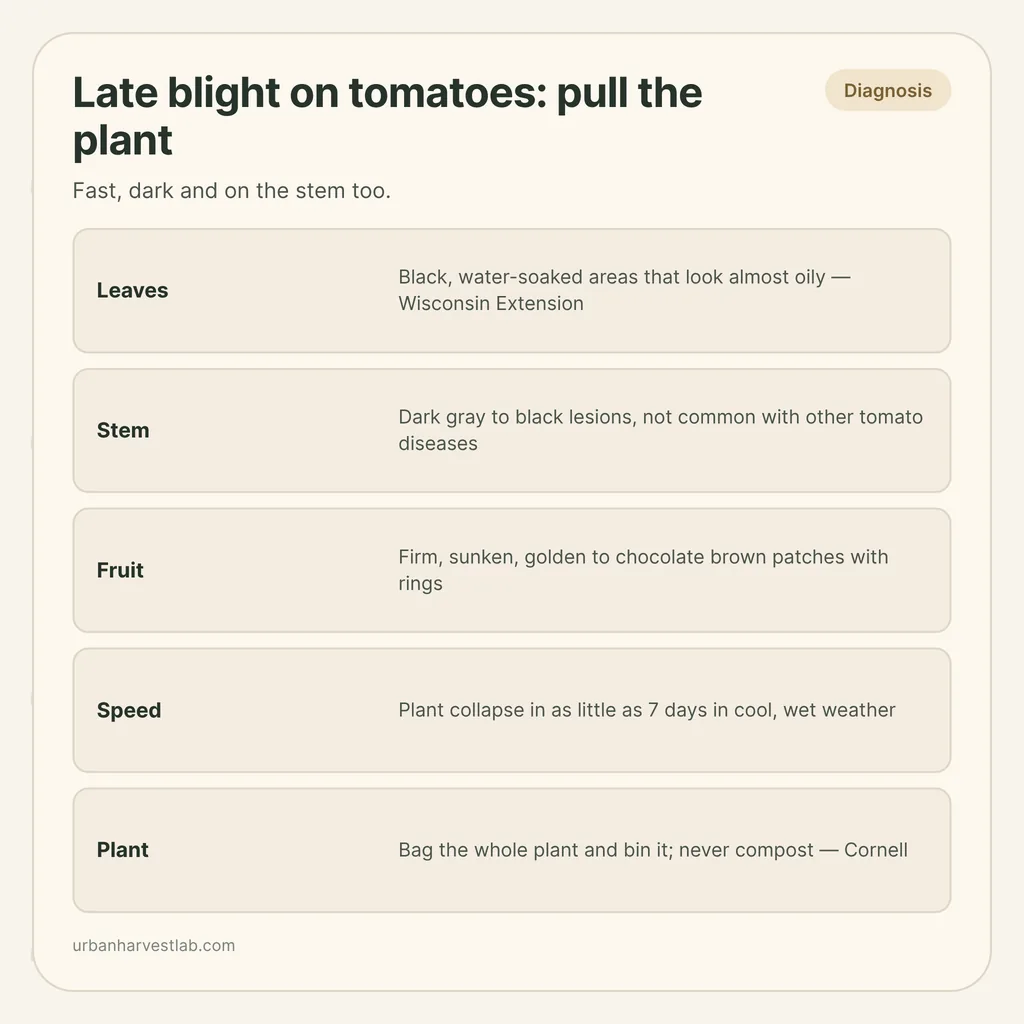
- A code only protects against the disease it names. The letters above do not mention late blight, so a hybrid with V and F is not covered for it. If late blight is what worries you, late blight on tomatoes explains what to watch for.
- Resistance is not immunity. Illinois recommends reading carefully: for basil downy mildew, the best available in some varieties is intermediate resistance. Utah State adds that varietal resistance can break down when pathogen strains change or when conditions favor the organism. The page on basil downy mildew shows what the disease looks like.
Illinois also gives a simple rule for gardeners who already have soil-borne disease: stick with the hybrids, since you cannot treat those diseases and save the plants.
Flavor, looks and cracking: where heirlooms earn their place
University of Illinois Extension says heirloom, antique and open-pollinated vegetables can give fruit with a lot of visual character and a different texture and flavor when eaten. That is the main reason to grow them, and it is a good one for a small container garden where you grow six plants rather than six hundred.
The cost shows up as cracking. In the same North Carolina State trial, heirloom tomato fruit tended to burst and crack, while the hybrids showed little of that. The page also notes heirloom varieties are often rough in appearance. If your tomatoes split after a heavy watering, why tomatoes crack covers the watering side.
Do not assume hybrids taste worse. North Carolina State’s taste panel rated two of its heirloom-type hybrids the best tasting, and concluded these hybrids had flavor comparable or superior to several favorite heirlooms. Yield did not split along the label either: in that trial, the heirlooms ‘Cherokee Purple’ and ‘Mr. Stripey’ had total yields as high as the best hybrid. Variety matters more than the label.
How to choose for a pot
Match the choice to what you most want from the plant.
- You want the safest harvest from one or two plants. Pick an F1 hybrid with resistance codes that match the diseases common where you garden. Your local extension office can tell you which those are.
- You want a tomato nobody sells in a shop. Pick an heirloom, expect some cracking, and give it steady watering.
- You want free seed next year. Pick open-pollinated or heirloom, and a self-pollinating crop such as tomato, pepper, bean or pea.
- You want a compact plant for a balcony. Check the size words first, because heirloom and hybrid versions of compact tomatoes both exist. The dwarf tomatoes for pots guide goes through them.
- You are unsure. Grow one of each side by side. Utah State recommends trying a new variety on a small scale first and comparing it with the one you already know, which is easy to do with two pots.
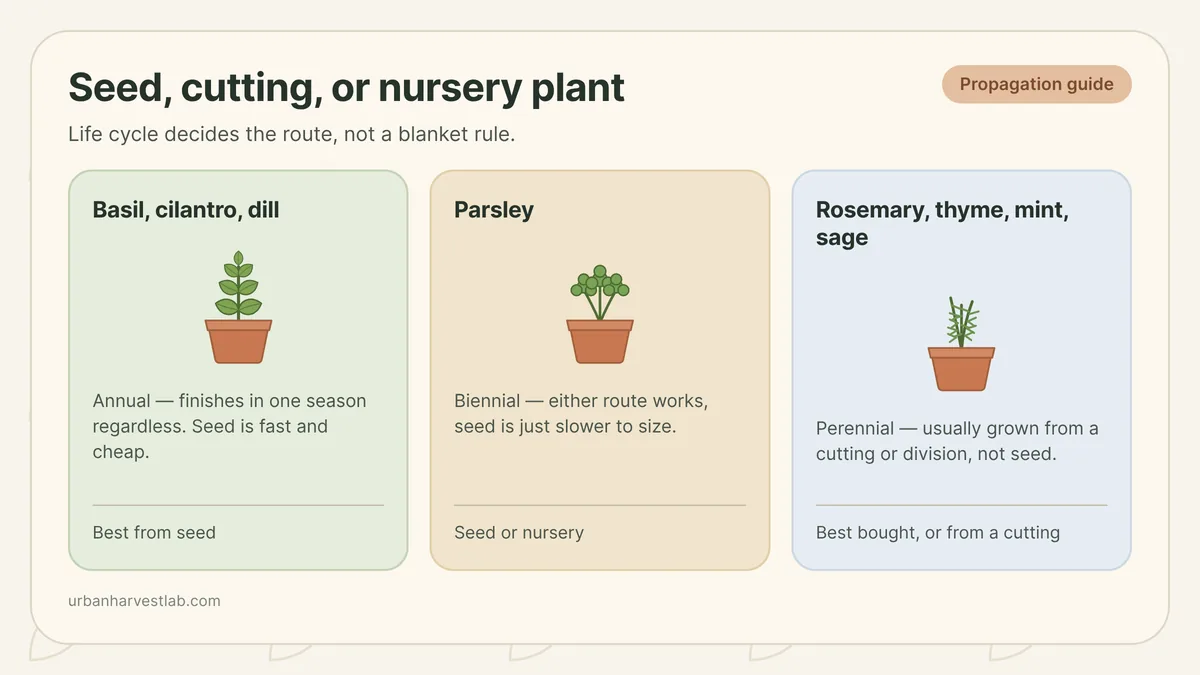
Plenty of gardeners end up with a mix: a resistant hybrid as the dependable plant, and one or two heirlooms for the fruit you cannot buy. If you are also weighing seed against nursery plants, herbs from seed or buying plants covers that decision for herbs.
Sources
- Utah State University Extension, “Varietal Selection”
- University of Illinois Extension, “Catalog Code” (Over the Garden Fence)
- University of Illinois Extension, “Open-Pollinated vs. Hybrid: An important distinction when saving seeds”
- North Carolina State University, N.C. Specialty Crops Program, heirloom tomato trial
Choose and keep your seed
Read the rest of the packet, save seed from the right plants and store it properly.
Common questions
What is the difference between heirloom and hybrid seeds?
Heirloom seeds are old varieties preserved over many generations, and they are open-pollinated, so saved seed grows into similar plants. A hybrid comes from a controlled cross of two chosen parents. Utah State University Extension says seed saved from a hybrid often grows into plants that are different from the hybrid and may be less vigorous and productive. University of Illinois Extension says a first-generation F1 hybrid can give a higher yield and more disease resistance than either parent.
Are heirloom seeds better than hybrid seeds?
Neither is better across the board. Heirlooms offer unusual shapes, colors and flavors, and you can save their seed. Hybrids usually carry disease resistance. North Carolina State University found that most heirloom tomatoes have little or no disease resistance and tend to crack, though in its trial two heirlooms yielded as well as the best hybrid. The same trial rated new hybrids as comparable or superior in flavor to several favorite heirlooms.
Is F1 the same as GMO?
No. Utah State University Extension describes hybrids as the product of crossing specific individuals under carefully controlled pollination, and genetically modified varieties as ones made by inserting genetic material from different plants, animals or organisms. Those are different methods. The same page says organic seed cannot be genetically modified, and that organic varieties can be heirlooms, open-pollinated or hybrids.
Can I save seed from an F1 hybrid?
You can, but the plants it grows will often differ from the one you took it from. Utah State University Extension says they are often not true to type and may be less vigorous and productive. If you want seed you can save year after year, buy an open-pollinated or heirloom variety.
Related guides

How to grow beans in pots: bush or pole, support and a steady harvest
Bush beans crop in a burst from a small pot with no support. Pole beans climb a trellis and keep producing for longer. Here is how to choose, plant and pick each one in a container.
Herbs from seed or buying plants: how to decide
Some herbs finish a whole life cycle from seed in a matter of weeks; others are slow, woody, or simply propagated a different way. The life cycle of the herb, not a blanket rule, is what actually decides which route makes sense.
Late blight on tomatoes: how to spot it and what to do
Late blight moves in days, not weeks, and spreads on the wind to other people's plants. Learn the signs that separate it from ordinary leaf spot and how to dispose of the plant.