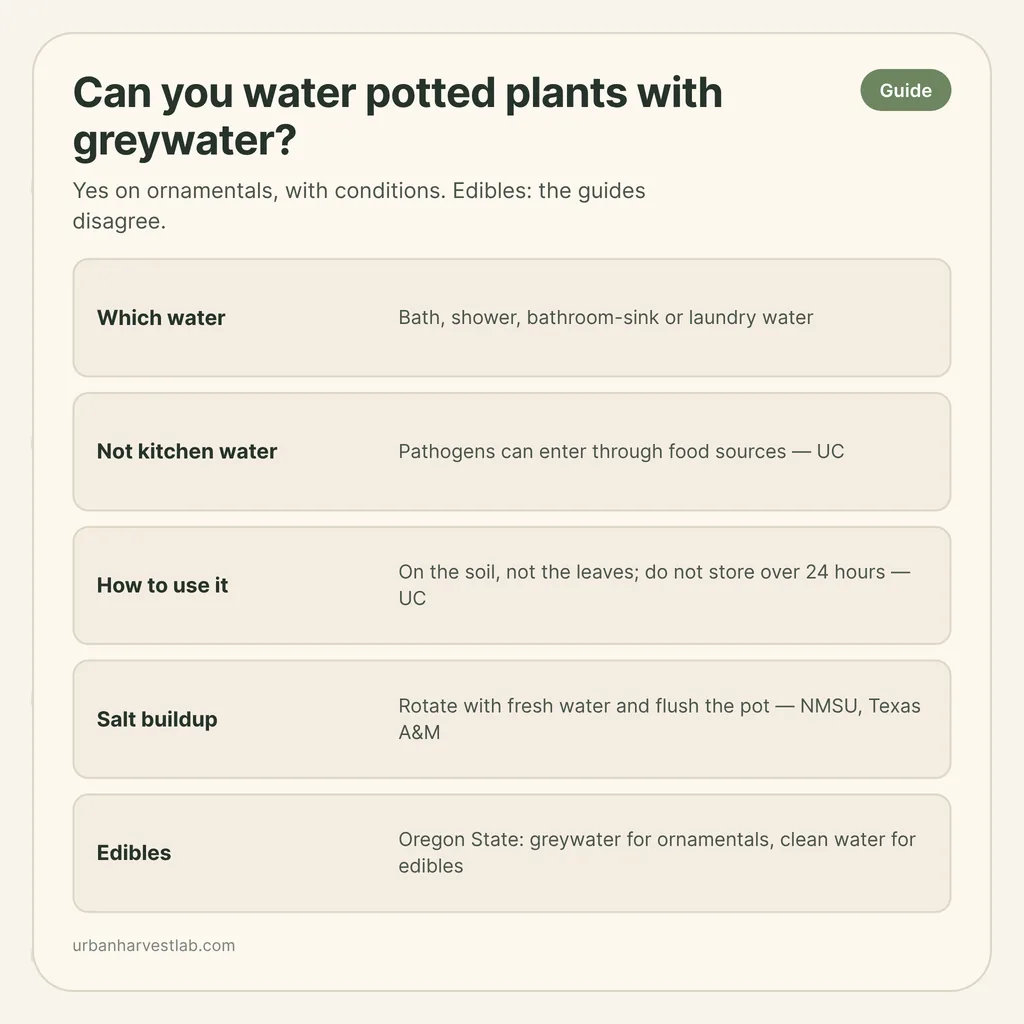
Yes, on ornamentals, with conditions: bath, shower, bathroom-sink or laundry water, put on the soil (not the leaves), used within a day, and made with low-sodium, bleach-free products. On vegetables and herbs, the extension guides do not agree, and the cautious ones say to keep greywater off anything you eat.
If your pots get plain tap water, tap water for plants covers what is in it. If you collect roof runoff, rainwater for container plants covers that. Here the subject is the used water from your own fixtures.
What counts as greywater
Virginia Cooperative Extension defines greywater as “any household wastewater other than that used for toilet flushing,” and notes that in many states it means water from baths, showers, laundry and bathroom sinks. UC Cooperative Extension (Hartin and Faber) excludes wastewater from kitchen sinks, dishwashers and toilets.
The kitchen exclusion matters for pots. UC says pathogens can enter graywater through food sources in the kitchen, so kitchen-sink and dishwasher water is not recommended. NMSU goes further: dishwasher water should not be used for irrigation, and water from washing cooking utensils may contain grease, fats and oils and “is not acceptable.” Oregon State Extension adds a practical list of things to watch for: food particles, cooking oil, and body products such as sunscreen.
Laundry water from diapers is out. NMSU says it should not be reused, and UC says to avoid water contaminated by human waste.
Edible plants: where the guides stand
This is the question most readers actually have, and the answers differ.
| Source | What it says about edibles |
|---|---|
| UC Cooperative Extension | Not on edible parts or root crops; “to be safe,” only on nonedible ornamentals |
| Texas A&M AgriLife Extension | Avoid irrigating edible fruit and vegetable gardens |
| Virginia Cooperative Extension | States that permit irrigation limit it to nonedible landscape plants |
| Oregon State Extension | Best on landscape and flowers; save clean water for vegetables and fruits |
| NMSU Extension (guide reprinted 1996) | Suitable for food crops if applied to the soil, not leaves; no uncooked root crops; established plants only, not seedlings |
NMSU is the most permissive and also the oldest of these. Its conditions are specific: water the soil directly, not through a sprinkler or any method that touches the above-ground plant, leave out root crops eaten uncooked, and use greywater only on well-established plants rather than seedlings or young plants.
Legal rules sit on top of this. Virginia Cooperative Extension says regulation “varies widely from state to state,” UC notes that cities and counties can be stricter than the state, and Oregon State says greywater use in Oregon requires a permit from the state environmental quality department. Check what applies where you live before you plumb anything.
A pot of basil or lettuce is eaten leaf by leaf, which UC and Texas A&M say to avoid and NMSU permits only with soil-level watering. The simplest position is Oregon State’s: greywater for ornamentals, clean water for the edibles.
Salts, pH and what happens in a pot
The plant-side problem is chemical. UC says studies indicate greywater may contain significant levels of sodium and other salts harmful to plants, particularly from powdered laundry detergents. Texas A&M describes the long-term effects on soil as a rise in pH or alkalinity and an accumulation of sodium, and says sodium can damage soil structure and eventually reduce the soil’s ability to accept water. Signs of excess chlorine or sodium, Texas A&M says, include leaf burn and yellowing leaves; too much boron brings leaf tip and margin burn and cupping.
Those guides were written for yard landscapes, where rain and a large soil volume dilute the load. Hartin and Faber say very little is known about the effect on annual bedding plants. What the guides do offer is a two-part approach that can be applied to a pot:
- Rotate with fresh water. NMSU: “rotate with fresh water to avoid buildup of sodium salts.”
- Flush. Texas A&M recommends periodically flushing the soil with fresh water. In a pot, that means watering until it runs out of the drainage holes, which is the routine described in salt buildup in herb pots.
Both NMSU and Texas A&M say plants that grow best in acid soil should not get greywater, because it is alkaline. That rules out acid-loving plants such as the ones in blueberries in containers.
Detergents and products to avoid
What goes down the drain decides what lands in the pot. The sources agree on the direction:
- UC: use salt-free and boron-free liquid laundry detergents, and avoid chlorine bleach.
- NMSU: greywater containing sodium, bleach or borax can damage plants; avoid liquid fabric softeners and detergents with softeners, and use a dryer sheet instead.
- Texas A&M, quoting a California greywater guide: concentrated liquid detergents usually have lower sodium than regular detergents because they contain no fillers. The same guide lists bleaches, softeners, whitening ingredients, enzymatic powders, borax, peroxygen, sodium perborate and petroleum distillates as ingredients to avoid.
Hartin and Faber also warn that many shampoos, soaps and detergents contain dyes, bleach, chlorine, sodium, boron and phosphate, which can injure or kill plants at high doses over a short period or at smaller doses over a longer one. If you cannot find an ingredient list that clears those, use tap water or rainwater for the pot.
Handling it
- Time. UC Cooperative Extension says do not store greywater more than 24 hours. NMSU gives one day and says to use it the day it is collected, because the high bacteria count causes odors.
- Contact. UC says to wear gloves and avoid direct contact, and not to let it pool or run off the soil surface.
- Method. UC says not to apply it through sprinklers. In a pot, that points to a watering can poured at soil level rather than a mister.
- Splash. UC says to avoid splashing greywater on neighbouring edible plants, so keep a mixed balcony in mind when you pour.
Sources
- UC Cooperative Extension (Hartin and Faber), “Use of Graywater in Urban Landscapes”
- NMSU Cooperative Extension, Guide M-106, “Safe Use of Household Greywater”
- Texas A&M AgriLife Extension, L-5480, “Graywater safety”
- Virginia Cooperative Extension, BSE-114NP, “Greywater Reuse”
- Oregon State University Extension, “Is it okay to use gray water to water my garden?”
Other water sources for pots
Tap water, rainwater and salt buildup, the three things that decide how a pot copes with whatever you pour on it.
Common questions
Can I water houseplants and potted flowers with shower water?
Extension guides treat bath and shower water as greywater and accept it on ornamentals when it goes on the soil, is used within a day, and comes from low-sodium, bleach-free products. Rotate it with fresh water, as NMSU advises, so salts do not accumulate.
Can I use greywater on vegetables in pots?
The sources differ. UC Cooperative Extension says to apply it only to nonedible ornamental plants, Texas A&M says to avoid irrigating edible fruit and vegetable gardens, and NMSU allows food crops if the water goes on the soil and uncooked root crops are left out. Oregon State Extension suggests saving clean water for vegetables and fruits.
Can I use dishwater or kitchen sink water on plants?
UC Cooperative Extension and Virginia Cooperative Extension exclude kitchen-sink and dishwasher water from greywater. NMSU says dishwasher water should not be used for irrigation and that water from washing cooking utensils is not acceptable.
How long can I keep greywater before using it?
UC Cooperative Extension says not to store it more than 24 hours. NMSU says untreated greywater should not be kept longer than one day and warns of odors from the high bacteria count.
Related guides
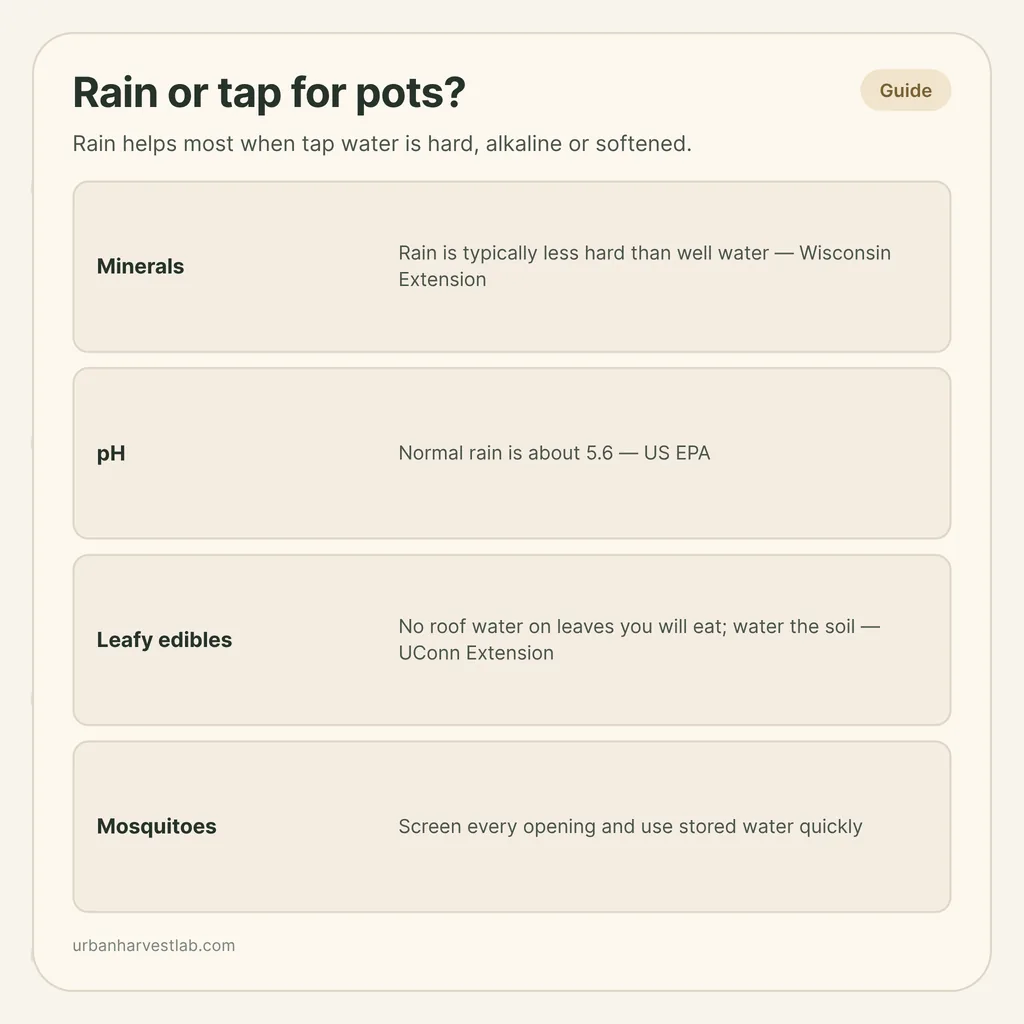
Is rainwater better for container plants? When it helps and how to collect it safely
Rain carries fewer dissolved minerals than most hard tap water, which matters in a small pot. It is not a cure-all, and where you collect it decides whether it is safe near food.
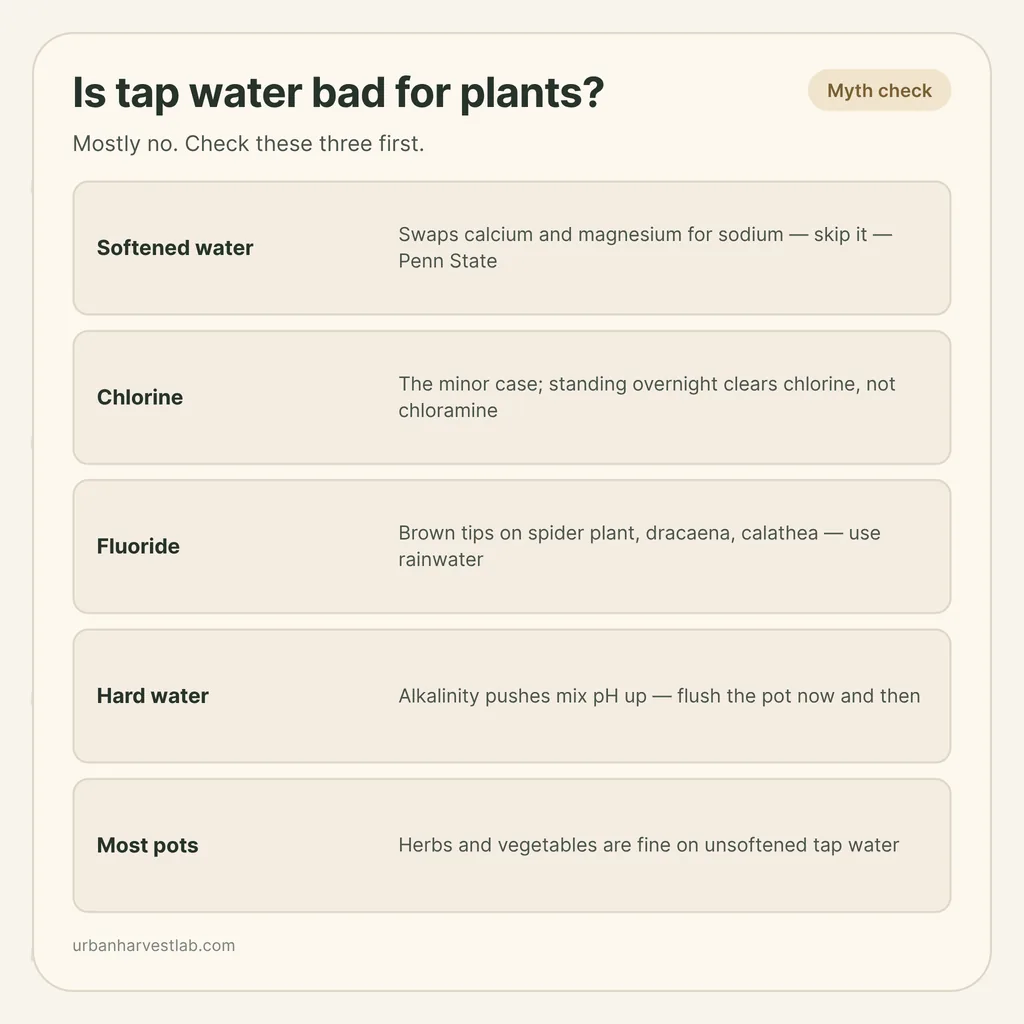
Is tap water bad for plants? Chlorine, fluoride, hardness and softened water
Most tap water grows herbs and vegetables without trouble. Three things can change that: softener sodium, fluoride and alkaline hard water. Here is how to tell which one you have.

How to grow blueberries in pots: acidic mix, a second variety and the right water
Blueberries are fussy about acidity, not about space. Here is the pot size, the mix, the pollination partner and the watering that keep a container bush fruiting.