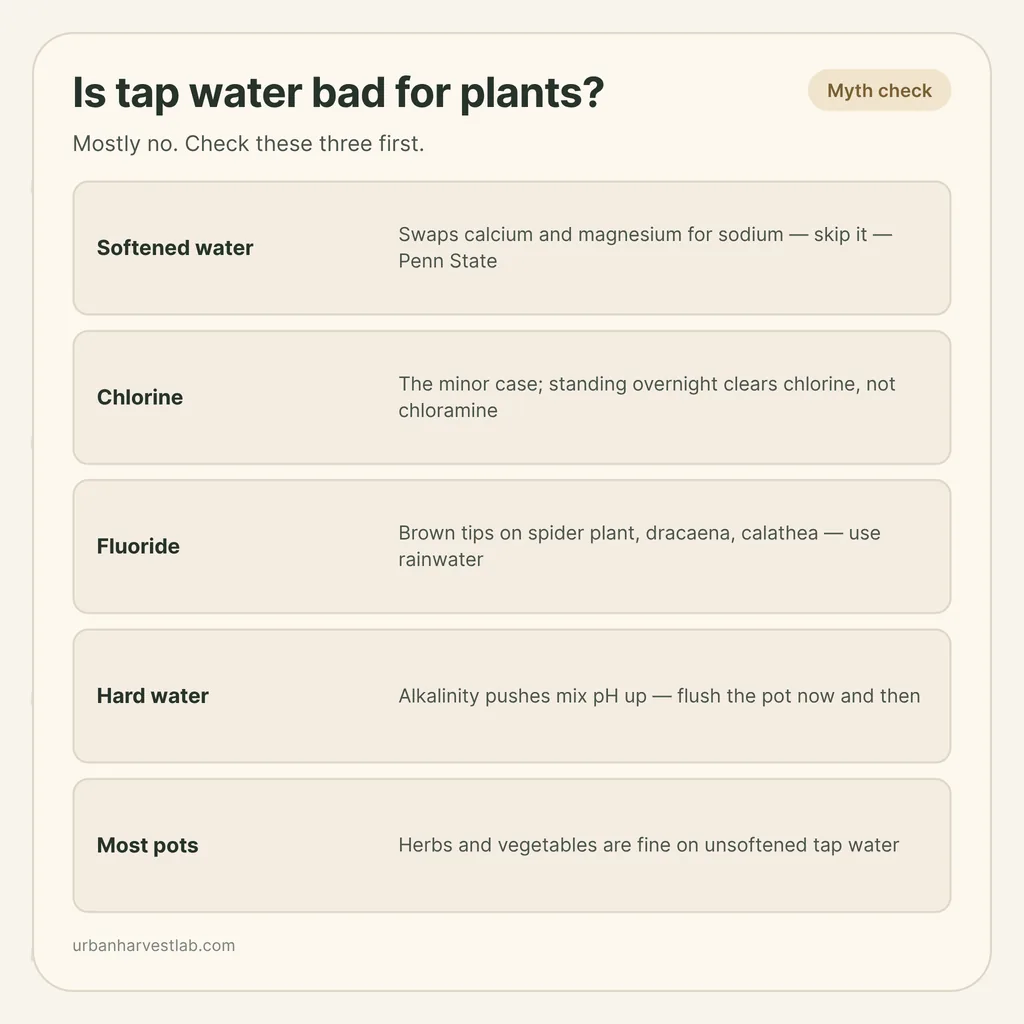
What each tap-water issue does, and what to do
| Water issue | What it does in a pot | What to do |
|---|---|---|
| Chlorine | Minor for most plants; one possible tip-burn cause on sensitive foliage plants | Fill the can and let it stand a day, if your utility uses chlorine |
| Chloramine | Does not leave on standing or boiling | Check your utility's water report; if it uses chloramine, standing water does nothing |
| Fluoride | Brown, spotted leaf tips on sensitive plants such as spider plant and dracaena | Use rainwater or distilled water on those plants |
| Hard, alkaline water | Raises mix pH over time, like adding lime (Purdue); leaves white crusts | Test alkalinity, flush the pot, consider rainwater for pH-sensitive plants |
| Softened water | Adds sodium and chloride; can damage plants and soil drainage | Use an unsoftened tap or rainwater |
Tap water is fine for most potted herbs and vegetables. Three things can turn it into a problem: a water softener, fluoride on sensitive foliage plants, and alkaline hard water building up in a small pot. Chlorine and chloramine are the minor case. Work out which one applies to you and the rest can be ignored.
If your plants are healthy on what comes out of the tap, change nothing. For the wider routine of watering pots, see potted herb care.
Start with the one rule: skip softened water
A water softener works by swapping the calcium and magnesium in the water for sodium. Penn State describes homeowners softening water “to exchange the calcium and magnesium in the water for sodium” and says that “over long periods of time, sodium becomes toxic to plants.” It adds that excess sodium damages soil structure around the roots and reduces drainage. Penn State also notes that plants vary widely in how much softened water they tolerate, so some pots will look fine for a while.
Clemson’s Home and Garden Information Center is blunt: do not water plants with softened water, because sodium and chloride are added to the soil mix and may damage the plant. The University of Maryland says softened water contains more dissolved minerals than other water and should be avoided on houseplants.
What to do about it:
- Water from a tap that bypasses the softener. Some homes plumb the outdoor tap or one kitchen tap ahead of the softener. Check yours before you assume.
- Collect rainwater instead. The full case for it, and how to do it on a balcony, is in rainwater for container plants.
- If a pot has already had softened water for months, Penn State suggests leaching the sodium out with rainwater or unsoftened water, keeping the pot from standing in softened water, and repotting into fresh mix.
Softening removes hardness, so it can look like the kind option for plants. It is not: the exchange trades calcium and magnesium for sodium. If hard water is the problem, flush the pot or switch to rainwater instead.
Chlorine: stand it or ignore it
Chlorine, and chloramine with it, is the least worrying of the lot. Penn State says it generally presents less of a headache for houseplants, and that it can be removed by heating, aeration or letting a filled watering can stand overnight. The University of Maryland recommends drawing water the day before you need it: a day’s evaporation should clear chlorine and let most minerals settle, and it suggests discarding the bottom one to two inches of the container.
Iowa State lists chlorine alongside fluoride as a possible cause of brown leaf tips, especially over an extended period on sensitive species. That is a reason to switch water if a particular plant keeps browning, not a reason to dechlorinate everything.
Check whether your utility uses chloramine
Standing only works on chlorine. EPA Region 9 states that, unlike chlorine, chloramines do not rapidly dissipate on standing, and neither do they dissipate by boiling. Your utility’s annual water quality report says which disinfectant it uses. If it says chloramine, the overnight can does little. For most potted plants that changes nothing in practice, since the plant-side evidence concerns chlorine and fluoride rather than chloramine. The disinfectant detail is worked through in chlorine and chloramine in hydroponics, including the numbers behind why a normal residual is far below problem levels for plants.
Fluoride: a foliage-plant problem
Fluoride shows up as spotted, burned leaf tips. Penn State calls the spider plant a top indicator of fluoride in water. Iowa State lists spider plant, ti plant, dracaena, prayer plant and calathea as sensitive species and says to use a different water source if you suspect it. University of Maine Extension says minute amounts of fluoride in public drinking water can cause tip burn.
Two points keep this in proportion.
First, brown tips have several causes. The University of Wisconsin-Madison lists low humidity, excessively dry soil, salt accumulation, and fluoride or chlorine in tap water for spider plant. Check the others before blaming the tap. Brown leaf tips on potted herbs walks through that sorting.
Second, the species the extension pages name are foliage houseplants. If you grow a spider plant or a dracaena on the same windowsill as your basil, give those two rainwater or distilled water (Wisconsin’s suggestion) and leave the herbs on tap water.
Standing water does not fix this. Penn State treats chlorine and fluoride as separate problems with separate remedies. University of Maine Extension suggests keeping soil pH around 6.3 to 6.5, which increases calcium available to the plant and decreases fluoride availability, so a pH-balanced mix helps, while the simple fix is a different water source.
Hard water: the issue is alkalinity
Hard water carries calcium and magnesium. In a small pot the effect depends on alkalinity, which is the water’s capacity to neutralize acid. Purdue Extension, writing for greenhouse and nursery growers, explains that the main contributors are carbonates and bicarbonates and that irrigating with water high in alkalinity has the same effect as adding lime to the substrate. Water alkalinity can strongly affect substrate pH, Purdue says, while the pH of the irrigation water itself has a minimal effect. That is why a neutral pH reading on your tap does not clear it.
Purdue also notes that hardness can be used as an indicator of alkalinity. The two can diverge, though: a report can show high hardness with low alkalinity, or the reverse, and neither number predicts the other (hard water in hydroponics). So if your utility reports hardness but not alkalinity, treat it only as a prompt to get an alkalinity figure.
The University of Kentucky says high-alkalinity water pushes the pH of the mix up over time, sometimes quickly, and that up to about 150 ppm alkalinity is manageable for 4-inch or larger containers, with rising concern above that. Rainwater for container plants has the full bands.
What it looks like in a pot: white crust on the soil or rim as dissolved minerals are left behind when water evaporates. Small pots change fastest, and a larger pot buffers the mix for longer. Purdue’s advice is for commercial growers, so treat it as the mechanism rather than a home dosing plan.
Practical options, from least to most effort:
- Flush the pot now and then. The University of Maryland says to pour at least twice the pot’s volume of water through and let it drain completely, every four to six months. The method, with its crust-scraping step, is in salt buildup in herb pots.
- Empty the saucer. The University of Maryland says not to let the pot sit in the water that runs out.
- Switch to rainwater for plants that struggle at higher mix pH, since alkalinity is what pushes it up.
- Refresh the mix when it is crusted and tired: refresh old potting soil.
If you grow hydroponically, hard water behaves differently, because there is no soil to buffer it. Hard water in hydroponics covers that case.
Which water for which pot
Match your tap to the issue, then pick a source by plant:
- Herbs, tomatoes, peppers and salad greens on ordinary unsoftened tap water: keep using it, flush occasionally.
- Spider plant, dracaena, calathea and prayer plant with browning tips: rainwater or distilled water for a few weeks.
- Any plant on softened water: switch to an unsoftened tap or rainwater now.
University of Maryland also lists rainwater and the drain-pan water from a dehumidifier as mineral-free options, since the latter is distilled water.
Sources
- Clemson HGIC: Indoor plants, watering
- University of Maryland Extension: Watering indoor plants
- Penn State: Softened water can cause hard times for indoor plants
- Iowa State Extension: Diagnosing houseplant problems from improper environmental conditions
- University of Wisconsin-Madison Extension: Spider plant
- University of Maine Cooperative Extension: Tips for growing houseplants in Maine
- Purdue Extension HO-242-W: Alkalinity management in soilless substrates
- U.S. EPA Region 9: Chloramine
Water your pots well
Source water is one part of watering. These pages cover the rest, from salt crusts to rain collection.
Common questions
Is tap water bad for plants?
Not for most potted herbs and vegetables. The cases extension services flag are softened water (Clemson, University of Maryland and Penn State all advise against it), fluoride on sensitive foliage plants such as spider plant and dracaena (Iowa State, Wisconsin), and alkaline hard water building up in small pots (Purdue). Plain municipal water that is neither softened nor very hard is the ordinary case.
Do I need to let tap water sit overnight?
Only for chlorine. The University of Maryland says a day of evaporation clears chlorine, and Penn State says the same for standing overnight. EPA Region 9 says chloramine does not dissipate on standing or by boiling, so standing water does nothing if your utility uses chloramine. Standing also leaves fluoride and minerals in the water.
Can I water plants with softened water?
Avoid it. Clemson says not to water plants with softened water because sodium and chloride are added to the soil mix, possibly causing plant damage. Penn State adds that over long periods sodium becomes toxic to plants and can break down soil structure, reducing drainage. Use a tap that bypasses the softener, if your home has one, or rainwater.
Why do the tips of my spider plant turn brown with tap water?
Fluoride and chlorine in tap water are one possible cause, along with low humidity, dry soil and salt buildup (University of Wisconsin-Madison Extension). Iowa State lists spider plant, ti plant, dracaena, prayer plant and calathea as sensitive species. Switch to rainwater or distilled water for a few weeks and watch whether new leaves stay green.
Related guides
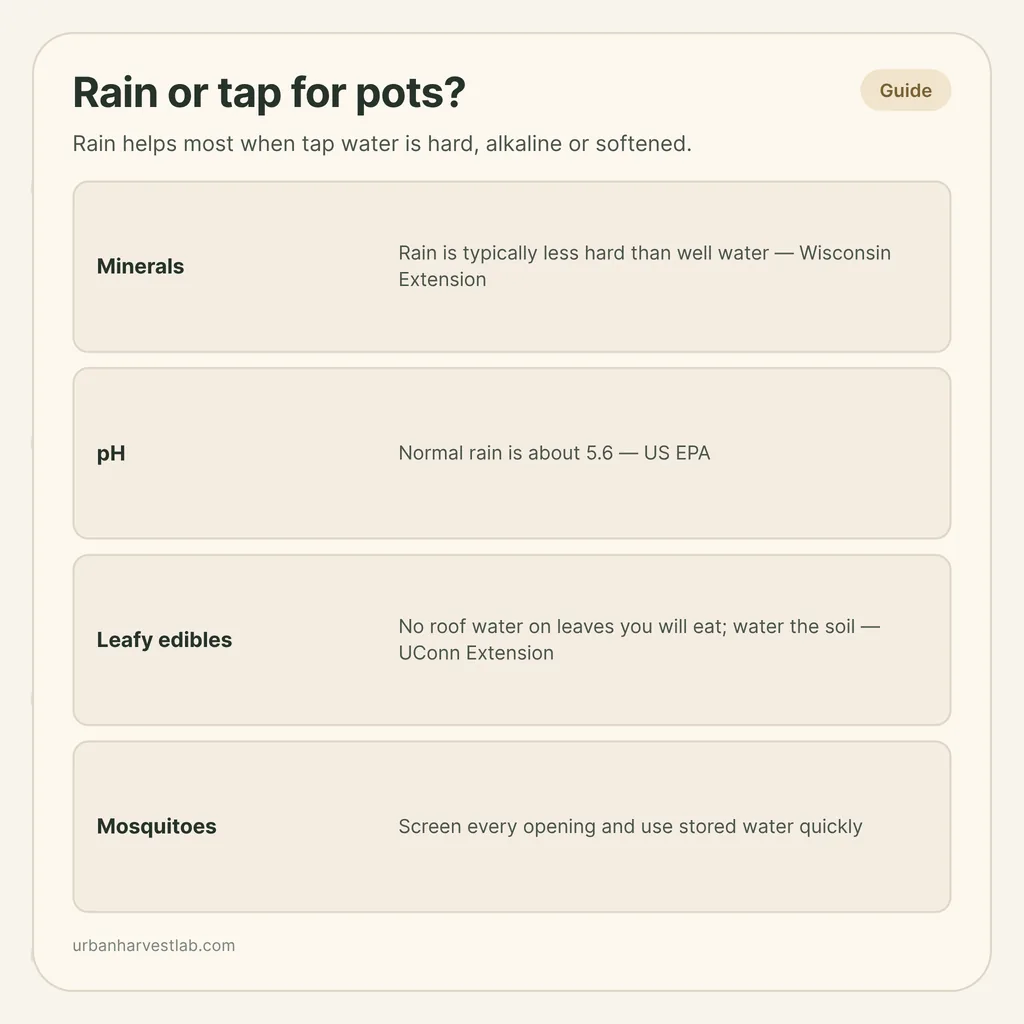
Is rainwater better for container plants? When it helps and how to collect it safely
Rain carries fewer dissolved minerals than most hard tap water, which matters in a small pot. It is not a cure-all, and where you collect it decides whether it is safe near food.
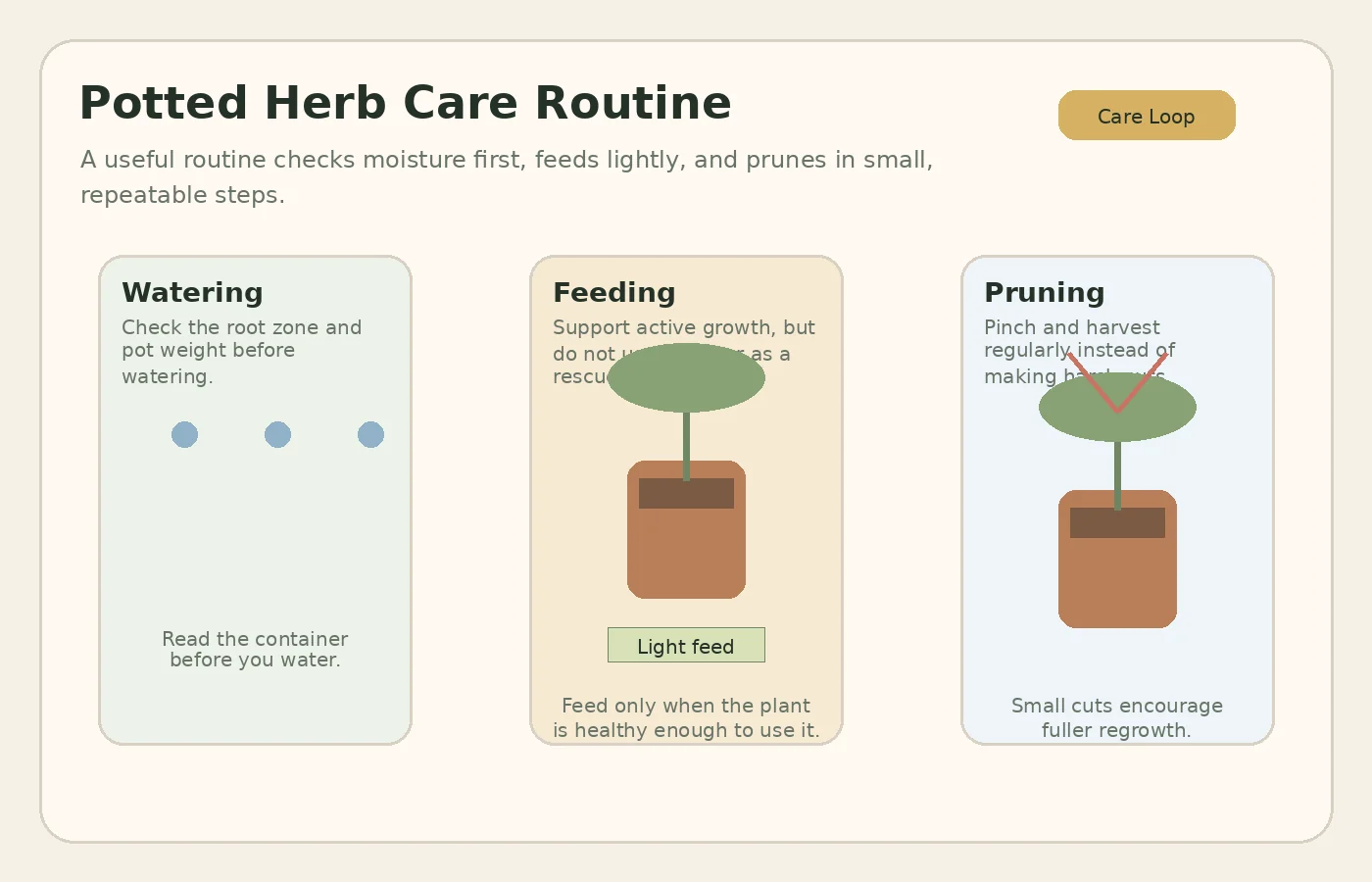
Potted herb care: watering, feeding, and pruning without guesswork
A practical guide to keeping basil, parsley, mint, thyme, and chives healthy by matching watering, feeding, and pruning to the setup.
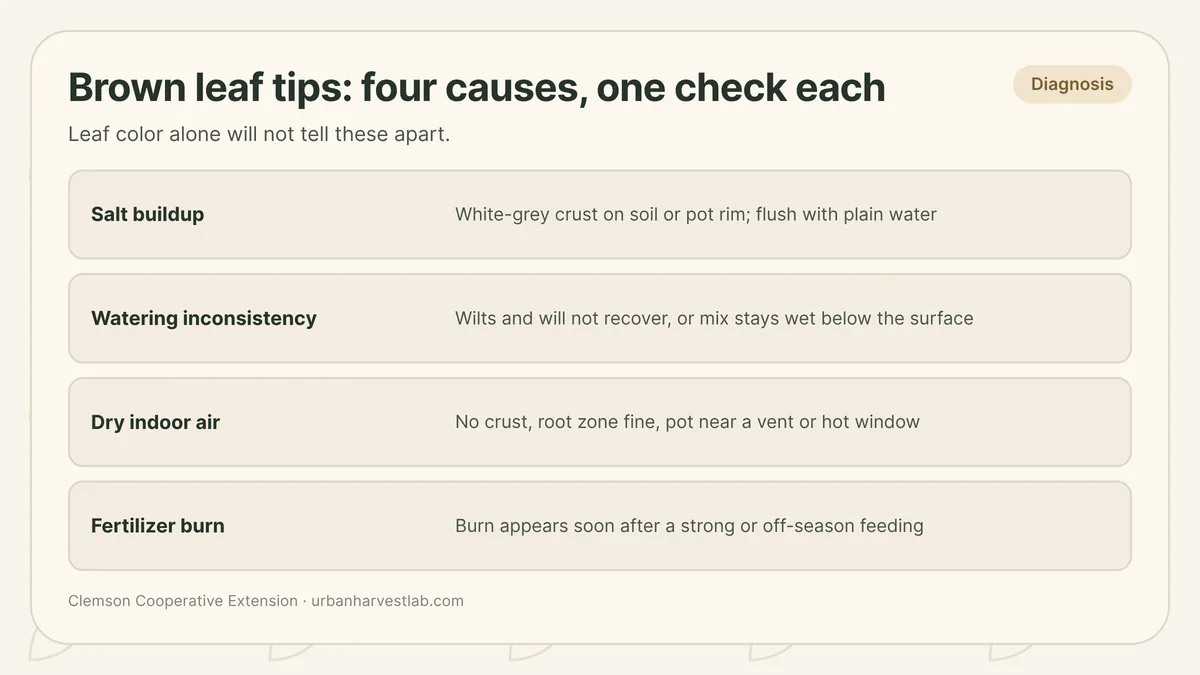
Brown tips on potted herbs: four causes and how to tell them apart
Four different problems produce the same crisped, brown tip. The soil surface, the root zone, and your last feeding date each point at a different one.