Rainwater and tap water for potted plants
| Question | Rainwater | Tap water |
|---|---|---|
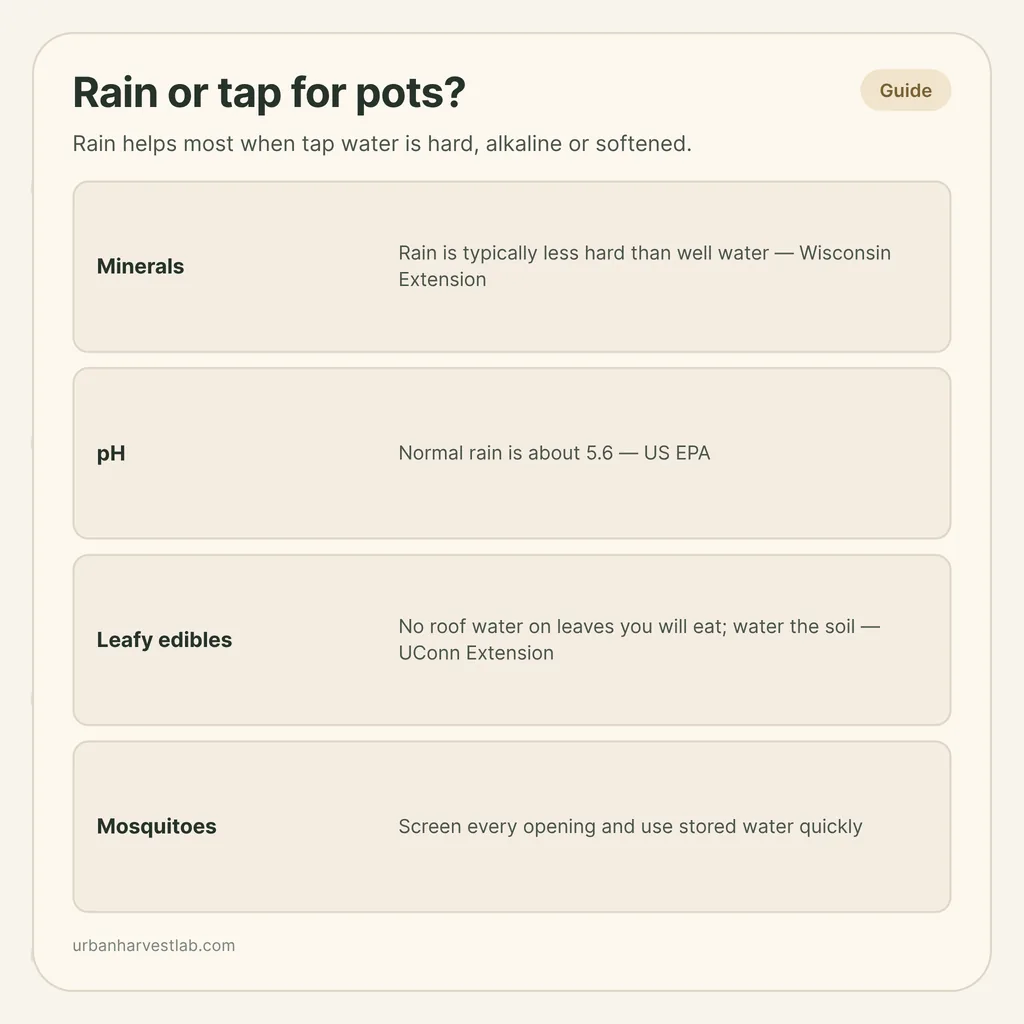
| pH | About 5.6 for normal rain (US EPA) | Set by your supply; the utility report lists it |
| Hardness and minerals | Typically less hard than well water (Wisconsin Extension) | Hard water leaves more minerals; softened water has more still (Maryland Extension) |
| Salt crust risk | Low, because buckets of rain are mineral-free (Maryland Extension) | Salts come partly from the water you irrigate with (Colorado State Extension) |
| Safe on leafy edibles | Not from a roof (UConn Extension); soil level only | Not an issue: no roof is involved |
| Storage | Needs screens and quick use (Rutgers, San Diego County) | Runs from the tap |
Rainwater is better for pots when your tap water is hard, alkaline or softened, and it makes little difference when your tap water is already low in minerals. The gain comes from what rain leaves out, not from anything it adds. The catch is that rain collected off a roof is not clean enough to splash on food, and a barrel of stored water is a mosquito nursery unless you screen it.
If you are deciding whether your tap water is the problem in the first place, start with the tap water guide for potted plants. Here is the other side: what rain does differently, and how to collect it from a balcony or a roof without creating a new problem.
What rain does differently in a pot
Normal rain has a pH of about 5.6, according to the US EPA. It is slightly acidic because carbon dioxide dissolves into it. That number is the one most people quote, and it is the less important one.
Alkalinity is the figure that decides how a pot behaves. The University of Kentucky defines it as the water’s ability to neutralize acids, including those in fertilizers and growing mixes, and says high-alkalinity water pushes the pH of the mix up over time, sometimes quickly. Its guidance for 4-inch or larger containers that are not especially pH sensitive is that an alkalinity of up to 150 ppm is manageable. From 150 to 300 ppm it causes increasing concern, especially if the water pH is above 7.5. Above 300 ppm with a water pH above 7.5, it expects significant problems.
Size matters here. Kentucky points out that the larger the volume of mix, the more buffering it has, so pH changes gradually in large containers and much faster in small ones. A windowsill herb pot is at the fast end.
Two extension sources describe the practical difference. Wisconsin Extension says collected rainwater typically is not as hard, nor as high in pH, as well water. Maryland Extension suggests setting buckets outside before rain and filling them, describing the water as having no added chemicals, and says softened water contains more dissolved minerals than other water and should be avoided on houseplants.
That is the whole case for rain: it dilutes the mineral load that builds up as water evaporates from the pot. Colorado State Extension lists the water you irrigate with among the sources of the white crust on potting mix, along with the mix and fertilizer. If your pots grow that crust, swapping to rain for some waterings helps, and the guide to salt buildup in herb pots covers flushing the salts that are already there.
When it is not worth the trouble
- Your tap alkalinity is low. Your water utility publishes a report with alkalinity or hardness. If it sits well under Kentucky’s 150 ppm figure, rain will not change much.
- You grow in a large pot. More mix buffers more.
- Your problem is something else. Brown leaf tips have several possible causes besides water source. The brown leaf tips guide separates the causes.
- You grow acid-lovers. This is where rain pays off most. Blueberries are the clearest case, covered in growing blueberries in pots.
For the mechanics of alkalinity in a nutrient solution, the alkalinity and pH drift guide explains it from the hydroponic side.
How to collect rain on a balcony
The simplest setup needs no downspout. Put clean buckets or wide tubs out when rain is forecast and bring the water to the pots after. Maryland Extension suggests exactly this. Rain caught in an open container does not touch a roof, so the roof contaminants discussed below do not apply, though a dirty bucket or a bird-visited railing will add its own. That does not make it safe for leaves. University of Minnesota Extension says rainwater is not a safe water source for leafy greens, so rain of any kind should go on the soil, not the leaves, of herbs and greens you will eat.
If you collect from a downspout into a barrel, you are collecting roof runoff, and the roof sets the quality. UConn Extension cites one study in which most metals tested the same in barrel water as in rain before it hit the roof. Zinc was the exception: UConn says elevated levels can build up in soil, can injure plants at high enough levels, and that such plants should not be eaten, so it suggests a soil test. A few samples exceeded official standards for E. coli or total coliform bacteria for some uses. The main bacterial source it names is fecal matter from animals such as squirrels and birds on the roof.
Two practical points from that source. The first water off a roof tends to carry higher concentrations of contaminants that built up since the last rain, so diverting the first flush helps. And the roof type matters: the University of Washington’s Miller Library does not recommend reclaimed water from an asphalt shingle roof for any edible crop.
Using roof water near edibles
Most balcony crops are leafy herbs, so this is the part to get right. UConn Extension’s Mike Dietz recommends not using roof water on anything leafy that you are going to eat directly, and says it is acceptable to water soil or plants where there is no direct contact. Do that:
- Pour at the base of the plant, under the leaves, or run drip lines from the barrel. UConn calls a drip system connected to the barrel an ideal setup. The balcony drip system guide sizes the reservoir and emitters.
- Apply in the morning and let leaves dry in the sun before harvesting, as UConn advises.
- Wash all harvested produce thoroughly, and wash your hands with warm, soapy water after touching collected water.
UConn’s summary is that there are risks to using collected rainwater on food crops, that in most cases the risk appears to be low, and that these sanitation practices can reduce it. It also says the water should not be used for drinking, cooking or washing.
If your balcony sits over a busy road, the air itself is another question, handled in the balcony traffic pollution guide.
Keep stored rain from breeding mosquitoes
Rutgers Extension says mosquitoes lay eggs in any container that can hold water for a week or so, and that in the warmest weather some species go from egg to adult in 5 to 7 days. It advises checking for larvae if water remains after 72 hours.
What the two agencies recommend:
- Screen the top. Rutgers says to cover it with window screening that fits tightly.
- Screen every opening. San Diego County’s environmental health department says to cover the inlet and outflow with mosquito-proof screen of 1/16 inch mesh.
- Fit a long overflow hose. Rutgers says the overflow hose should be at least 8 to 10 feet long, which discourages mosquitoes from climbing it.
- Use it up. San Diego County says to use the water quickly. Rutgers adds that emptying it soon after rain also leaves room for the next storm.
- Treat if it sits. Rutgers says Bti, sold as Mosquito Dunks, is labeled for rain barrels. San Diego County says to add a bacterial larvicide monthly, according to the label.
UConn Extension notes that a full 55-gallon rain barrel weighs about 500 pounds and should sit on a solid, stable base. Most balconies are better served by smaller containers or buckets, and the balcony weight limit guide shows how to check the load. Check your lease, building rules and local water authority before putting a barrel on a balcony or under a downspout.
Sources
- US EPA, What is acid rain?
- University of Kentucky, Understanding and managing irrigation water alkalinity
- University of Wisconsin-Madison Extension, Growing blueberries in containers
- University of Maryland Extension, Watering indoor plants
- Colorado State University Extension, Whitish crust on potting mixes
- UConn Extension, Can I water vegetables with my rain barrel water?
- University of Washington Miller Library, Harvesting rooftop runoff water for vegetable gardens
- Rutgers NJAES, Rain barrels and mosquitoes (FS1240)
- San Diego County Environmental Health, Prevent mosquitoes in rain barrels
Water your pots well
Compare tap water, deal with salt crust, and plan a reservoir for a balcony.
Common questions
Is rainwater better for plants than tap water?
It depends on your tap water. Rainwater has a pH of about 5.6 according to the US EPA, and Wisconsin Extension says collected rainwater typically is not as hard, nor as high in pH, as well water. If your tap water is hard, alkaline or softened, rain is gentler on a pot. If your utility reports low alkalinity, the gain is small.
Can I use rainwater on vegetables and herbs?
Yes, at soil level, whether the rain came off a roof or from an open bucket. University of Minnesota Extension says rainwater is not a safe water source for leafy greens, so keep it off the leaves. UConn Extension recommends not using roof water on anything leafy that you are going to eat directly, and says it is acceptable to water soil or plants where there is no direct contact. It also advises washing all harvested produce thoroughly. The University of Washington library advises against runoff from an asphalt shingle roof for any edible crop.
How do I keep mosquitoes out of stored rainwater?
Cover the top with tightly fitting window screening (Rutgers Extension), screen the inlet and outflow with 1/16 inch mesh (San Diego County), and use the water quickly. Rutgers says some mosquitoes can go from egg to adult in 5 to 7 days in the warmest weather, so check any water that has stood for more than 72 hours.
Should I drink or cook with collected rainwater?
No. UConn Extension says rain barrel water should not be used for drinking, cooking or washing. It is for watering plants.
Related guides
Is tap water bad for plants? Chlorine, fluoride, hardness and softened water
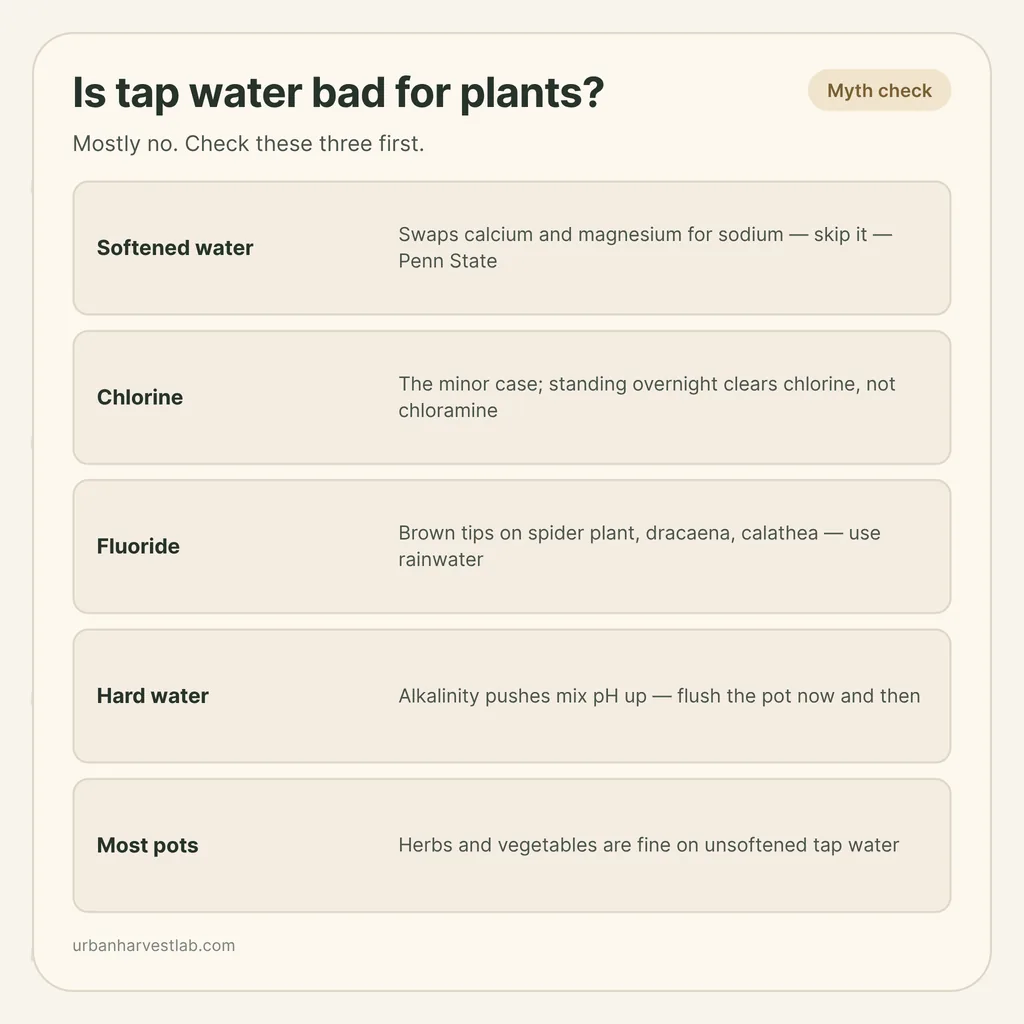
Most tap water grows herbs and vegetables without trouble. Three things can change that: softener sodium, fluoride and alkaline hard water. Here is how to tell which one you have.

How to grow blueberries in pots: acidic mix, a second variety and the right water
Blueberries are fussy about acidity, not about space. Here is the pot size, the mix, the pollination partner and the watering that keep a container bush fruiting.
Balcony drip irrigation: sizing your emitters and reservoir
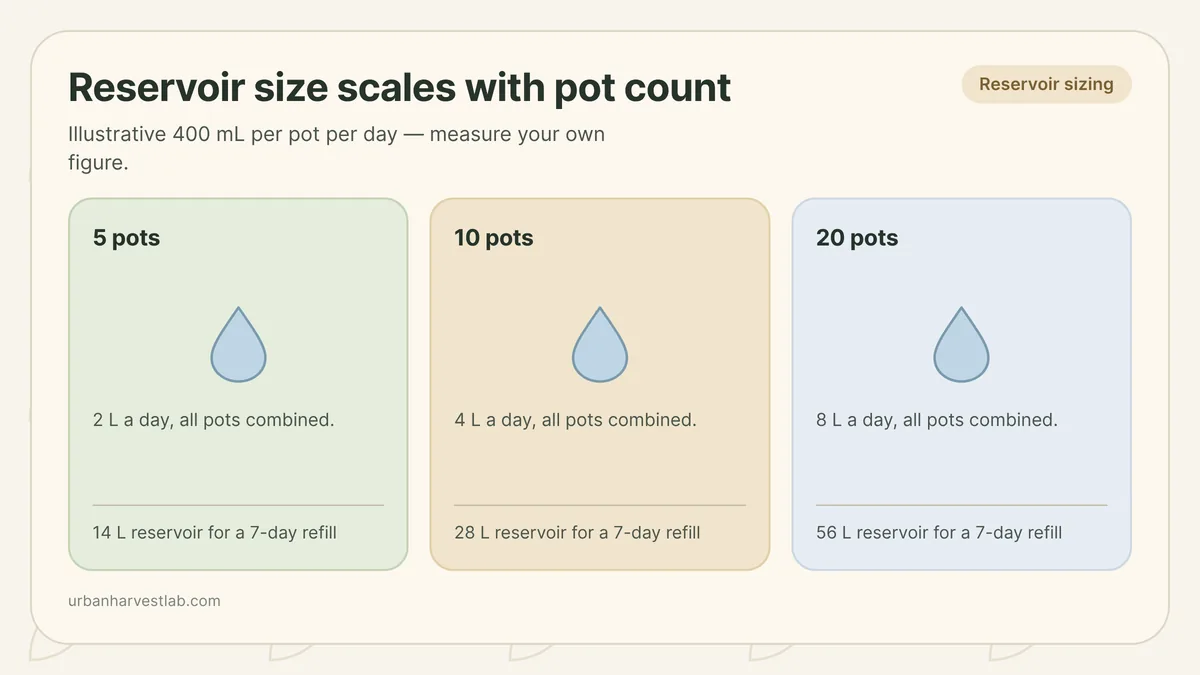
A gravity-fed drip system with its own reservoir waters a whole row of balcony pots without a hose bib. Here is how to size the emitters and the tank from your own numbers.