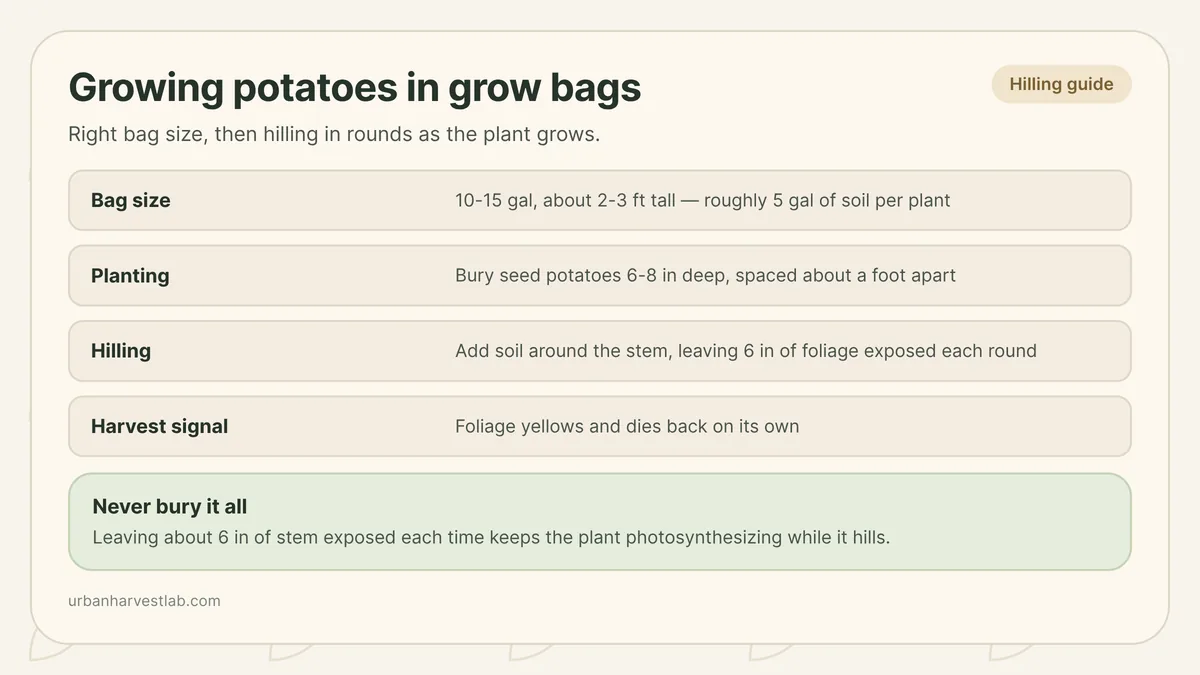
Hilling a potato grow bag from planting to harvest, following University of New Hampshire Extension's container-potato method
| Stage | What to do | Fill level |
|---|---|---|
| Planting | Bury seed potatoes 6-8 in deep, spaced about 1 ft apart, in the bottom of the bag | Bag filled 6-8 in deep only |
| Sprouts reach ~6 in tall | Add soil or mix around the stem, leaving about 6 in of foliage exposed above the new fill line | Fill rises partway up the bag |
| Through the growing season | Repeat hilling each time new growth clears the fill line by more than about 6 in | Fill climbs gradually toward the rim |
| Bag reaches capacity | Stop adding soil; let the plant flower and finish sizing tubers | Full (10-15 gal) |
| Flowering | Sample a few new potatoes by hand if you want them small and thin-skinned | Full, undisturbed elsewhere |
| Foliage yellows and dies back | Tip the bag out or open its side and harvest the full crop | Full, ready to empty |
Grow potatoes in a 10 to 15 gallon bag, about 2 to 3 feet tall, planting seed potatoes 6 to 8 inches deep and a foot apart — then the real work starts. University of New Hampshire Extension gives that as the working size, with roughly 5 gallons of soil volume per plant, but a grow bag only pays off if you keep adding soil around the stem as the plant grows, a process called hilling. Skip that step and a container-grown potato plant behaves like any other vegetable in a pot; do it right and the bag becomes the reason a small footprint can still produce a real harvest.
Picking a bag
Size is the first decision, and it does not need to be exact. University of New Hampshire Extension’s figure — 10 to 15 gallons, roughly 2 to 3 feet tall — gives one plant enough depth to hill all season without running out of room at the top. The Royal Horticultural Society frames the same choice by diameter instead of volume: plant one seed potato for every 30 cm of pot width, which is a useful rule if you are eyeing a wide half-barrel rather than a tall single-plant bag. Either way, the shape matters more than the material. Whether you land on a fabric bag, a plastic bucket, or a rigid pot of the same volume, fabric grow bags vs. plastic containers covers the trade-offs in drying speed, weight, and how each one handles the repeated hilling this crop needs.
A word on repurposed buckets, since potatoes are one of the crops people most often grow in a literal 5-gallon paint or food bucket rather than a bought grow bag: University of Maryland Extension flags recycling codes #2 (HDPE) and #5 (PP) as food-safe, and warns against #3, #6, and #7 plastics for anything growing food. A bucket that ever held paint, solvent, or cleaning chemicals does not become food-safe again just because the resin code is right.
If you already own a wide tub or half-barrel and are deciding whether it qualifies instead of buying a dedicated bag, University of Illinois Extension’s own diameter-to-volume conversion is a useful shortcut for straight-sided round containers: roughly 18 inches (46 cm) across works out to about 15 gallons, and 24 inches (61 cm) across works out to about 25 gallons. Under the Royal Horticultural Society’s one-tuber-per-30-cm-of-diameter rule, that puts an 18-inch tub at one seed potato and a 24-inch tub at two, rather than the single-plant-per-bag setup a narrower grow bag is built for. UNH’s own 5-gallons-of-soil-per-plant figure would allow more plants in the same tub than the RHS spacing rule does, so which rule you follow changes the count. The conversion is approximate and specific to round, straight-sided shapes, so a tapered planter or a square trough will not match it exactly — measure the container itself if the shape is unusual.
Filling it and planting
Start with only 6 to 8 inches of soil in the bottom of the bag, not a full container — that is where the seed potatoes go, spaced about a foot apart. Filling the whole bag on planting day defeats the point, since there needs to be room left above the seed potatoes for every later round of hilling. Potting mix for container vegetables covers building a loose, well-draining mix that will not compact under repeated topping-up.
Drainage matters more here than in most containers, since the same bag gets watered all season. Washington State University Extension’s research is clear that a gravel layer at the bottom does not help drainage; it creates a perched water table that holds the root zone wetter than potting mix run straight through to the drainage holes. Texas A&M AgriLife Extension still recommends about an inch of coarse gravel in its own container guidance, but the physics runs the other way — pot drainage holes covers why drainage holes and a uniform mix do the job a gravel layer cannot.
Hilling: the step that makes the bag worth it
Potato tubers form along the buried part of the stem, not at the original seed piece, so burying more stem creates more room for the plant to produce tubers. That is the entire logic behind hilling: once sprouts reach a few inches tall, add soil or potting mix around the stem, leaving about 6 inches of foliage exposed above the new fill line, per University of New Hampshire Extension. Repeat that every time new growth clears the fill line by roughly that same margin, and keep going until the bag is full.
The 6-inch rule is the part growers most often get wrong in either direction. Bury the plant past that point and, per University of New Hampshire Extension, too little leaf surface is left to keep photosynthesizing, which slows the whole plant down. The instruction UNH supports is to hill whenever growth has cleared the fill line by more than about 6 inches, rather than waiting for a specific day count.
A fabric bag makes this physically easier than a rigid pot of the same size, since some growers start with the sides rolled down and unroll them gradually as the fill level rises, rather than adding soil to a container that is already at full height from day one. That rolling technique is one of the practical differences fabric bags handle differently from a hard-sided pot, on top of the drying-speed and weight differences that page covers.
Watering and feeding through a growing bag
A bag that is only partly filled in spring and full by midsummer is also a bag whose soil volume, and therefore its water-holding capacity, keeps changing under you. Check moisture at the actual root zone rather than assuming the schedule that worked in June still applies once the fill line has climbed a foot. Feeding a container vegetable through the season is worth reading alongside hilling, since each round of fresh soil is also a chance to work in the next feeding rather than treating watering and fertilizing as separate routines.
Reading the harvest signals
The main harvest signal is foliage that yellows and dies back on its own. University of New Hampshire Extension’s container method is built around hilling in rounds, keeping about 6 inches of stem exposed each time, right up to that point — once the top growth is gone, the plant has stopped adding size to the tubers underneath, and that is when to tip the whole bag out or open its side and collect the crop in one pass.
Foliage yellowing at the end of a potato plant’s life is normal and expected, which is a different situation from foliage yellowing partway through active growth. If leaves are yellowing while the plant is still small or clearly still pushing new growth, that points toward a watering, nutrient, or pest problem rather than a finished crop — a cause-finder for yellowing leaves works through those possibilities separately from the end-of-season pattern described here.
Sources
- University of New Hampshire Extension — What is the best way to grow potatoes in containers?
- Royal Horticultural Society — Vegetables in containers
- Washington State University Extension — The Myth of Drainage Material in Container Plantings
- University of Maryland Extension — Growing Vegetables in Containers and Salad Tables
- University of Illinois Extension — How to Grow Fruits, Vegetables, Herbs in Container Gardens
- Texas A&M AgriLife Extension E-545 — Vegetable Gardening in Containers
Filling out the potato container setup
These guides cover the bag material choice, the soil mix, and the feeding schedule that go with growing potatoes in a container.
Common questions
What size grow bag do I need for potatoes?
University of New Hampshire Extension recommends a 10 to 15 gallon container that stands about 2 to 3 feet tall, which works out to roughly 5 gallons of soil volume for each plant. A bag much smaller than that runs out of room before the plant finishes forming tubers.
How deep do I plant seed potatoes in a grow bag?
About 6 to 8 inches deep, spaced roughly a foot apart, following University of New Hampshire Extension's planting guidance. Start with only that much soil in the bag rather than filling it, since the rest of the fill gets added gradually as the plant grows.
What is hilling and why does it matter in a bag?
Hilling means adding more soil or potting mix around the stem as the plant grows taller, which buries part of the stem and gives the plant more underground space to form tubers along it. University of New Hampshire Extension's method is to keep hilling while leaving about 6 inches of foliage exposed above the fill line at any time, repeating until the bag is full.
How do I know when to harvest potatoes grown in a bag?
Wait for the foliage to yellow and die back on its own. University of New Hampshire Extension's guidance is built around keeping the plant hilled with about 6 inches of stem exposed until that point, rather than a specific calendar date; once the top growth is gone, tip the bag out or open its side and collect the crop in one pass.
Related guides
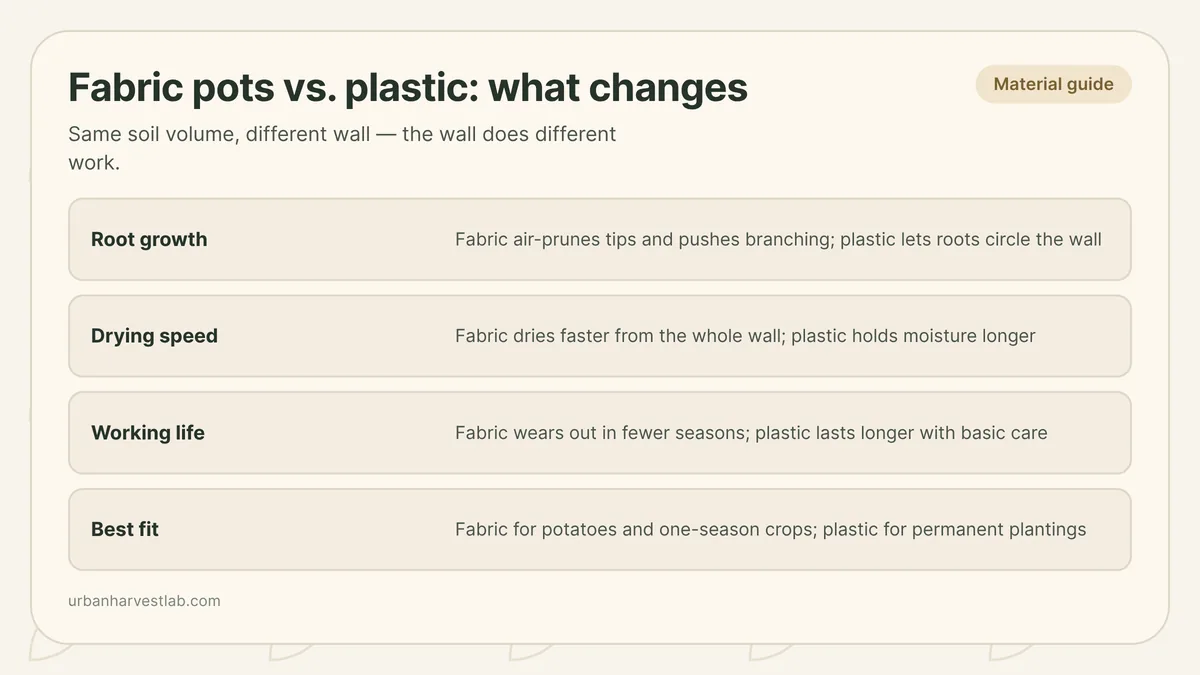
Fabric pots vs. plastic: what the wall material actually changes
A fabric pot and a plastic pot can hold the same soil volume and still grow different root systems, because the wall itself does different work.
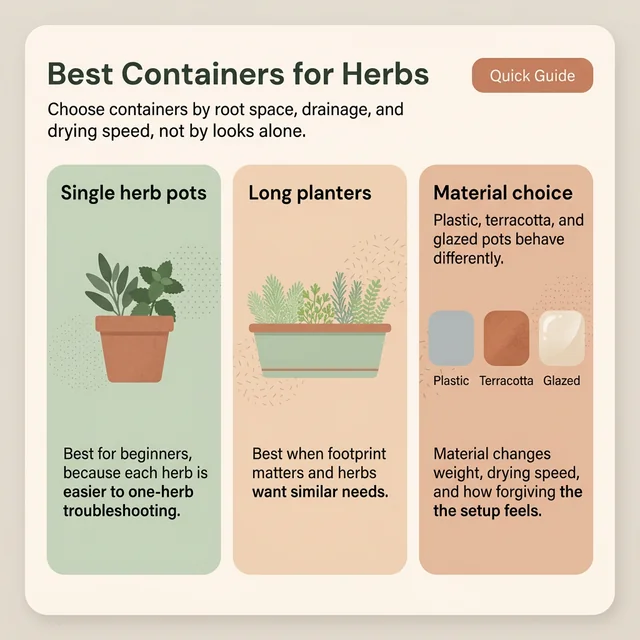
Best containers for herbs: drainage, pot size, and materials that work
A practical guide to herb containers that explains which pots work best, why drainage matters, and how material changes the way containers dry.
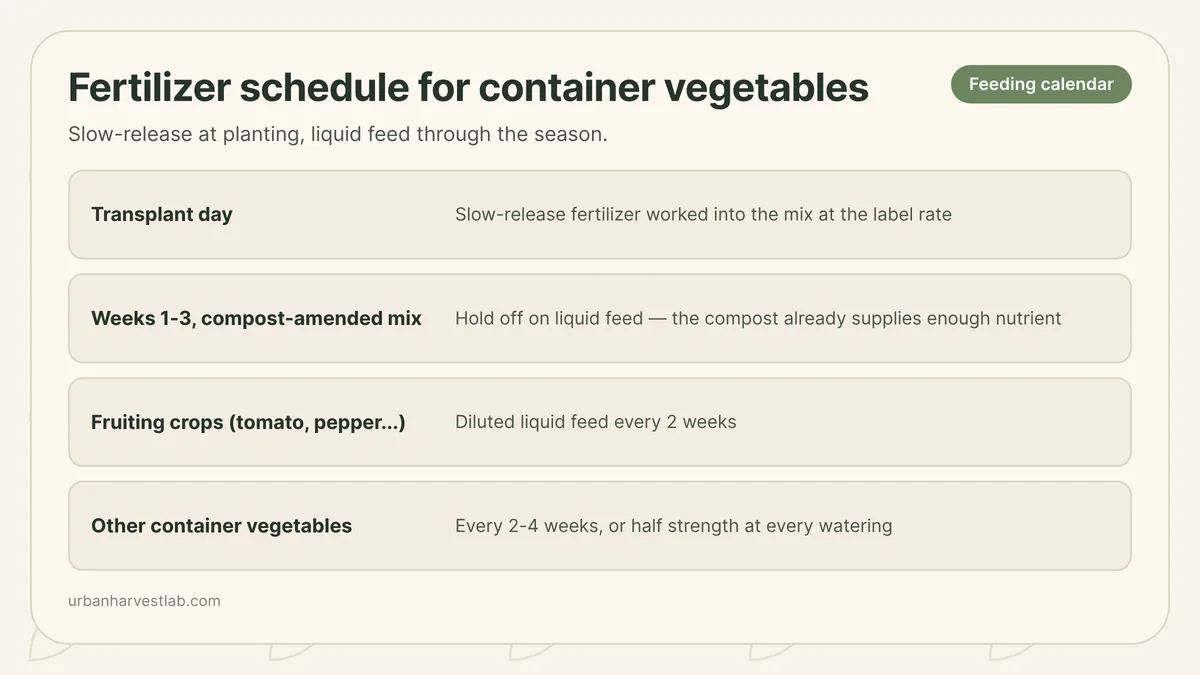
Fertilizer schedule for container vegetables: what to feed and when
A stage-by-stage feeding calendar for container vegetables, built from extension guidance on slow-release charges, liquid top-ups, and the intervals that keep fruiting crops producing.