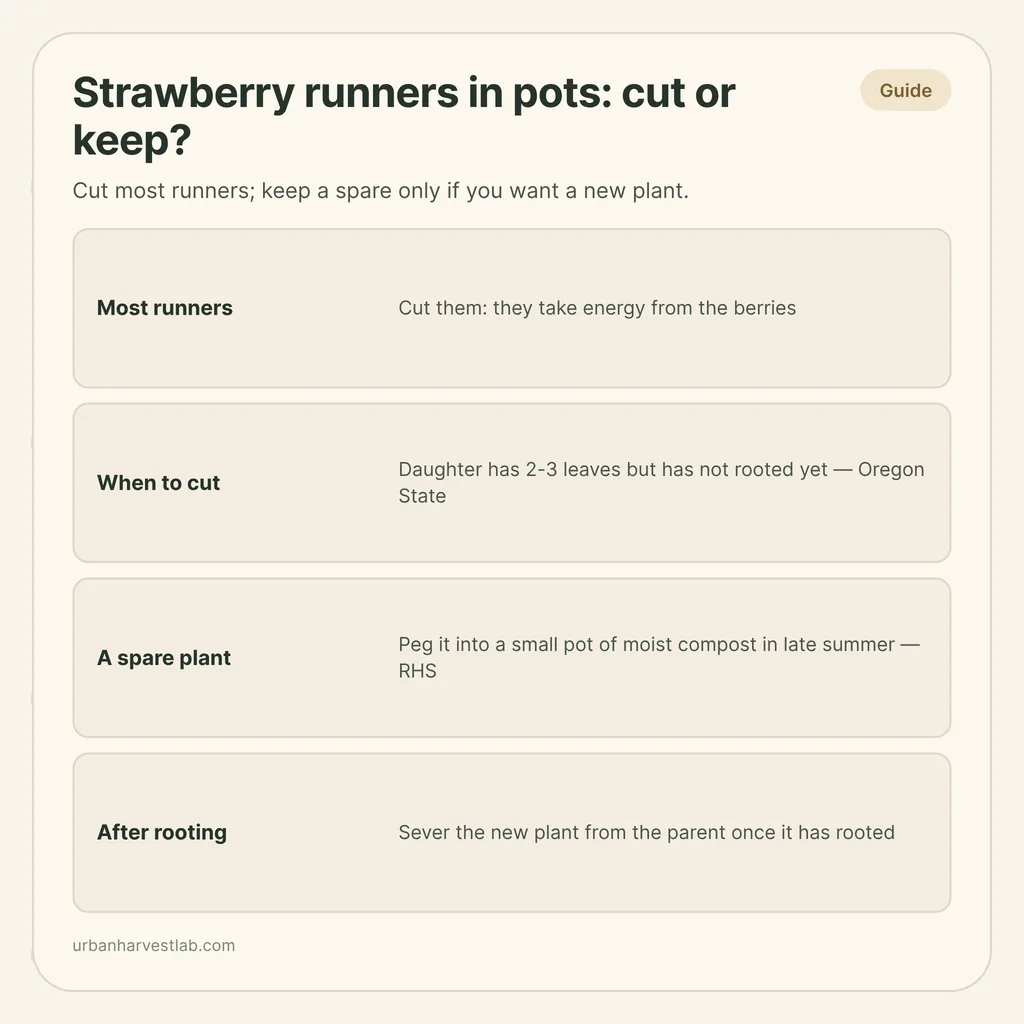
What to do with a runner, by situation
| Situation | What to do | Why | Source |
|---|---|---|---|
| Day-neutral or everbearing plant fruiting in a pot | Cut runners every 2 to 3 weeks once the daughter has 2 to 3 leaves and has not rooted | Plantlets take resources from flowers and fruit | Oregon State (hill system), Iowa State |
| June-bearing plant in a pot | Cut runners as they form and expect a single early crop | More vigorous runners add stress, and runner development is not beneficial in pots | Iowa State |
| You want one new plant | Peg one spare runner into a 9 cm (3.5 in) pot of moist compost in late summer, then sever when rooted | A rooted daughter becomes independent of the parent | RHS, UConn |
| Plantlet dangling over the pot edge | Remove it | It cannot root, so it only drains the parent | Iowa State, Oregon State |
| Runner appears in fall | Remove it | Encourages bud and branch crown development | UConn |
| Parent plant is weak or old | Replace it with certified plants rather than its own runners | Runners from existing plants often carry viruses | Oregon State |
On a potted strawberry, cut most runners and keep a spare only if you want a new plant. To keep one, peg it into a small pot of moist compost beside the parent in late summer, then sever it once it has rooted. The runners you leave on take energy from the berries.
A runner is a long, thin stem that grows out of the crown, with a plantlet (a “daughter”) forming along it. Oregon State University Extension notes that a daughter roots when it touches soil. If it does not, it keeps growing but stays dependent on the parent.
Pot size, spacing and replanting each year are covered in the strawberry container guide. What follows is only the decision for each runner.
Cutting runners to protect the harvest
Iowa State University Extension’s advice for container strawberries is blunt: remove any runners that form. The reason is a trade. Plantlets hanging from the edge of a container cannot root and support themselves, so they take additional resources from the parent at the expense of flower and fruit development.
UConn describes the other side of the trade in its hill system, where no runners are allowed to root. Removing the runners causes the mother plant to develop more crowns and flower stalks, and berry size and yields are larger, but plants must be replaced more often. A potted plant is already on the replace-it-regularly track, so the trade suits a pot.
How much this matters depends on the type:
- Day-neutral and everbearing. Iowa State says these typically produce few runners, so one or two small plantlets can be allowed to root alongside the parent. The rest come off. The RHS likewise says perpetual strawberries produce fewer runners than summer-fruiting ones.
- June-bearing. Iowa State says these produce runners more vigorously than day-neutral or everbearing types, which means more care and more stress on the plant. It also says it is best to let them flower and fruit in the first year, since it is not feasible to overwinter strawberries grown in containers and runner development is not beneficial.
If your plant is flowering but not setting fruit, runners are rarely the only cause. The strawberry not fruiting guide goes through the rest.
When to cut, so they do not come back faster
Timing changes the result. Oregon State’s hill-system advice is to remove all runners every two to three weeks, and to wait until the runners have formed daughter plants with two to three leaves but have not rooted yet. It adds that cutting the stem before a daughter has formed is likely to increase runner production.
So the routine is simple. Check the plant every couple of weeks. Where a daughter has two or three leaves and nothing is anchored in the soil, cut the stem close to the crown with clean scissors. A runner that is already rooted in the pot is harder to remove cleanly; lift it gently or cut the stem and pull the small plant out.
UConn adds one seasonal rule: runners that develop in the fall should be removed to encourage bud and branch crown development.
Rooting a spare runner into a small pot
The RHS describes propagating strawberries from runners from plants in the ground or in containers, and says late summer is an ideal time. The RHS gives these steps, with its sizes:
- Fill RHS-sized 9 cm (3½ in) pots with peat-free multi-purpose compost and set them beside the strawberry plant.
- Insert an individual runner into each pot.
- Peg each runner down with a U-shaped piece of wire, RHS-sized at about 15 cm (6 in) long.
- Keep the compost slightly moist to promote root growth.
- Sever the new young plant from the parent once it has rooted.
On a balcony, stand the small pot on the same tray or shelf as the parent so the stem has slack and does not pull. Take one or two plantlets at most. Each one you keep rooted is a plantlet still drawing on the parent until you cut it.
Everbearing types make few runners, and UConn says they are best propagated by crown division. Where the plant has several crowns, they can be broken apart or cut with a sharp knife, giving each section at least 5 to 10 roots. The RHS adds that new perpetual plants often have to be bought in.
When to buy new plants instead
The RHS says spare runners can replace older plants, and for a healthy plant that can refresh a pot. Oregon State is more cautious. It says not to use runners from your existing planting to start a new one, because these often contain viruses that will carry over to the new planting, and recommends certified disease-free plants when a planting declines.
The two are easy to reconcile in practice. If the parent has grown well, the RHS approach of rooting a runner or two is reasonable, accepting Oregon State’s point that a virus may not show yet. If the parent has been weak, stunted or low-yielding, start from certified plants instead.
A daughter rooted in late summer has to come through winter in a small pot. Iowa State treats that as hard enough (“it’s not feasible to overwinter strawberries grown in containers”) that it recommends against overwintering them and says new plants can be purchased and planted next spring; the strawberry container guide covers the overwintering detail.
A rooted daughter is a new plant, so it needs its own space in a pot. Iowa State suggests plants about 8 inches apart, with a 12-inch container holding 3 or 4. Do not hang the daughter over the edge of the original pot to grow on. If you grow strawberries in a basket, see edible hanging baskets; Oregon State says to remove runners there, because daughters that cannot root over the edge would weaken the mother plant.
Sources
More on potted strawberries
Pot size, hanging baskets and fruiting problems are covered in their own guides.
Common questions
Should I cut strawberry runners off?
In a pot, usually yes. Iowa State University Extension says to remove runners that form on container strawberries, because the plantlets take resources from the parent at the expense of flowers and fruit. Iowa State allows one or two small plantlets on day-neutral and everbearing types to root alongside the parent.
When is the best time to root a strawberry runner?
The Royal Horticultural Society gives late summer as an ideal time. Peg the runner into a small pot of moist compost beside the parent, then sever the young plant from the parent once it has rooted.
Can I leave a runner hanging over the edge of the pot?
No. Iowa State University Extension says plantlets hanging from the edge of a container cannot root and support themselves, so they take resources from the parent. Oregon State University Extension says such daughters cannot become self-sufficient and would weaken the mother plant.
Will cutting runners early stop the plant making more?
Not necessarily. Oregon State University Extension, in its hill-system guidance, says that cutting the stem before the daughter has formed is likely to increase runner production. It advises waiting until the daughter has two to three leaves but has not rooted.
Related guides

Edible hanging baskets: what to grow and how to water them
A hanging basket frees floor space but dries out faster than most containers. These are the edibles that cope, the ones that do not, and a watering routine that keeps the basket alive.
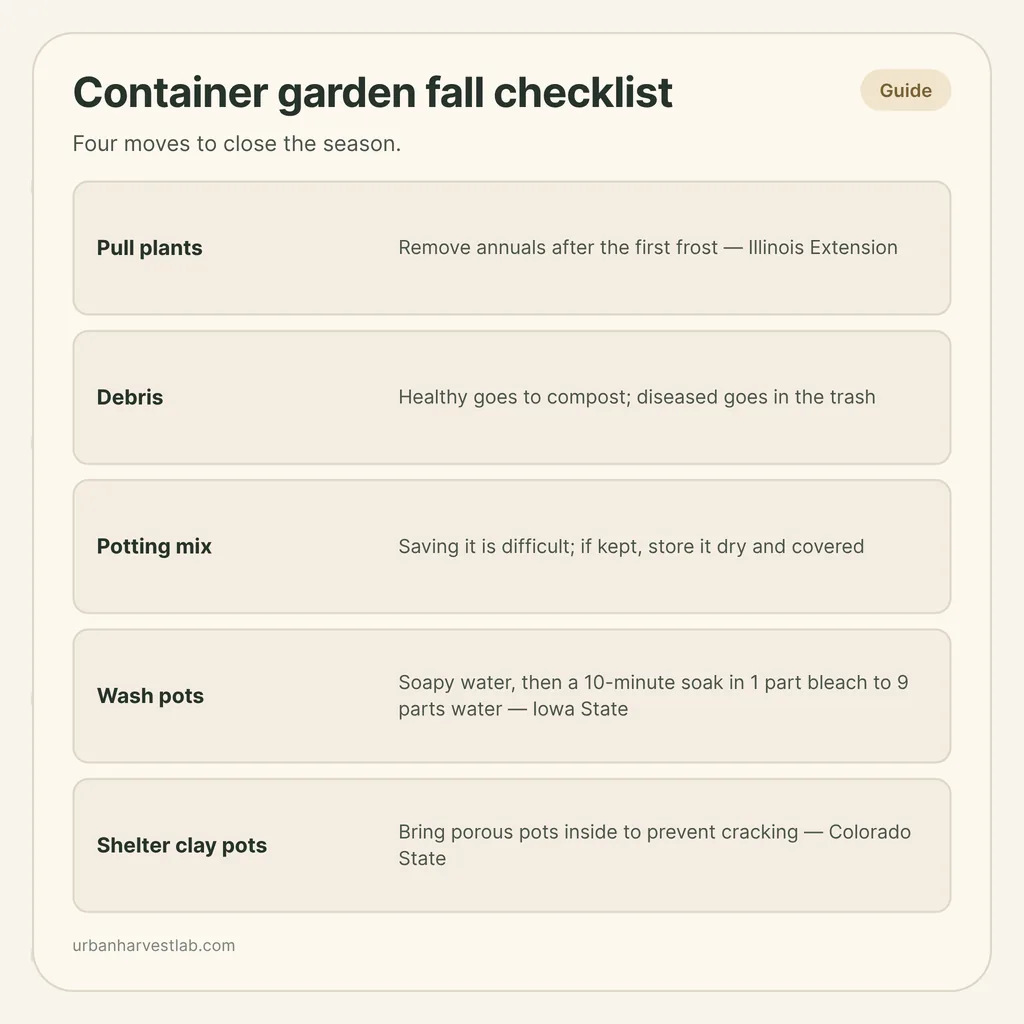
What to do with container plants in fall: a season-end checklist
A balcony garden does not need a big autumn job, just four decisions in the right order: which plants stay, where the debris goes, what happens to the mix, and how the pots are cleaned and stored.

Strawberry plants not fruiting in pots: type, age, light, and heat
A strawberry pot with leaves and no berries is rarely sick. The variety type, the plant's age, the sun, the heat and an early frost explain most of it.