
Troubleshoot the system before you change the inputs.
Symptoms
- The plant is leafy and healthy but carries no flowers, or flowers that do not turn into berries.
- Flowers open but the centres are black or brown, or the berries that form are small and misshapen.
- A planting that cropped well in an earlier year now gives little.
Possible causes
- A June-bearing variety, which fruits once a year and sets its flower buds the previous autumn.
- A new planting whose first flush of blooms was pinched off on purpose, or a garden-style rule applied to a pot that holds back flowers for longer than needed.
- Heat above about 80-85 °F, which stops day-neutral plants flowering.
- Fewer than 6 hours of direct sun, or a plant carried over from a previous season instead of replaced.
- Frost on open flowers, or poor pollination in cool wet weather.
Quick fixes
- Read the plant label or the seller's listing and work out whether you have a June-bearing, everbearing or day-neutral variety.
- Move the pot to a spot with at least 6 hours of direct sun and shade it from the hottest afternoon sun.
- Pinch off runners so the plant puts its energy into the crown and fruit.
- Cover open flowers with a floating row cover when a frost is forecast.
- Replace container strawberries each spring, as Iowa State treats them as annuals.
A strawberry plant with healthy leaves and no berries is usually the wrong type for the season, too young, too old, too hot, too shaded or hit by a late frost, not diseased. Start with which type you planted, because it changes everything else. If you are still choosing a pot or planting from scratch, the setup is covered in strawberries in containers.
Work out which type you have
Strawberries fall into three groups, and each fruits on its own schedule.
| Type | When it fruits | What it means for a pot |
|---|---|---|
| June-bearing | Once, early in the season. UConn says buds form as daylight shortens in September, October and November and open the next spring | One crop a year, and no second chance if that crop is lost |
| Everbearing | Two flushes. UConn says buds also form in late spring and early summer | A spring crop and a later one |
| Day-neutral | From May to the frost, per UConn; Iowa State says flowering pauses above 80-85 °F | The most useful type for pots, according to Iowa State |
Iowa State University Extension says June-bearing types “will only flower and fruit once early in the growing season” and are not recommended for containers. If your plant is June-bearing and it is mid-summer with nothing on it, there is nothing wrong: that single crop has already passed, and the buds for next year’s are set in autumn. Iowa State says it is not feasible to overwinter container strawberries, so a June-bearer in a pot will not reliably fruit again; the practical fix is a day-neutral or everbearing variety next spring. The risks of carrying one over are covered in strawberries in containers. If you cannot tell what you bought, the label or the seller’s listing will name the type.
A young plant is often held back on purpose
Gardeners are told to remove flowers, and a plant with no flowers has no fruit. For a container planting, Iowa State University Extension’s container guide asks only for removal of the first flush of blooms in early spring, so the roots develop before the plant spends energy on fruit. It also says to let June-bearing strawberries flower and fruit in their first year, since overwintering strawberries in containers is not feasible.
The stricter rules are garden-bed guidance. In the ground, Iowa State says all first-year blossoms should come off June-bearing plants, and that everbearing and day-neutral blossoms should be removed until early July, with the first berries ripening from August until frost. UConn gives a similar garden timetable for everbearing plants: remove flower stalks until the plant is growing vigorously, usually around July 1.
So if you planted this spring and pinched off more than the first flush, you may have held back fruit your pot could have given. Let later flowers stay.
Heat switches day-neutral plants off
Iowa State states that day-neutral strawberries stop flowering and fruiting when temperatures go above 80-85 °F, and harvest typically resumes in the fall when it cools. A south-facing balcony in July can sit above that for weeks, and a dark pot in the sun runs hotter than the air. The same extension guide notes that as soil temperatures rise, fruit size gets smaller, especially for day-neutral varieties, which is why it advises against hanging baskets that heat up and dry out quickly.
The fix is to cool the pot rather than the plant: afternoon shade, a lighter-coloured pot, and grouping pots so they shade each other’s sides. The full set of tactics is in the guide to protecting container plants in a heatwave. Expect the plant to flower again once nights and days ease.
Light, runners and feeding
Iowa State University Extension asks for at least 6 hours of direct sunlight per day for container strawberries. UConn’s garden guidance is higher, full sun at 8 hours per day. Both are aimed at fruiting plants, so a pot getting four hours behind a railing may produce leaves and few flowers. Measure the hours on your own balcony before moving anything; the balcony sunlight guide shows how.
Runners are the long stems that creep out of the plant and root. Iowa State says to remove any runners that form, and notes that day-neutral and everbearing types typically produce few, so one or two plantlets can be left to root beside the parent while the rest come off. UConn says runners that develop in the fall should be removed to encourage bud and branch crown development. Pinching them off keeps the plant’s energy in the crown, where the flowers come from.
For feeding, Iowa State applies fertilizer 2 to 3 times through the growing season, ideally just after a flush of fruit is harvested, using a water-soluble all-purpose product. That is a light schedule. For general container feeding see the vegetable fertilizer schedule; UConn’s gray-mold guidance also advises avoiding excess nitrogen.
Old plants decline
UConn says plants that have borne fruit for two to three years decline in productivity, but that figure describes garden-bed plantings. In a pot, Iowa State’s one-season rule applies: it treats container strawberries as annuals and does not recommend overwintering them, so new plants are bought and planted the next spring. If your pot holds last year’s plants, replacing them is the fix.
Flowers that open but no fruit follows
Look at the flowers. Pistils in the centre of blossoms that turn black or brown are a sign of frost injury, according to the University of Delaware, which adds that frost and freezes will commonly kill the whole strawberry flower. Strawberries bloom early, so a late cold night can take the first flush. UConn suggests floating row covers over open blossoms when a frost is forecast; the steps for a cold night are in the guide to emergency cold snap protection.
If the flowers look healthy but the berries are small and misshapen, the University of Delaware says misshapen strawberries in spring often result from poor pollination, and cold injury can cause fruit with multiple tips. Frost damage on an open flower cannot be undone. Delaware notes that poor pollination is common when bloom has been rainy, stormy or cold.
Checking a fruitless strawberry pot
- Identify the type. June-bearing means one crop early in the season; in a pot, plan to replace it with a day-neutral type.
- Check what you did to the first flowers. Only the first flush of spring blooms needs pinching in a pot.
- Check the temperature. Above about 80-85 °F, day-neutral plants pause.
- Count the sun hours. Aim for at least 6.
- Remove runners and feed lightly after a flush of fruit.
- Check the age. Iowa State treats container strawberries as annuals: replace them each spring.
Sources
- Iowa State University Extension — “How to Grow Strawberries in Containers”
- Iowa State University Extension — “I planted strawberries this spring. Do I need to remove this year’s blossoms?”
- UConn Home & Garden Education Center — “Strawberries”
- University of Delaware — “Misshapen Strawberry Fruits, Cold Damage and Frost Injury”
Strawberries in pots
Container setup, feeding and heat protection for a strawberry planting that fruits.
Common questions
Why are my strawberry plants not producing fruit?
The usual reasons are the variety type, the age of the plant, heat, too little sun and frost on the flowers. June-bearing plants fruit once a year and set their buds the previous autumn, a young plant may have had its first flush of blooms pinched off, day-neutral plants stop above about 80-85 °F, and Iowa State University Extension asks for at least 6 hours of direct sun.
Should I remove strawberry flowers in the first year?
Only the first flush. For pots, Iowa State University Extension says to remove the first flush of blooms in early spring, and to let June-bearing plants flower and fruit in their first year because overwintering container strawberries is not feasible. In a garden bed, Iowa State advises stripping all first-year blossoms from June-bearers and removing everbearing and day-neutral blossoms until early July.
How long do container strawberries keep fruiting?
One season. Iowa State University Extension treats container strawberries as annuals: buy new plants and replant each spring rather than carry them over. UConn gives two to three years before decline, but that describes garden-bed plantings.
Do I need to cut off strawberry runners?
In a pot, yes. Iowa State University Extension says to remove any runners that form, and UConn says runners that develop in the fall should be removed to encourage bud and branch crown development.
Related guides
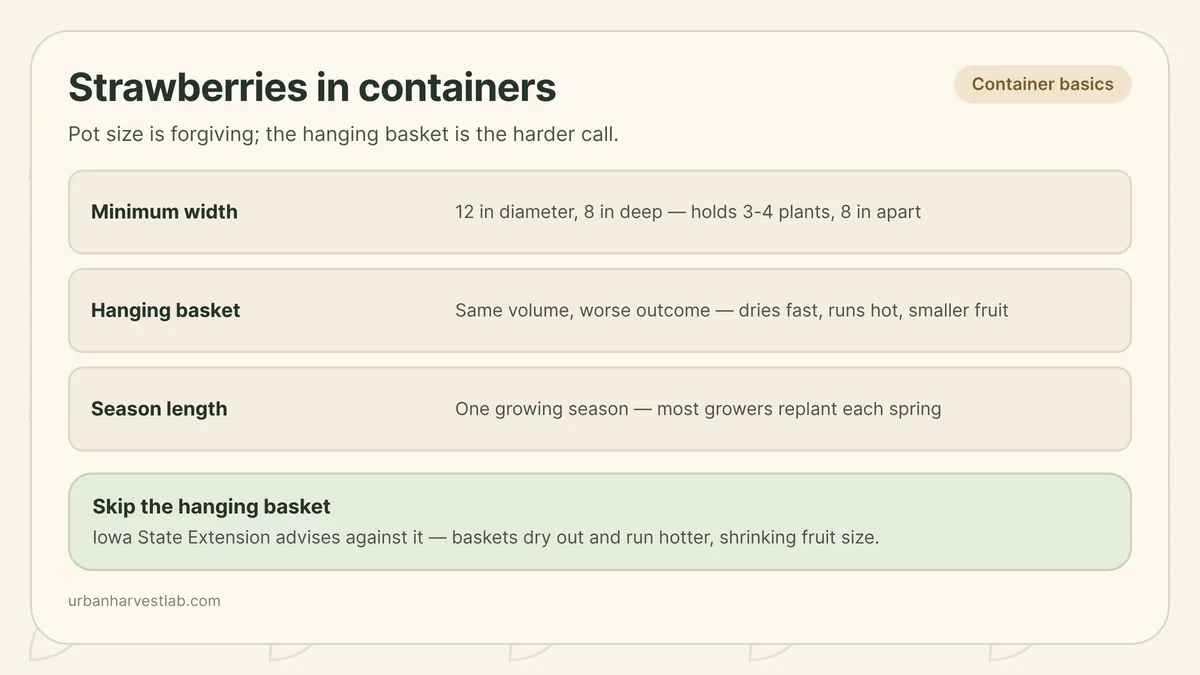
Strawberries in containers: pot size, hanging baskets, and annual replanting
Container strawberries behave differently from garden strawberries: the pot size is forgiving, hanging baskets are the harder option, and most growers treat the planting as a one-season crop.
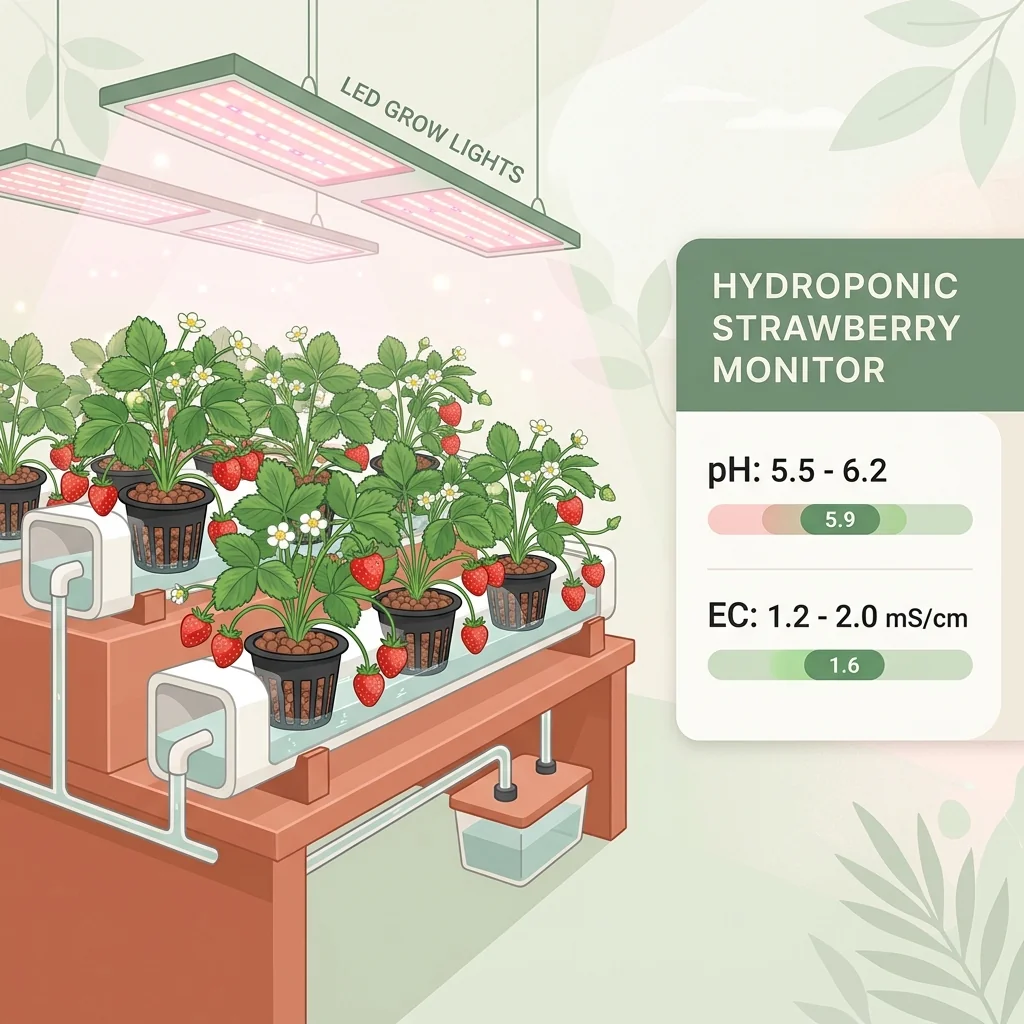
Hydroponic strawberries indoors: is it worth it?
Indoor hydroponic strawberries are rewarding but demanding: they need strong light, hand pollination, and patience. Here is an honest look at whether it is worth it.

Tomato flowers falling off: heat, cold nights, and stress
Flowers that yellow and fall without setting fruit are usually reacting to temperature or stress, not disease. Work out which, then change the one thing that applies.