Self-watering pots: which herbs and what to look for
| Factor | Guidance | Notes |
|---|---|---|
| Best herbs | Basil, mint, parsley, cilantro | Thirsty, moisture-loving |
| Avoid for | Rosemary, thyme, oregano, sage | Need to dry out |
| Key features | Reservoir, level indicator, overflow | Overflow prevents waterlogging |
Editorial note: The retailer link is an untracked shopping reference; Urban Harvest Lab does not currently receive a commission from it. Recommendations are based on stated features and suitability criteria, not on undocumented hands-on testing.
Self-watering pots can reduce rapid wet-to-dry swings, but they do not water intelligently and they are not automatically safe for every herb. They work most predictably with an established, actively growing plant, a suitably porous mix, a functioning overflow, and a reservoir that can be inspected. Read are self-watering pots worth it for herbs? before choosing a specific model.
Who they suit
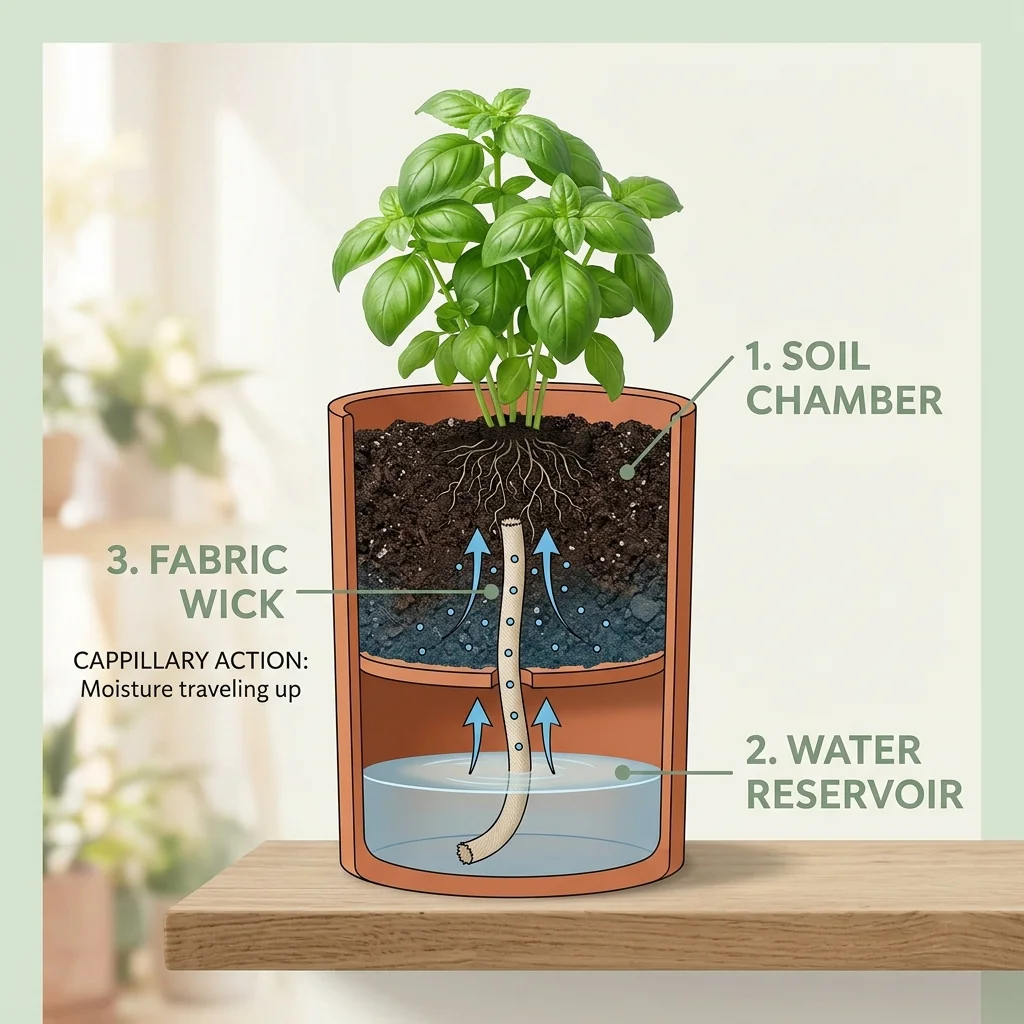
Self-watering pots hold water below the growing medium and move it upward through a wick or capillary column. They are most useful for steady-moisture herbs such as basil, mint, parsley, and cilantro when those plants are consuming water actively. They may extend the interval between checks, but reservoir duration changes with pot size, canopy, temperature, and airflow.
Browse self-watering herb pots on Amazon
Who should avoid them
Dry-side herbs such as rosemary, thyme, oregano, and sage are usually simpler in a free-draining standard pot; see best containers for herbs. A self-watering pot is not an absolute prohibition, but the reservoir must be allowed to empty and the mix must retain air. Do not keep topping it up merely because an indicator has moved. Compare preferences in the herb watering chart.
What to look for
- Reservoir size: larger means less frequent topping up.
- Water-level indicator: so you know when to refill without guessing.
- Overflow hole: prevents the soil becoming waterlogged after rain or overfilling.
- Good wicking: the wick or base design must actually draw water up to the roots.
Also look for a removable insert, a fill port that can be cleaned, and a reservoir you can drain. An opaque reservoir may reduce algae compared with one exposed to light, while a removable liner makes it possible to inspect roots and accumulated salts.
Test the pot before trusting it
Run a seven-day commissioning test:
- Moisten the potting mix evenly from above when planting; a dry mix may not begin wicking uniformly.
- Leave the reservoir empty until transplanted roots start exploring the lower mix, unless the manufacturer’s instructions specify a different establishment method.
- Fill only to the marked maximum and confirm that the overflow releases surplus water.
- Record the reservoir level and pot weight daily without automatically refilling.
- Probe the upper and lower mix. A dry surface is not proof that the root zone is dry, and a full reservoir is not proof that water is reaching it.
If water disappears unusually fast, check for a leak or an oversized wick. If the reservoir stays full while leaves decline, inspect root-zone moisture and oxygen before blaming thirst.
Match reservoir size to absence, not convenience
Estimate daily use from your own pot over several representative warm days. Divide usable reservoir volume by that observed daily use, then apply a safety margin. Do not rely on “weeks of watering” marketing because the same reservoir lasts very different periods under a small winter plant and a large summer canopy.
For holidays, test the complete setup before leaving and provide a safe overflow route. Self-watering pots can fail through blocked fill tubes, disconnected wicks, root intrusion, or a reservoir that was never actually full.
Prevent salt and root-zone problems
Fertilizer and minerals can accumulate because water moves upward and evaporates while salts remain. Periodically water from above and allow drainage if the product and crop instructions support it. Inspect for crust, odour, persistently yellow foliage, or dark soft roots.
Use a container mix rather than dense garden soil. The mix has to balance capillary movement with air space; adding more wick cannot rescue a compacted root zone.
The bottom line
A self-watering pot is a useful moisture buffer, not an autopilot. Match it to the herb and growing medium, confirm the overflow and wicking, and keep observing the root zone. How watering frequency still varies by herb is covered in how often to water potted herbs.
Sources and further reading
Before you buy a self-watering pot, read these
These guides explain when self-watering pots help, how they compare to other pots, and which herbs want which moisture.
Common questions
Are self-watering pots good for herbs?
They can work well for established, actively growing basil, mint, and parsley when the reservoir, overflow, and mix are well matched. They do not remove the need to inspect roots and are less forgiving for herbs that need a pronounced dry interval.
What should I look for in a self-watering pot?
A reasonable reservoir size, a water-level indicator, an overflow hole to prevent waterlogging, and effective wicking. Larger reservoirs mean less frequent topping up.
Which herbs should not go in self-watering pots?
Rosemary, thyme, oregano, and sage are usually easier to manage in ordinary draining pots. A self-watering design is possible only if the root zone remains aerated and the reservoir is allowed to empty between refills.
Do self-watering pots cause root rot?
They can if there is no overflow and the soil stays saturated, especially with herbs that dislike wet roots. Choose pots with an overflow and use them for moisture-loving herbs.
Related guides
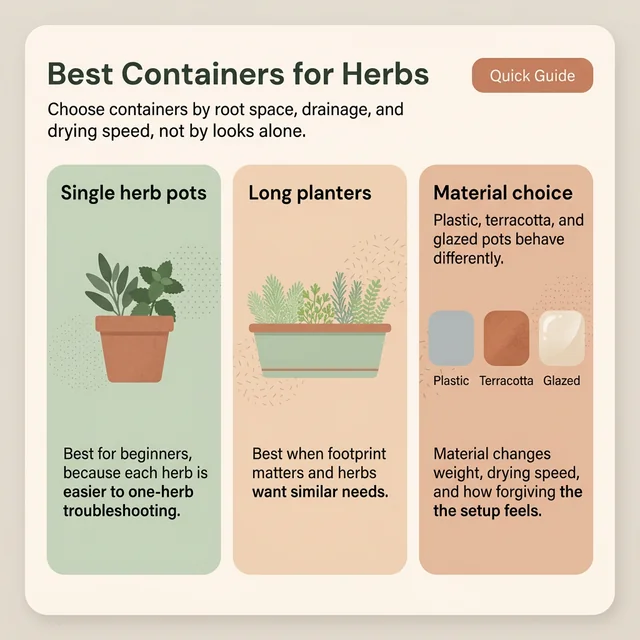
Best containers for herbs: drainage, pot size, and materials that work
A practical guide to herb containers that explains which pots work best, why drainage matters, and how material changes the way containers dry.
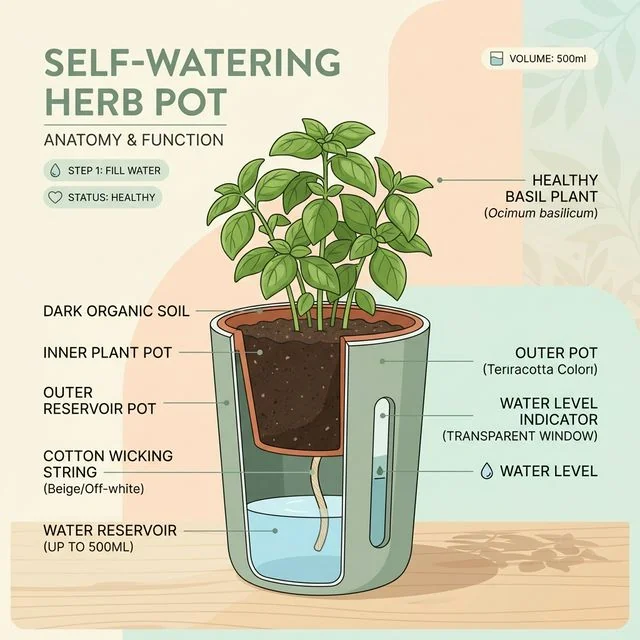
Self-watering pots for herbs: worth it or more trouble?
Self-watering pots sound like the holy grail for busy gardeners. While they are fantastic for moisture-loving herbs like mint, they can quickly turn into a swamp of rotting roots for drought-tolerant plants like rosemary.
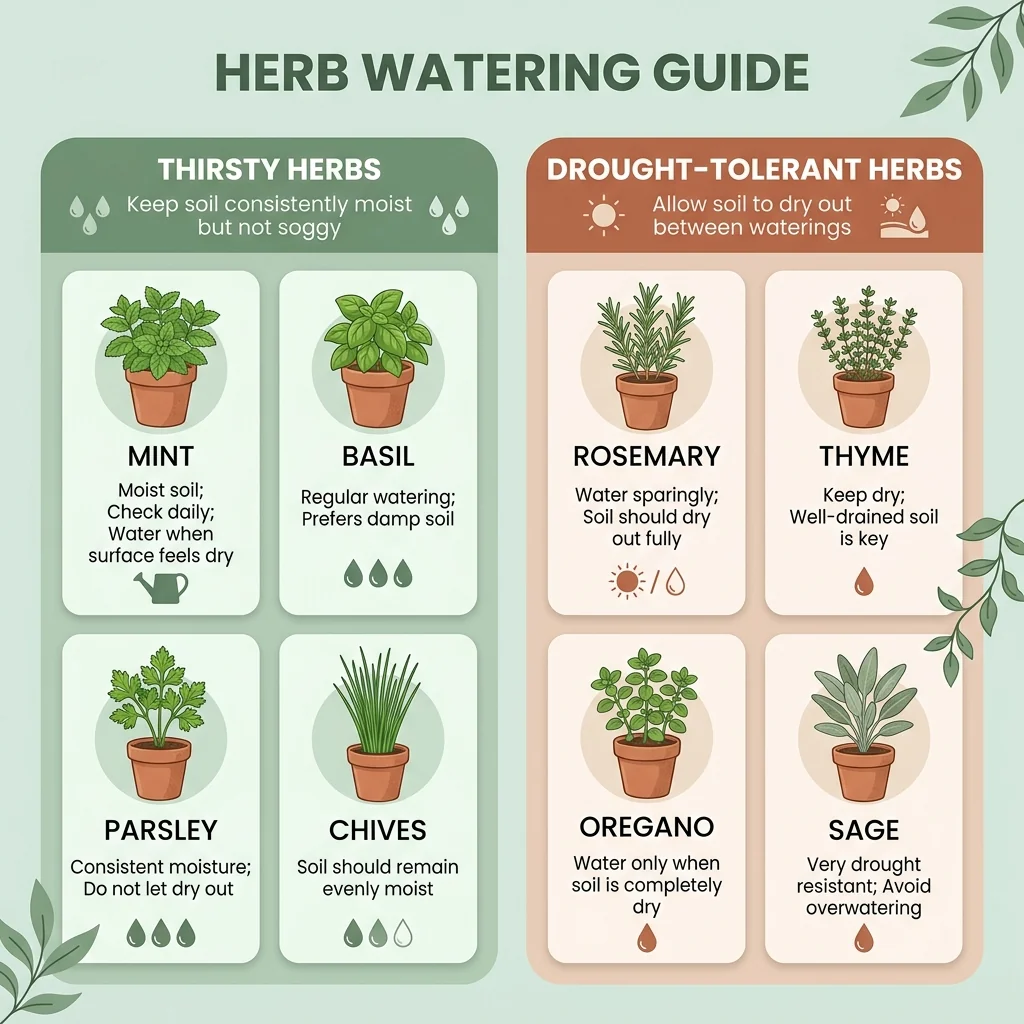
Watering a mixed herb collection: which pot to check first
How to water several potted herbs at once: which camp each herb belongs to, which pot to check first, and how to tell a dry wilt from a wet one.