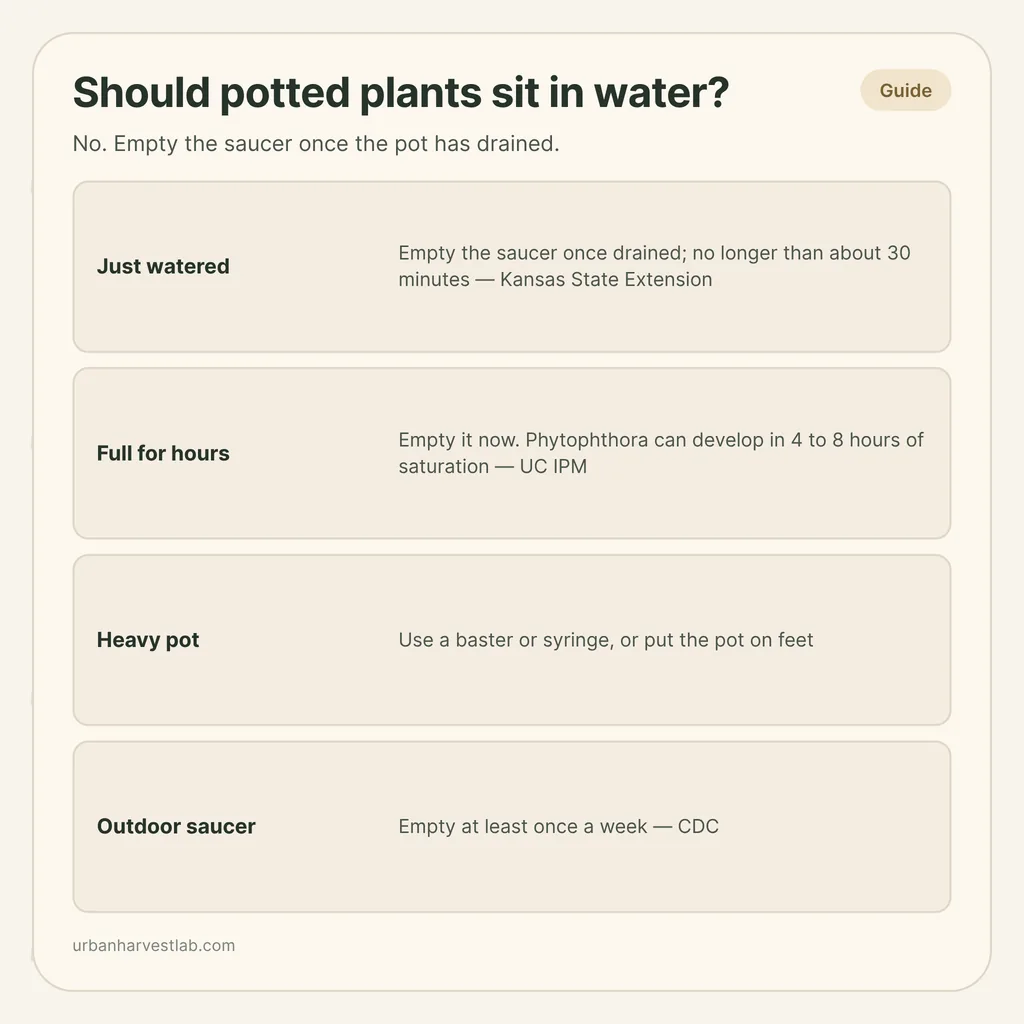
What to do with the water that collects under a pot
| Situation | Do this | Why |
|---|---|---|
| Just watered | Empty the saucer once the pot has drained, and do not leave it past about 30 minutes | Kansas State Extension: houseplants, discard what collects; container plants, up to 30 minutes for the mix to soak up free water, then dump the rest |
| Saucer still full hours later | Empty it now | UC IPM: Phytophthora diseases can develop in as little as 4 to 8 hours of saturation |
| Heavy pot you cannot lift | Draw the water out with a baster or syringe, or put the pot on feet | Kansas State Extension suggests a syringe or turkey baster, and pots with feet |
| Outdoor saucer, rain-prone | Empty at least once a week, or take the saucer away | CDC: flowerpot saucers are on its weekly empty, scrub, turn over or cover list |
No, potted plants should not sit in water. After you water, empty the saucer once the pot has stopped draining. Do not leave it longer than about half an hour, the soak window Kansas State Extension allows container plants for a dry mix to take up free water from below. Do not leave it for hours. A saucer that stays full turns a drained pot back into a waterlogged one, which is the problem the drainage hole was supposed to solve in the first place.
Why half an hour, and why not longer
Kansas State Extension spells out the sequence for container plants: water until some runs out of the drainage holes, “leave it for at least 30 minutes giving soil time to soak up free water from the bottom,” then “dump excess water or extract it with a syringe or turkey baster.” The point is to be sure the whole mass of mix is moist, not only the top and the channels the water ran down. Clemson Extension is blunter: water until it runs out of the bottom, then “Don’t let the pot sit in the water that runs out. Empty the saucer.”
Those two readings fit together. Kansas State’s houseplant section says only to discard what accumulates in the saucer once excess water has drained through, and its half hour for container plants is a brief window for a dry pot to finish taking up water. It is not a licence to leave the saucer topped up. Leaving it for good is where the damage starts: UC IPM warns that Phytophthora diseases can develop in as little as 4 to 8 hours of soil saturation. A saucer left full overnight is exactly that situation, repeated every watering. For what that looks like in the plant, and how to tell it from thirst, see overwatered vs underwatered; if the roots are already brown and soft, root rot in potted plants covers what is salvageable.
Emptying the saucer also protects the point of watering thoroughly. Kansas State notes that water draining from the bottom of the pot carries away dissolved fertiliser salts, a process called leaching. Kansas State adds that accumulated soluble salts can contribute to root damage, and water left in the saucer is water carrying those salts that has not left the pot.
What the saucer is for
The hole in the pot is the drainage; the saucer catches drips. Its job is to protect the shelf, windowsill or floor under the pot. For the short soak Kansas State describes, it can also let a dry mix take up a little water from below, but it is not a reservoir. A dry, shrunken mix can also let water run straight down the side of the pot and out the hole, so Kansas State advises checking that water is moving through the mix and not simply down the gap beside it. A pot without a hole is a different problem, covered in do pots need drainage holes. A layer of gravel in the base does not change any of this either: the drainage layer myth explains why.
The real fixes
Empty it after the soak. For a pot you can lift, tilt it over a sink or tip the saucer. This is the whole fix for most indoor pots.
Use a baster for heavy pots. Kansas State suggests extracting water with a syringe or turkey baster, which is the practical answer when a large ceramic pot cannot be lifted without straining.
Lift the pot on feet. Kansas State advises you to “choose pots with feet, or elevate to provide air space underneath.” The same publication warns that flat-bottomed pots on a flat surface may develop an airlock that seals the bottom and prevents drainage. Feet or a riser solve both: the base stands clear of whatever collects below, and air can reach the hole. Pot feet over a dish still need that dish emptied.
Remove the saucer. On an open terrace or a ground-level spot where runoff harms nothing, or anywhere rain fills it faster than you empty it, the simplest saucer is none. On a balcony with a neighbour below, keep the saucer (or pot feet over a dish) and empty it after watering and after rain.
Do not rely on the saucer as a water reserve. If you want the pot to supply its own moisture, a purpose-built reservoir does that with a controlled overflow. Self-watering pots for herbs compares that route; a plain saucer is not a substitute.
Outdoor saucers, balconies and the neighbours below
Outdoors there are two separate problems. The first is the plant’s, the same as indoors. The second is yours to manage: standing water breeds mosquitoes. The CDC’s guidance for homes is to empty and scrub, turn over, cover, or throw out water-holding items once a week, and its list names “flowerpot saucers” by name. The EPA explains why it matters: the egg, larva and pupa stages of a mosquito all happen in water, and the life cycle typically takes up two weeks but can be as short as 4 days. The CDC’s weekly emptying is the minimum; since the EPA says the cycle can be as short as 4 days, empty saucers more often in hot weather and after every rain.
On a balcony the same saucer has a third job: it keeps your watering from running over the edge onto a neighbour’s balcony below. If you use one, water slowly and stop before it fills. Empty the saucer rather than letting it overflow in a storm, and check your building rules on what may drain from a balcony.
Sources
- Kansas State University Research and Extension, MF-2805, Watering Raised Beds, Berms, Containers, and Houseplants
- Clemson Cooperative Extension HGIC, Indoor Plants - Watering
- UC IPM Pest Notes 74133, Phytophthora Root and Crown Rot in the Garden
- CDC, Preventing mosquito bites
- US EPA, Mosquito life cycle
Water the pot, not the root rot
Drainage, overwatering and root rot sit right next to the saucer question.
Common questions
Should potted plants sit in water?
No. Water until it runs out of the bottom, then empty the saucer once it has drained. Clemson says do not let the pot sit in the water that runs out. Kansas State Extension allows container plants at least 30 minutes to soak up free water from below before the excess is dumped, so treat half an hour as the longest wait.
How long can a plant sit in a saucer of water?
For container plants, Kansas State Extension gives at least 30 minutes as the soak-up window before dumping the excess; for houseplants it says to discard what collects once the pot has drained. UC IPM warns that Phytophthora diseases can develop in as little as 4 to 8 hours of soil saturation, so overnight is too long for most plants.
Do I need a saucer at all?
Only if the surface under the pot needs protecting. Pot feet over a small dish catch drips without letting the pot sit in them, but any dish still has to be emptied after watering and after rain.
Can a saucer breed mosquitoes?
Yes, when it holds water outdoors. The CDC lists flowerpot saucers among items to empty, scrub, turn over, cover or throw out once a week, and the EPA notes that the egg, larva and pupa stages all happen in water.
Related guides
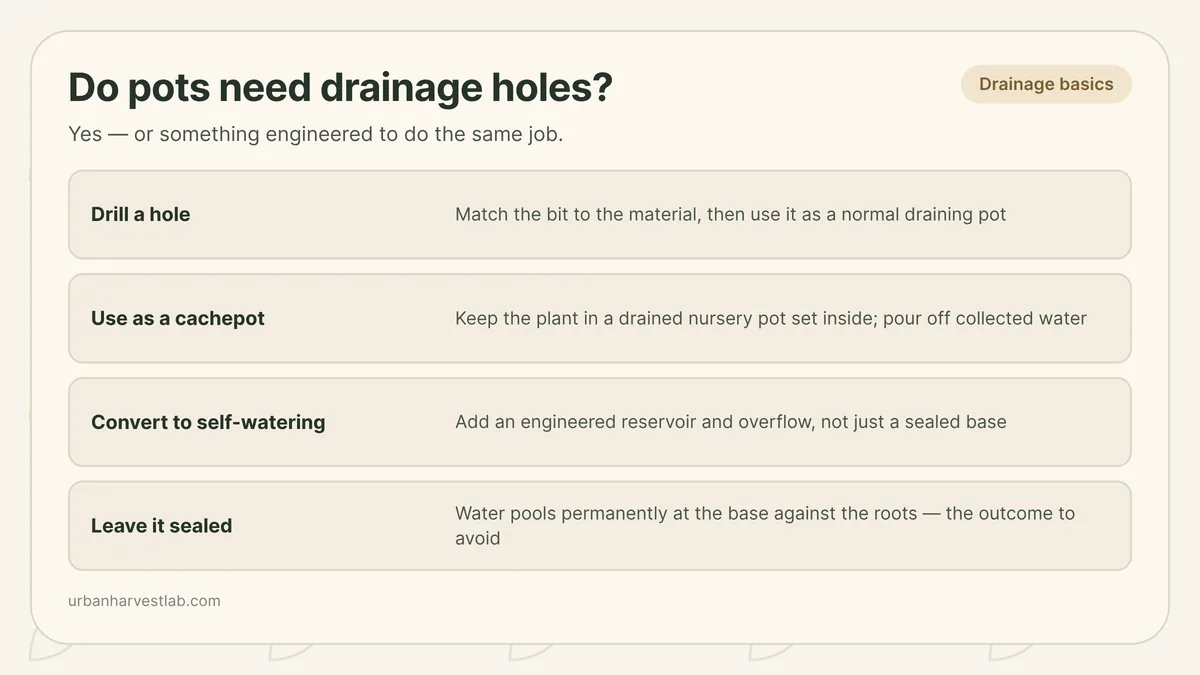
Do pots need drainage holes, and how to add one safely
A pot with no drainage hole is not a design quirk you can water around. Here is why that matters, how to drill one safely by material, and how to use a hole-less pot the right way instead.
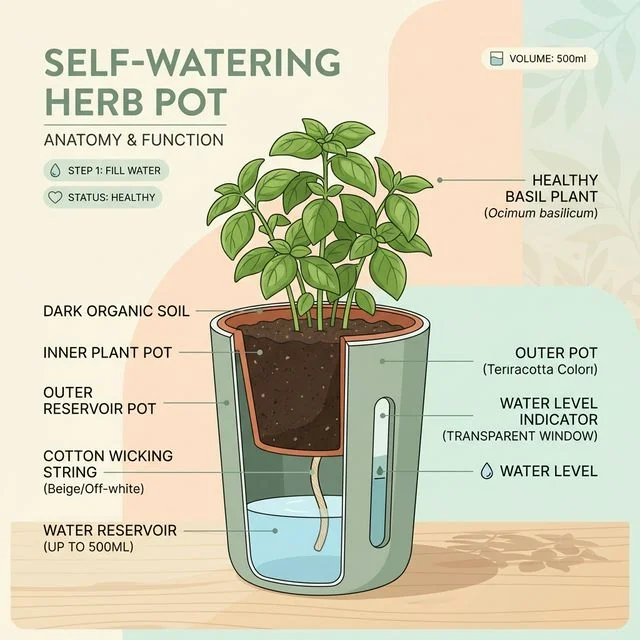
Self-watering pots for herbs: worth it or more trouble?
Self-watering pots sound like the holy grail for busy gardeners. While they are fantastic for moisture-loving herbs like mint, they can quickly turn into a swamp of rotting roots for drought-tolerant plants like rosemary.
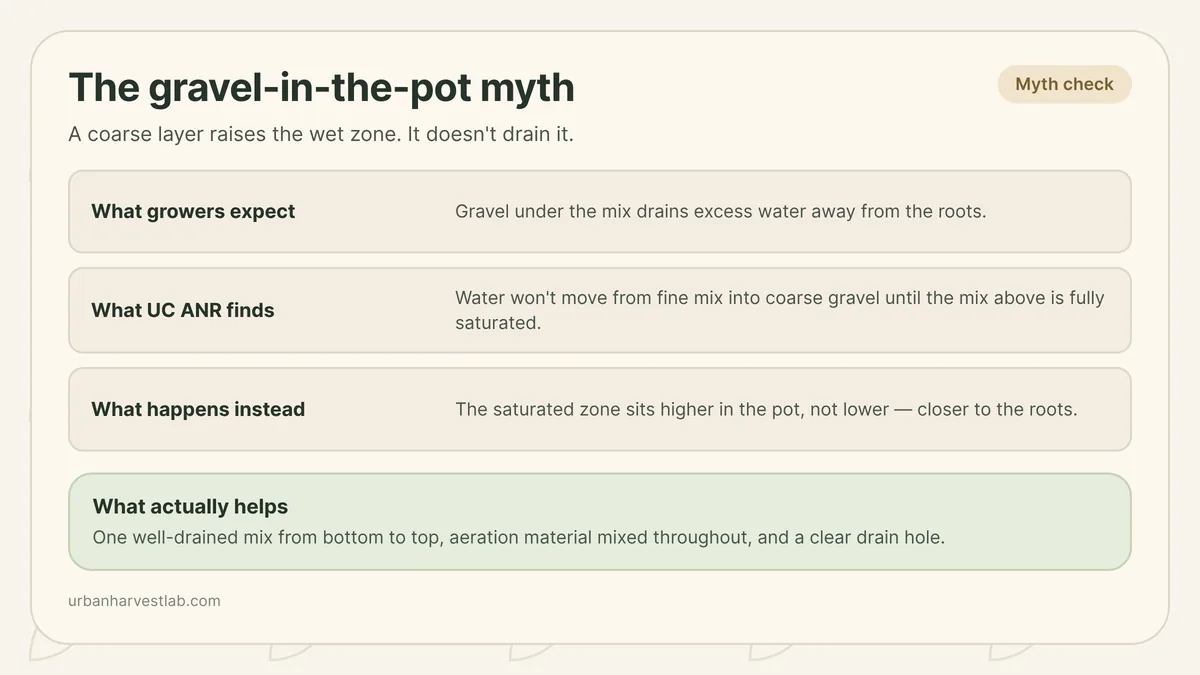
The gravel-in-the-pot myth: why it doesn't improve drainage
Putting gravel or rocks under potting mix feels like it should help drainage, but it creates a wetter zone right where roots grow, not a drier one.