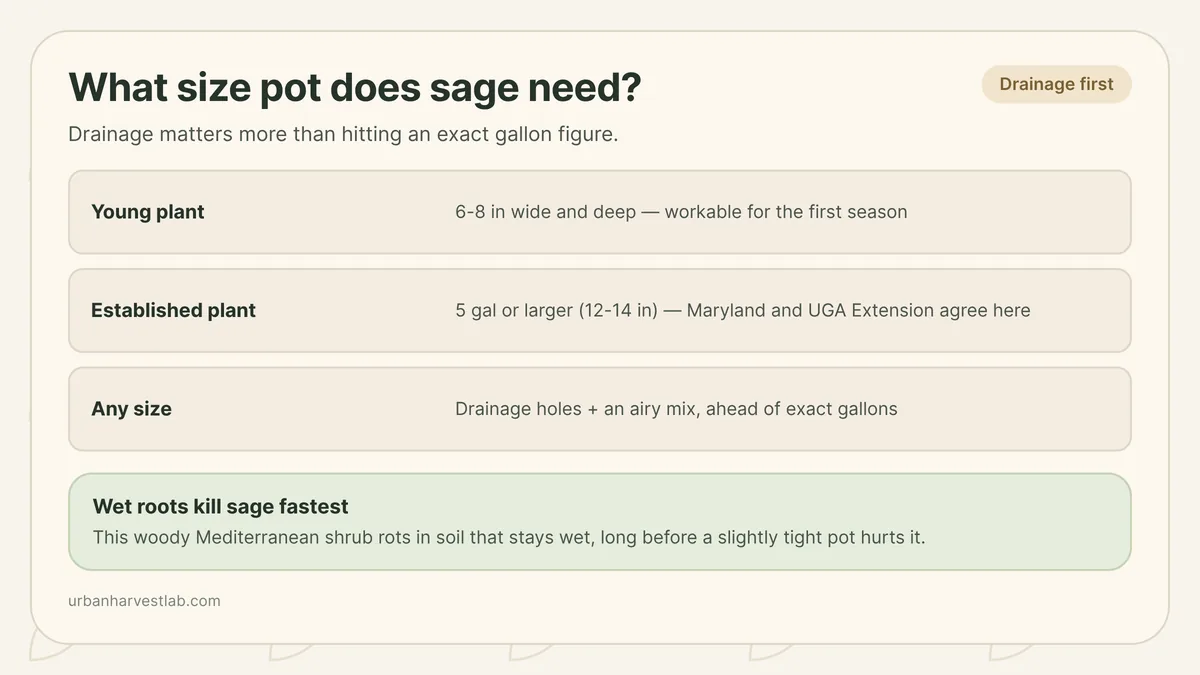
Sage pot size at a glance
| Stage | Pot size | Notes |
|---|---|---|
| Young plant | 6-8 in wide and deep (15-20 cm) | Workable for the first season if you plan to size up |
| Established plant | 5 gal or larger (12-14 in) | University of Maryland and UGA Extension both put mature sage here |
| Any size | Drainage holes + airy mix | Matters more than hitting an exact gallon figure |
Sage does best in a pot of 5 gallons or larger, roughly 12 to 14 inches wide on University of Illinois Extension’s diameter-to-volume table for straight-sided round pots (12 inches holds about 5 gallons, 14 inches about 7), but the size number is the easy part. University of Maryland Extension puts sage in its “larger herbs” bracket, needing 5-gallon or larger containers alongside rosemary, bay leaf, parsley, lavender, dill and fennel, and UGA Fulton County Extension agrees from a different angle, grouping sage with rosemary and lavender as a perennial herb that wants 5 gallons. Where sage actually gets into trouble is drainage: it is a woody, drought-tolerant Mediterranean shrub, and a pot that holds water against its roots kills it faster than a pot that is a size too small. The full herb-by-herb breakdown, including how sage compares with softer annual herbs, sits in the herb pot size chart.
Why sage cares less about gallons than about staying dry
Sage evolved on rocky, fast-draining Mediterranean hillsides, and its roots carry that preference into a pot. A woody root system built for lean, well-aerated soil does not adapt well to a container that holds water for days after each watering — the roots simply do not get the oxygen they need, and rot sets in before the plant shows any obvious sign above ground. That is a different failure mode than a soft annual herb running out of soil volume: basil in too small a pot wilts and recovers with a good soak; sage in a pot that stays soggy declines slowly and often does not recover at all. Sizing up matters less here than getting drainage right from the start.
Sizing sage as it grows
Texas A&M AgriLife Extension gives a broader, undifferentiated figure of 6 to 10 inch pots for herbs generally, and a young sage sits comfortably at the low end of that band for its first season. As it builds the woody stems and spreading root mass that mark a mature plant, moving it up toward the 5-gallon figure both extension sources agree on gives the roots room to keep expanding. Size up one step at a time, once roots have visibly filled the current pot, rather than jumping straight to a large final container while the plant is still small.
A big volume of soil around a small root ball holds moisture for weeks. That is exactly the condition sage cannot tolerate, which is why this schedule matters more for sage than for a softer annual — every size-up is a trade against the wet-roots risk the section above describes. This is the same pattern rosemary follows, another woody Mediterranean perennial that starts small and needs a schedule rather than one fixed number; the rosemary pot size guide lays out that progression in more detail, and it applies to sage with only minor adjustment.
A sage plant does not keep expanding forever inside a 5-gallon pot. Once the woody crown has filled that container and new growth thins out toward the center — the shrub equivalent of a root-bound herb, but expressed in stems rather than roots — dividing the plant or starting a fresh one from a cutting usually restores vigor faster than sizing up again into a container too heavy to move easily. A sage plant that has held the same pot for several years, flowered repeatedly, and gone woody at the base is a better candidate for replacement than for one more size-up.
The gravel-layer myth, and why it is worse for sage specifically
A widely repeated tip is to put a layer of gravel or rocks at the bottom of a pot to “help drainage.” Washington State University Extension has tested this directly and found the opposite: water does not move freely from a fine-textured potting mix into a coarser layer underneath it until the finer material is fully saturated, so the gravel creates what soil scientists call a perched water table — a zone of standing-wet soil sitting just above the gravel, closer to the root ball than the water would otherwise reach. The fix, per that same research, is drainage holes and a uniform mix run straight to the bottom of the pot, not a coarse layer partway down. Texas A&M AgriLife Extension’s container gardening guide still recommends adding about an inch of coarse gravel to improve drainage, so it is worth checking that whatever pot you buy skips it — for a plant as sensitive to wet roots as sage, a perched water table is close to the worst possible setup. The mechanism, and how it plays out for herbs generally, is also covered in how to repot herbs without slowing growth.
Pot material favors sage, if you let it
University of Illinois Extension notes that porous materials such as unglazed terracotta dry out faster than plastic or glazed ceramic — for a plant that wants to dry out between waterings, that faster dry-down works in sage’s favor rather than against it, at the cost of checking the pot more often. Plastic vs. terracotta pots for herbs covers the full material trade-off.
Self-watering pots need extra caution, not a ban
University of Maryland Extension describes the mechanism: growing medium sits on a perforated platform above a water reservoir, with no bottom drainage hole, and roots grow down to draw water up by wicking — which keeps the root zone consistently moist, the opposite of what sage wants. An airy, fast-draining mix, a smaller reservoir than the manufacturer’s maximum, and a deliberate dry spell between refills reduce the risk. Self-watering pots for herbs covers the mechanism and which herbs handle it more comfortably.
Overwintering a potted sage plant
A sage left in its container outdoors over winter faces a colder root zone than the same plant would in the ground. A pot has none of the soil’s temperature-buffering mass. University of Illinois Extension’s standard rule for any potted perennial is to treat it as one to two hardiness zones less hardy than your actual zone when it is staying outside in a container through winter.
Practical insulation, in order of how much protection it gives: sink the whole pot into the ground and cover it with 6 to 12 inches of mulch such as straw, leaves or shredded bark; or cluster several pots together with the largest on the outside and mulch heavily over the group, a method Colorado State University Extension’s PlantTalk program also recommends; or move the container into an unheated garage or shed kept roughly between 20 and 45 degrees Fahrenheit. Moist growing medium freezes more slowly than dry medium, so check soil moisture periodically through winter rather than letting the pot dry out completely, and pull mulch back gradually as the weather warms. Bringing the plant indoors entirely as a tender perennial is the other route; overwintering rosemary and thyme in pots covers that method for the same class of woody Mediterranean herb.
If you are reusing a bucket
Sage is often grown from a plant that started life in a nursery pot too small for it, which makes a reused bucket a tempting free upgrade. If you go that route, check the recycling code stamped on the bottom: University of Maryland Extension identifies #2 (HDPE) and #5 (PP) plastics as food-safe, and recommends avoiding #3 (PVC), #6 (polystyrene) and #7 (polycarbonate, which can contain BPA). A bucket that previously held anything other than food — paint, cleaning chemicals, pool supplies — is not food-safe again no matter what code is stamped on it. If you are building a wooden planter box instead, University of Kentucky Cooperative Extension warns specifically against wood treated with creosote or pentachlorophenol near anything you plan to eat.
Sources
- University of Maryland Extension — Growing Vegetables in Containers and Salad Tables
- UGA Fulton County Extension — Container Gardening: Thinking Outside the Box
- Texas A&M AgriLife Extension E-545: Vegetable Gardening in Containers
- University of Maryland Extension: Self-Watering Containers
- Washington State University Extension — The Myth of Drainage Material in Container Plantings
- University of Illinois Extension — How to Grow Fruits, Vegetables, Herbs in Container Gardens
- University of Illinois Extension — Overwintering potted plants
- Colorado State University Extension, PlantTalk Colorado — Overwintering Container Plants
Getting sage's container right
These guides cover the pot-size chart sage sits inside, the material trade-off, and how to size up a woody root system without shocking it.
Common questions
What size pot does sage need?
At least 5 gallons, roughly a 12 to 14 inch pot. University of Maryland Extension puts sage in its "larger herbs" bracket requiring 5-gallon or larger containers, and UGA Fulton County Extension separately groups sage with rosemary and lavender as a perennial herb needing 5 gallons.
Does sage need a bigger pot or just better drainage?
Drainage is the more common failure point. Sage is a Mediterranean perennial that tolerates a slightly undersized pot far better than it tolerates soil that stays wet, so drainage holes and a fast-draining mix matter more than chasing an exact gallon figure.
Can sage go in a self-watering pot?
Usually not the easiest choice. A self-watering pot keeps the root zone consistently moist by design, and sage wants to dry out between waterings. If you use one, give it an airy mix, keep the reservoir small, and let it empty before refilling.
How do I overwinter sage in a container outdoors?
Give it more cold protection than sage growing in the ground would need. University of Illinois Extension notes that container roots are far less cold-hardy than field-grown roots, so the standard rule is to treat a potted perennial as one to two hardiness zones less hardy than your actual zone, insulating with 6 to 12 inches of mulch or moving the pot into an unheated space kept between 20 and 45 degrees Fahrenheit.
Related guides
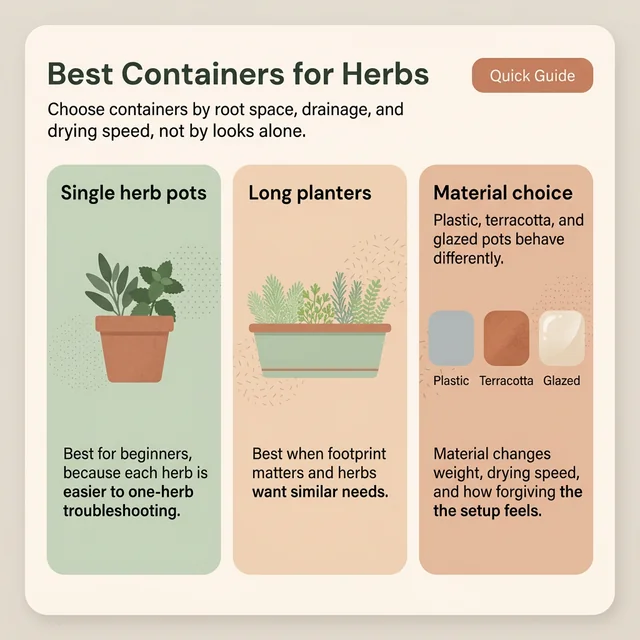
Best containers for herbs: drainage, pot size, and materials that work
A practical guide to herb containers that explains which pots work best, why drainage matters, and how material changes the way containers dry.
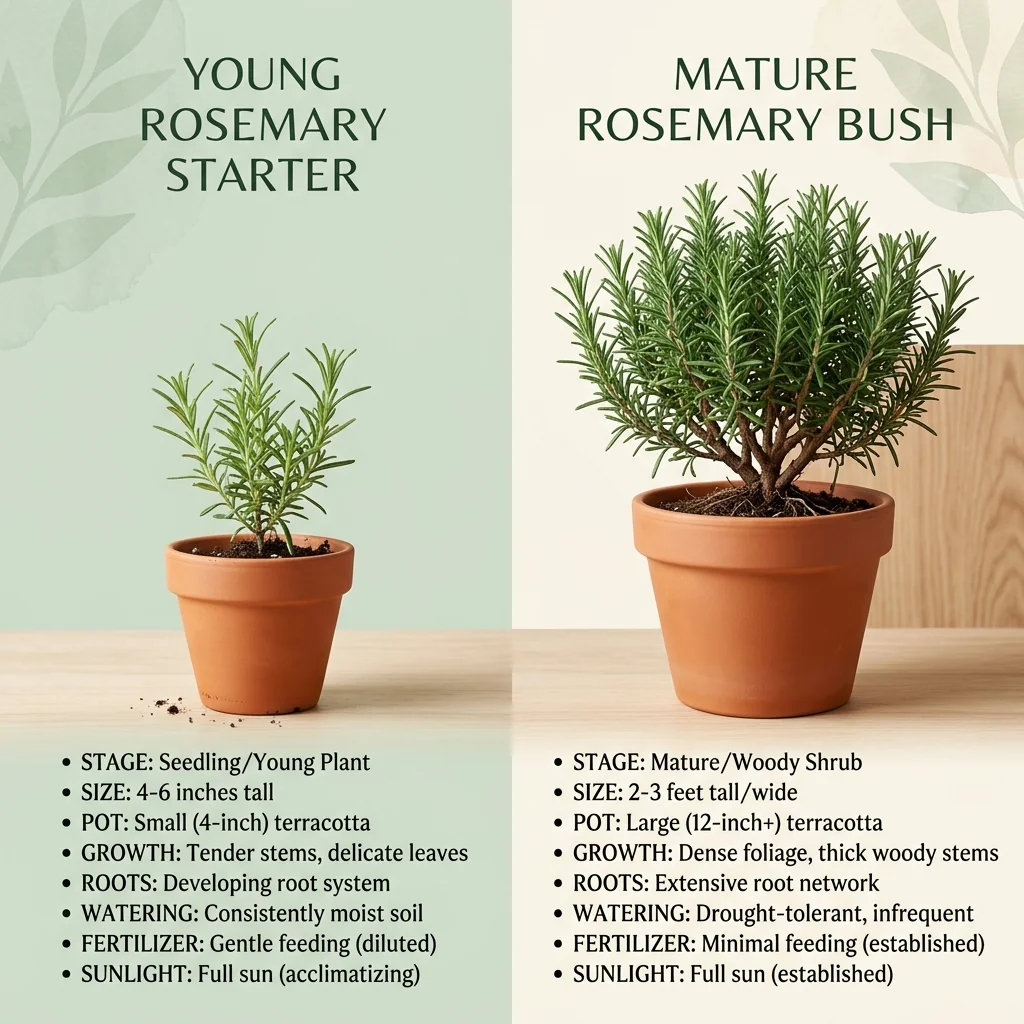
What size pot does rosemary need? Start small, size up
Rosemary is a small shrub in disguise. It starts in a modest pot but needs upsizing as it grows woody, plus the sharp drainage every Mediterranean herb demands.
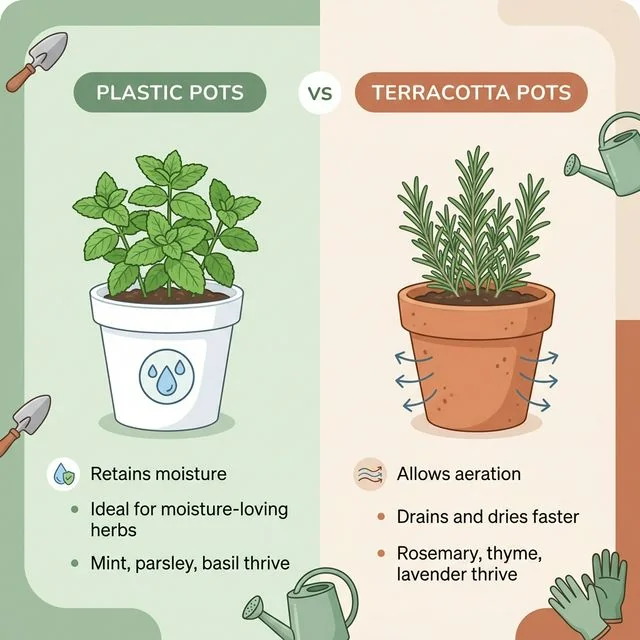
Plastic vs. terracotta pots for herbs: which makes care easier?
The material of your pot dictates how fast your soil dries out. If you put a thirsty mint plant in unglazed terracotta, you will be watering every single day. If you put rot-prone rosemary in a plastic pot, you must be extremely careful.