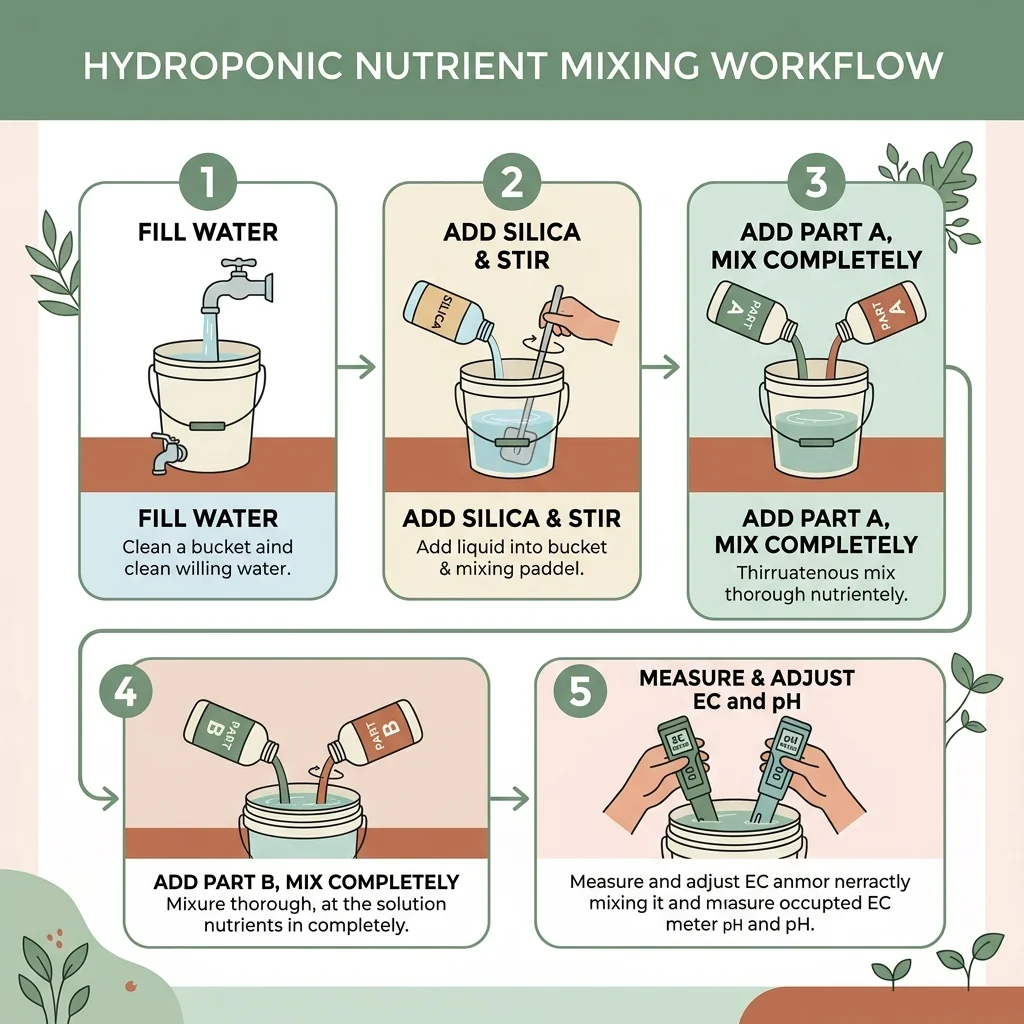
The mixing order at a glance
| Step | Action | Why |
|---|---|---|
| 1 | Start with clean water | Know your starting point |
| 2 | Add each nutrient part separately, stir | Prevents nutrient lockup |
| 3 | Measure EC to the crop target | Confirms strength |
| 4 | Adjust pH last (5.5-6.5) | Nutrients shift pH |
Mixing hydroponic nutrients looks intimidating but follows a simple, fixed order. As a quick answer: start with water, add each nutrient part separately, measure EC to your crop’s target, then adjust pH last. Get the order right and you avoid the two classic beginner mistakes: nutrient lockup and chasing pH. For the concepts behind EC and pH, read hydroponic nutrient basics.
Step by step
- Start with clean water. Fill your reservoir or mixing container so you know your starting volume.
- Add nutrient parts one at a time. Most nutrients come as a two- or three-part set (often labelled A and B); if you still need to pick one, Best hydroponic nutrients for herbs and greens covers beginner-friendly formulas. Add one part, stir it in fully, then add the next. Never pour concentrated parts together, or calcium and other elements react and form solids the plant cannot use.
- Measure EC. Use an EC meter and build up to your crop’s target from the hydroponic EC chart by crop. Add nutrients gradually; it is easier to add more than to dilute.
- Adjust pH last. Adding nutrients changes pH, so adjust after the complete formula is diluted and mixed. Use the crop and product range rather than treating
5.5 to 6.5as a universal command.
Why the order matters
Two mistakes cause most beginner problems:
- Combining concentrates locks up nutrients before they reach the plant.
- Setting pH before nutrients wastes effort, because the nutrients shift it anyway.
Following water → nutrients → EC → pH avoids both.
Mix for the conditions
Begin conservatively for young plants only when the crop program supports it. Warm conditions can change water and nutrient uptake, but the direction is not identical in every system. Follow the product and crop program, then use EC trends and plant response rather than an automatic seasonal reduction.
Measure concentrates safely
Wear the protective equipment named on the product label and safety data sheet. Use dedicated syringes, cylinders, or scales for each concentrate; never return a used measure to the stock container. Work over a washable tray away from food preparation, children, and pets.
For dry salts, weigh by mass and dissolve each component according to the recipe. Kitchen teaspoons are not precise enough for concentrated stock solutions. Label stock with contents, concentration, preparation date, and hazard information.
Account for source water
Record source-water EC before mixing. It exposes a changing baseline but does not identify individual ions. Hard or alkaline water may require a formulation designed for it or a water analysis; repeatedly adding acid is not a substitute for understanding alkalinity.
Use a known final reservoir volume. Marking a tank by eye can introduce a larger concentration error than the meter resolution being optimised.
Verify the batch before plants enter
- Circulate until temperature and readings stabilise.
- Confirm the EC meter with an appropriate standard on its calibration schedule.
- Confirm the pH meter with fresh buffers bracketing the working range.
- Inspect for precipitate, unusual cloudiness, or incomplete dissolution.
- Record volume, source EC, each input, final EC/pH, and temperature.
If a mistake is uncertain, discard the solution according to local guidance and remix. Counter-dosing an unknown error creates an untraceable reservoir.
Scale a recipe without ratio errors
Use new amount = original amount × new volume ÷ original volume. Calculate every component independently and keep units visible. A recipe specifying 20 mL per 10 L needs 50 mL for 25 L. Prepare a small test batch when changing brand, source water, or scale because the manufacturer may specify a different order.
After mixing
Top up and replace the solution on a documented schedule, covered in when to change hydroponic nutrient solution. If pH keeps climbing, use why pH keeps rising in hydroponics to distinguish uptake, alkalinity, aeration, and measurement error.
Sources and further reading
After mixing, use these guides
These guides cover the targets to mix toward and when to change the solution.
Common questions
How do you mix hydroponic nutrients step by step?
Start with water, add each nutrient part separately and stir between them, measure the EC to hit your crop's target, then adjust pH last into the 5.5 to 6.5 range. Adjusting pH before the nutrients are in wastes effort because nutrients shift it.
Why can't I mix nutrient concentrates together?
Combining concentrated A and B parts directly causes nutrients like calcium to react and lock up, forming solids your plants cannot use. Always add them to water one at a time, stirring between.
Do you adjust pH before or after adding nutrients?
After. Adding nutrients changes the pH of the water, so always mix the nutrients first, then adjust pH last to the target range.
How much nutrient should I add?
Follow the product's dilution rate and measure EC to confirm. Mix to the lower end of your crop's range for seedlings or in warm weather, and build up as plants grow.
Related guides
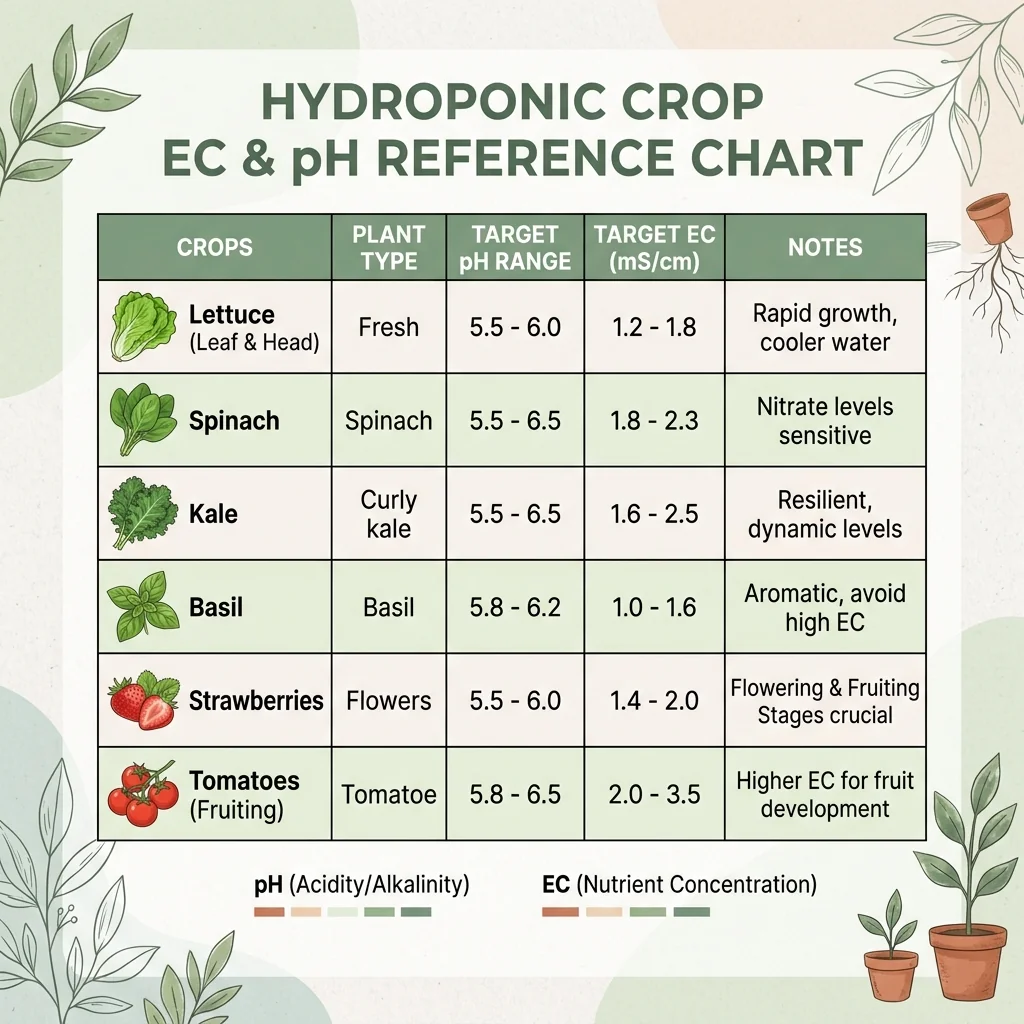
Hydroponic EC chart by crop (not just lettuce)
One reference chart for the EC and pH targets of common hydroponic crops, from leafy greens and herbs to fruiting plants, plus how to use the numbers safely.
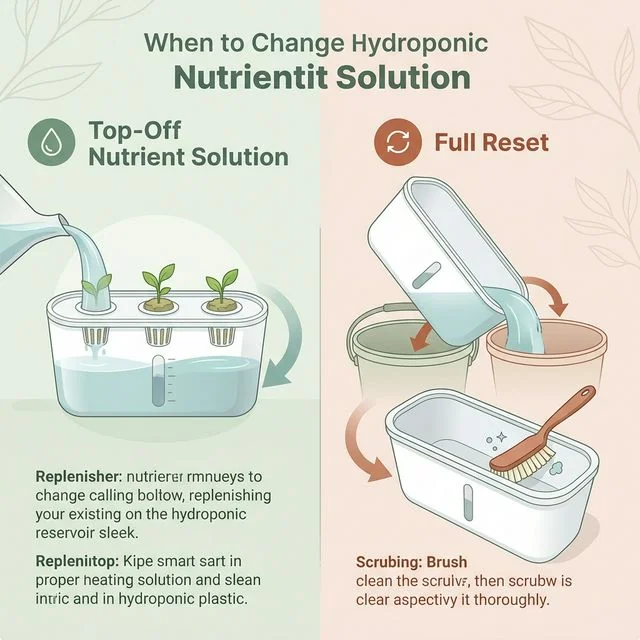
When to change hydroponic nutrient solution: top off vs full reset
A hydroponic reservoir should not be treated like a closed loop forever. This guide shows when a simple top off is enough and when a full reset is the safer move.
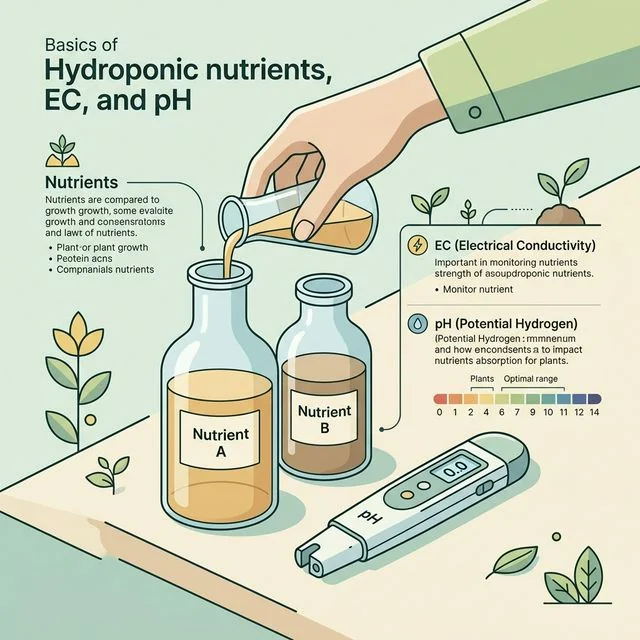
Hydroponic nutrient basics: EC, pH, dilution, and reservoir stability
Most hydroponic problems are not mysterious. They come from concentration drift, pH drift, heat, or neglected maintenance. This guide covers the basics clearly.