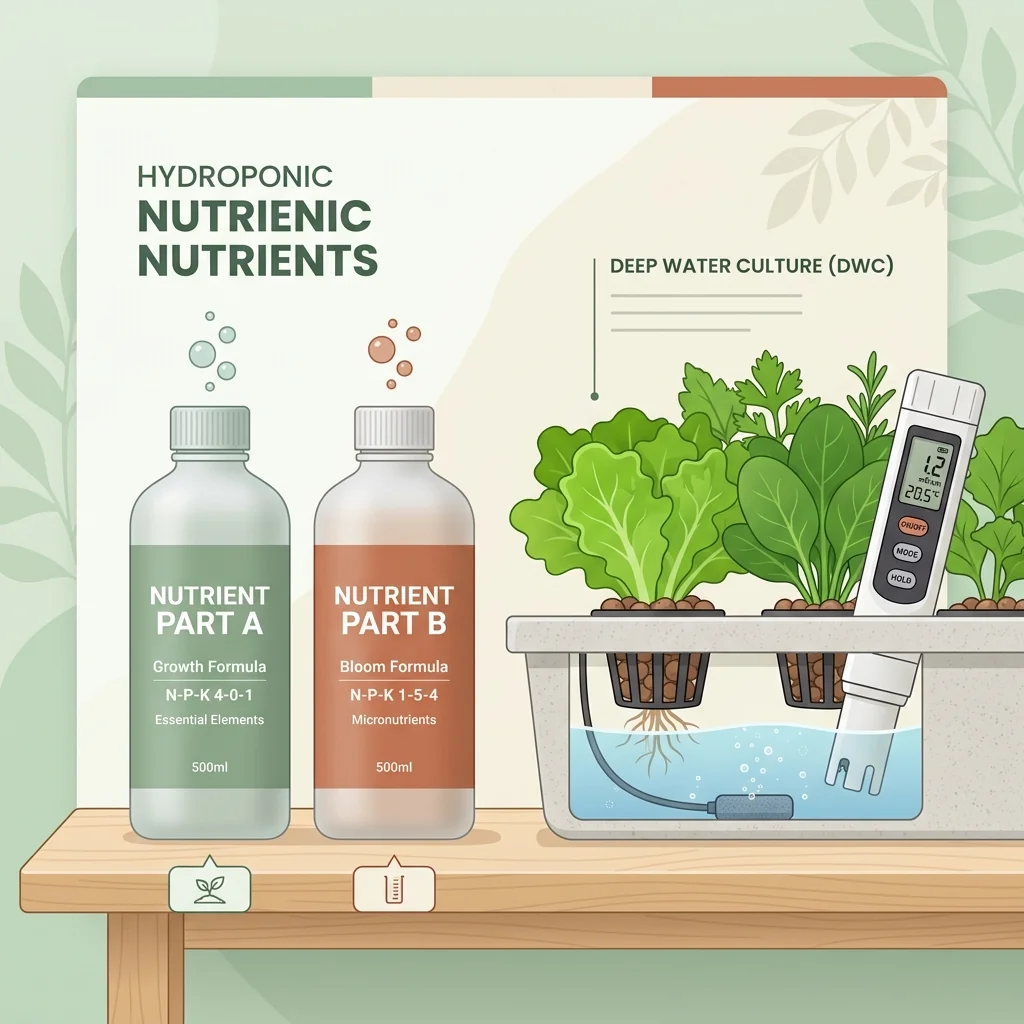
Choosing hydroponic nutrients
| Type | Best for | Notes |
|---|---|---|
| One-part formula | Beginners, herbs and greens | Simplest to mix |
| Two-part (A + B) | Most growers | Tune ratios as plants grow |
| Three-part (e.g. Flora series) | Hobbyists wanting control | Most flexible, more steps |
Editorial note: Retailer links are untracked shopping references; Urban Harvest Lab does not currently receive a commission from them. Recommendations are based on stated features and suitability criteria, not on undocumented hands-on testing.
Herbs and leafy greens are not fussy feeders, but they do need a complete hydroponic nutrient rather than a generic plant food. As a quick answer: choose a complete two- or three-part formula (or a simple one-part for beginners) with full micronutrients, and mix it to a low EC for greens. How EC and pH work is covered in hydroponic nutrient basics.
What makes a good hydroponic nutrient
The key is that it is complete and made for water culture: it must supply all the macro and micronutrients in plant-available form, because there is no soil to buffer or supply anything. Generic houseplant feeds usually miss micronutrients and lead to deficiencies.
There is no named winner without controlled comparative growing. Use the guaranteed analysis, complete recipe, mixing burden, crop label, and cost per finished reservoir to make the selection.
Browse hydroponic nutrients on Amazon
One-part vs multi-part
- One-part: add one product to water; simplest, ideal for beginners and for herbs and greens.
- Two-part (A + B): the most common balance of simplicity and control.
- Three-part (e.g. Flora series): maximum control over ratios, more relevant for fruiting crops than greens.
For herbs and leafy greens, a one- or two-part formula is plenty.
That statement assumes the final recipe is complete. “One part” can mean one bottle used alone, or one base that still expects supplements. “Two part” usually keeps concentrated calcium away from phosphates or sulfates until dilution. Read the complete directions before comparing product count.
A six-point buying scorecard
Score each candidate from 0 to 2 on completeness, crop fit, measurability, water guidance, transparency, and true cost. A credible product supplies macro, secondary, and micronutrients itself or documents every complementary component. Its rate is based on known water volume, not an unexplained capful.
Reject products that rely on “equivalent,” “booster,” or proprietary claims without explaining how they fit into a complete program. A higher number of bottles does not establish higher yield. Include every required part and supplement when comparing cost per 100 L or 25 gal of finished solution.
Test the water before blaming the nutrient
Measure source-water EC and, where possible, alkalinity. EC tells you how much ionic material is present but not its identity; alkalinity describes resistance to pH change. Two taps with the same pH can behave very differently after nutrient addition.
Mix the first batch at a conservative labelled rate, add each concentrate separately to water, circulate, and measure final EC and pH. Record actual amounts. If a crop declines, this log distinguishes a formula issue from a mixing error.
Separate product selection from crop control
A nutrient product cannot compensate for weak light, warm low-oxygen water, crowding, or diseased roots. Use the same formula for a documented trial while changing only one environmental variable at a time. Conversely, do not conclude that a nutrient is “best” because one healthy crop grew under favourable conditions.
For editorial integrity, a retailer link here is a shopping shortcut, not evidence of hands-on comparison. Future named rankings require test conditions, batch dates, source water, crop, EC/pH record, and outcome.
The brand matters less than the method
Most beginner failures are not the nutrient brand; they are mixing or pH mistakes. Whatever you buy:
- Mix to your crop’s EC using the EC chart by crop.
- Add parts separately and adjust pH last, per how to mix hydroponic nutrients.
- Refresh the solution on schedule, per when to change hydroponic nutrient solution.
Get those right and an inexpensive complete nutrient will grow excellent herbs and greens. Ready to pick one? Browse hydroponic nutrients for leafy greens on Amazon and pair it with a pH and EC meter so you can mix it to target.
Sources and further reading
Use your nutrients with these guides
These guides explain how to mix to target, the EC by crop, and when to change the solution.
Common questions
What are the best hydroponic nutrients for herbs and leafy greens?
A complete hydroponic formula with full macro and micronutrients designed for water culture. Popular options include General Hydroponics Flora series, Masterblend, and FoxFarm liquid lines. For greens, a balanced or slightly nitrogen-forward mix at a low EC works well.
Can I use regular plant food in hydroponics?
Not reliably. Most houseplant or garden fertilisers lack the full set of micronutrients in plant-available form for water culture, so plants develop deficiencies. Use a nutrient labelled for hydroponics.
Should I use one-part or two-part nutrients?
One-part formulas are simpler and great for beginners and leafy crops. Two- and three-part formulas let you adjust the ratios as plants grow, which matters more for fruiting crops than for herbs and greens.
How much nutrient do herbs and greens need?
Less than fruiting crops. Aim for a low EC, around 0.8 to 1.2 for lettuce and 1.0 to 1.6 for herbs, and mix to the lower end for seedlings. See the EC chart by crop for targets.
Related guides
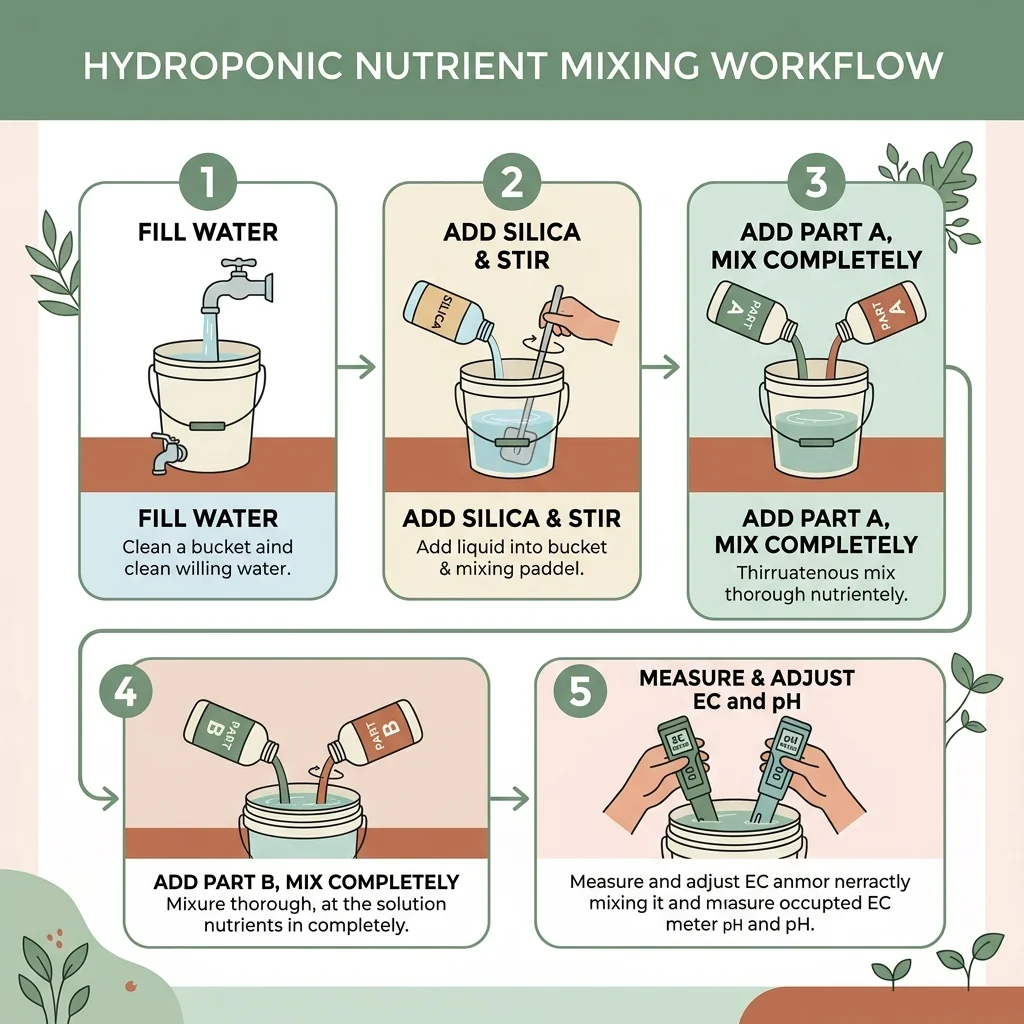
How to mix hydroponic nutrients: a beginner guide
Mixing hydroponic nutrients is simple once you know the order: water first, nutrients separately, measure EC, then adjust pH last. Here is the step-by-step.
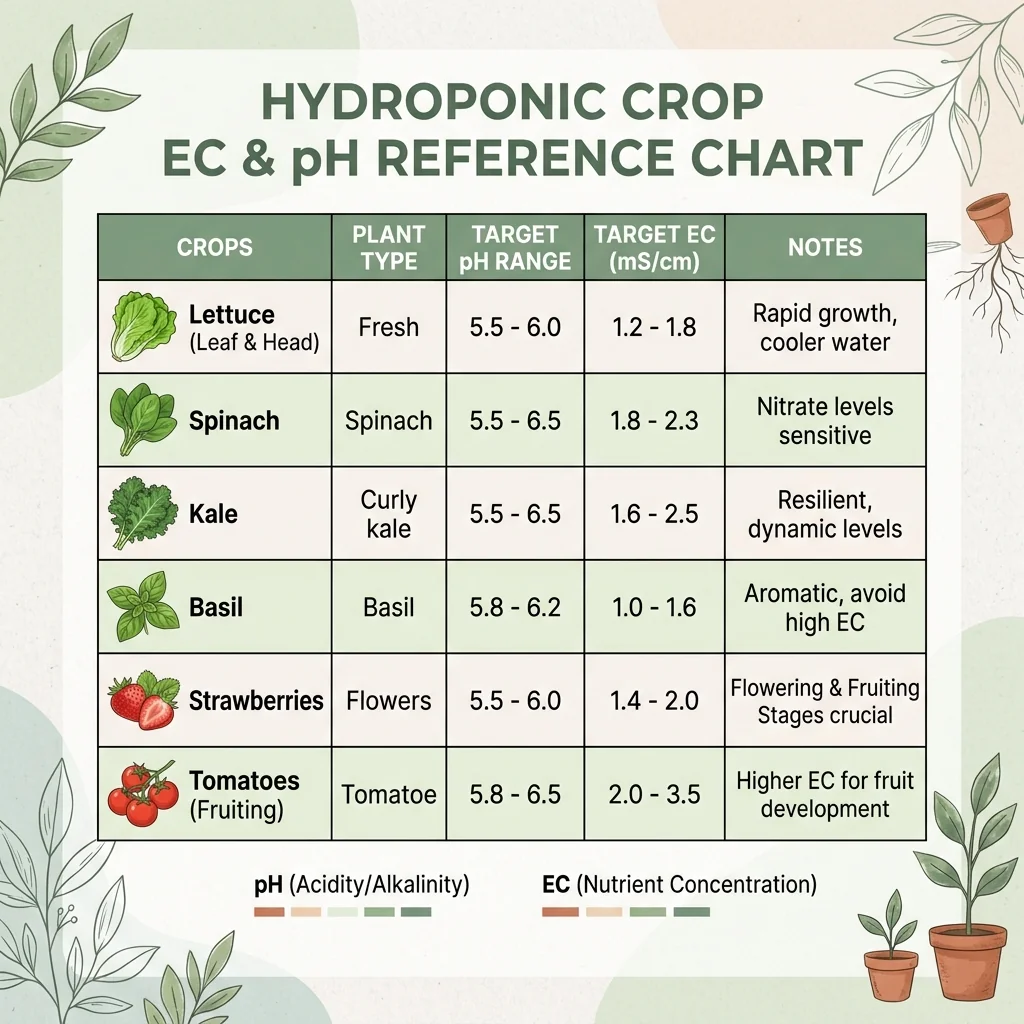
Hydroponic EC chart by crop (not just lettuce)
One reference chart for the EC and pH targets of common hydroponic crops, from leafy greens and herbs to fruiting plants, plus how to use the numbers safely.
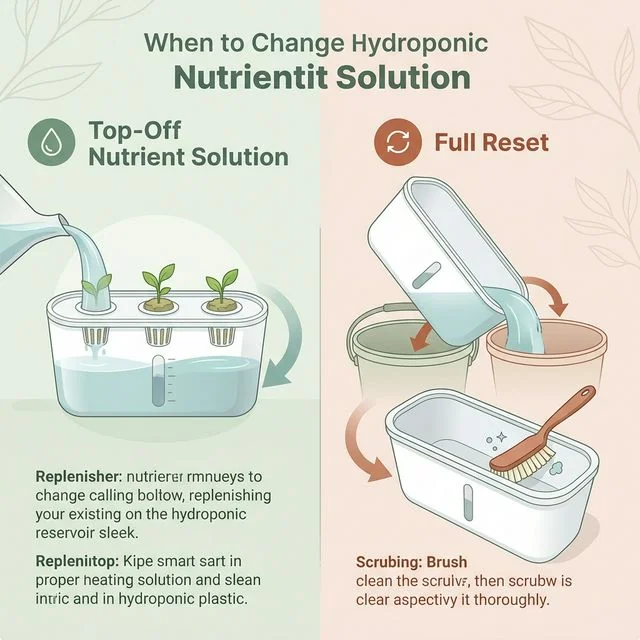
When to change hydroponic nutrient solution: top off vs full reset
A hydroponic reservoir should not be treated like a closed loop forever. This guide shows when a simple top off is enough and when a full reset is the safer move.