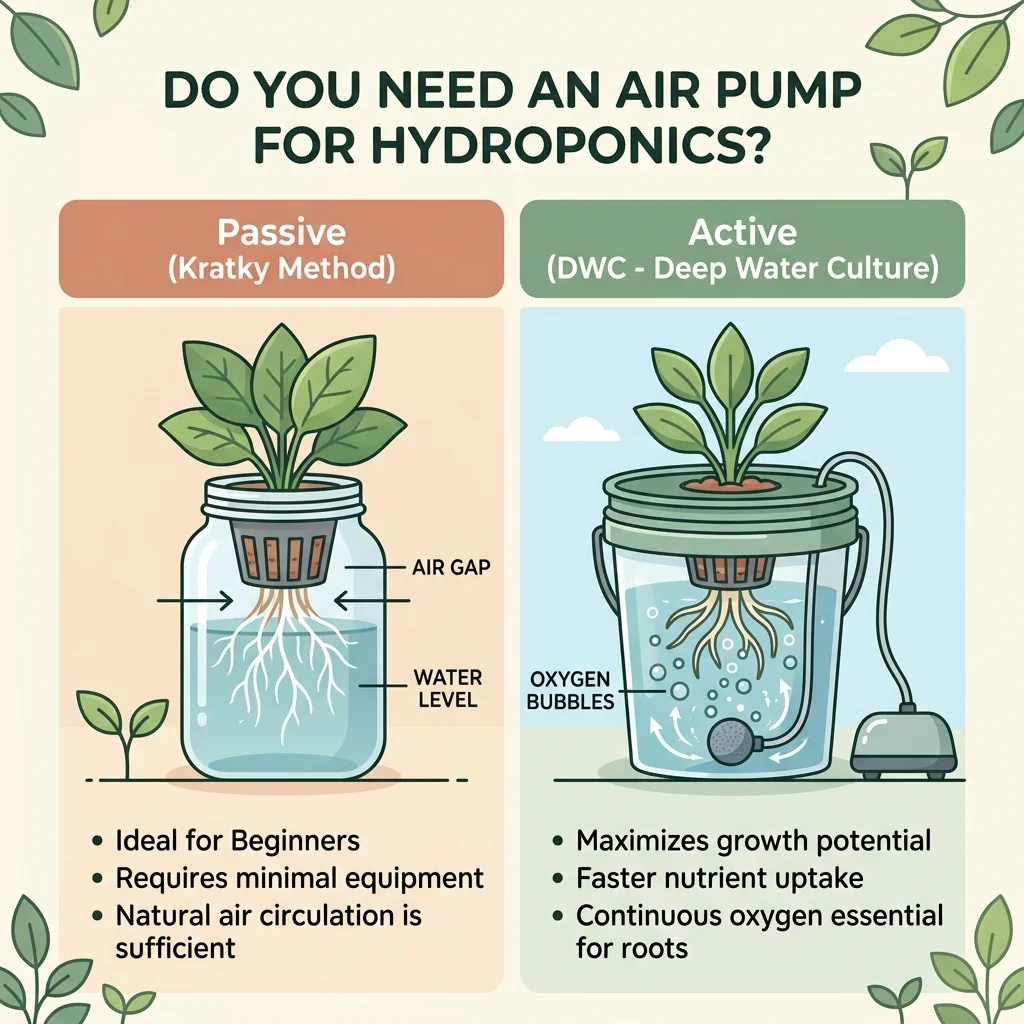
Passive vs. Active Aeration Systems
| Feature | Passive (Kratky Method) | Active (DWC / NFT) |
|---|---|---|
| Electrical Needed | No. Entirely passive and off-grid. | Yes. Requires 24/7 power for pumps. |
| How Roots Breathe | An air gap between the net cup and water level. | Air pump forces oxygen bubbles into the water. |
| Best Crops For | Short-cycle leafy greens (lettuce, spinach, herbs). | All crops, including long-term fruiting plants. |
| Growth Speed | Moderate (similar to high-quality soil). | Explosive (20-30% faster than passive). |
| Root Rot Risk | Low, if the air gap is strictly maintained. | High, if water temperature spikes or pump fails. |
If you browse online hydroponic communities, you will see a tech-heavy landscape. Massive DWC buckets, bubbling reservoirs, high-powered air pumps, and intricate PVC piping are considered standard gear. For a beginner, this complexity can be incredibly intimidating.
It leads to a fundamental question: Do you actually need an electrical air pump to grow plants in water?
The short answer is no—but it depends entirely on the style of hydroponic system you choose to build. While active oxygenation is the gold standard for high-performance growing, nature has a clever way of letting plants breathe without any moving parts.
Here is the science behind how roots breathe, and how to decide if your system requires an active pump or can run completely off-grid.
The Direct Quick Answer
You do not need an air pump for hydroponics if you use a passive method like the Kratky Method.
In a Kratky system, you leave a permanent physical air gap of 2 to 3 inches between the bottom of the plant’s net cup and the surface of the water. The plant develops specialized “air roots” in this humid gap to breathe oxygen, while the lower “water roots” drink nutrients below.
However, if you choose an active system like Deep Water Culture (DWC), where the root system is fully submerged, an air pump is 100% mandatory. Without bubbles, the stagnant water will deplete its oxygen in hours, leading to root suffocation and deadly Root Rot.
Why Roots Must Breathe: The Biology of Aeration
To understand why air pumps exist, you must understand root biology.
Unlike the leaves above ground, which inhale carbon dioxide ($CO_2$), plant roots require oxygen ($O_2$) to perform cellular respiration. Without oxygen, roots cannot metabolize nutrients or drink water.
In traditional soil gardening, microscopic pockets of air exist between dirt particles. In hydroponics, soil is removed. If you place a root system directly into stagnant, non-aerated water:
- Suffocation: The roots quickly absorb whatever tiny amounts of oxygen are naturally dissolved in the water.
- Anaerobic State: The water becomes an anaerobic zone (zero oxygen). The roots physically choke and stop growing, as detailed in our Water Temperature and Oxygen Guide.
- Pythium Infection: Pathogenic fungi (like Pythium) thrive in stagnant, low-oxygen conditions. They attack the dead root cells, destroying the plant within days.
To prevent this, you must choose between two strategies: Active Aeration (forcing air into the water) or Passive Aeration (letting roots touch the air directly).
Option A: Passive Aeration (The Kratky Method)
Invented by Dr. Bernard Kratky at the University of Hawaii, this method is the ultimate “set-it-and-forget-it” system.
How It Works:
You fill a jar, bucket, or tank with nutrient-rich water. You place a net cup with a seedling on top.
- The Water Level: Initially, the bottom of the net cup barely touches the water so the young taproot can drink.
- The Drop: As the plant grows, it drinks the water, causing the level to drop.
- The Gap: The space where the water used to be becomes a highly humid air chamber. The roots left dangling in this gap adapt into “air roots,” absorbing atmospheric oxygen. The roots that reach all the way to the bottom drink the liquid nutrients.
The Golden Rule of Kratky:
Never refill the reservoir to the top. If you pour water back in and submerge the air roots, you will drown the plant. You must only top off the bottom third of the container, leaving the air roots dry.
Option B: Active Aeration (Deep Water Culture)
If passive growing is so easy, why does anyone buy air pumps? The answer is performance.
How It Works:
In Deep Water Culture (DWC), the reservoir is kept completely full at all times. The roots are 100% submerged in liquid.
- The Bubbles: An electrical air pump sits outside the bucket, pumping air through a silicone tube to a porous airstone at the bottom.
- The Saturation: The airstone breaks the air into thousands of tiny bubbles. As these bubbles rise, they physically force oxygen into the liquid, saturating the water with Dissolved Oxygen (DO).
The Active Advantage:
Active aeration delivers a massive, continuous stream of oxygen directly to the root membrane. Because the plant never has to work to find oxygen, its metabolic rate increases. Active DWC plants grow 20% to 35% faster than Kratky plants and yield significantly heavier canopies.
The Verdict: Which Should You Choose?
Use this decision matrix to plan your hydroponic garden:
Choose Passive (No Pump) If:
- You are a complete beginner or want a cheap project.
- You are growing short-cycle leafy greens (lettuce, spinach, kale) or soft herbs (cilantro, basil).
- You want a completely silent system (ideal for bedrooms or classrooms).
- You want an off-grid system that does not require electrical outlets.
Choose Active (With Pump) If:
- You want the fastest possible growth and maximum yields.
- You are growing long-term crops with large root systems (tomatoes, cucumbers, peppers).
- You are using a countertop kit like those described in our Countertop Herb Guide.
- You want a safety buffer: highly aerated water naturally suppresses root pathogens, making it much more forgiving of minor system errors.
For a simple windowsill lettuce crop, skip the pump and try the Kratky method. For an explosive, high-yielding indoor veggie factory, invest in a quality air pump—your roots will thank you.
System setup and crop management?
Choosing passive vs. active systems changes how you transplant, clean, and manage temperature. Check these guides.
Common questions
Can I run an active DWC system without an air pump?
No. In a Deep Water Culture (DWC) bucket, the roots are fully submerged from top to bottom. Without an active air pump providing bubbles, the stagnant water will deplete its oxygen in hours, causing root rot and drowning.
Is the Kratky method slower than DWC?
Yes. Because DWC saturated water delivers a constant stream of highly available dissolved oxygen directly to the root membrane, active plants typically grow 20% to 30% faster than passive Kratky plants.
How loud is a hydroponic air pump?
Most small aquarium air pumps emit a low hum (approx. 35 to 45 decibels), similar to a modern refrigerator. Placing the pump on a piece of foam or hanging it by a rubber band virtually eliminates mechanical vibration noise.
Related guides
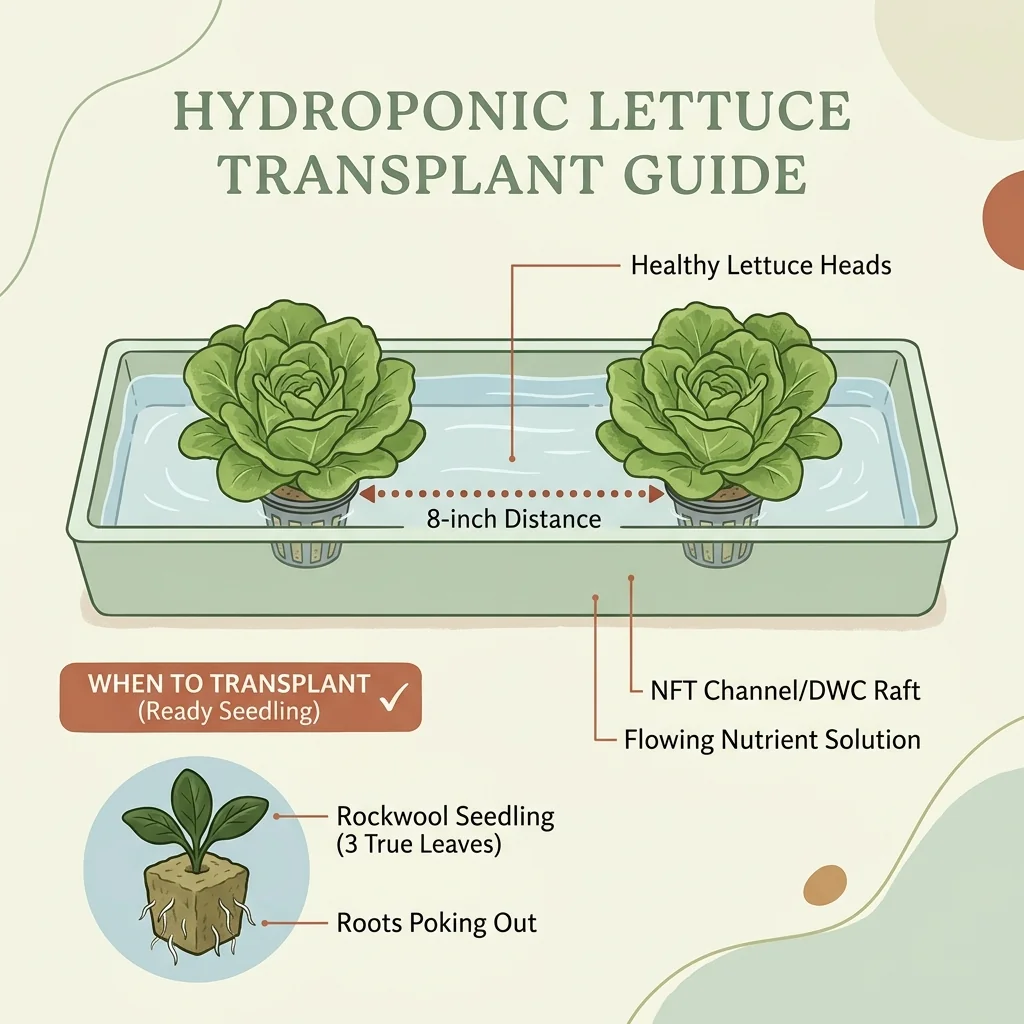
When to transplant hydroponic lettuce and how far apart to space it
Moving your fragile seedling from the nursery tray to the main hydroponic system is a high-risk maneuver. If you move it a day too early, it will drown. If you plant the heads too close together, they will choke each other out. Here are the exact metrics for a perfect transplant.
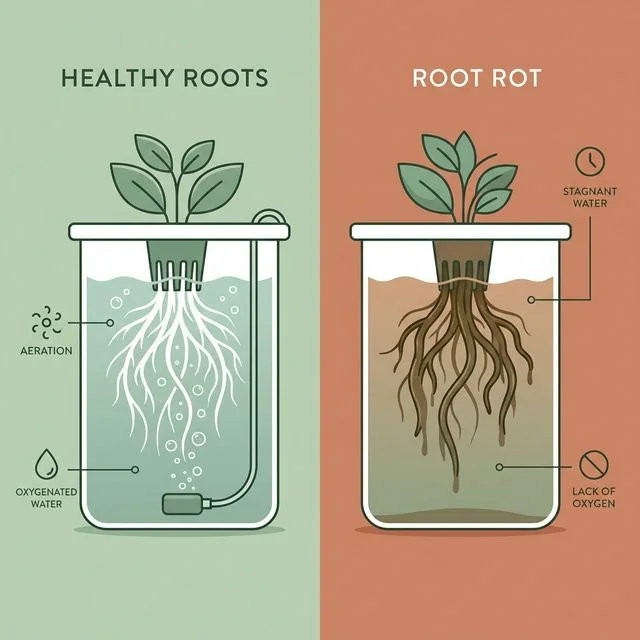
Hydroponic root rot: how to spot it early and stop it
Brown, slimy or swampy-smelling roots mean root rot. Catch it early and fix the conditions behind it — warm water, low oxygen and stagnant flow.
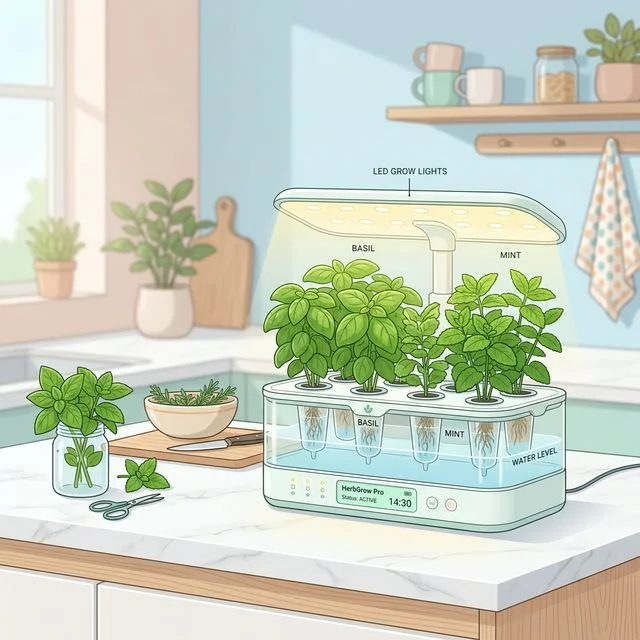
Countertop hydroponic herbs for beginners: what to buy and what to ignore
Countertop hydroponic systems can work very well for herbs, but only if you treat them as small growing systems rather than decorative appliances.