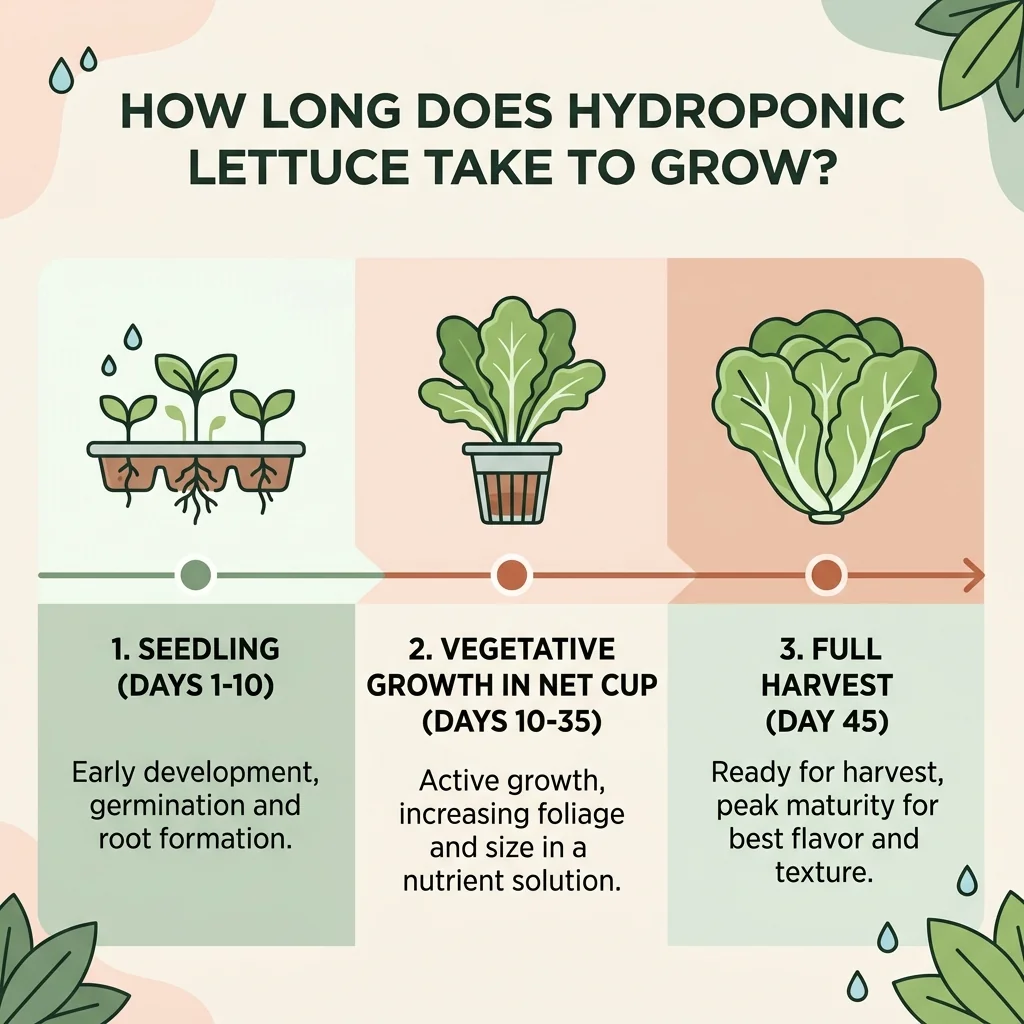
A planning range for home hydroponic lettuce
| Stage | Approximate days from sowing | Move on when |
|---|---|---|
| Germination | 0–3 | Cotyledons open and the dome can come off |
| Seedling growth | 3–13 | Roots hold the plug and true leaves are developing |
| Transplant window | 13–15 | Roots can reach solution without burying the crown |
| Main growth | 15–45/55 | Plant reaches the intended leaf or head size |
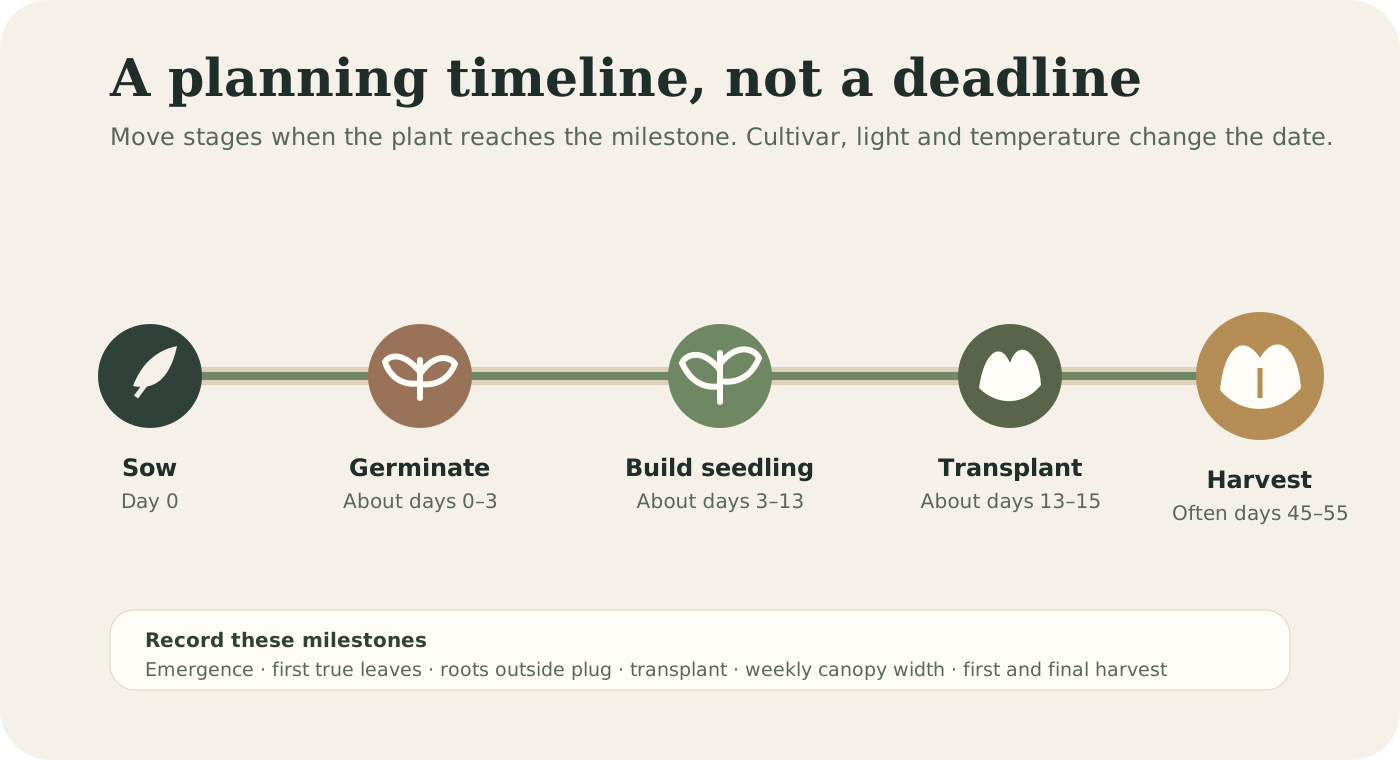
At home, hydroponic lettuce commonly needs about 45 to 55 days from sowing to a full harvest. Treat that as a planning range, not a promise. A compact butterhead in a controlled greenhouse can finish sooner; a large romaine head under modest winter light can take longer.
The useful question is not only “what day is it?” It is “has the plant reached the milestone for this stage?” Roots, true leaves, canopy size, flavor, temperature, and cultivar tell you more than an exact date copied from another system.
Days 0–3: germination
Sow one fresh seed in a clean, bonded plug suited to the system. Keep the plug evenly moist, not submerged. Lettuce germinates best under cool, stable conditions; excessive heat can make germination slow and uneven.
The first visible milestone is a root followed by two rounded cotyledons. Remove a humidity dome once most seedlings have emerged so stagnant moisture does not persist. Give emerging seedlings gentle light rather than leaving them covered in darkness.
Three days is a useful controlled-environment target, not a failure deadline. Seed age, cultivar, plug temperature, and moisture can extend the window. Use the troubleshooting steps in how to germinate lettuce seeds for hydroponics when emergence is patchy.
Days 3–13: build a transplantable seedling
The seedling stage is for roots and true leaves. Keep the plug moist while preserving air; standing water around the stem encourages weak growth. Increase light gradually as the cotyledons open and the first textured true leaves appear.
Do not transplant because a calendar says “day 10.” Move the seedling when:
- roots hold the plug together and are visible at its edge
- at least two true leaves are developing
- the stem is compact rather than stretched
- the main-system water level can reach the root zone without submerging the crown
This is commonly around days 10 to 15 in a well-run nursery. A slower but compact seedling is safer to transplant than a pale seedling forced on schedule.
Days 13–25: transplant and establish roots
Place the seedling into its final site with enough solution contact for the roots and enough air around the crown. Check spacing now. Lettuce that looks far apart at transplant can overlap quickly, and crowded leaves reduce airflow later.
The first days after transplant may look quiet above the reservoir while roots expand. New leaves should still appear and the center should remain active. Use the lettuce EC and pH chart for a measured starting range instead of increasing nutrients to force speed.
Record one overhead photograph and root-zone check each week. A fixed camera position makes real growth visible and answers the many search questions asking what each stage should look like.
Days 25–45: canopy expansion
Leaf lettuce and butterhead should now add area steadily. The plant does not divert “100%” of its energy into leaves just because roots are in water; it still maintains roots and responds to the same limits as any plant. Hydroponics helps when it supplies stable water, nutrients, oxygen, temperature, and light. It does not override a weak environment.
Track canopy width or the longest leaf once per week. If that measurement stalls across two checks, investigate in this order:
- inspect roots for color, odor, and texture
- confirm reservoir temperature and aeration
- verify pH and EC with calibrated meters
- measure light at canopy height
- check whether neighboring leaves are shading the center
The guide to slow hydroponic lettuce walks through those causes. Do not raise EC automatically; stressed roots may make a stronger solution more difficult to use.
Days 45–55: choose the harvest, not just the date
A whole-head harvest is ready when the cultivar reaches its intended shape and useful size, leaves are crisp, and the center has not begun to elongate. Butterhead forms a soft, layered head rather than a hard cabbage-like ball. Loose-leaf cultivars remain open. Romaine should build an upright center.
Harvest before quality falls. A lengthening central stem, tighter upward growth, increasingly bitter flavor, or rapid response to heat can signal the approach of bolting. Waiting for a larger head can produce a worse harvest.
Cut the plant just above the plug with a clean knife, or remove the whole plant and roots before cleaning the site. Avoid splashing reservoir solution onto edible leaves during harvest.
Baby leaf and cut-and-come-again timelines
Baby leaves can be taken earlier once they reach a useful size, often during the main expansion phase. Do not use one universal “day 25” rule: cultivar, density, and light change the date.
For loose-leaf lettuce, remove a limited number of clean outer leaves and leave the growing center intact. Allow the plant to rebuild before the next cut. Repeated harvests extend the occupancy of the site, so compare total usable yield with the simplicity of one whole-head harvest.
Butterhead and romaine are usually more predictable as whole heads. Repeated outer-leaf harvest can distort the final shape and create more handling around a dense canopy.
Why a home crop may take seven weeks
University of New Hampshire Extension uses a seven-week home lettuce rotation as a practical planning example. That is longer than the fastest controlled commercial schedules because home fixtures, room temperatures, cultivar choices, and daily management vary.
Season matters even indoors. Window contribution falls in winter, reservoir temperature follows the room, and a fixed timer does not guarantee the same delivered light. A crop that takes 48 days in spring may need longer in the same system in December.
Instead of calling every crop after day 55 a failure, compare milestones and records. If the plant is healthy and still growing, adjust the next cycle. If growth is stalled, roots are deteriorating, or flavor is already declining, harvest what is usable and correct the system before reseeding.
Plan a rolling harvest
For a six-site system, sow one or two plugs each week rather than all six at once. After the first cycle matures, you can replace harvested sites with established seedlings. This spreads work, provides repeated harvests, and gives each batch a comparison growing under nearly the same conditions.
Keep a small crop log with cultivar, sowing date, emergence date, transplant date, first harvest, final harvest, weekly canopy width, and notes on light and reservoir temperature. After three cycles, your own median timeline is more useful than any generic promise.
Sources and further reading
- University of Kentucky Center for Crop Diversification: Hydroponic Lettuce Production in Controlled Environments describes a typical sequence of about 3 days germination, 10 days seedling growth, transplanting around days 13–15, and 30–40 days to harvest after transplant.
- University of New Hampshire Extension: Hydroponics at Home uses a seven-week lettuce crop to explain rolling weekly sowing and harvest at home.
- Cornell Controlled Environment Agriculture: Hydroponic Lettuce Handbook provides controlled-environment research context for lettuce production, lighting, spacing, and crop management.
Is your plant missing its milestones?
If growth misses several milestones, check light, roots, water temperature, spacing, and nutrient strength before changing the calendar.
Common questions
Does Romaine lettuce take longer to grow than Butterhead?
Often, but cultivar and harvest size matter. Compact butterhead and loose-leaf cultivars are commonly selected for short controlled-environment cycles, while a full romaine head may need additional time and spacing. Check the seed supplier's maturity range.
How do I know when the lettuce is fully ready to harvest?
Harvest when the plant reaches the size and structure promised for its type, before the center elongates or flavor turns bitter. Butterhead should form a usable soft head; loose-leaf lettuce can be harvested by leaf size rather than firmness.
Can I leave the lettuce in the system for 90 days?
You can keep harvesting some loose-leaf plants, but quality usually declines as the stem elongates and the plant approaches bolting. Heat, long days, cultivar, and plant stress determine when bitterness and bolting appear.
Related guides
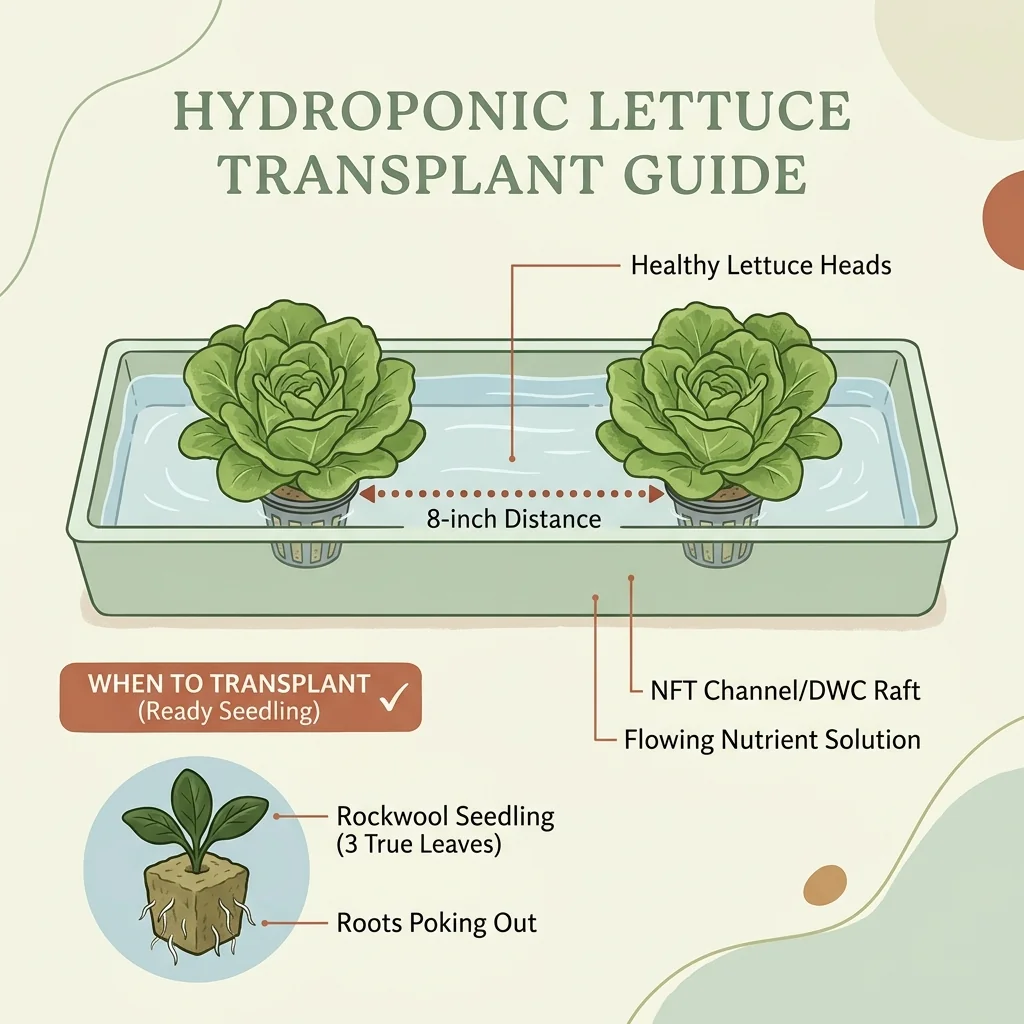
When to transplant hydroponic lettuce and how far apart to space it
Moving your fragile seedling from the nursery tray to the main hydroponic system is a high-risk maneuver. If you move it a day too early, it will drown. If you plant the heads too close together, they will choke each other out. Here are the exact metrics for a perfect transplant.
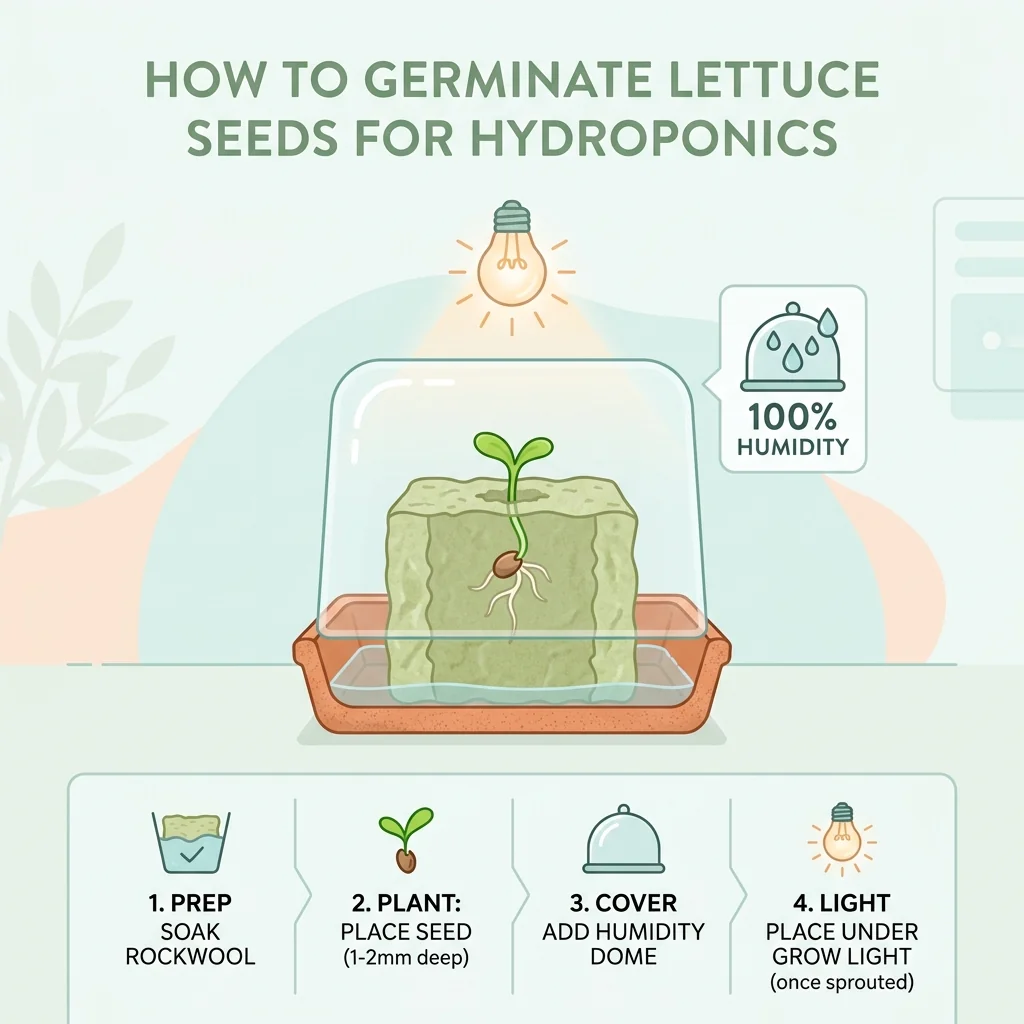
How to germinate lettuce seeds for hydroponics
You cannot start hydroponic seeds in potting soil. The dirt will wash off into your reservoir, clogging your pump and causing a massive bacterial bloom. Here is the sterile, foolproof method to start seeds for water-based growing.
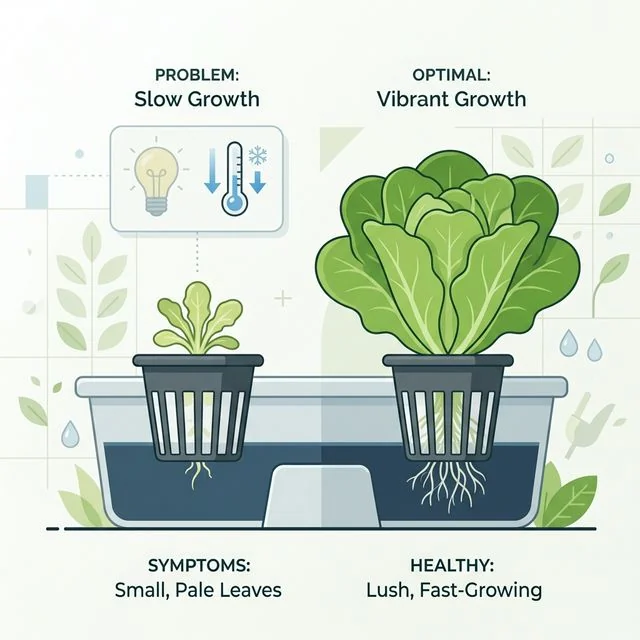
Hydroponic lettuce growing slowly? Check light, roots, and EC in order
Slow hydroponic lettuce is usually a systems problem, not a mystery deficiency. The goal is to find the bottleneck without overcorrecting five variables at once.