Three ways to feed a home reservoir
| Route | What you handle | What it asks of you | Source |
|---|---|---|---|
| Single complete fertilizer | One bag | Simplest, but calcium and magnesium may be missing | Penn State Extension |
| Two-part: calcium nitrate plus a complete hydroponic fertilizer | Two bags, two stock tanks | Dissolve separately, keep apart | University of Kentucky |
| From individual salts (Hoagland-style) | Four or more salts plus micronutrients and iron | Calculation, a precision scale, pure salts | Hoagland and Arnon; Penn State |
You can make a complete hydroponic solution from four ordinary salts, a micronutrient supplement and an iron source, and the University of California published exactly how in 1950. Most home growers still do better with a complete fertilizer or a bottled two-part, because the difficult part is the weighing, not the chemistry.
If you already own a bottled concentrate, how to mix hydroponic nutrients covers diluting it. The step before that is formulating from salts, and deciding whether to.
What Hoagland and Arnon published
The solution everyone calls “Hoagland” comes from University of California Agricultural Experiment Station Circular 347, by D. R. Hoagland and D. I. Arnon, first issued in 1938 and revised in January 1950. It is a water-culture method written for plants grown in tanks of solution. The authors are plain that it is a starting point: no single nutrient solution beats every other, and “many solutions may be used with good results,” and the formulas they give were tried at Berkeley “with a source of good water.”
The laboratory directions use distilled water and chemically pure salts. Each salt is dissolved as its own molar stock solution, and you add a measured volume of each stock to every litre of finished solution. The circular gives two versions:
| Stock (1 M each) | Solution 1, mL per litre | Solution 2, mL per litre |
|---|---|---|
| Potassium phosphate (KH₂PO₄) | 1 | none |
| Ammonium phosphate (NH₄H₂PO₄) | none | 1 |
| Potassium nitrate (KNO₃) | 5 | 6 |
| Calcium nitrate (Ca(NO₃)₂) | 5 | 4 |
| Magnesium sulfate (MgSO₄) | 2 | 2 |
Hoagland and Arnon note that Solution 2 “may often be preferred because the ammonium salt delays the development of undesirable alkalinity.” Quantities scale in proportion: a 10 litre reservoir takes ten times the volumes above.
A molar stock is one mole of the salt made up to a litre. In the University of California circular’s own worked example, one mole of MgSO₄·7H₂O of magnesium sulfate is 246.50 grams, dissolved in water and made up to 1 litre. For the other salts you need the formula weight printed on your bottle or bag, including its water of crystallisation, and the figure only works if the salt is pure and the hydrate is the one you think it is.
The two additions that complete it
The four salts do not carry the trace elements or iron. The circular adds two things.
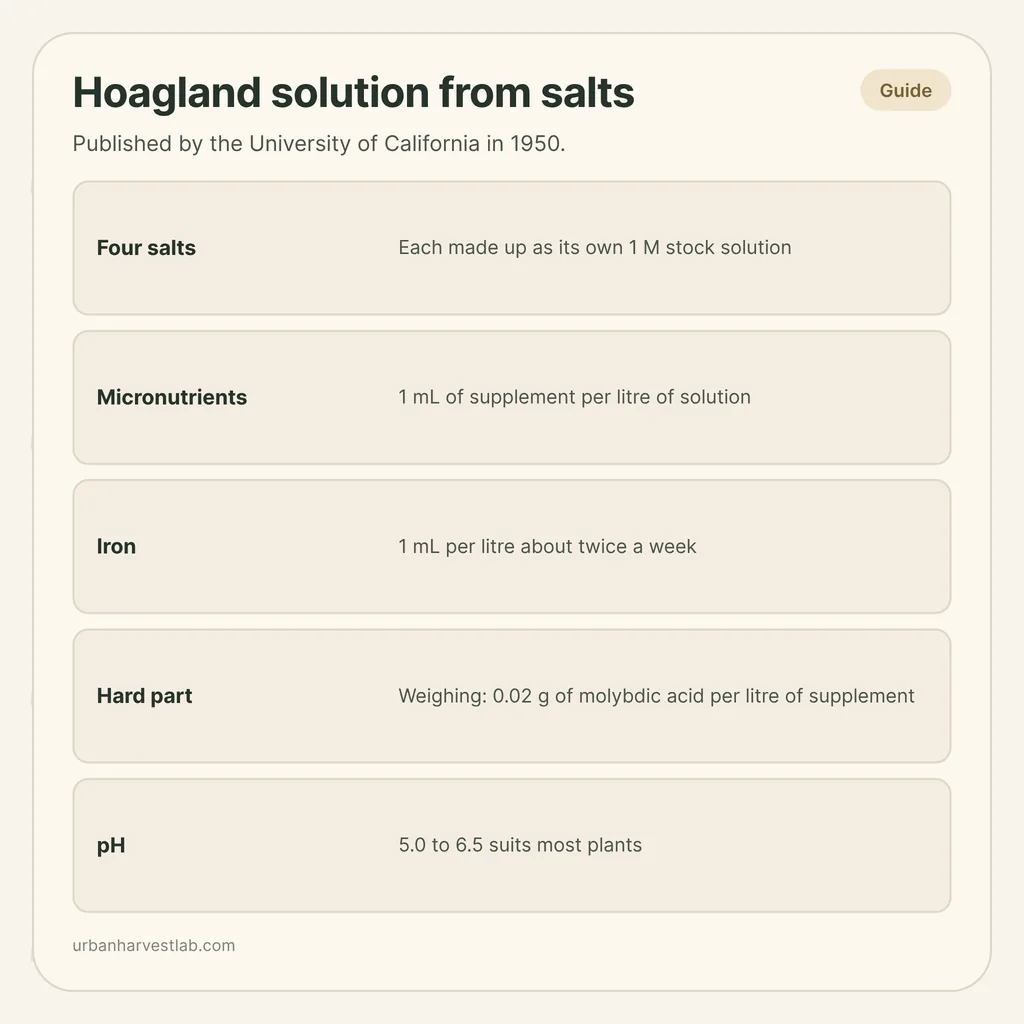
Micronutrient supplement. The University of California circular dissolves these in 1 litre of water, then add 1 mL of the supplement to each litre of finished solution when you first make it and at every change:
| Compound | Grams in 1 litre of supplement | Gives, ppm in the solution |
|---|---|---|
| Boric acid (H₃BO₃) | 2.86 | boron 0.5 |
| Manganese chloride (MnCl₂·4H₂O) | 1.81 | manganese 0.5 |
| Zinc sulfate (ZnSO₄·7H₂O) | 0.22 | zinc 0.05 |
| Copper sulfate (CuSO₄·5H₂O) | 0.08 | copper 0.02 |
| Molybdic acid (H₂MoO₄·H₂O, 85% MoO₃) | 0.02 | molybdenum 0.01 |
Iron. The circular adds iron as a 0.5 per cent iron tartrate solution “or other suitable iron salt,” at 1 mL per litre about twice a week, or as the plants’ appearance indicates. Iron is the element the authors expect to need topping up: they link a drift in pH to the precipitation of iron and manganese, so that “they are no longer available to the plant.”
pH. The circular says a moderately acid reaction, pH 5.0 to 6.5, is suitable for most plants, and it adjusts the finished solution to about pH 6 with 0.1 N sulfuric acid. Alkaline tap water is to be acidified before the salts go in. Hoagland and Arnon also warn that concentrated sulfuric acid “is dangerous if handled by inexperienced persons.” pH correction at hobby scale is in how to raise and lower pH in hydroponics, and if your tap water is hard the hard water guide explains why your starting point is not zero.
Why the stocks stay in separate bottles
Hoagland and Arnon prepare a stock for each salt, not one blended bottle. Penn State Extension gives the practical reason for anyone making concentrates: “When nutrient solutions are concentrated some nutrients can form precipitates that can clog drip lines. To avoid this, use two stock tanks.” Its rule of thumb is that calcium goes in a different tank from phosphates and sulfates.
In the Hoagland formula that puts calcium nitrate on one side, and the phosphate and sulfate salts on the other. The University of Kentucky describes the same split in commercial terms: calcium nitrate (15.5-0-0 in its example) in Tank A, and a complete fertilizer (5-11-26 Hydroponic Special) in Tank B. Keep the concentrates in their own containers rather than pouring them together.
The circular itself gives a lower-tech version of the same habit: the salts “are added to the water, preferably in the order given,” into a tank that is only partly full and then topped up with a rapid stream of water.
What the scale has to do
The bulk salts are weighed in grams. The micronutrient supplement is where the weighing gets small: the University of California figures are 0.02 g of molybdic acid and 0.08 g of copper sulfate in the litre.
Penn State Extension lists this as the main drawback of recipes: “A high precision scale is required to measure micronutrients because of the small amounts needed.” The circular warns about the other side of the error: “There is danger of toxic effects if much greater quantities of these elements are added than those indicated.” If you go this way, the smallest figure is 0.02 g, so the scale has to resolve hundredths of a gram, and a milligram scale is worth a look before you buy any salts.
Purity is the other catch. Hoagland and Arnon note that “some commercial salts” carry impurities, “fluorine, for example,” commonly found in phosphate fertilizers, which can be toxic under water-culture conditions. The laboratory version asks for chemically pure salts for that reason, and fertilizer-grade bags are a trade against that.
Hoagland or a modern recipe?
The Hoagland solutions state quantities as stock volumes. Extension recipes today are more often written as target concentrations. Penn State prints a Modified Sonneveld recipe for herbs in ppm: nitrogen 150, phosphorus 31, potassium 210, calcium 90, magnesium 24, iron 1, manganese 0.25, zinc 0.13, copper 0.023, boron 0.16, molybdenum 0.024. You pick the fertilizers, then calculate how much of each to add. Penn State’s fertilizer list for that job includes calcium nitrate (15.5-0-0, 19% calcium), potassium nitrate, monopotassium phosphate and magnesium sulfate.
The ppm route has one advantage the stock-volume route lacks. Your water already contains minerals, and Penn State’s example is a source water with 30 ppm potassium: against a 210 ppm target, you add 180 ppm. A fertilizer program, it says, cannot “account for nutrients already in the water source.” The mix calculator handles the dose arithmetic for bottled A and B parts.
Solubility sets how concentrated a stock can be. Penn State’s table, from Resh, gives grams per 100 mL in cold and hot water: calcium nitrate 121.2 and 376, monopotassium phosphate 33 and 83.5, magnesium sulfate 71 and 91, potassium nitrate 13.3 and 47. Potassium nitrate is the lowest of the four in cold water.
Should you make your own?
Mix from salts if you run several reservoirs or one large one, you can weigh to hundredths of a gram, you will track down pure salts, and you want to adjust single elements. Penn State says recipes allow “easily adjusting nutrients” and can be less costly than fertilizer programs. Work out the saving from your own prices.
Buy a bottled two-part or a complete fertilizer if you grow one or two small systems. The University of Kentucky is blunt about the made-from-scratch route: “While this made-from-scratch approach offers precision, it can be complex and labor-intensive, particularly for small-scale or beginning hydroponic growers.” Its simpler alternatives are a single complete fertilizer or a two-part system. Penn State agrees a complete fertilizer is the simplest of its three approaches, with a catch: “magnesium and calcium may not be included.”
One shortcut is not a shortcut. Garden-store soil fertilizer is not a stand-in for the salts above; can you use regular soil fertilizer for hydroponics explains what goes wrong.
Sources
- Hoagland, D. R. and Arnon, D. I. (revised 1950). The Water-Culture Method for Growing Plants without Soil, Circular 347. University of California Agricultural Experiment Station.
- Penn State Extension. Hydroponics Systems: Nutrient Solution Programs and Recipes.
- University of Kentucky Center for Crop Diversification. Hydroponic Lettuce Production in Controlled Environments (CCD-CP-63).
Formulating, mixing, and balancing hydroponic solutions
From diluting a bought concentrate to calculating doses and understanding why soil fertilizer does not substitute.
Common questions
What is in the Hoagland solution?
In the University of California circular by Hoagland and Arnon (revised 1950), Solution 1 is made from 1 M stocks of potassium phosphate, potassium nitrate, calcium nitrate and magnesium sulfate, at 1, 5, 5 and 2 mL per litre of finished solution. A micronutrient supplement and iron are added on top.
Why is the Hoagland solution made from separate stocks?
Penn State Extension warns that concentrated solutions can form precipitates that clog drip lines, and advises keeping calcium in a different tank from phosphates and sulfates. Hoagland and Arnon prepare a separate stock for each salt.
Can I weigh the salts on a kitchen scale?
The bulk salts are weighed in grams, but the micronutrient supplement calls for 0.02 g of molybdic acid and 0.08 g of copper sulfate per litre of stock. Penn State Extension states that a high precision scale is required to measure micronutrients.
Is making your own hydroponic nutrients cheaper?
Penn State Extension says recipes can be less costly than fertilizer programs, and Kentucky describes the made-from-scratch route as complex and labor-intensive for small-scale growers. Neither gives a per-litre price, so compare your own costs including a precision scale.
Related guides
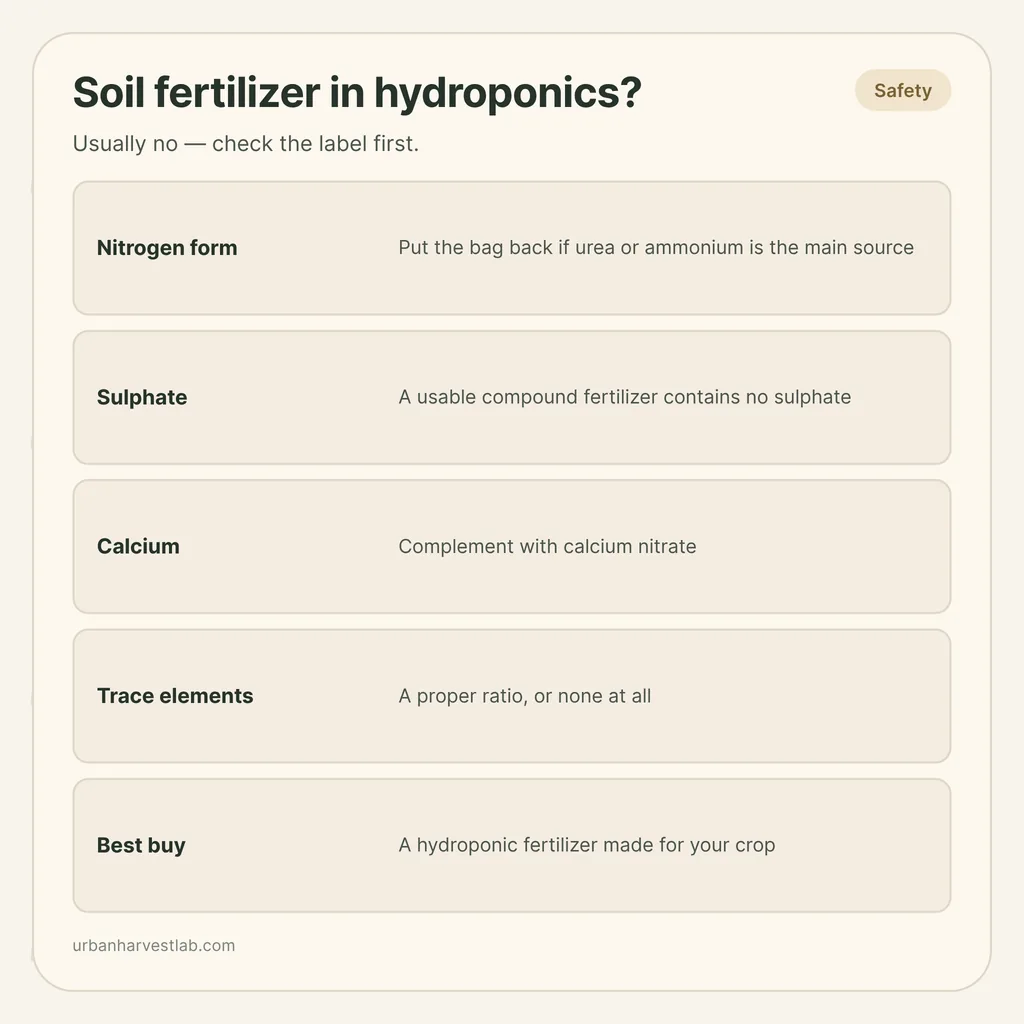
Can you use regular soil fertilizer for hydroponics?
A box of garden fertilizer is built for soil that supplies the rest. In a bare-water reservoir the label has to carry everything, and these are the checks that decide whether it can.
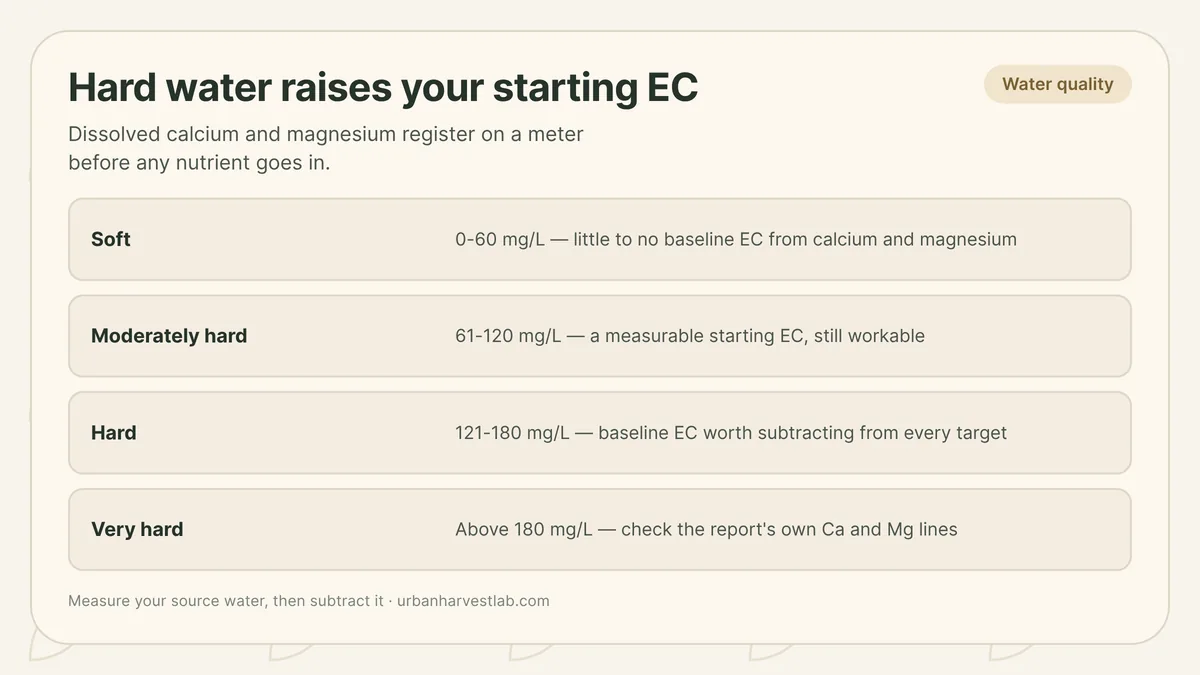
Hard water in hydroponics: how it raises your starting EC
Tap water carrying dissolved calcium and magnesium does not start at zero EC. Here is how much that shifts your baseline, and how to mix around it.
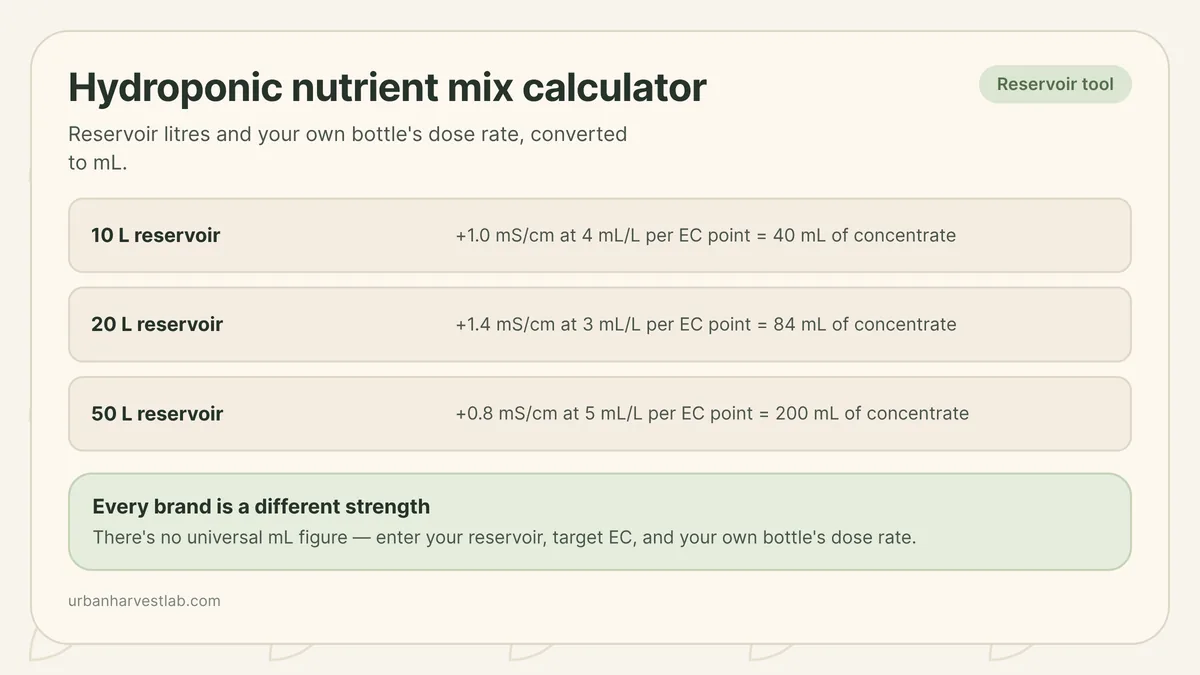
Hydroponic nutrient mix calculator: reservoir litres to ml of A and B
There is no single ml-per-litre number for hydroponic nutrients, because every brand's concentrate is a different strength. Enter your reservoir, your target EC, and your own label's dose rate here.