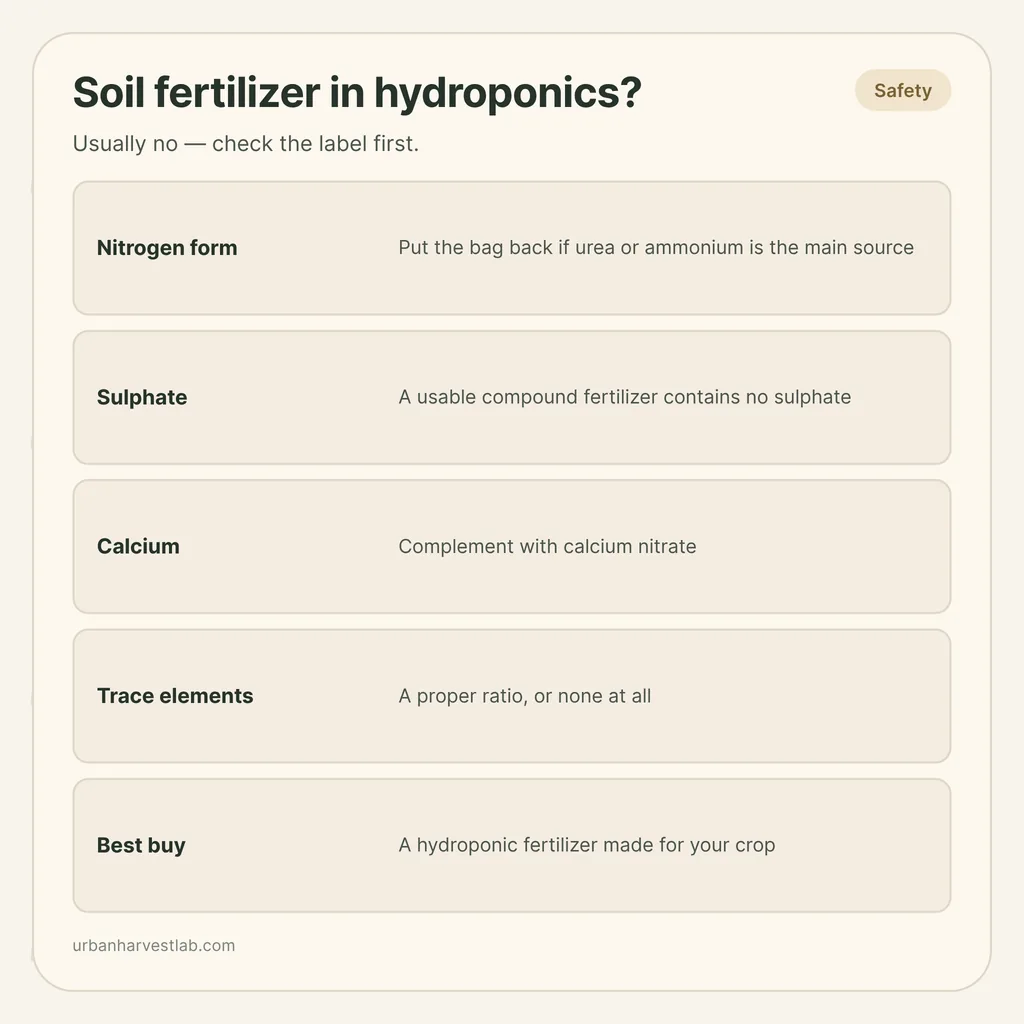
What to check on a fertilizer label before it goes in a reservoir
| Check | Why it matters | Source |
|---|---|---|
| Nitrogen form: ammonium or urea | Can acidify the water; too much reduces growth | Wageningen UR, University of Minnesota |
| Calcium supplied | Wageningen says compound fertilizers must be complemented with calcium nitrate | Wageningen UR |
| Sulphate content | Compound fertilizers should contain no sulphate | Wageningen UR |
| Trace elements | Needs a proper ratio, or none at all | Wageningen UR |
| Complete element list | Water culture needs all 14 essential mineral elements | University of Kentucky |
Usually no. Garden fertilizer is formulated for soil that supplies the rest, and in bare water a bag that fails on nitrogen form, calcium, sulphate or trace elements will stunt the crop. A soluble all-purpose product can pass, but only if its label clears the checks below.
If you are still deciding what to mix, how to mix hydroponic nutrients covers the routine for a product made for water culture. The narrower question is whether the bag already under your sink qualifies.
Why soil changes what a fertilizer has to do
Soil does a lot of work for a bag of plant food. University of Minnesota Extension points out that the soil naturally contains many of the essential nutrients, so gardeners rarely think about them. In hydroponics you supply not just nitrogen, phosphorus and potassium but also calcium, magnesium, sulfur, manganese, iron and the other elements on the list.
University of Kentucky’s lettuce guide puts the requirement plainly: whatever the system, a complete fertilizer solution containing all 14 essential mineral elements is necessary. That is a different job from topping up a bed that already holds some of them.
Wageningen UR Greenhouse Horticulture states the consequence directly. Soil fertilizers may reduce growth in hydroponics through too much ammonium, urea, sulphates, bicarbonates or trace elements. Each of those is worth a look.
The nitrogen form
Read the nitrogen line on the label first. University of Minnesota Extension notes that ammonium or urea-based fertilizers can acidify the water in your system, while nitrate-based ones can make it more basic. In a reservoir with no soil to buffer it, that is a pH problem you then chase with acid or base.
Penn State Extension adds the plant side. Ammonium is used immediately by the plant and is not stored, and too much can cause excessive vegetative growth and ammonium toxicity, whose symptoms are yellowing and the death of growing points. Nitrate, by comparison, can be stored and holds vegetative growth back.
Wageningen UR draws the line for compound fertilizers: they can only be used if they contain no ammonium nor urea. If the label names urea or ammonium as the main nitrogen source, put the bag back. A reservoir that keeps sliding down after you dose it is the symptom, and why pH drops in hydroponics walks through the checks.
Calcium, sulphate and trace elements
Wageningen’s list for a usable compound fertilizer has more entries than nitrogen. It must contain enough nitrogen and potassium, contain no sulphate, carry a proper ratio of trace elements (or none at all), and be complemented by calcium nitrate.
That last item is the one most soil products leave to the ground. Penn State Extension names tipburn in lettuce and blossom end rot in tomato and pepper as great examples of calcium deficiency. If your plants show the first, hydroponic lettuce tip burn separates a supply problem from a transport one.
Iron is the other trap. Penn State says the most common cause of iron deficiency is high pH in the media or irrigation water, and explains that chelates are organic molecules that surround metals, keeping them available for uptake even when pH changes. Whether a given bag carries its iron in a chelated form is something its label has to tell you.
Why one bag cannot carry everything
Even a product designed for water culture often comes in parts. Penn State Extension says that when nutrient solutions are concentrated, some nutrients can form precipitates that clog drip lines, and that calcium should be in a different tank than phosphates and sulfates. Wageningen’s layout agrees: the A tank holds the calcium fertilizer and chelate, and the sulphates, phosphates and trace elements go in the B tank.
That separation is why the University of Kentucky’s two-part method dissolves calcium nitrate in Tank A and a complete fertilizer in Tank B. It is also why a single-bag soil product is a risk: it has to put everything in one container and cannot supply calcium nitrate on the side.
When a soluble fertilizer does work
Kentucky offers a single complete fertilizer as a simpler option for growers, with a 17-5-17 grade as its example, so the route exists. The constraint is the checklist, not the word “soluble”. A label that lists urea or ammonium as the nitrogen source, lists sulphates, or gives no calcium and no way to add it fails Wageningen’s test. A complete fertilizer that is topped up with calcium nitrate is the pattern Kentucky and Wageningen both describe.
Mixing a two-part product is covered in how to mix hydroponic nutrients, and the EC and pH targets for the finished solution sit in hydroponic nutrient basics.
What most readers should buy
University of Minnesota Extension calls the simplest solution a hydroponic fertilizer tailored to your crop, such as one made for lettuce or tomatoes, with the label telling you how much to add per gallon. Following that label keeps you inside what the product was built for. Browse hydroponic nutrients on Amazon if you need to pick one up, and see best hydroponic nutrients for herbs and greens for what to look for.
When leaves go pale or edges brown after a switch, the hydroponic nutrient deficiency chart maps the symptom to the missing element.
Sources
- Wageningen UR Greenhouse Horticulture: Fertilization in hydroponic horticulture, technical information sheet No. 4
- University of Minnesota Extension: Small-scale hydroponics
- University of Kentucky CCD: Hydroponic lettuce production in controlled environments
- Penn State Extension: Hydroponics systems, nutrient solution programs and recipes
- Penn State Extension: Hydroponics systems and principles of plant nutrition
Mixing and managing nutrient solutions
From mixing order to EC and pH to reading deficiency symptoms.
Common questions
Can I use regular plant food in a hydroponic system?
Usually not as it comes. Wageningen UR says soil fertilizers may reduce growth through too much ammonium, urea, sulphates, bicarbonates or trace elements, and that only compound fertilizers made for hydroponic growing are reliable. A soluble product can work only if its label passes the checks in the table.
Why does urea or ammonium matter in water culture?
University of Minnesota Extension notes that ammonium or urea-based fertilizers can acidify the water, while nitrate-based ones make it more basic. Penn State Extension lists yellowing and death of growing points as ammonium toxicity symptoms.
Why can calcium and phosphate not share a concentrate?
Penn State Extension says concentrated solutions can form precipitates that clog drip lines, and that calcium should sit in a different tank than phosphates and sulfates. That is why hydroponic nutrients come as two parts or are topped up with calcium nitrate.
What is the simplest safe choice?
University of Minnesota Extension suggests buying a hydroponic fertilizer tailored to your crop and following its label for how much to add per gallon.
Related guides
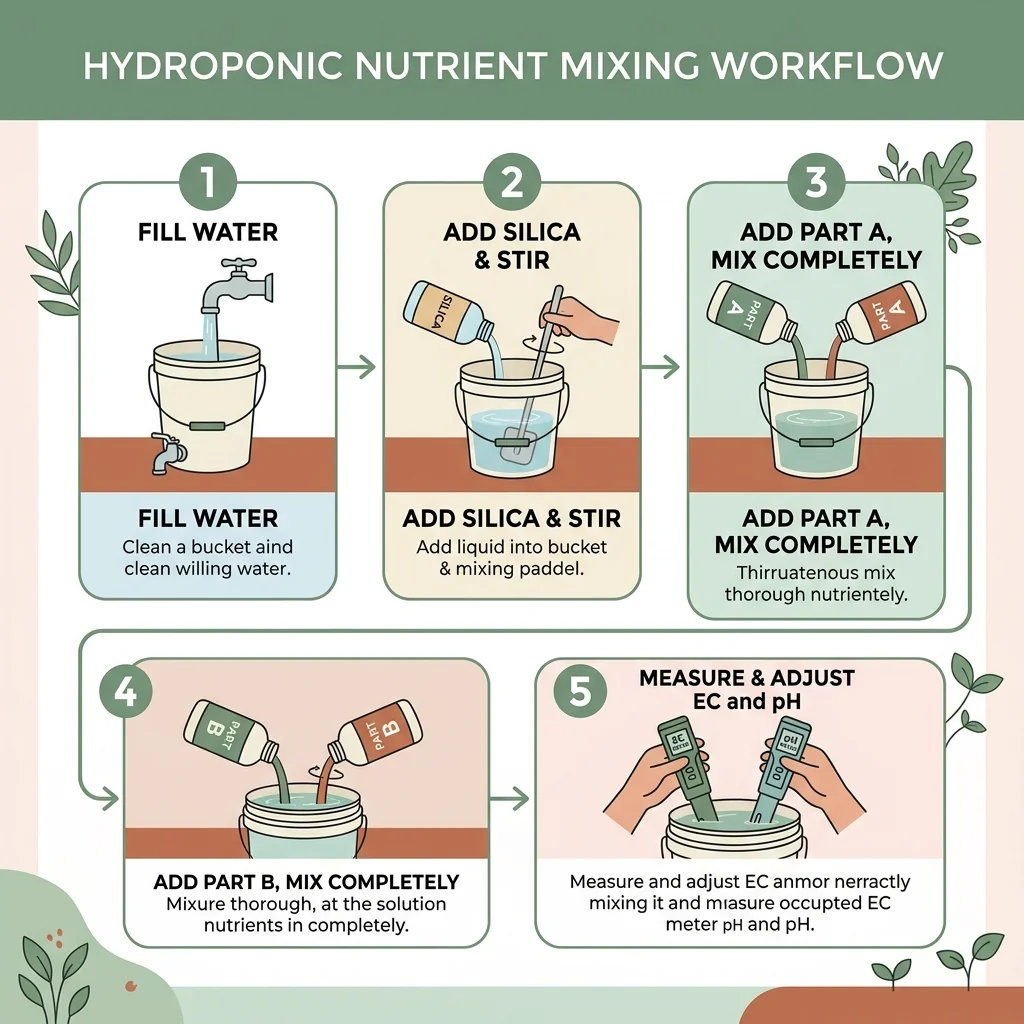
How to mix hydroponic nutrients: a beginner guide
Mixing hydroponic nutrients is simple once you know the order: water first, nutrients separately, measure EC, then adjust pH last. Here is the step-by-step.
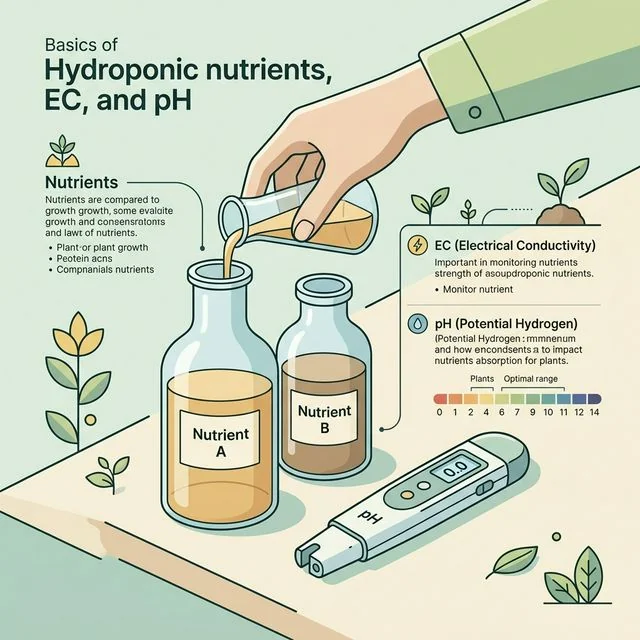
Hydroponic nutrient basics: EC, pH, dilution, and reservoir stability
Most hydroponic problems are not mysterious. They come from concentration drift, pH drift, heat, or neglected maintenance. This guide covers the basics clearly.
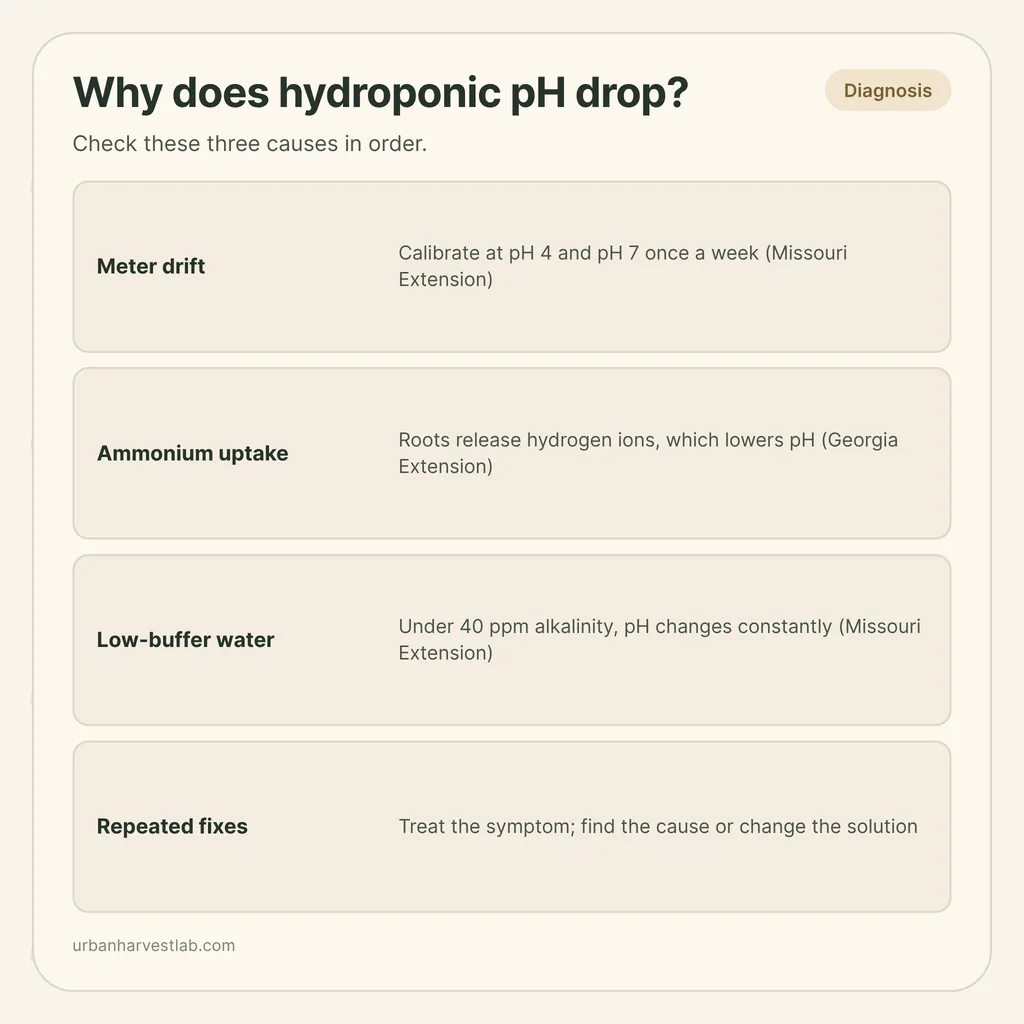
Why pH drops in hydroponics and what to check first
A pH that sinks between checks is a signal, not a lost battle. Plants taking up ammonium acidify the water, soft water cannot resist the change, and a drifting meter can fake the whole thing.