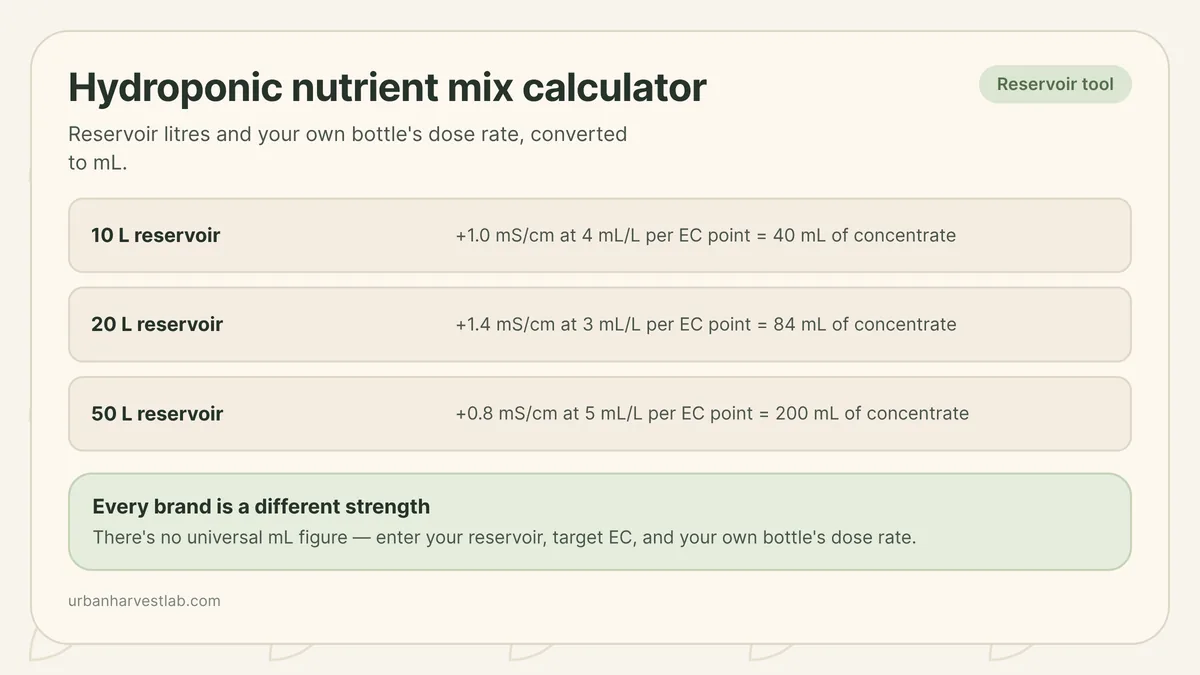
Worked examples: reservoir, EC to add, and mL of one part
| Reservoir | EC to add | Dose rate (mL/L per EC point) | mL of that part |
|---|---|---|---|
| 10 L | 1.0 mS/cm | 4 mL/L | 40 mL |
| 20 L | 1.4 mS/cm | 3 mL/L | 84 mL |
| 50 L | 0.8 mS/cm | 5 mL/L | 200 mL |
A hydroponic nutrient calculator cannot hand you a millilitre figure out of thin air, because every manufacturer’s Part A and Part B concentrate is a different strength. Penn State Extension’s modified Sonneveld herb solution and the University of Kentucky’s lettuce fertigation recipe both target 150 ppm nitrogen, yet they differ on calcium (90 vs 139 ppm) and magnesium (24 vs 47 ppm) — even recipes built around the same nitrogen level are not the same concentrate. Enter your reservoir’s volume, your source water’s EC, your target EC, and the dose rate printed on your own bottles (or measured with the short test below), and the calculator converts that into the millilitres your specific product needs. If EC and pH are still unfamiliar terms, hydroponic nutrient, EC, and pH basics covers the concepts this calculator assumes.
What decides your mL-per-litre number
Two growers with identical 20-litre reservoirs and the same 1.4 mS/cm target can need very different doses, because their bottles are not the same product. A concentrated two-part fertilizer delivers more dissolved salt per millilitre than a diluted one, and manufacturers do not standardise strength the way a paint counter standardises tint bases. The only number that tells you how much your product raises EC per litre is on your own label, or in your own short test — not in a generic calculator, and not in a number copied from a different brand’s chart.
The reading itself is not standardised either. UF/IFAS Extension states a general nutrient solution target of 1.2 to 1.8 mS/cm, equal to 560 to 840 ppm — a conversion factor of about 467 ppm per mS/cm, not the 500 or 700 scale that many hobby meters default to. Two meters can show different ppm numbers for the same physical solution, so if yours reads in ppm rather than mS/cm, convert it with the EC to ppm converter first, then use mS/cm consistently here and in your own calibration test.
Find your product’s dose rate
Check the label first. University of Missouri Extension lists the expected EC at a stated concentration among the things a hydroponic fertilizer label should tell you — some manufacturers already print it, as a feeding chart showing something like “4 mL per litre yields about 1.2 mS/cm.” If yours does, divide the stated mL per litre by the EC it produces and that is the dose rate the calculator below needs.
Most labels only give a flat dose, such as “2 to 4 mL per litre for full-strength feeding,” without stating the EC that dose produces. When that is what you have, a short calibration test is the more reliable route:
- Fill a clean litre container with your ordinary source water and note its starting EC.
- Add a small, measured amount of Part A only — enough to move the meter clearly, well above its resolution — and stir until it is fully dissolved.
- Measure EC again and subtract the starting reading.
- Divide the millilitres you added by the EC rise. That figure is Part A’s dose rate, in mL per litre per EC point. If 2 mL raised the EC by 0.6 mS/cm, the dose rate is 2 divided by 0.6, or about 3.3 mL per litre per EC point.
- Repeat with a fresh litre of water and Part B.
Oklahoma State University Extension’s order of operations for any hydroponic reservoir is to set EC first and adjust pH only afterward, because the nutrients you are dosing shift pH once they are in solution. Run this calibration test, and every mix that follows it, in that order.
Calculate your mix
Your target EC comes from the crop, not from the calculator — Oklahoma State University Extension’s fact sheet tabulates EC and pH for 27 crops, and the hydroponic EC chart by crop works through the ranges and where the sources disagree.
Live estimate
Use your own product's dose rate, from its label or from the calibration test above.
EC to add
—
above your source water
- Part A needed
- —
- Part B needed
- —
- Total concentrate
- —
- Part A per litre
- —
- Part B per litre
- —
Do the math by hand
The calculator above is doing one multiplication, twice — once for each part:
mL of a part = reservoir litres × (target EC − source water EC) × your product's dose rate (mL per litre per EC point)
Worked example: a 20-litre reservoir, source water reading 0.3 mS/cm, a target of 1.4 mS/cm, and a Part A rated at 4 mL per litre per EC point on your own bottle.
20 L × (1.4 − 0.3) mS/cm × 4 mL/L per EC point = 88 mL of Part A
If Part B is dosed at the same rate, it also needs 88 mL, for 176 mL of concentrate total. Two-part nutrients often dose A and B at different rates, so run the multiplication twice, once per bottle, using each part’s own number rather than assuming they match.
Subtract your source water’s EC first
Do not calculate from zero. Cornell University’s hydroponic lettuce program measures reservoir EC as an increment above the source water’s own reading, and subtracts that baseline before deciding how much to add, because tap and well water already carry dissolved minerals that register as EC on the meter, and that portion is not fertilizer. University of Missouri Extension puts the optimum EC for hydroponic source water at 0.2 to 0.8 dS/m — the same units as mS/cm — so a typical hard or mineral-rich tap supply can start you several tenths above zero before a drop of nutrient goes in; hard water in hydroponics covers what that starting reading is actually made of. Missouri’s rule of thumb is that source water ideally sits below 1 dS/m (the same as 1 mS/cm), which leaves room to dose up to a target EC without pushing the total solution too high.
Set EC first, then adjust pH last
Once the concentrate is in and circulated, measure EC before touching pH. Oklahoma State University Extension’s stated order is to set EC first and adjust pH last, because pH will have moved once the nutrients are dissolved — correcting pH before the reservoir is at its final concentration means adjusting a number that is about to shift again anyway. How to mix hydroponic nutrients walks through the full mixing sequence, including why the two concentrates go in separately rather than together.
Keep Part A and Part B apart until each is dissolved
The reason two-part nutrients ship as two bottles is chemistry, not marketing. The University of Missouri Extension explains that a concentrated calcium source reacts with phosphate and sulfate from the other part on contact, forming an insoluble precipitate that sinks out of solution and becomes unavailable to roots. Dissolve each part separately into the reservoir water, one after the other, and do not combine two concentrates directly in the same container. The University of Kentucky’s home-scale version of the same rule keeps a calcium-nitrate fertilizer in one tank and a complete blended fertilizer in a second, with any pH-adjusting acid in a third tank — or uses a single complete fertilizer formulated so it does not need splitting at all.
Build up gradually, then confirm with your meter
EC tolerance is not fixed through a crop’s life. University of Minnesota Extension notes that a system can run at a higher EC while plants are young, but lowering it in a controlled way as they mature is part of keeping growth healthy, so a target you enter today is not necessarily the number for the whole season. Dose toward the calculated amount rather than mixing at full strength on the first attempt: add roughly half the calculated volume, circulate the reservoir, measure with your EC meter, and add the remainder only if the reading still falls short of target. Hitting the target EC does not mean the solution is balanced — University of Missouri Extension is explicit that EC is a proxy for total dissolved ions and does not confirm that each nutrient sits at its target concentration, which is why the dose rate has to come from a complete fertilizer’s own label rather than from mixing to a number. Best pH and EC meters for hydroponics covers what makes a meter worth trusting for this kind of incremental check.
After the reservoir is running, topping up is a different calculation
This calculator answers one question: how much concentrate to add when building a reservoir from scratch, or raising its EC on purpose. Topping up an already-running reservoir between full changes is a different job, and the sources split on how to do it: University of Minnesota Extension’s top-up rule is that any water added should carry nutrients at the label concentration, while Cornell University’s hydroponic lettuce program treats EC as rising when evaporation and transpiration remove water and has you lower it back down with plain water — which is why the decision belongs to your own meter reading rather than to a fixed rule. When to change hydroponic nutrient solution covers when a plain-water top-off is enough and when the reservoir needs a complete reset instead, and hydroponic reservoir size covers how many litres a given plant count actually needs before you get to this point.
Common mixing mistakes
- Copying a dose rate from a forum post or a different brand’s chart instead of your own label or your own calibration test. Two products with the same stated EC target can use different salt concentrations to reach it.
- Skipping the source-water subtraction and dosing to hit the full target EC from zero, which overshoots by exactly your tap water’s own baseline reading.
- Combining Part A and Part B concentrate directly, before either has fully dissolved into the reservoir water.
- Adjusting pH before the full dose is in, then adjusting it again once the nutrients shift it back.
- Mixing the entire calculated dose in one step rather than half, measuring, and completing it — the only way to catch a dose-rate error before it is already in the reservoir.
Sources
- Oklahoma State University Extension: Electrical Conductivity and pH Guide for Hydroponics
- Cornell University CEA Program: Hydroponic Lettuce Handbook
- University of Missouri Extension: Hydroponic Nutrient Solutions
- University of Minnesota Extension: Small-scale hydroponics
- Penn State Extension: Hydroponics Systems: Nutrient Solution Programs and Recipes
- UF/IFAS Extension: Growing Lettuce in Small Hydroponic Systems
- University of Kentucky Center for Crop Diversification: Hydroponic Lettuce Production in Controlled Environments
Mix, monitor, and maintain your reservoir
These guides cover the mixing order, the EC and ppm scales your meter uses, and when to change the solution.
Common questions
Why can't this calculator just tell me how many mL to add?
Because every nutrient brand's Part A and Part B concentrate is a different strength. A single universal number would give the wrong amount for whichever bottle you actually own, so the calculator asks for your own product's dose rate, from its label or from the calibration test above.
My nutrient label does not give a dose rate in mL per litre per EC point. What do I do?
Run a short test with a spare litre of your source water. Measure its starting EC, add a small known amount of Part A only, stir until it is fully dissolved, and measure again. Divide the millilitres you added by the EC rise to get that part's dose rate, then repeat with Part B. Oklahoma State University Extension's order of operations, setting EC before pH, applies to this test as much as to a full mix.
Should I subtract my tap water's EC before calculating a dose?
Yes. Cornell University's hydroponic lettuce program subtracts the source water's own EC from the meter reading before deciding how much nutrient to add, since that baseline conductivity comes from dissolved minerals already in the water, not from fertilizer, and it does not change as you dose. Enter your source water's EC and the calculator subtracts it from your target automatically.
What if my two-part nutrient doses Part A and Part B at different rates?
Enter each part's dose rate separately. Many two-part concentrates are not dosed at a 1:1 ratio, because one part often carries more of the total fertilizer salts than the other, so the calculator works out Part A and Part B independently rather than assuming they match.
Related guides
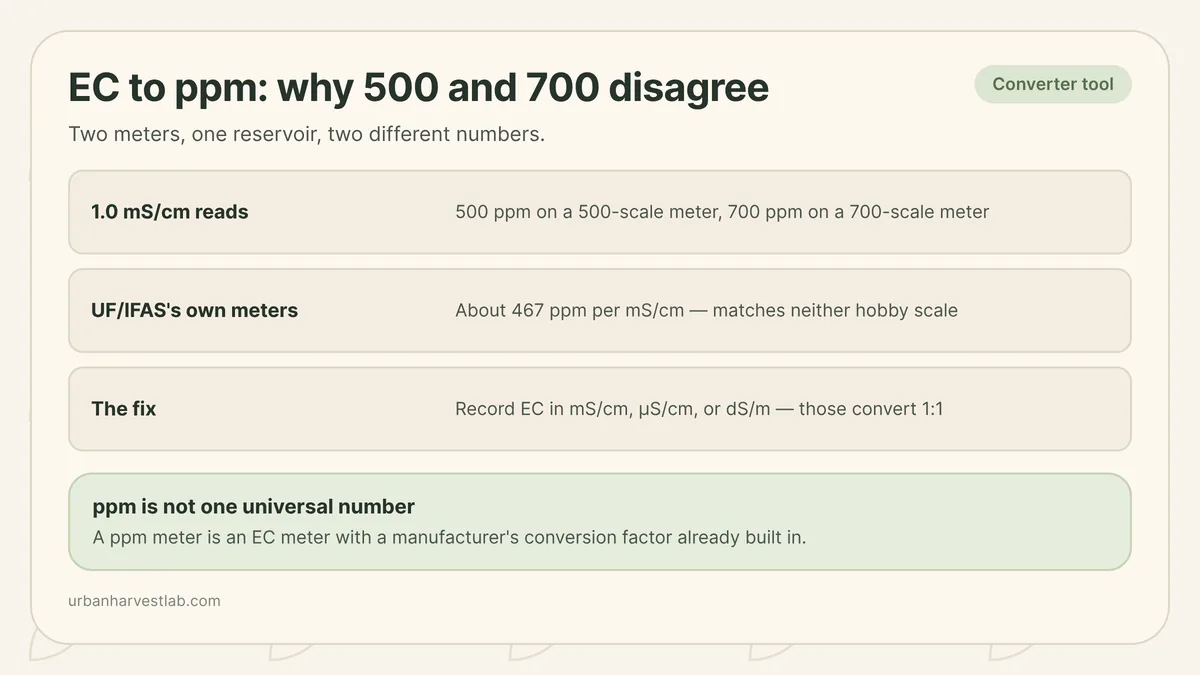
EC to ppm converter for the 500 and 700 scales
An EC reading converts to two different ppm numbers depending on which scale a meter uses. Convert both directions here, and see why 500 and 700 disagree.
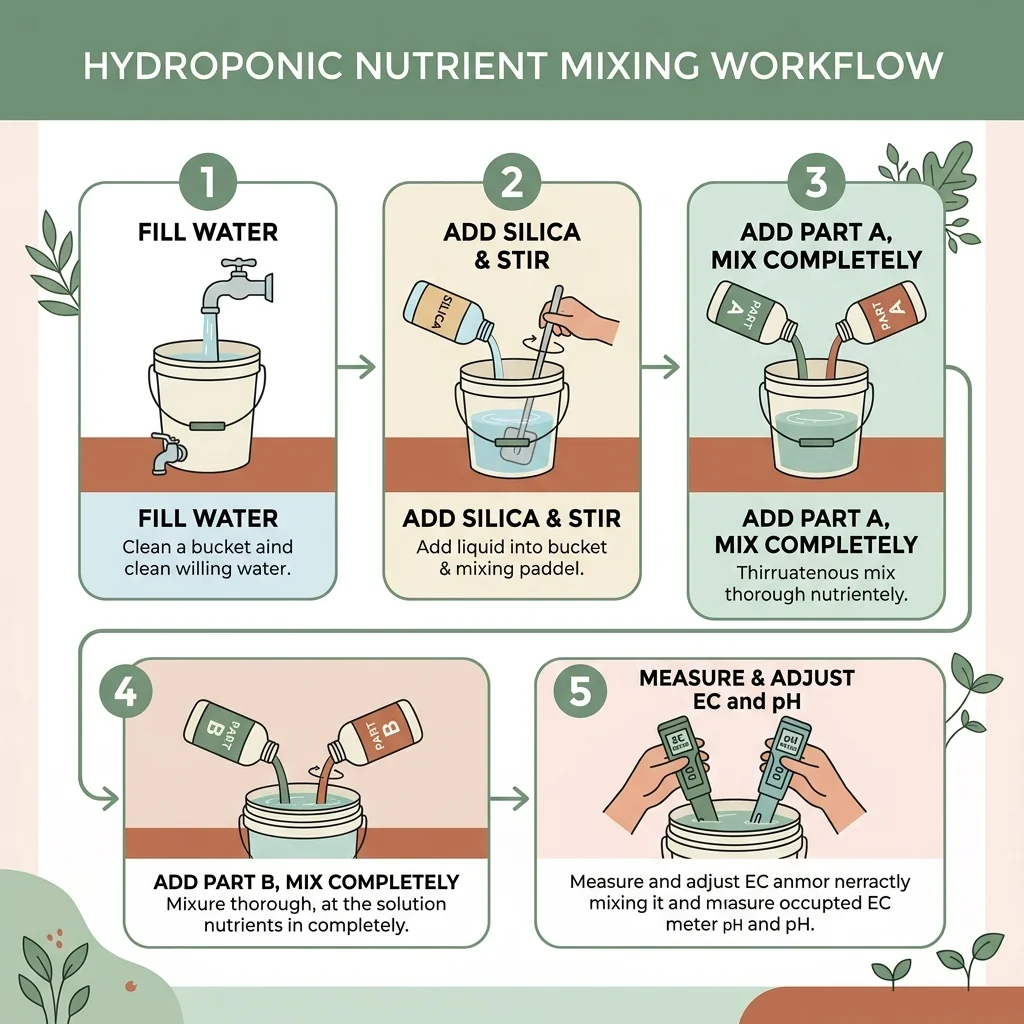
How to mix hydroponic nutrients: a beginner guide
Mixing hydroponic nutrients is simple once you know the order: water first, nutrients separately, measure EC, then adjust pH last. Here is the step-by-step.
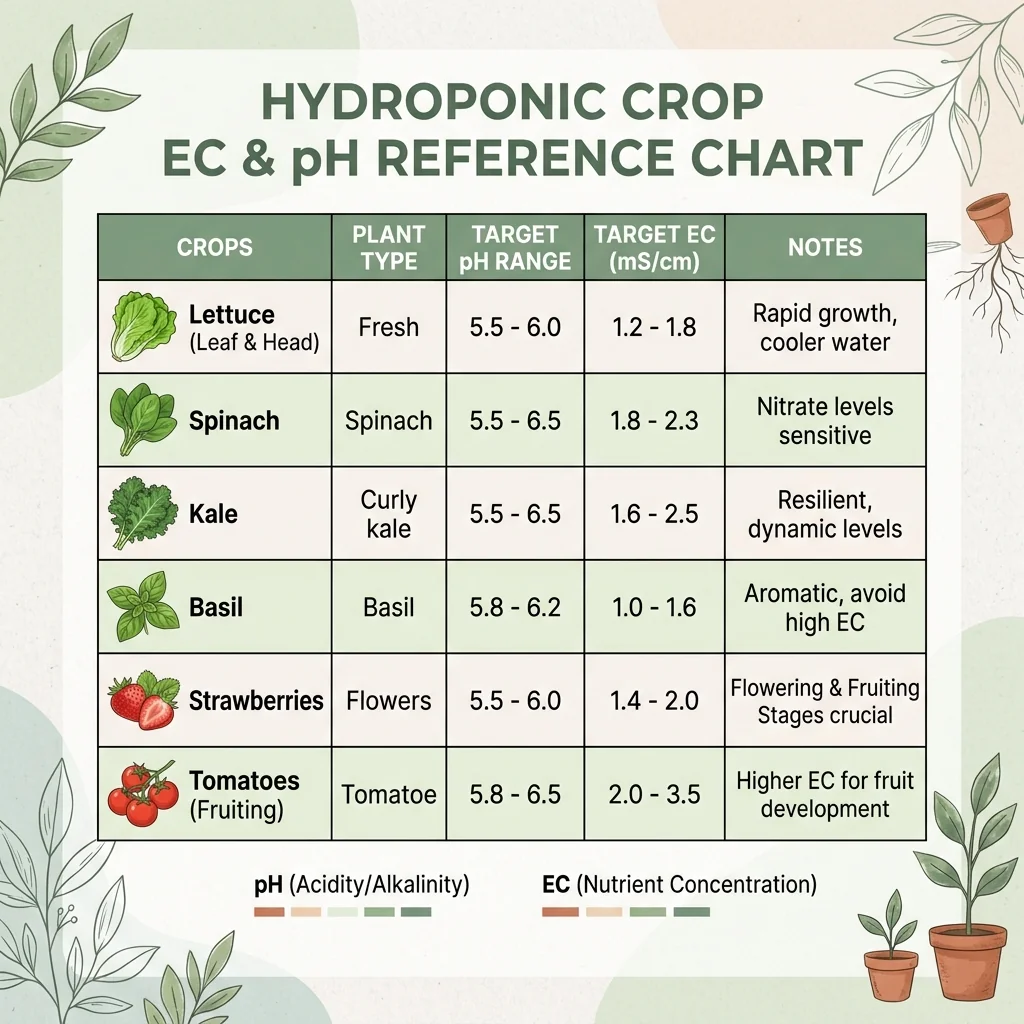
Hydroponic EC chart by crop (not just lettuce)
One reference chart for the EC and pH targets of common hydroponic crops, from leafy greens and herbs to fruiting plants, plus how to use the numbers safely.