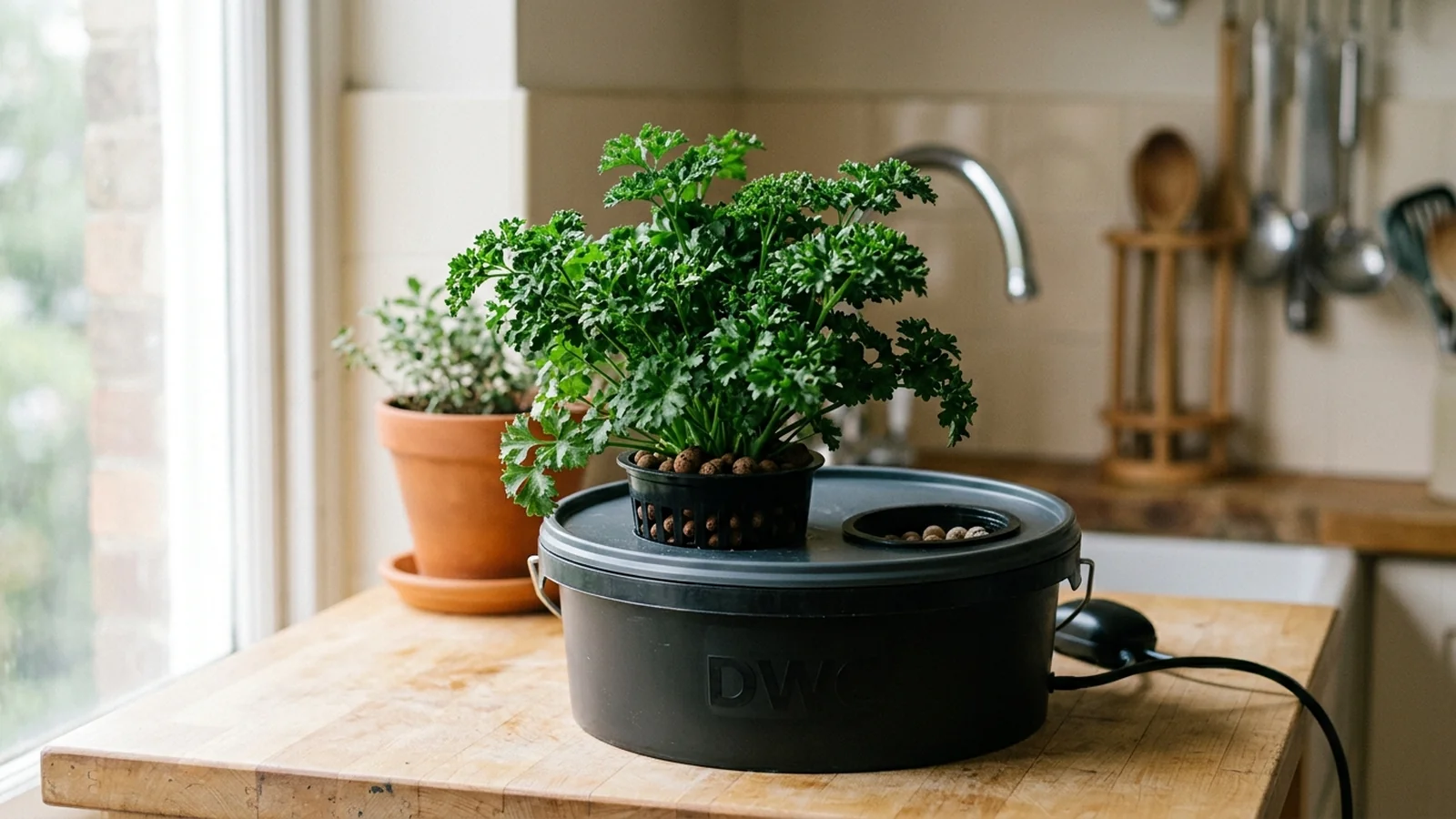
Hydroponic parsley targets
| Variable | Target | Notes |
|---|---|---|
| EC | 1.8-2.2 mS/cm | Stronger than basil or sage; do not use a generic herb blend EC |
| pH | 6.0-6.5 | Half a point higher than basil's 5.5-6.0 |
| Germination | Slow; no fixed day count | Judge by taproot and first true leaves, not by a calendar |
| Feed | Low dose, steady | Increasing frequency mainly affects flavor, not speed |
Parsley is a good hydroponic herb once it is up and running: dense, steady, and forgiving of a missed day here and there. Getting it there is the part that trips people up. Hydroponic parsley wants a stronger nutrient solution than most herbs — EC 1.8 to 2.2 mS/cm and pH 6.0 to 6.5 — and it germinates slower than most kitchen herbs. If you are choosing which herbs to start together, the hydroponic herbs guide covers the wider lineup. What makes parsley its own case is its nutrient strength and its patience at the tray.
The EC and pH parsley actually wants
Most hydroponic herb advice bundles parsley into the same broad range as basil and mint. Oklahoma State University Extension’s electrical conductivity and pH guide does not: it gives parsley its own line, at EC 1.8 to 2.2 mS/cm and pH 6.0 to 6.5. In the same table, basil sits at 1.0 to 1.6 mS/cm, pH 5.5 to 6.0, and sage at 1.0 to 1.6, pH 5.5 to 6.5. Parsley runs meaningfully stronger and a touch more alkaline than either of them.
That gap matters most if you are running several herbs off one reservoir — grouping herbs by EC is what the hydroponic herbs guide ranks the bench on, and parsley usually is not a good match for that grouping. One reservoir can only run at one EC: set it to basil’s 1.0 to 1.6 mS/cm and parsley sits below its own 1.8 to 2.2 target; set it to parsley’s and basil is above the band Oklahoma State gives it. For the underlying logic of setting EC before pH and reading a meter correctly, see hydroponic nutrient basics; for how parsley compares with the other crops on the site, see the EC chart by crop.
Parsley makes you wait at the germination tray
Clemson Cooperative Extension describes parsley seed as slow to germinate compared with most other kitchen herbs, so sow it well before any faster herb sharing the same tray. Cornell’s hydroponic lettuce programme sets its germination room to 68°F (20°C), and Kentucky’s extension work adds a humidity target above 88%. Neither publication covers parsley, but 68°F and high humidity are the nearest published germination conditions this site has, and holding the tray there is a better use of attention than counting days.
Judge parsley the way you would judge any slow seed: watch for the taproot to appear, then the first true leaves, and treat those as the milestones rather than a number on a calendar. If you are sowing parsley alongside a fast crop like lettuce or basil in the same tray, start the parsley first — days before the others, not the same morning — so the tray does not end up with mature seedlings shading a handful of parsley cells that have barely cracked.
The general method is the same one used to start any hydroponic seed: a sterile, soil-free medium such as rockwool or a peat plug, kept moist under a humidity dome until the seed sprouts, with no fertilizer added while the seed lives off its own reserves. How to germinate lettuce seeds for hydroponics covers that medium and dome setup in detail; the difference with parsley is patience, not technique.
Manage the wait, not just the seed
A longer covered wait changes the risks at the tray, even though the setup is identical to a fast-germinating crop:
- Check the dome more often, not less. A tray that sits covered and moist for an extended stretch gives mold and algae more time to establish on the medium surface than a tray that sprouts in a few days. Lift the dome briefly to look and to let a little air exchange happen.
- Keep the medium moist, not soggy. The seed still needs constant moisture to soften and sprout; a medium that dries out even once during a long wait can set germination back further.
- Do not add fertilizer early because nothing has happened yet. A dormant seed has no roots to take up nutrient, and dosing an ungerminated cell risks salt injury to the taproot the moment it does emerge.
- Resist pulling cells that look empty. A cell with no visible taproot at the point another herb would already have two true leaves is not necessarily a dud; give parsley the extra stretch before writing off a tray.
Growing parsley on once it is established
Once parsley is rooted into the main system, Penn State Extension’s general guidance for indoor herb culture applies well: give it roughly 6 hours of direct light, or position it 6 to 12 inches from cool white fluorescent tubes for 14 to 16 hours a day if you are growing without natural sun. Fertilize with a low dose of water-soluble nutrient about every 2 weeks; feeding more often does not push parsley to grow meaningfully faster, and Penn State notes it can actually work against flavor and aroma in herbs generally.
Established parsley is a steady grower rather than a fast one. Clemson Cooperative Extension describes parsley as a biennial that produces leaves in its first year, so a steady rather than explosive pace after establishment is normal. If growth stalls after the plant is clearly rooted and leafing out, check EC and pH against the 1.8 to 2.2 / 6.0 to 6.5 target before assuming a problem. Then check the nutrient solution itself: Oklahoma State University Extension calls 72 to 75°F (22 to 24°C) optimal, and UF/IFAS Extension gives a wider 65 to 80°F (18 to 27°C) range for small systems, with warmer, poorly aerated water raising the risk of root rot — the root rot prevention guide covers that diagnosis. Penn State Extension’s air-temperature range for indoor herbs, at least 65 to 70°F day and 55 to 60°F night, applies here too. The countertop hydroponic herbs guide covers the same root inspection routine for a whole herb bench.
Harvest without stalling the plant
Cut the outer, older stalks first and leave the fine center growth alone; new stems keep forming from that center, so taking it removes the plant’s growing point rather than just a few leaves. Take a little at each visit rather than stripping the plant down to a stub in one pass — steady, partial cuts keep the plant producing, where one heavy cut sets it back sharply. University of Minnesota Extension notes that most hydroponic growers harvest three to five times from the same planting before reseeding, and parsley holds up well to that pace. A clean pair of scissors or a sharp knife gives a tidy cut; pinching the fibrous stalks by hand tends to tear the stem instead, which leaves a ragged wound that dries out slower than a clean cut.
Curly and flat-leaf parsley behave the same way at the reservoir and at the tray. The main practical difference between them shows up at harvest: flat-leaf stalks are easier to bunch and cut cleanly, while curly parsley’s tighter growth habit hides the center rosette more easily, so look closely before cutting to avoid taking the growing point by accident.
Sources
- Oklahoma State University Extension HLA-6722, “Electrical Conductivity and pH Guide for Hydroponics”
- Penn State Extension — Growing herbs indoors
- Cornell University CEA Program, “Hydroponic Lettuce Handbook”
- UF/IFAS Extension HS1422, “Growing Lettuce in Small Hydroponic Systems”
- University of Minnesota Extension — Small-scale hydroponics
- Clemson Cooperative Extension HGIC: Herbs
Growing hydroponic parsley alongside other herbs
Parsley shares a lot with basil, mint, and the rest of the herb bench, but its nutrient strength and its patience at the tray are its own.
Common questions
What EC and pH does hydroponic parsley need?
Oklahoma State University Extension gives hydroponic parsley an EC of 1.8 to 2.2 mS/cm and a pH of 6.0 to 6.5. That is well above the 1.0 to 1.6 mS/cm that suits basil and sage in the same table, so treat parsley as a stronger-feeding herb rather than folding it into a generic low-EC herb blend.
How long does hydroponic parsley take to germinate?
Clemson Cooperative Extension describes parsley seed as slow to germinate compared with most other kitchen herbs — sow it days before any faster herb sharing the same tray, and judge it by the taproot and first true leaves rather than a calendar. Keep the medium constantly moist under a dome and do not write off a cell that still looks empty when its neighbours have true leaves.
Can I grow parsley in the same reservoir as basil or mint?
You can, but parsley wants a noticeably stronger solution than basil or sage. Oklahoma State University Extension's table does not list mint at all, so a shared reservoir runs mint on the general soft-herb range rather than a mint-specific figure. Sharing a reservoir means picking one EC that is a compromise for every crop in it, and running the whole tank at basil strength will underfeed parsley.
Why is my hydroponic parsley slow even after it has sprouted?
Parsley is a steady grower rather than a fast one, so slow does not automatically mean a problem. Check EC and pH against the target before assuming something is wrong, and check the nutrient solution temperature: Oklahoma State University Extension calls 72 to 75°F optimal and UF/IFAS Extension gives a wider 65 to 80°F range for small systems, and water running warmer than that with poor aeration raises the risk of root rot rather than pointing to a parsley-specific problem.
Related guides
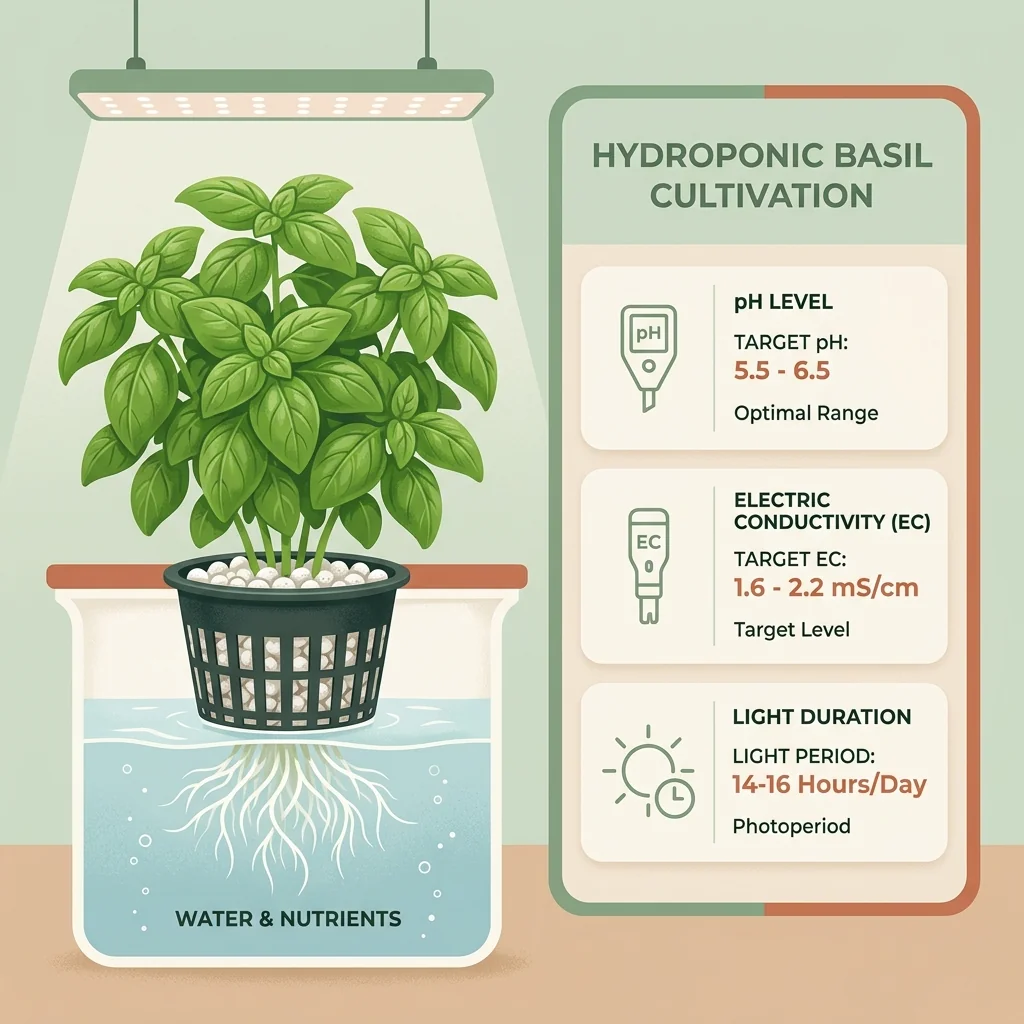
Hydroponic basil: EC 1.0-1.6, pH 5.5-6.5, 14-16 h of light
Basil is one of the fastest, most rewarding hydroponic crops once the water chemistry and light are right. Here are the exact EC, pH, and light targets to hit.
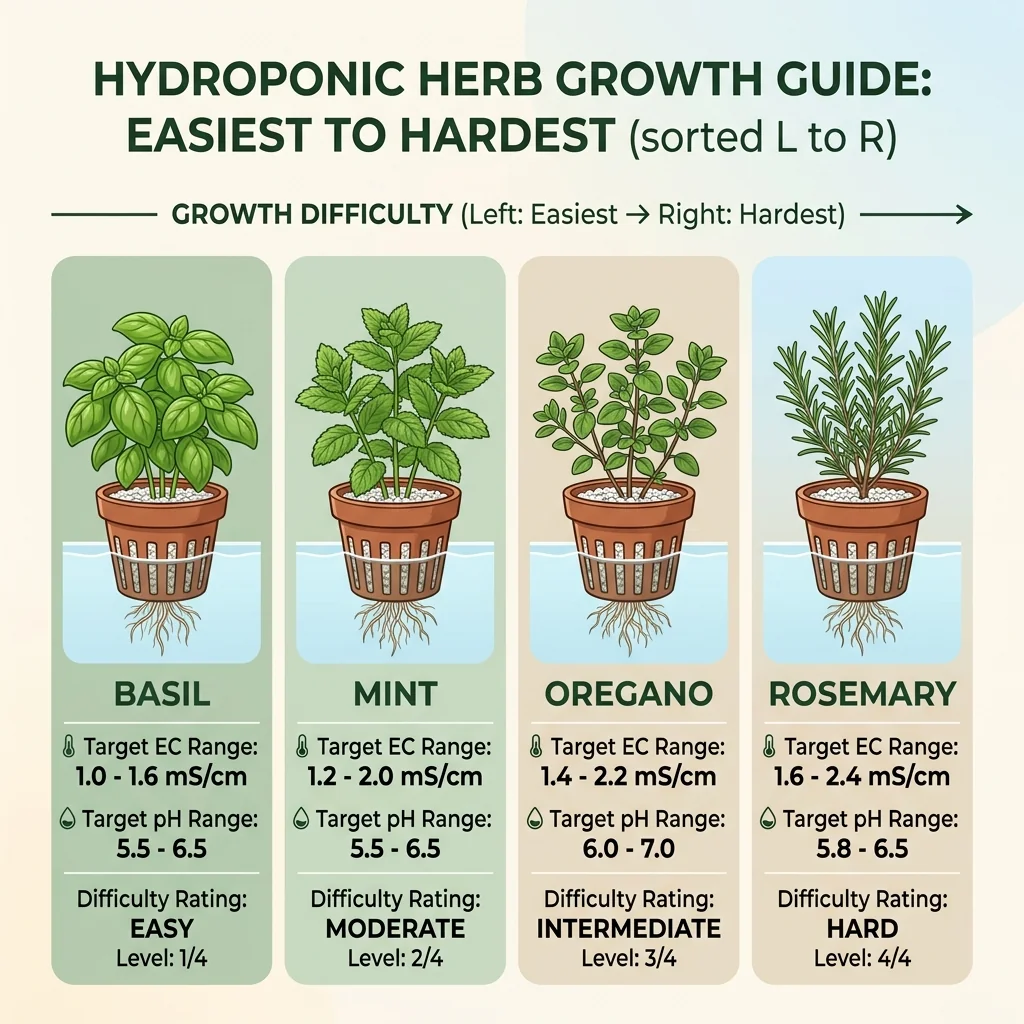
Hydroponic herbs: which grow best and how
Most soft, leafy herbs thrive in hydroponics, while woody Mediterranean herbs are trickier. Here is a ranked guide to which herbs grow best and how to set them up.
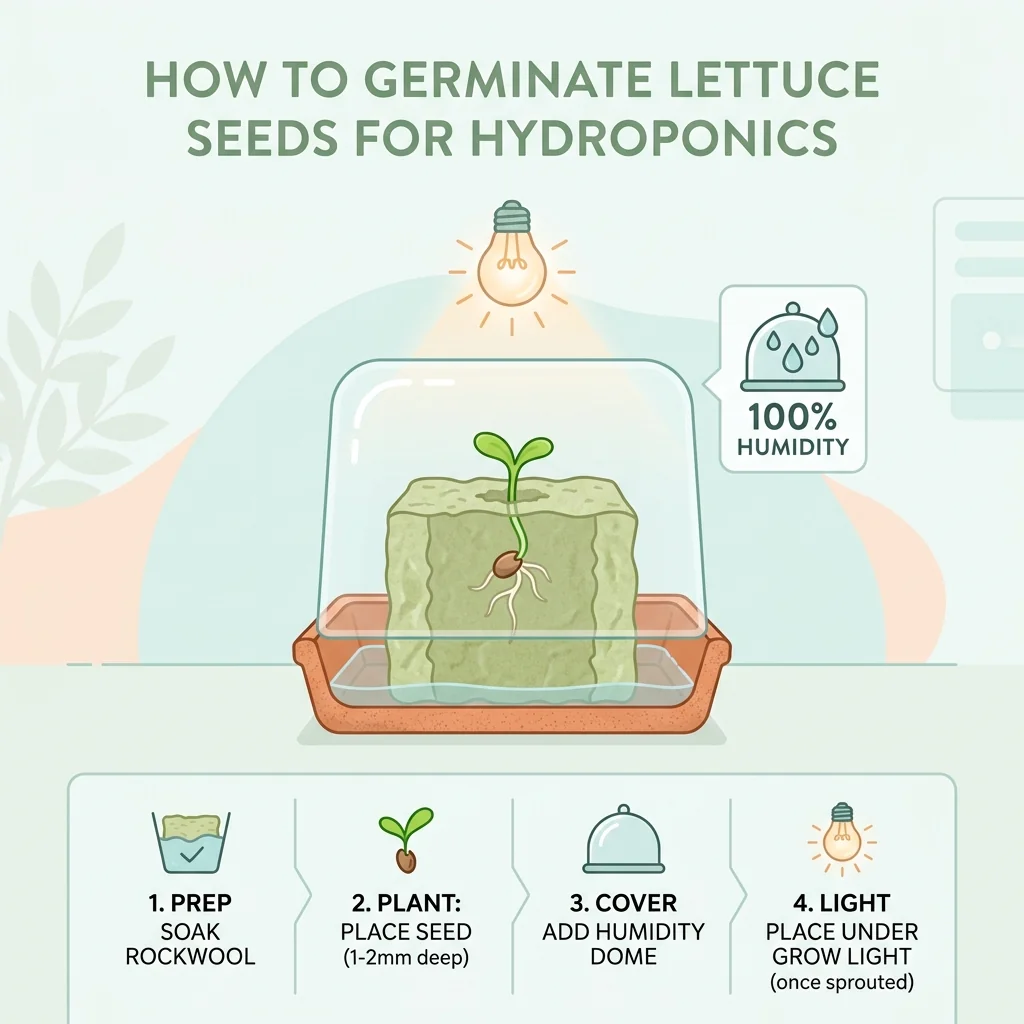
How to germinate lettuce seeds for hydroponics
You cannot start hydroponic seeds in potting soil. The dirt will wash off into your reservoir, clogging your pump and causing a massive bacterial bloom. Here is the sterile, foolproof method to start seeds for water-based growing.