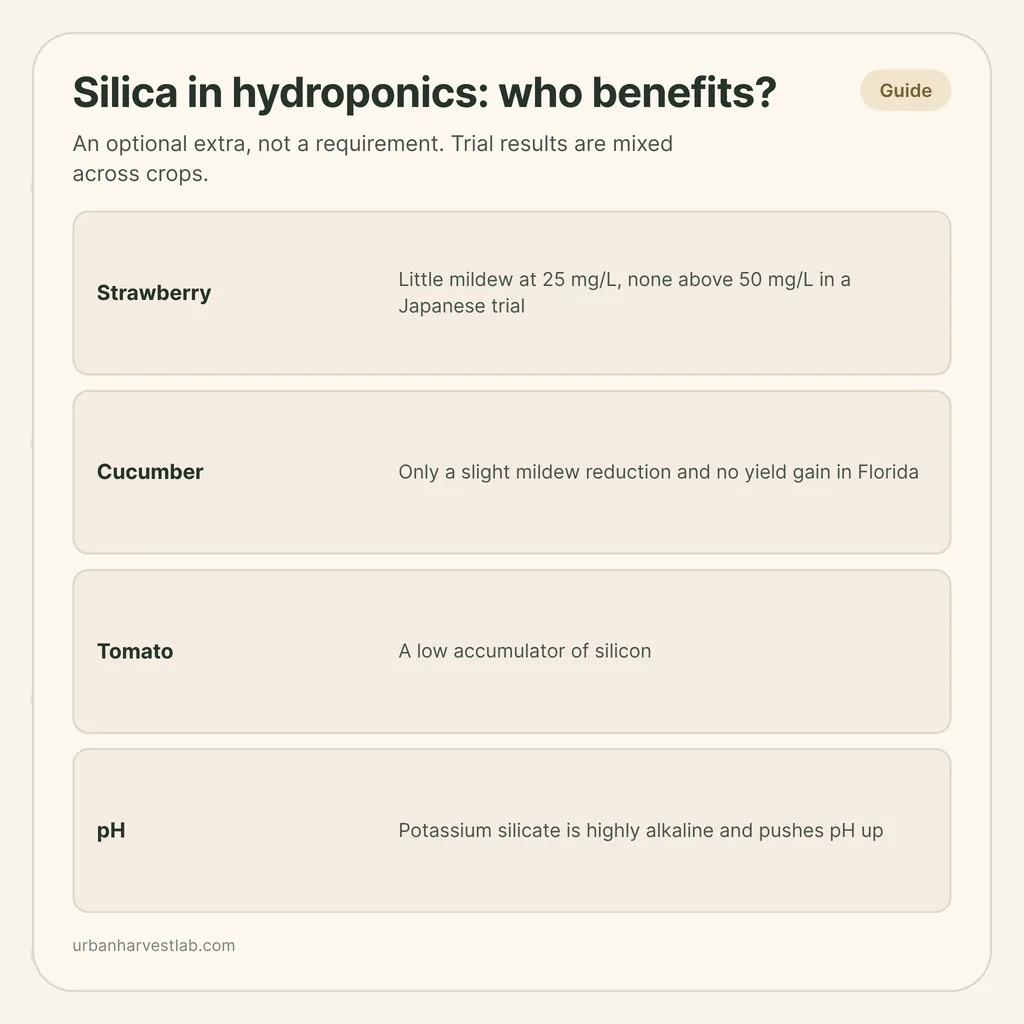
Silica is an optional additive, not a requirement. It is worth trying if you grow cucumbers or strawberries and have had powdery mildew; for lettuce and tomatoes the case is thin, and every dose of potassium silicate pushes your pH up and has to be kept away from calcium. The trial results are real but smaller and less consistent across crops.
What silicon is, and why it is not in your nutrient mix
Plants take silicon up from the solution as monosilicic acid, Si(OH)4, according to a 2025 lettuce study from the Jordan University of Science and Technology. Researchers writing in Greenhouse Canada note that silicon is “not a common ingredient in hydroponic recipes”, even though several benefits have been demonstrated in hydroponic systems. The claims made for it are about stress resistance and tougher tissue; in the strawberry trial below, treated leaves measured harder.
The usual source is liquid or powdered potassium silicate. The same Greenhouse Canada authors explain that it is made by combining potassium hydroxide with silica, which is why it is highly alkaline. That single fact drives most of the practical trouble covered below.
Which crops take silicon up
Plants fall into three groups by how they absorb silicon: high, intermediate and low accumulators. A peer-reviewed paper on cadmium stress, citing Mitani and Ma, gives rice, cucumber and tomato as the examples of each. A salt-stress paper on cucumber adds that its silicon content is far lower than rice or sorghum. A USDA advisory panel review notes that cereals and grasses accumulate the most and dicotyledons “much less”.
| Crop | Uptake class | What hydroponic trials report |
|---|---|---|
| Cucumber | Intermediate accumulator | Mixed: slight mildew reduction in Florida, success reported earlier in Canada |
| Strawberry | Not classed in the sources used here | Leaf silicate rose to about 24 times the control; mildew suppressed at 25 mg/L and above |
| Lettuce | Not classed in the sources used here | Fresh weight gain at 75 and 100 mg/L, none at 25 and 50 mg/L |
| Tomato | Low accumulator | No hydroponic silicon trial reviewed here |
Cucumbers are the crop growers describe as heavy users. Greenhouse Canada’s authors call cucumber a “scooper” of silicon that has to be applied constantly, and in their own studies with seedless cucumbers they fed 100 ppm of silicon dioxide from potassium silicate with every watering. If you are growing them, the space and trellis questions are in the hydroponic cucumber guide.
What the powdery mildew trials found
Strawberries. A Japanese team (Kanto and colleagues, Journal of General Plant Pathology) grew strawberries hydroponically in a greenhouse for four months and tested potassium silicate at 0, 25, 50 and 100 mg/L. Mildew spread in the control plot. Little developed at 25 mg/L, and none developed in plots above 50 mg/L. The suppression lasted about four months on fruit and longer on leaves. The leaf silicate content in treated plants reached about 24 times the control, and disease severity dropped significantly once it passed 1.5 percent of the leaf. Nitrogen, phosphate, potassium and calcium in the leaves did not differ greatly between treatments.
Cucumbers. The picture is less tidy. Schuerger and Hammer, writing in Plant Disease, ran trials in Florida greenhouses after reporting that Canadian growers had used silicon successfully. On susceptible cultivars, potassium silicate at 100, 150 or 200 mg/L gave a slight but statistically significant reduction in mildew over 49 days. They concluded it was not commercially useful, because it failed to increase fruit yields. Changing the nutrient formula, rooting medium or light level made no difference to the suppression.
Temperature did. The effect was greatest at 20 C. At 25 and 30 C there was still suppression, but significantly less. The authors suggest this explains the gap with Canada, where greenhouses averaged 20 to 25 C, against 24 to 32 C in Florida. A warm indoor room or a balcony in summer may sit closer to the Florida conditions.
What this means in practice: silicon is a layer of protection, not a treatment. If mildew is already on the leaves, deal with it with the steps in the powdery mildew guide for squash and cucumbers, and treat silicon as prevention for the next crop.
What about lettuce and other crops
The Jordan University of Science and Technology lettuce trial grew lettuce in a raft system with silicon at 0, 25, 50, 75 and 100 mg/L. Total fresh weight rose significantly at 75 and 100 mg/L, with a 17.7 percent gain at 75 mg/L over the control; 25 and 50 mg/L did not differ from the control. Stored at 4 C, shelf life improved by 40, 40, 60 and 80 percent across the four silicon levels. At room temperature, the shelf life was the same across all treatments. That is one trial, in one system, with a finely ground silicon fertilizer rather than potassium silicate, so treat it as a lead and not a recommendation. Weight and storage are the claims it supports; mildew resistance is not.
Silica and pH
The USDA advisory review lists potassium silicate stock at a pH of about 11.3 and notes that solutions with high pH can harm alkali-sensitive crops. Greenhouse Canada puts the figure at above 10. The reservoir will not stay at that level once diluted, but the push is upward, and the growers described there correct it: they inject the silicate into a storage tank and then send that high-pH water through an injector that brings it down to 6.0 before other fertilizers are added.
The lettuce trial held its solution between 5.5 and 6.5 to keep monosilicic acid stable and available. Expect to need pH-down after adding silicate, and check the reading before the plants go back in. If your pH was already drifting, work out why first with the guide to why pH keeps rising in hydroponics, and use the steps in raising and lowering pH safely to correct it.
Mixing order
Greenhouse Canada’s authors say potassium silicate should not go into either of the two usual stock tanks, the calcium nitrate tank or the tank with all the other nutrients, because its pH is above 10. The cucumber grower in their example runs three injectors: one for calcium nitrate, one for nitrogen-phosphorus-potassium, magnesium and trace elements, and a third for potassium silicate. Their sequence is silicate into water first, pH corrected, other fertilizers after.
That is one commercial grower’s practice, not a procedure any of the studies tested, and it describes injectors rather than a home bucket. For a reservoir, follow the product label, and see how to mix hydroponic nutrients for the general mixing basics. The trials above give the concentrations they tested, not a dose for your plants.
Should you buy it
Buy it if you grow cucumbers or strawberries and have had mildew in a previous crop; the Florida trial suggests cooler conditions favour the effect. Skip it for lettuce unless you want to experiment (no trial reviewed here covers herbs), and skip it for tomatoes. If you do try it, run one reservoir with and one without, because the Florida result shows how easily the benefit can vanish. Whatever you pick, check that the product states what form of silicon it contains and what it does to pH; you can browse potassium silicate for hydroponics on Amazon to compare labels.
Sources
- Schuerger AC, Hammer W. 2003. Suppression of powdery mildew on greenhouse-grown cucumber by addition of silicon to hydroponic nutrient solution is inhibited at high temperature. Plant Disease 87(2):177-185.
- Kanto T, Miyoshi A, Ogawa T, Maekawa K, Aino M. 2004. Suppressive effect of potassium silicate on powdery mildew of strawberry in hydroponics. Journal of General Plant Pathology 70.
- Albalasmeh AA and colleagues, Jordan University of Science and Technology. 2025. Silicon extends the shelf life of hydroponically grown lettuce. Scientific Reports.
- Rashid MT, Mirza M. 2023. Silicon nutrition of hydroponic crops. Greenhouse Canada.
- USDA National Organic Program, Technical Advisory Panel review compiled by UC SAREP. 2003. Potassium silicate for use in crop production.
- Distinct physiological responses of tomato and cucumber plants in silicon-mediated alleviation of cadmium stress.
- Silicon enhanced salt tolerance by improving the root water uptake and decreasing the ion toxicity in cucumber.
Mixing, cucumbers and pH drift
The basics you need before adding anything extra to the reservoir.
Common questions
Do I need silica in a hydroponic system?
No. Plants grow without it, and Greenhouse Canada notes silicon is not a common ingredient in hydroponic recipes. It is an optional extra with the best trial evidence for strawberries and cucumbers, and weaker or mixed evidence elsewhere.
Does silica stop powdery mildew in hydroponics?
It reduced it in trials but did not stop it reliably. In a hydroponic strawberry trial with potassium silicate at 0, 25, 50 and 100 mg/L, mildew spread in the control, little developed at 25 mg/L and none above 50 mg/L. In Florida cucumbers at 100 to 200 mg/L the reduction was slight and yield did not improve.
Does silica change the pH of the reservoir?
Yes. Potassium silicate is highly alkaline, with a stock pH reported around 11.3 by a USDA advisory review, so adding it pushes the solution up. Growers in a Greenhouse Canada article inject it into water and then bring pH down to 6.0 before the other fertilizers go in.
Can I mix silica into my calcium nitrate stock?
Greenhouse Canada advises against putting potassium silicate in either of the two usual stock tanks, the calcium nitrate tank or the tank with all other nutrients, and describes a cucumber grower who uses a third, separate injector for it.
Related guides
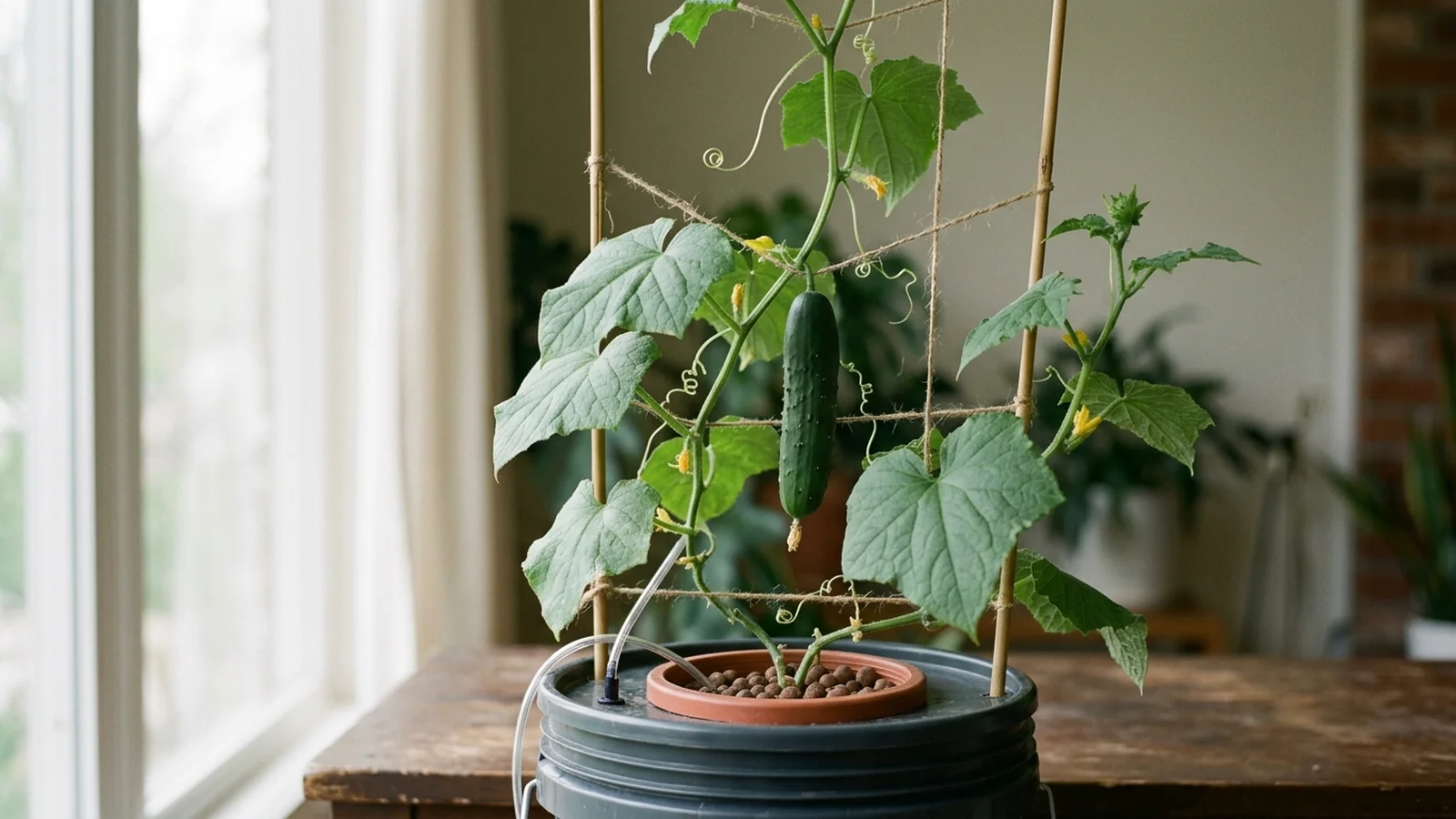
Hydroponic cucumbers indoors: the space and trellis they actually need
Hydroponic cucumbers need a more acidic solution than most crops, and a vine that keeps climbing well past where a leafy-green tray stops. Here is the footprint an apartment setup actually takes, trellis included.
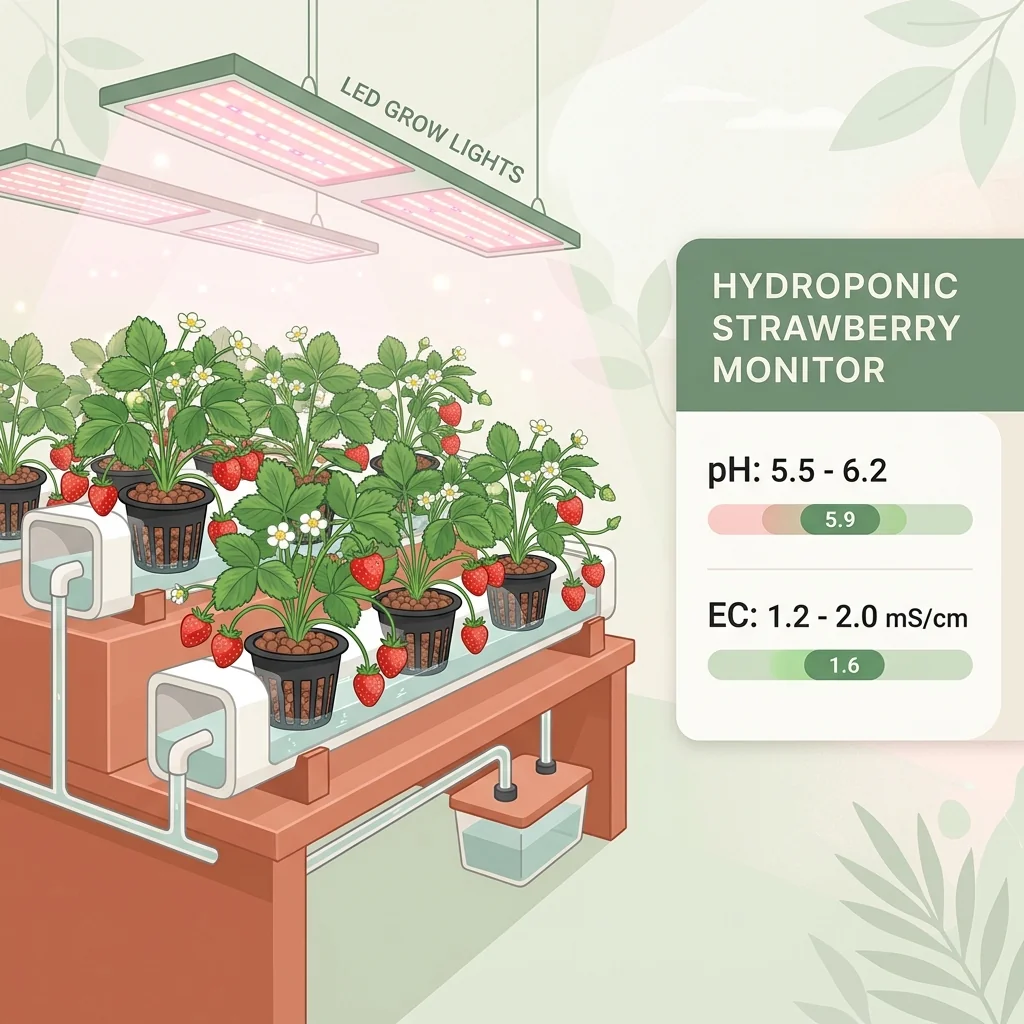
Hydroponic strawberries indoors: is it worth it?
Indoor hydroponic strawberries are rewarding but demanding: they need strong light, hand pollination, and patience. Here is an honest look at whether it is worth it.
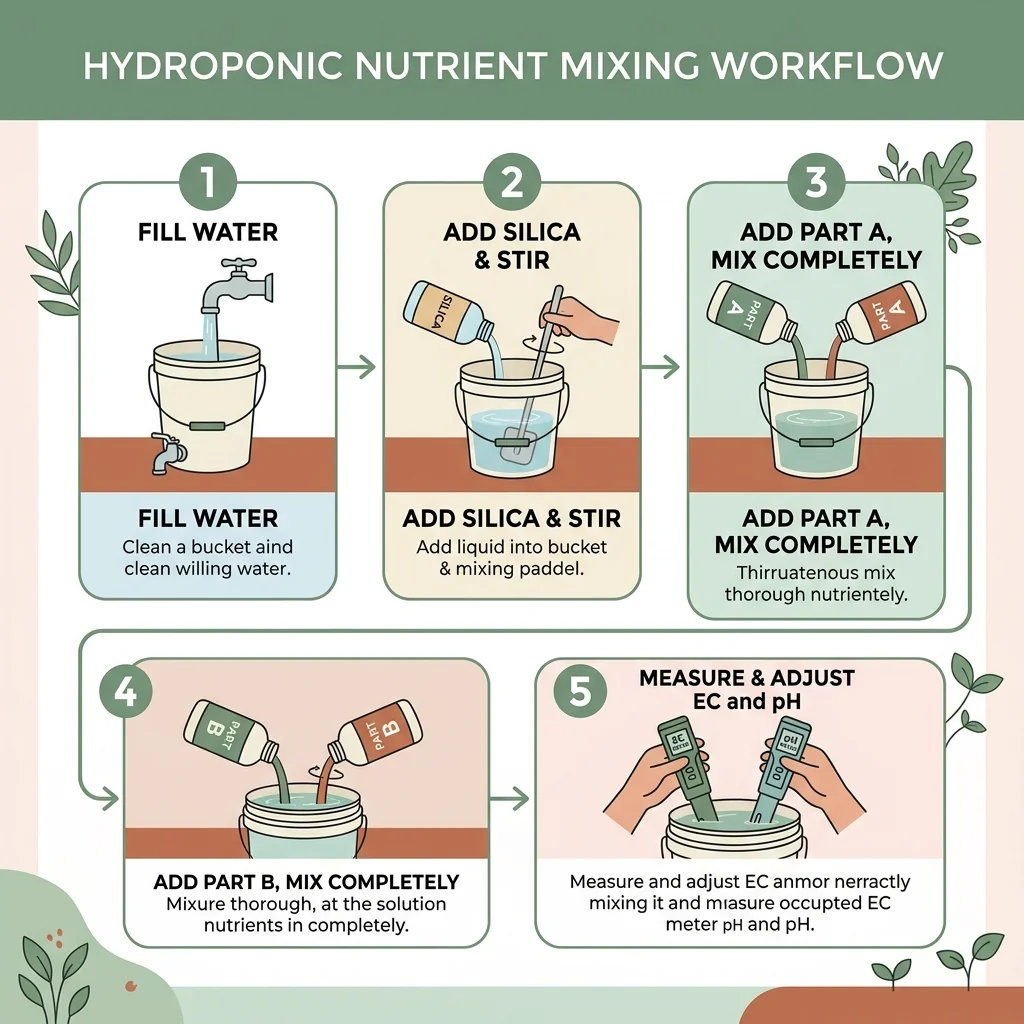
How to mix hydroponic nutrients: a beginner guide
Mixing hydroponic nutrients is simple once you know the order: water first, nutrients separately, measure EC, then adjust pH last. Here is the step-by-step.