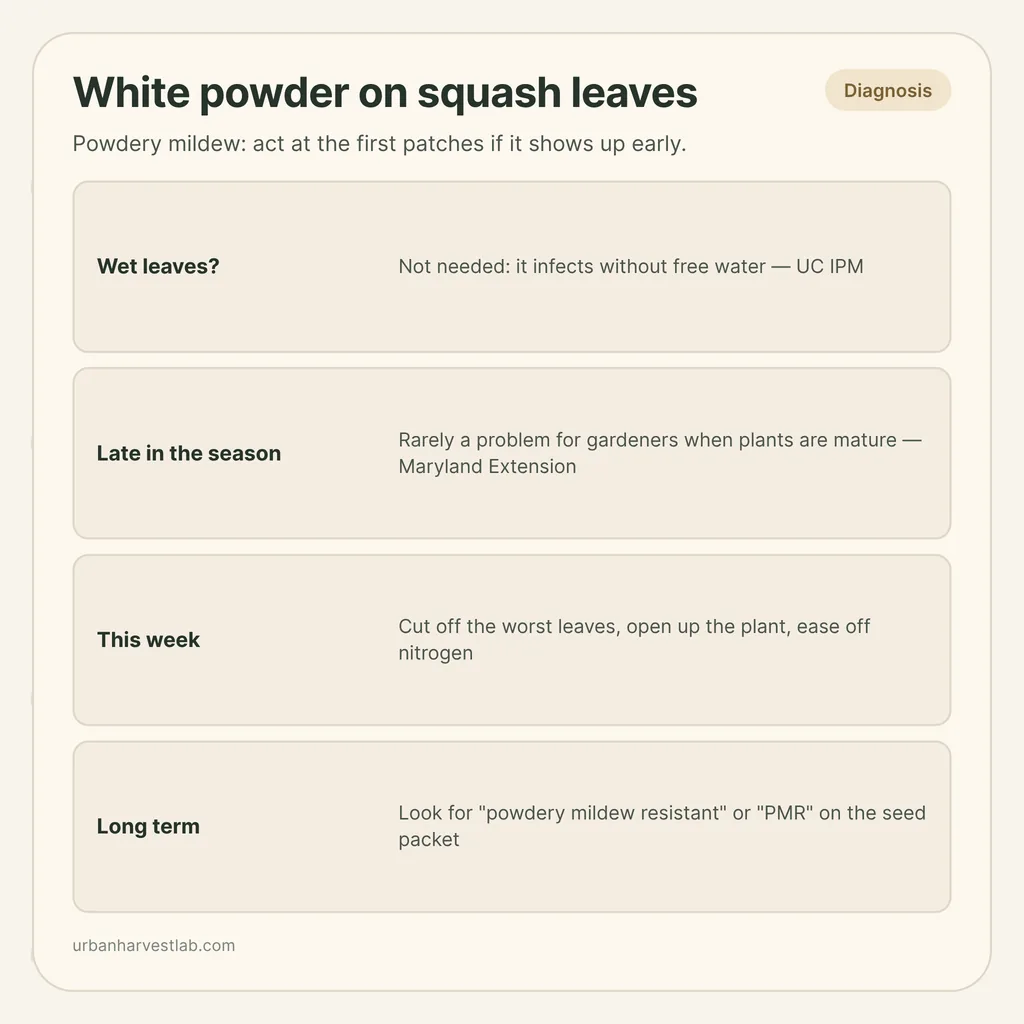
Troubleshoot the system before you change the inputs.
Symptoms
- White, talc-like powder on the upper side of older leaves, then on undersides, stems and younger leaves.
- Leaves that turn yellow, then brown and papery, sometimes drooping in afternoon heat.
- Fruit that is fine, but fewer and smaller later in the season.
Possible causes
- Powdery mildew spreading on shaded, crowded, mature leaves.
- A susceptible variety, especially a squash or a cucumber without disease resistance.
- Too much nitrogen, producing lush, dense foliage.
Quick fixes
- Cut off the worst leaves, bag them, and open the canopy so sun and air reach the centre.
- If it is early in the season, protect clean leaves with a product labelled for your crop and follow its limits.
- Next year, choose a resistant variety and space plants.
White, talc-like powder on zucchini or cucumber leaves is nearly always powdery mildew. If it shows up late in the season on a plant that has already given you fruit, you can usually live with it. If it appears early, act at the first patches: UC IPM says treatments must go on no later than the first sign of disease, and severe infections cut yield.
Most leaf diseases want wet leaves. This one does not. The University of Maryland Extension describes it as favoured by warm weather and, unlike many other plant pathogens, not encouraged by wet foliage. UC IPM adds that all powdery mildew species can germinate and infect without free water. So a gardener who waters carefully at the base can still get it, and a plant in a still, shady corner of a balcony is a good candidate.
What it looks like on squash and cucumbers
It starts small. UConn describes pale yellow spots on stems, petioles and leaves that enlarge as white, fluffy growth spreads over the surface. Washington State says older leaves, shaded leaves and leaf undersides are favoured, and that tiny black specks can appear in the white mats. University of Maryland Extension notes that leaves around the base of the plant are affected first.
Left alone, the leaves go dull and yellow, then brown and papery. UConn mentions some wilting in afternoon heat. If your real worry is a plant that collapses, read why a zucchini plant suddenly wilts first, because mildew rarely explains a sudden collapse on its own.
Check the look-alikes before you reach for a spray.
| What you see | More likely | Where to go |
|---|---|---|
| Yellow angular spots on the top of older cucumber leaves, grey fuzz underneath | Downy mildew, a different organism | Cucumber leaves turning yellow |
| Sticky leaves, tiny white insects when you shake a leaf | Whiteflies or aphids and their honeydew | Sticky leaves and honeydew |
| White, powdery coating that spreads and returns, starting on old shaded leaves | Powdery mildew | Keep reading |
Is it a problem, or just the end of the season?
Both. University of Maryland Extension says infections often start when plants are mature and are rarely a problem for gardeners. If your zucchini is in its third month and the lowest leaves are going white, the plant has done most of its work. Remove those leaves and keep picking.
The picture changes when it arrives early. UC IPM says severely infected plants may have reduced yields, shortened production times and fruit with little flavour. UConn adds premature foliage loss. Leaf loss also matters on its own terms: UC IPM warns that yellowed, dropped leaves can expose fruit to sunburn.
The fruit itself is usually not the target. UC IPM says powdery mildew fungal growth does not usually grow on vegetable fruits, while Washington State notes occasional fruit infections on cucumber, though most commercially grown varieties are resistant.
What to do this week
- Cut off the worst leaves. Take heavily coated ones, along with fallen leaves, and bag them. Washington State says to destroy or discard diseased material rather than compost it. UC IPM takes a different view, saying properly maintained compost piles should kill spores. A small balcony bin is unlikely to qualify as a properly maintained pile, so bin it.
- Open the plant up. Both UC IPM and Washington State call for good air circulation and spacing, and Washington State notes that dense plantings are more likely to be affected. Thin crowded stems and move the pot so the centre of the plant gets sun. UC IPM says spores and fungal growth are sensitive to direct sunlight and to extreme heat above 90 degrees F, and that shade favours the disease.
- Ease off the nitrogen. UC IPM says too much nitrogen causes lush foliage and shade, which suits the fungus. UConn points out the opposite risk: healthy, vigorous plants on a good nutritional programme are less susceptible than plants under nutritional stress. Feed steadily rather than heavily.
- Do not count on rinsing. UC IPM says overhead sprinkling may help by washing spores off, but it does not usually recommend it for vegetables because it can contribute to other pest problems.
Choosing a variety that resists it
This is where the fix lasts. Washington State lists resistant cucumbers including ‘Calypso’, ‘Cherokee’, ‘Cross Country’, ‘Dasher II’, ‘Flurry’, ‘Marketmore’, ‘Pioneer’, ‘Quest’, ‘Regal’, ‘Royal’ and ‘Turbo’. UConn’s list adds, for zucchini, ‘Ambassador’, ‘Hurakan’, ‘Judgement III’, ‘Justice II’, ‘Lynx’, ‘Payroll’, ‘Sebring’, ‘Senator’, ‘Wildcat’ and ‘Zucchini Elite’. For yellow squash it names ‘Fancycrook’, ‘Multipik’, ‘Patriot II’, ‘Prelude II’, ‘Success’, ‘Sunglo’, ‘Sunray’ and ‘Supersett’.
Those are regional lists, and UConn’s was last revised in 2016, so seed catalogues may have dropped or renamed some. Look for the words “powdery mildew resistant” or “PMR” on the packet. Resistance is also not immunity: UC IPM’s commercial cucurbit guidelines note evidence that resistance-breaking races are present in California, so you still need sun and spacing.
For a pot, pair a resistant variety with a compact growth habit, as in growing zucchini in a container.
Do you need to spray?
Often not. Washington State says the disease usually does not warrant fungicide applications, and UConn says chemical control should be used only after all other methods have failed. UC IPM is more cautious about cucurbits specifically: it says very susceptible vegetables such as cucumbers, melons, squash and pumpkins may require fungicide, and that the least-toxic options must go on no later than the first sign of disease.
If you do spray, the timing logic is the same across these sources.
- Protect clean leaves. UC IPM says sulfur works only when applied before symptoms appear, and that protectant products need thorough coverage, with repeat applications at 7- to 10-day intervals while conditions favour the disease. It also says sulfur can be damaging to some squash and melon varieties.
- Treat early infections with oil. UC IPM says oils work best as eradicants, and University of Maryland Extension says horticultural oil products labelled for powdery mildew on cucurbits exist. Washington State’s limits: no spray oils below 50 degrees F or above 90 degrees F, on plants under heat or moisture stress, or on wet foliage.
- Keep oil and sulfur apart. UC IPM says to keep an oil spray at least 2 weeks away from a sulfur spray, and to consult the label, because some plants need an even longer gap.
- Do not expect much from copper or biological sprays. UC IPM says copper is not very effective, and that a Bacillus-based biological fungicide has not proven as effective as oils or sulfur.
- Once the mildew is extensive, UC IPM says control with any fungicide becomes more difficult. At that point removing leaves does more than spraying.
The label decides everything else: which crops are listed, the amount, the interval and the wait before harvest. Choosing a pest treatment for plants you eat walks through reading one. Mildew on herbs behaves differently and has its own advice in powdery mildew on container herbs.
Next season
Pull up the plant debris at the end of the season, as University of Maryland Extension advises, because these fungi can overwinter as spores on fallen leaves. Washington State says not to plant cucumbers and related crops in the same spot for at least two years. In a single pot, that means fresh potting mix and a different crop family, or a fresh container.
Sources
- UC IPM: Powdery mildew on vegetables (Pest Notes 7406)
- UC IPM: Powdery mildew, cucurbits (Pest Management Guidelines)
- Washington State University HortSense: Cucumber, pumpkin, squash powdery mildew
- UConn Home Garden Education Center: Powdery mildew of cucurbits
- University of Maryland Extension: Powdery mildew on vegetables
Keep squash and cucumbers healthy
Growing zucchini in a pot, other causes of yellow cucumber leaves, and how to choose a treatment for food plants.
Common questions
Is white powder on zucchini leaves powdery mildew?
It is the most likely cause when the powder is talc-like, starts on older or shaded leaves and spreads over days. UConn describes it as talc-like patches that start as pale yellow spots on older leaves and spread. If the leaves are yellow with angular spots, or sticky with tiny white insects, you are looking at something else.
Can I still harvest zucchini and cucumbers from a mildewed plant?
Yes in most cases. UC IPM says the fungus does not usually grow on vegetable fruits, although it can reduce yield and flavour on a badly infected plant. Cucumber fruit is occasionally infected, according to Washington State. The extension pages read here do not say whether the leaves themselves are safe to eat, so leave them off the plate.
Does overwatering or wet leaves cause powdery mildew?
No. University of Maryland Extension notes it is not encouraged by wet foliage, and UC IPM says the spores can infect without free water. Humid air, shade and crowded leaves help it along. Water the soil, but do not expect dry leaves to prevent it.
What can I spray on zucchini for powdery mildew?
UC IPM names sulfur, horticultural oil, neem oil and jojoba oil as options, with limits: sulfur works only before symptoms appear, an oil should not go on within 2 weeks of sulfur, and neither belongs on the plant near or above 90 degrees F. The product label has to list your crop and decides the dose and harvest wait.
Related guides
Choosing a pest treatment for plants you are going to eat
Once you know which pest you have, the next question is what you can treat it with without compromising the food. The answer is a ladder of methods, and the label on any product you buy sets the legal limits of the top rung.

Cucumber leaves turning yellow in pots: which cause fits
Where the yellow starts and what it looks like tells you whether a potted cucumber is hungry, waterlogged, mildewed or infested.
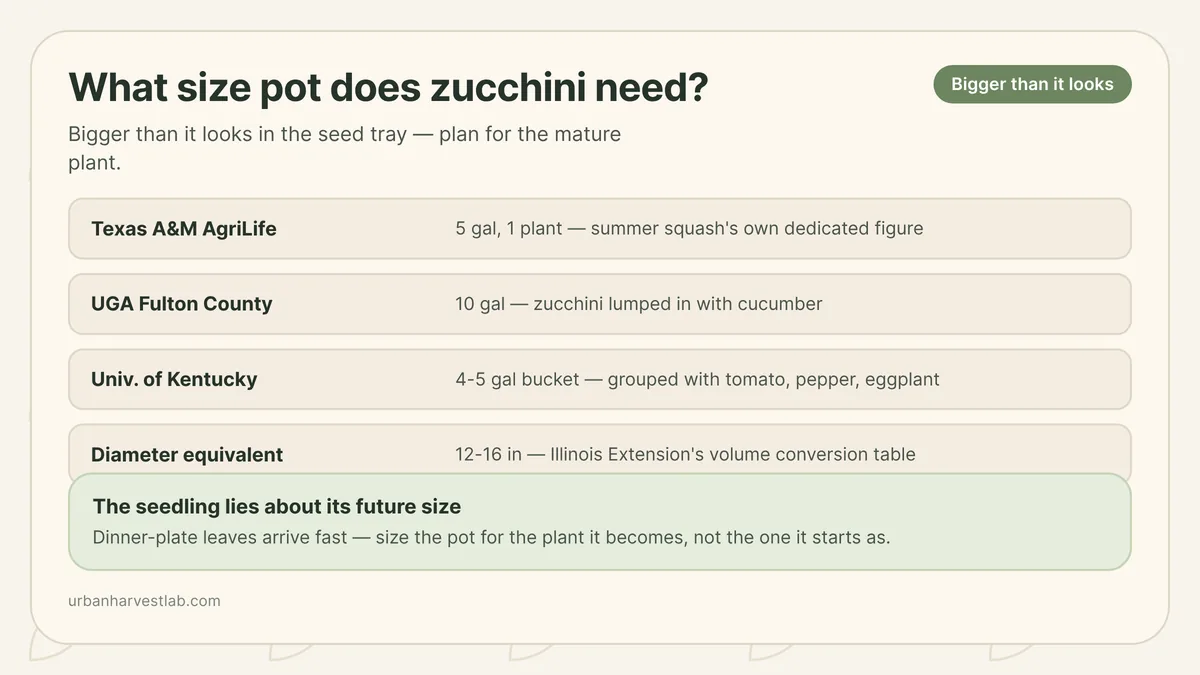
What size pot does zucchini need? Bigger than it looks in a seed tray
A zucchini seedling looks modest for weeks, then fills a pot almost overnight. The container has to be sized for the plant it becomes, not the one it starts as.