
Oklahoma State trial: three pH-lowering products, 30 days (shoot fresh weight per plant)
| Crop | pH Down (phosphoric) | Lime juice (citric) | White vinegar (acetic) |
|---|---|---|---|
| Lettuce | 235.9 g | 210.8 g (not different from pH Down) | 116.7 g |
| Basil | 293.0 g | 213.6 g | 151.8 g |
| Swiss chard | 187.7 g | 118.8 g | 50.1 g |
Vinegar will lower the pH of a nutrient solution, but it is a weak choice for anything beyond a one-off rescue. In a controlled trial at Oklahoma State University, white vinegar needed far more product than a dedicated pH Down, let the pH creep back up, and reduced the yield of every crop tested.
The routine with a dedicated product is in how to raise and lower pH in hydroponics. Here is what the kitchen alternatives do when you use them.
What the trial measured
Researchers at Oklahoma State University (Singh, Dunn and Payton) grew red lettuce, basil and Swiss chard on ebb-and-flow tables. Each table used one pH modifier: white vinegar at 5% acidity, bottled lime juice diluted to pH 2.5, or a commercial pH Down. The tank held 141.4 litres, the tap water was pH 7.8, and the target band was pH 5.5 to 6.5, checked every other day for 30 days after transplanting.
Three things stood out.
Volume. Across a run, the Oklahoma State team used 600 ml of pH Down, 6,000 ml of lime juice and 8,000 ml of vinegar. Vinegar took roughly 13 times the volume of pH Down over the same 30-day run, and still did not hold the band.
Stability. The pH rose steadily on every modifier. Measured before each correction, the pH with pH Down levelled off around 6.7 from about day 25; with lime juice and vinegar it kept climbing and reached 7.5 by harvest. The authors state that pH Down “resulted in the most stable solution pH.”
Growth. Vinegar reduced yield in all three crops compared with pH Down. Lime juice matched pH Down for lettuce but lowered basil and Swiss chard yield.
By crop: lettuce did fine on pH Down or lime juice and lost yield on vinegar. The lettuce was a red cultivar, and the authors note chlorosis shows less in red leaves, so a green lettuce may not fare as well on lime juice. Basil should get pH Down only, because lime juice and vinegar caused chlorosis and lower nitrogen uptake. For Swiss chard the authors recommend pH Down; the vinegar plants weighed about a quarter as much.
The authors concluded vinegar “would not be recommended for any of the crops studied.” They also note the low yields on vinegar and lime juice may reflect concentrations that were too high for these crops, so the trial does not show that a tiny, occasional splash harms plants. It shows that holding a reservoir in range with vinegar did.
Why the pH bounces back
Acid only removes the alkalinity that is in the water at that moment. It does nothing about what pushes pH up afterwards. Two things did that in the trial. Plants take up anions and cations unevenly, which the authors name as one cause of pH change in a nutrient solution. And every top-up with pH 7.8 tap water raised the pH again.
Citric acid was the clearest case. The authors report that citric acid alone “was only effective for a day then the pH increased steadily.” The commercial pH Down they used also contains citric acid, plus ammonium dihydrogenorthophosphate and phosphoric acid, and it held the band far better.
The cause of the drift is covered in why pH keeps rising in hydroponics. If your tap water is the driver, tap water alkalinity and pH drift explains why, as University of Missouri Extension puts it, the amount of acid you need depends on alkalinity rather than on the pH reading, and why swapping vinegar for a stronger acid does not fix a high-alkalinity source.
Vinegar, citric acid and lime juice compared
- Vinegar (acetic acid). Cheap and easy to find. Largest volume, lowest stability and the biggest yield penalty in the trial.
- Citric acid and lime juice. University of Kentucky lists citric acid among the acids that can be added to a stock tank to lower the pH of alkaline source water. In the Oklahoma State trial lime juice worked for lettuce, but its effect on pH lasted about a day. Only lime juice was tested, not lemon juice or powdered citric acid.
- Phosphoric acid (pH Down). Held the band with the least product and gave the best growth. The trade-off is that it adds phosphate, so the nutrient balance shifts slightly. The Kentucky guide notes that sulfuric and phosphoric acids contribute sulfate or phosphate ions to the solution.
If you use vinegar anyway
Treat it as a rescue, not a system. Add a very small amount to circulating water, let it mix, and retest before adding more. No university source gives a dose for vinegar in a home reservoir, and the right amount depends on your alkalinity and volume, so measure rather than guess. Use a calibrated meter (see choosing a pH meter) and set EC before you adjust pH, as in hydroponic nutrient basics.
Leafy herbs deserve extra care. Basil was the crop that showed yellowing and weaker growth on both kitchen acids.
When to stop correcting
If you are adding acid every day or two, the better move is to find out why. A water test for alkalinity tells you more than a stronger acid does, and a reservoir that has drifted far out of balance is often cheaper to replace than to patch, as covered in when to change hydroponic nutrient solution.
Sources
- Singh, Dunn and Payton (Oklahoma State University), Hydroponic pH modifiers affect plant growth and nutrient content in leafy greens, Journal of Horticultural Research 27(1), 2019
- University of Kentucky Center for Crop Diversification, Hydroponic lettuce production in controlled environments (CCD-CP-63)
- University of Missouri Extension, Hydroponic nutrient solutions (G6984)
Keep your pH steady
Dedicated pH products, the reason pH drifts up, and the tap water chemistry behind it.
Common questions
Can I use vinegar to lower pH in hydroponics?
It lowers pH, but it is a poor routine choice. In an Oklahoma State trial, white vinegar needed 8,000 ml per run against 600 ml of pH Down, the pH, measured before each correction, reached 7.5 by harvest, and shoot weight fell in lettuce, basil and Swiss chard. The authors did not recommend vinegar for any of the three crops.
Is lemon juice or citric acid better than vinegar?
Somewhat. In the same trial, lime juice gave lettuce yields close to pH Down (210.8 g against 235.9 g per plant), but it cut basil and Swiss chard yields, and its effect on pH lasted about a day. Lemon juice was not tested.
How much vinegar should I add?
No university source gives a safe dose. The amount depends on your water alkalinity and reservoir volume. Add a very small amount to circulating water, mix, retest, and repeat, or follow the label of a pH down product made for hydroponics.
Why does my pH go back up after I add vinegar?
Plants take up nutrient ions unevenly, which shifts pH, and topping up with alkaline tap water pushes it higher still. In the Oklahoma State trial the tap water was pH 7.8 and the pH rose steadily with vinegar and lime juice.
Related guides
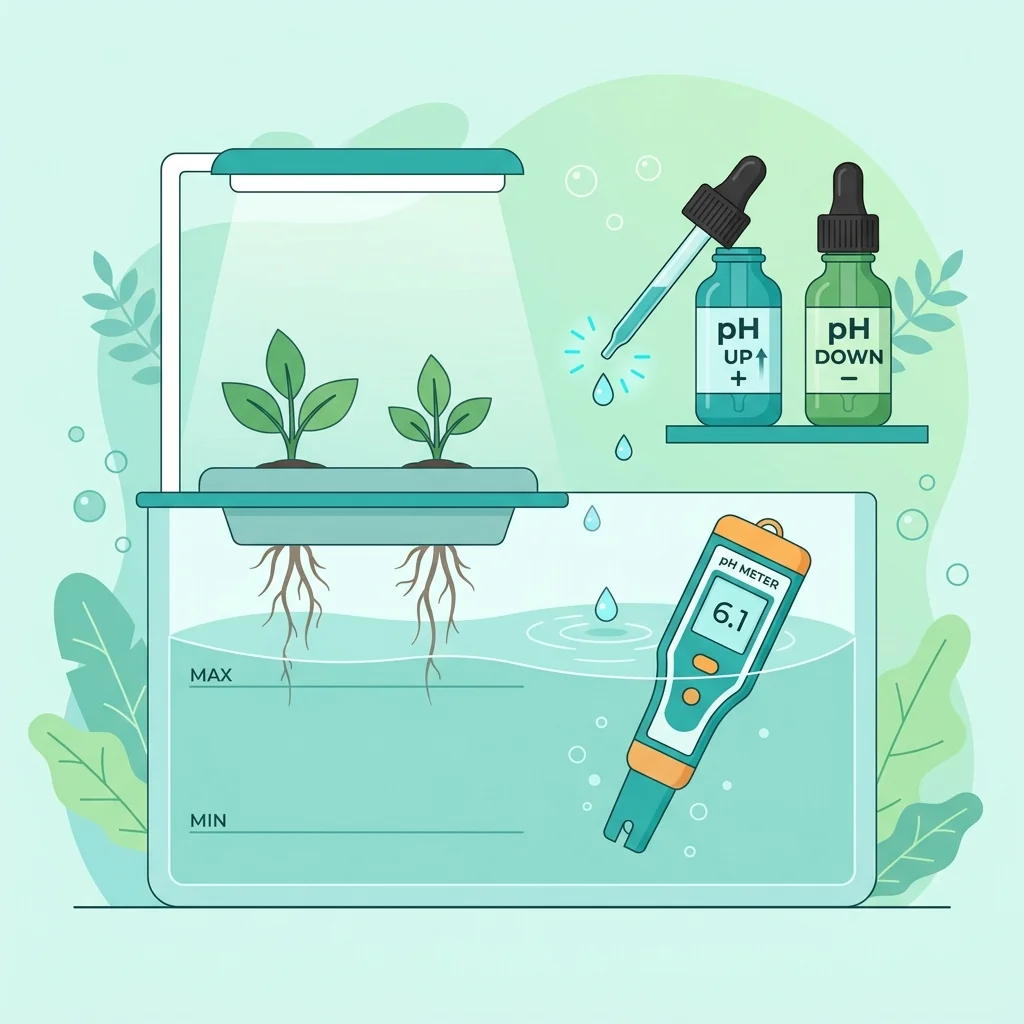
How to raise and lower pH in hydroponics (safely)
Adjusting hydroponic pH is simple once you know which product does what. Here is how to raise and lower pH safely, in small steps, without chasing the meter.
Tap water alkalinity: why hydroponic pH keeps drifting back up
Dosing pH down and watching the reading climb back up within a day usually means the water itself is buffered against the change. Here is what alkalinity measures, the range that keeps a reservoir stable, and how it differs from hardness.
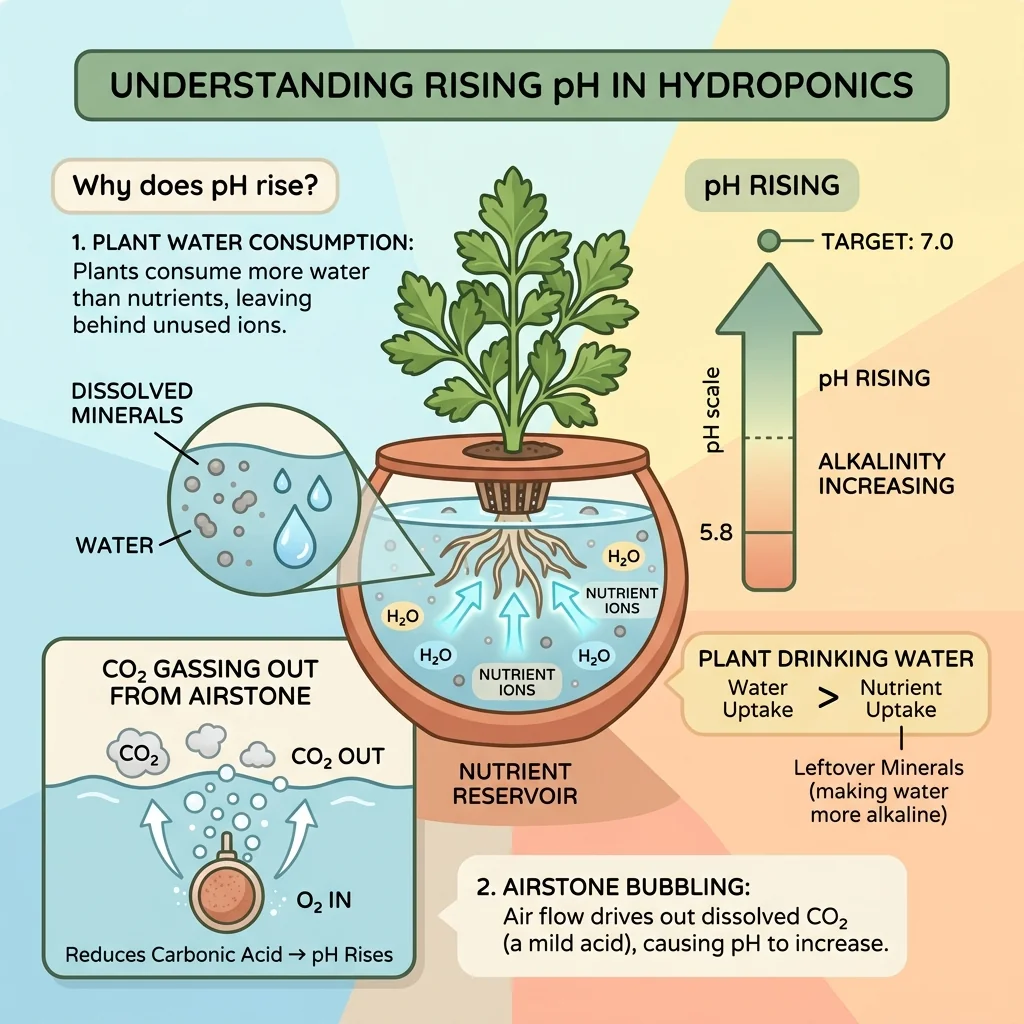
Why pH keeps rising in hydroponics (and how to stop it)
You balanced your hydroponic reservoir to a perfect 5.8 pH. Two days later, it has drifted back up to 6.8. This constant upward drift is the bane of hydroponic growers. Here is the chemistry behind why it happens and how to fix it.