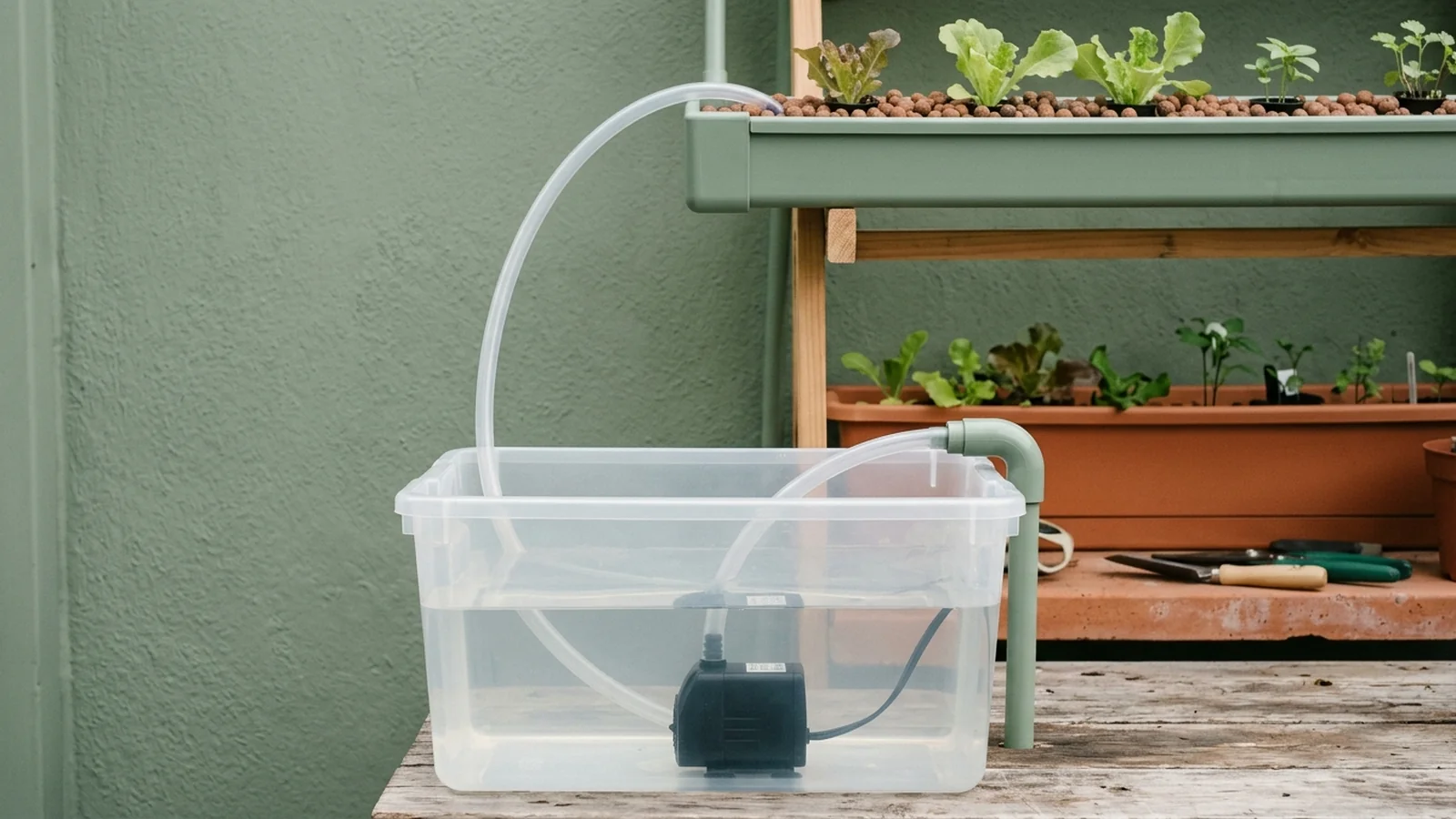
A submersible pump’s GPH or L/h rating is measured with the outlet sitting at the same height as the water: no lift, no tubing run, no elbow. The instant that water has to climb — up a return line, through a fitting, into a grow tray mounted above the reservoir — flow drops, and it keeps dropping along a curve until it reaches zero at the pump’s maximum head. The number on the box is the top of that curve. It says nothing about where your setup actually sits on it.
That gap is why a pump bought “with room to spare” can still arrive at the top of a tower or channel as a trickle. Systems built around continuous flow, like NFT and DWC, depend on the pump clearing its real head comfortably rather than technically, and the pump curve is where that comfort margin actually gets decided — not the GPH figure on the packaging.
The rated number is a zero-height number
Pump manufacturers publish flow at a series of heights because flow is not one number; it is a relationship between height and flow, plotted as a curve. The zero-head figure — the one printed largest on packaging and listings — is simply the top-left point of that curve, where resistance from lift is at its minimum. Every other point on the curve sits below it. A pump rated at a given GPH is not capable of delivering that figure to anything above the waterline; it is capable of delivering it only at the waterline itself.
Reading a real curve
Curves are model-specific, but seeing one with real numbers attached makes the shape concrete. Little Giant publishes exactly this kind of chart for its 5-Series submersible utility pump, giving flow at a series of heights up to the point where flow reaches zero:
| Head height | Flow rate |
|---|---|
| 1 ft (0.3 m) | 1,500 GPH |
| 3 ft (0.9 m) | 1,464 GPH |
| 5 ft (1.5 m) | 1,395 GPH |
| 10 ft (3 m) | 1,191 GPH |
| 20 ft (6 m) | 528 GPH |
| 26.3 ft (8 m) | 0 GPH (shut-off head) |
The shape is the point, more than any single figure in it. Across the first ten feet, this pump loses only around a fifth of its zero-head flow — a gentle, forgiving slope. Across the next ten feet, it loses more than half of what remained. And the final six feet or so erase whatever is left, bringing flow to zero exactly at the shut-off head. That is a curve, not a straight line: it stays relatively flat low down and then falls away fast as it approaches its ceiling. A different pump, from a different manufacturer, will trace a different shape entirely, even at the same zero-head rating — a smaller motor might hold its flow more evenly and shut off earlier, while a larger one might barely dip over the same ten feet and only collapse in its last few. The number on a box tells you nothing about which of those shapes you are getting.
What “head” actually includes
Vertical lift is usually the biggest single piece of head, but it is not the whole of it. The U.S. Department of Energy’s fluid-flow handbook explains that head loss in a pumped line has two components: friction along the length of straight pipe or tubing, and separate losses at fittings such as elbows and valves — losses the handbook notes are often called “minor” but can matter more than straight-line friction does. The same handbook states that friction loss runs inversely proportional to the diameter of the pipe, so a narrower length of tubing resists flow more than a wider one carrying the same water the same distance.
The Hydraulic Institute, the trade body for pump engineering, tabulates resistance for individual fittings the same way: each elbow, bend, or valve has its own resistance coefficient, summed together with straight-line friction to get the total the pump has to overcome. The Institute also notes that published resistance values for a given fitting type vary widely across manufacturers and testing conditions — which is one more reason a generic number for “how much an elbow costs you” would be a guess dressed up as a fact.
Put together, a run with one gentle bend in wide tubing and a run with three tight elbows through a narrow line can sit at the same vertical height and still present very different total head to the pump. Measuring only the rise from reservoir to outlet and ignoring the rest of the path undercounts the resistance the pump is actually fighting.
The dead zone near maximum head
Working close to the top of the curve is the worst place to run a pump, and not only because flow there is thin. The trade publication Pumps & Systems describes what happens as flow collapses toward a pump’s shut-off point: the motor keeps drawing power, but with almost nowhere for that energy to go as useful flow, it converts into heat inside the water the pump is recirculating. Left there, that heat builds gradually rather than announcing itself, and the same source notes that a float switch or a simple water-level check will not catch it, since the water level in a closed loop does not drop the way it would from a leak or dry-out.
For a grower, the practical version of that mechanism is straightforward: a pump straining near its maximum head is delivering little water to the plants that need it, while warming the reservoir it sits in. Neither effect shows up immediately, which is exactly what makes this zone worth staying out of rather than tolerating.
Building in a margin
None of this argues for buying the largest pump available. It argues for knowing your real total head — vertical lift plus the tubing and fittings along the way — and choosing a pump whose curve still has flow to spare at that point, rather than one whose curve is already bending toward zero there. A pump running on the flat, forgiving part of its curve has room to lose a little output to a clogged filter or a degrading impeller and keep working. A pump already near its shut-off head has no such room: any further resistance pushes it straight toward the dead zone described above.
That margin is not a fixed percentage that applies to every setup, because every curve bends differently and every plumbing run adds its own resistance. It is a habit: find the real head your system presents, then check where that point falls on the specific pump’s own curve before buying, not after.
Why there’s no calculator here
A calculator for this would need one thing it cannot have: a single curve that applies to every pump. The table above shows why that is a problem, not just a technical footnote. Two pumps rated at the same zero-head GPH can lose that flow at completely different rates as height increases, and reach zero at completely different heights, because the shape of the curve comes from the motor and impeller inside that specific model. A tool built to take your reservoir height and tubing length and hand back a flow figure would have to invent a curve to run that math on — and whatever curve it picked would apply to no pump you actually own.
The manufacturer’s own chart is where that number lives, for your specific model. It is usually printed on the packaging, listed on the product page, or included as a downloadable spec sheet, plotted as flow (GPH or L/h) against head (feet or meters), running from the zero-head rating down to the shut-off head. Find your pump’s real total head on that axis — measured, not estimated — and read the flow at that point. That is the number the box was not built to give you.
Matching pump behavior to the system it feeds
How forgiving a pump’s curve needs to be depends on what it is feeding. Ebb-and-flow systems only need the pump to clear head during a flood cycle, so a curve that dips more steeply matters less than it would somewhere the pump runs continuously. Deep water culture setups built for small spaces usually ask far less of a pump in vertical terms, since the reservoir and growing site sit close together, which keeps the whole system lower on a gentler part of most curves to begin with. Reservoir depth itself changes the starting point for head as the water level drops between refills, and sizing that reservoir correctly is worth doing on its own terms, using the reservoir size calculator rather than folding it into a pump-sizing decision.
None of this replaces planning for the pump stopping altogether. Running near shut-off head is a performance problem while the pump is still working; a full stoppage is a different situation with its own timeline by system type, covered separately in the pump failure plan.
Common mistakes
- Buying by the biggest GPH number on the box. That figure is a zero-head measurement and tells you nothing about performance at your actual height.
- Measuring only the vertical rise. Tubing length, tubing diameter, and every elbow add resistance the pump has to overcome on top of the lift itself.
- Treating “still running” as “still fine.” A pump near its shut-off head is still turning and still drawing power while delivering almost nothing, and warming the water it cannot move.
- Assuming one pump’s curve tells you about another. Two pumps with identical zero-head ratings can behave completely differently once height enters the picture.
- Skipping the manufacturer’s chart because the math looks tedious. It is the only source for the actual number; nothing generic stands in for it.
Sources
Match the pump to the system it feeds
These guides cover the systems that live or die by pump flow, and what to do when the pump itself stops.
Common questions
Why doesn't my pump reach the GPH printed on the box?
Because that number is measured at zero head, meaning no vertical lift and no tubing run at all. As soon as the pump has to raise water to a grow tray or channel, flow drops below the rated figure, and it drops further the higher and longer that path gets.
What is a pump's maximum head, or shut-off head?
It is the height at which the pump is still running and drawing power but moves no water at all; flow at that point is zero. A pump's published curve shows flow falling from its zero-head rating down to zero exactly at this height, and the shape of that fall is specific to the model.
Does tubing length and diameter really matter, or just the vertical rise?
Both matter. The vertical rise is only part of the resistance a pump works against; the length of the tubing, how narrow it is, and each elbow or fitting along the way all add resistance on top of it, which is why two setups with the same vertical lift can behave very differently.
How much extra pump capacity should I buy over what I calculate I need?
Enough that your system runs on the flatter part of the curve rather than near the point where flow collapses toward zero. Reading the manufacturer's curve at your real total head, then choosing a model with headroom above that point, matters more than picking by the biggest number on the box.
Related guides
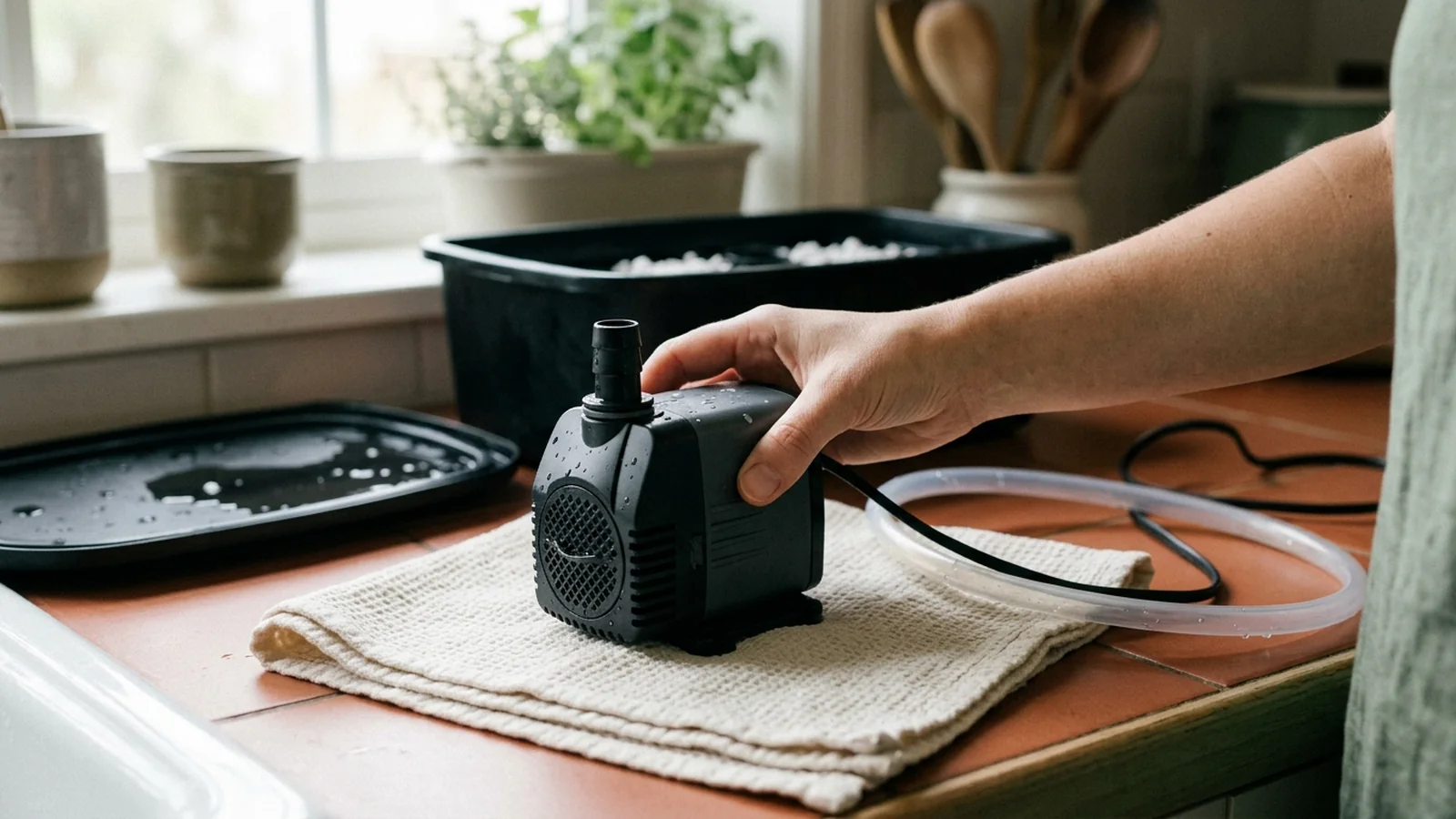
Hydroponic pump failure: what happens and what to do
A stopped pump does not threaten every hydroponic system the same way. Here is the mechanism behind each one, and the plan to run when yours goes quiet.
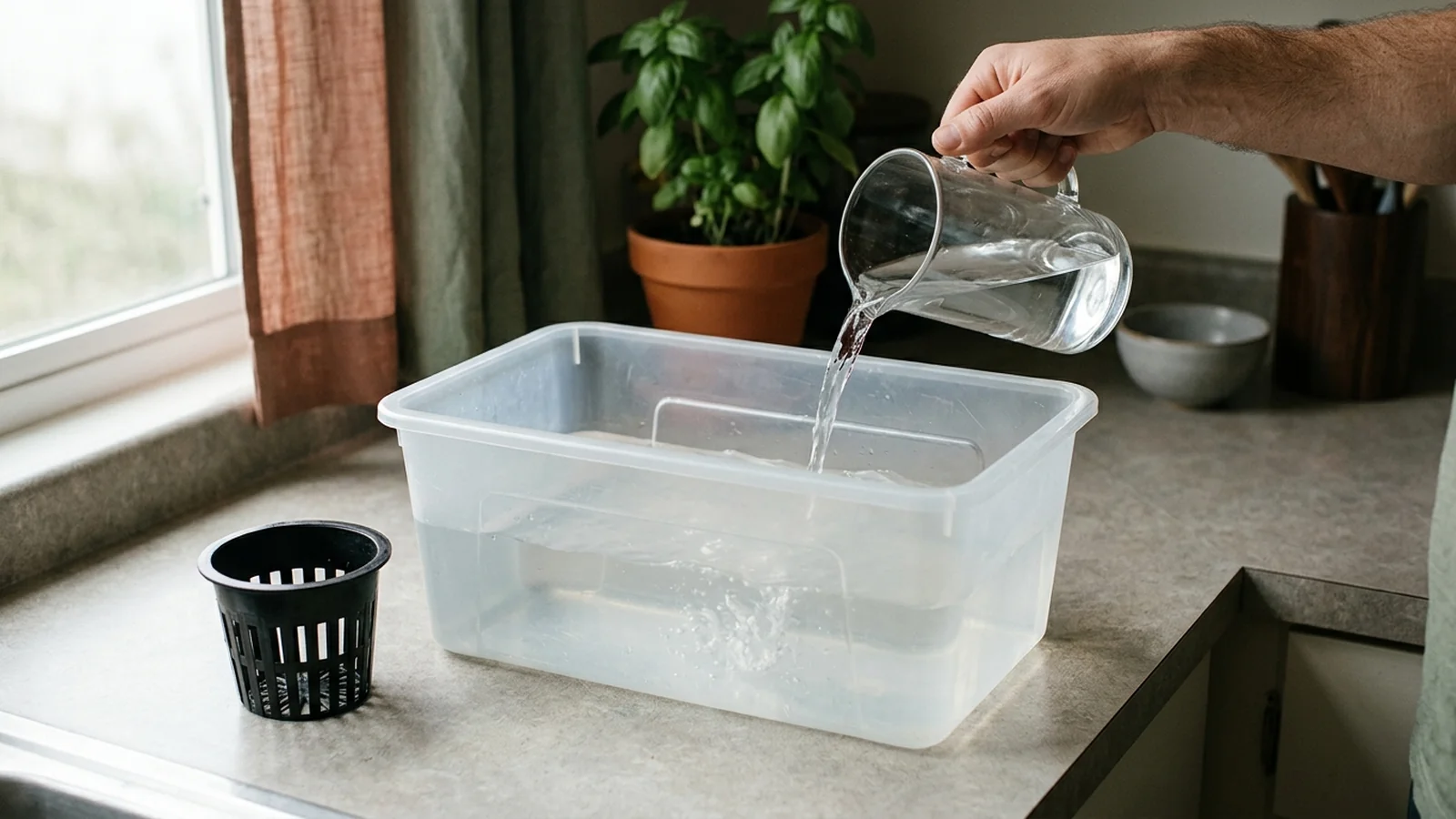
Hydroponic reservoir size: how many litres you actually need
Reservoir size is a function of plant count, system type, and one sourced rule for deep water culture: more than 4 litres per plant. Here is how to size yours.
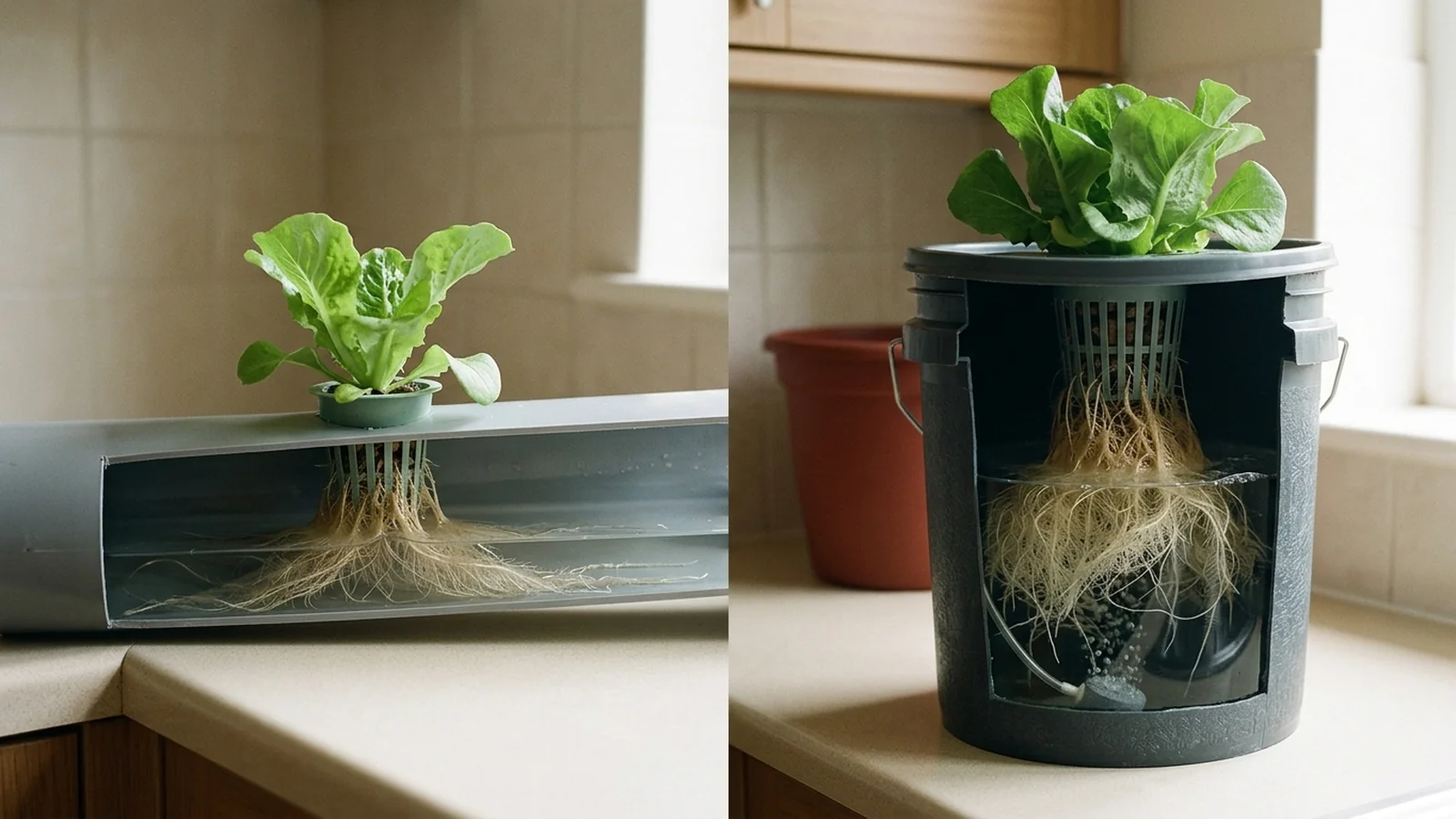
NFT vs DWC: the concrete differences that decide which one fits
NFT and DWC both grow lettuce and greens well, but they get oxygen to the roots in opposite ways, and that difference decides how each one fails.