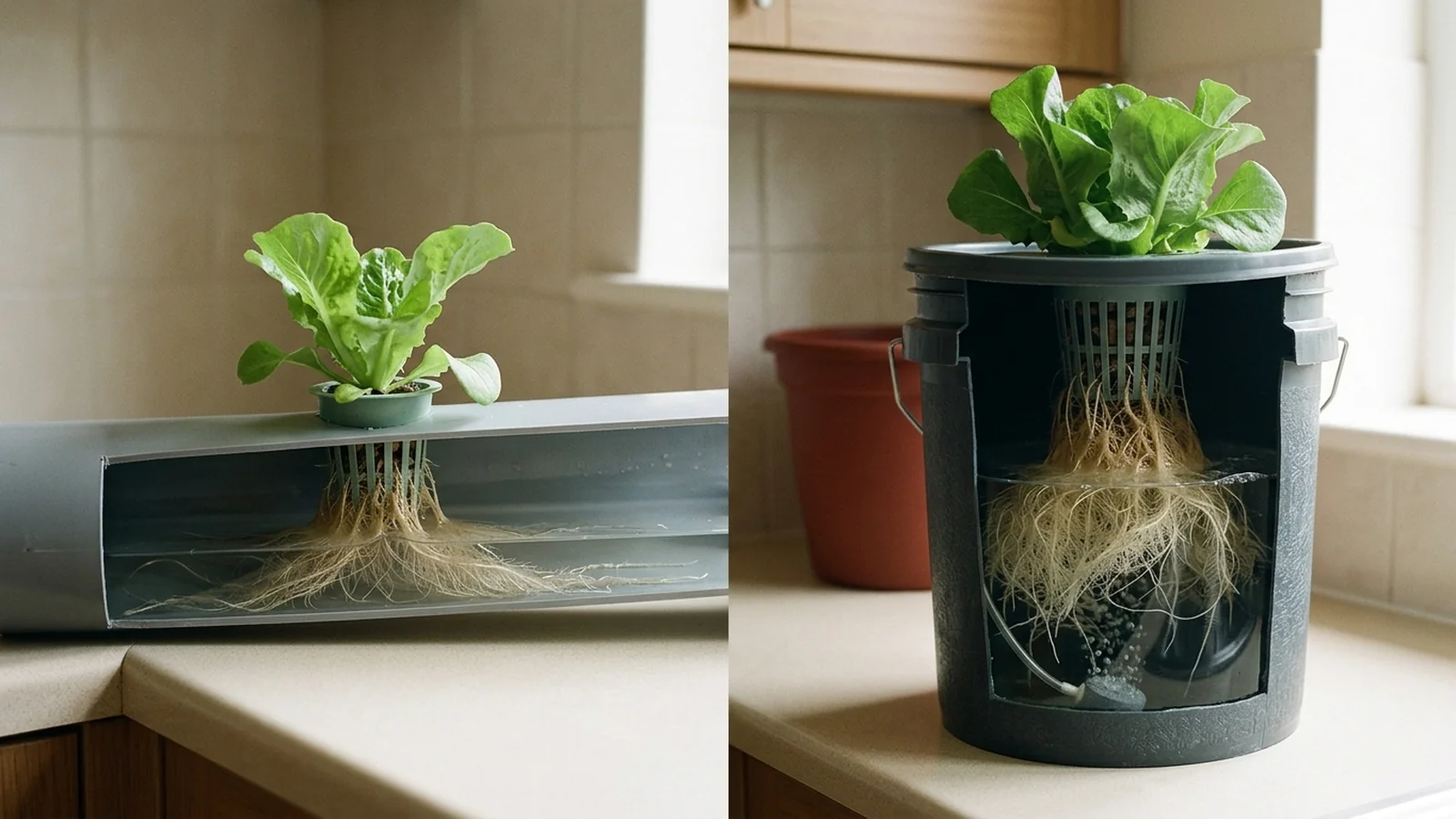
NFT vs DWC, mechanism and failure
| Factor | NFT | DWC |
|---|---|---|
| Root oxygen source | Humid air in the channel, wetted by a thin flowing film | Standing solution, forced open by an air pump and air stone |
| Pump type and role | Water pump; must run continuously to keep the film moving | Air pump; must run continuously to keep the water aerated |
| Dissolved oxygen equipment | None required | Air pump and air stones, targeting 6-8 ppm |
| Reservoir at the root zone | Low volume; a thin film only | More than 4 L (1 gal) per plant |
| What a stopped pump does | Roots dry out quickly; no water buffer at the channel | Water stays put, but dissolved oxygen falls as it is not replenished |
| Typical density (lettuce) | About 2 plants/ft2 (30/m2) | 3 to 4 plants/ft2 (35-40/m2) |
NFT and DWC are the two systems most people end up choosing between once they have decided to build something active. They solve the same problem, keeping roots supplied with oxygen, in opposite ways. NFT keeps roots mostly out of the water, in a humid channel wetted by a thin moving film, and needs no aeration equipment. DWC submerges roots fully in standing solution and depends on a running air pump to force oxygen into that water. That one mechanical difference is what decides how each system fails, how much it can hold, and which pump you are trusting not to stop.
For the wider field — Kratky, ebb-and-flow, drip — see the full system comparison for beginners. What follows stays on the pair growers actually cross-shop.
How each one gets oxygen to the roots
This is the mechanism that makes the two systems different, not just differently shaped.
In DWC, the plant’s root mass hangs directly in the nutrient reservoir. That water has a finite amount of dissolved oxygen in it, and roots and the microbes living on them consume it continuously. Left alone, a still reservoir depletes toward the level where growth suffers, which is why deep water culture is built around forced aeration: University of Kentucky Extension and Virginia Cooperative Extension both describe DWC as needing an air pump and air stones to reach 6 to 8 ppm dissolved oxygen. Missouri Extension’s more general figure agrees with the direction: over 6 ppm is optimum for hydroponic production, and low oxygen both slows growth and raises ethylene production in the plant.
NFT sidesteps that problem rather than solving it. Roots grow inside a sloped, mostly-empty channel, and only the underside of the root mat sits in the shallow film of solution flowing past. The rest of the root system is exposed directly to the humid air above the film. University of Kentucky Extension’s line on this is direct: NFT needs no aeration equipment at all, because the continuous thin film provides the oxygen the roots need. The mechanism is atmospheric contact, not dissolved oxygen in a body of water — which is also why the size of the reservoir feeding an NFT channel matters far less to root health than the size of a DWC bucket does.
Cornell’s greenhouse-scale research is a useful ceiling on both approaches: even a well-run air pump and air stone cannot match what a pure-oxygen injection system reaches, and Cornell targets 7 mg/L (7-10 ppm) with pure oxygen against a lettuce failure point of below 3 ppm. For a home DWC bucket without oxygen injection, the air pump is doing the entire job an extension-scale system splits between aeration and injected oxygen.
Water temperature affects both systems by the same physics, just through different plumbing. Warmer water holds less dissolved oxygen at saturation — the U.S. Geological Survey’s solubility table puts fresh water at 9.4 mg/L at 18°C (64°F) and 7.9 mg/L at 27°C (81°F), a roughly 16% drop. That number still clears Cornell’s 7 mg/L set-point and sits well above the 4 ppm minimum lettuce needs, so the real risk of a warm reservoir is not the water losing its capacity to hold oxygen — it is consumption by roots, algae, and pathogens outrunning resupply once a system goes quiet. In DWC that resupply is the air pump. In NFT it is the moving film itself; a warm, unmoving NFT channel loses its oxygen advantage the moment the water pump stops. Dissolved oxygen at a smaller scale is covered in full at dissolved oxygen for small systems; water temperature specifically is covered at hydroponic water temperature for lettuce.
What a stopped pump actually does
Both systems depend on a pump running continuously, but not the same kind of pump, and not with the same consequence when it fails.
NFT runs on a water pump moving solution up to the top of a sloped channel, where gravity carries the thin film back down past the roots. University of Kentucky Extension states plainly that NFT and drip systems will dry out rapidly once flow stops, because there is no standing reservoir buffering the root zone — the whole design trades reservoir volume for flow efficiency. University of Minnesota Extension adds a second failure path specific to NFT: if the reservoir’s water level falls below the pump intake, the pump itself can be damaged running dry. Minnesota is also blunt about the underlying dependency: a more complex system’s biggest downside is that it depends on pumps, which stop working the moment the power does.
DWC runs on an air pump, and a stalled air pump does not immediately dry anything out — the roots are still sitting in water. What changes is slower and easier to miss: dissolved oxygen in that standing water starts falling as plants and microbes keep consuming it with no aeration replenishing the supply. It is a quieter failure than an NFT channel drying out, but it ends the same way if the air pump stays off, and a warm reservoir accelerates it. Build in a failure margin on both: check how long an NFT reservoir’s level lasts before it reaches the pump intake, and check how quickly a DWC bucket’s air stone restarts after a power blip. The mechanics of sizing that margin, and what to do when a pump does fail, are covered in what happens when a hydroponic pump fails and in do you need an air pump for hydroponics?.
One risk both systems share regardless of pump health: a shared reservoir means a waterborne pathogen has one route to every plant. University of Kentucky Extension lists that shared-solution pathogen spread as a defining disadvantage of both DWC and NFT, not a flaw unique to either. Watching for it is a root-health question rather than a pump question — see preventing hydroponic root rot.
How much they hold, and how densely you can plant
The two systems also differ in how much of a buffer sits at the root zone, and that difference tracks the oxygen mechanism above rather than working against it.
DWC’s design point, per University of Kentucky Extension, is more than 4 litres (over 1 gallon) of water per plant, in a frame at least 12 inches deep. Virginia Cooperative Extension’s numbers for a raft-style DWC pond run 4 to 12 inches deep depending on target volume, built on the original Jensen raceway depth of 6 to 8 inches, with rafts typically 2 by 4 feet and lettuce spaced about 8 inches apart on the raft. That volume is what gives DWC its buffer: a reservoir that size changes temperature and loses oxygen more slowly than NFT’s thin film does, which is why DWC has margin NFT does not, and why it still needs forced aeration rather than relying on passive exposure.
NFT is built the opposite way on purpose: University of Kentucky Extension describes it as low volume, with the thin film doing the work instead of a standing reservoir. University of Minnesota Extension’s own trial found 8 to 10 ounces of solution per minute the ideal flow rate for lettuce, run from a 25-gallon reservoir — most of that reservoir’s volume sits in a holding tank away from the roots, not in the channel itself. Minnesota’s table-top example packs six 4-foot channels into a 55 by 55 by 31-inch footprint, for 36 plant spaces — a compact footprint the channel’s low water volume per plant makes possible.
Water volume per plant does not set planting density on its own. University of Kentucky Extension’s figures for lettuce show DWC packing more plants per square foot — 3 to 4 plants per square foot (35-40 per square metre) — than NFT’s roughly 2 plants per square foot (30 per square metre) — despite carrying over 4 litres of standing water per plant that NFT’s thin film does not hold. NFT’s advantage is water volume per plant, not planting density: it runs on a fraction of the standing solution a DWC bucket needs.
Which crops actually suit each one
Neither system is a small-space fit for fruiting crops. University of Minnesota Extension lists tomatoes, cucumbers, and peppers as summer crops and points growers toward herbs and leafy greens for anything grown indoors through a low-light season. University of New Hampshire Extension is blunter about why: even lettuce is hard to light through a New Hampshire winter, and “certainly not enough for plants with higher light requirements like tomatoes or cucumbers.” UF/IFAS Extension adds a limit that applies to both systems regardless of the pump: short-term crops finishing in 50 to 60 days, like lettuce, grow well in a wide range of systems, while crops running past 60 days are harder in NFT or floating beds.
Within leafy greens, the sourced crop lists lean toward NFT having the wider documented range: University of Minnesota Extension names arugula, butterhead lettuce, collard greens, herbs, kale, mustard greens, microgreens, spinach, and swiss chard as greens shown to perform well specifically in NFT. University of Kentucky Extension and Virginia Cooperative Extension both describe DWC as a lettuce and leafy-green raft or bucket system rather than a system tested crop-by-crop the way NFT’s list is — plan a DWC build around lettuce and soft herbs first, and treat anything beyond that as a build worth watching closely rather than a documented fit.
Choosing between them today
Building this weekend, the pump you already trust is a reasonable tiebreaker. An air pump and air stone are cheap, simple, and forgiving of a short outage because the water buffer around them is large. A water pump feeding an NFT channel carries far less water per plant than DWC’s more-than-4-litres-per-plant, so it is lighter and cheaper to fill, but it is also the single point of failure for every plant in that channel the moment flow stops. If a build already exists at home, deep water culture for small spaces covers the DWC side in build detail; anyone weighing the whole field including Kratky should start at the beginner system comparison instead.
Sources
- University of Kentucky Center for Crop Diversification CCD-CP-63 — Hydroponic Lettuce Production in Controlled Environments
- Virginia Cooperative Extension SPES-464 — Hydroponic Production of Edible Crops: Deep Water Culture (DWC) Systems
- University of Minnesota Extension — Small-scale hydroponics
- Cornell University CEA Program — Hydroponic Lettuce Handbook
- University of Missouri Extension G6984 — Hydroponic Nutrient Solutions
- USGS Techniques of Water-Resources Investigations, Book 9, Chapter A6.2 — Dissolved Oxygen
- UF/IFAS Extension HS1422 — Growing Lettuce in Small Hydroponic Systems
- University of New Hampshire Extension — Hydroponics at Home
Building either system? Also read
These guides cover the air-pump question directly, what a stalled pump does to roots, and the wider system field if NFT and DWC are not the final answer.
Common questions
What is the real difference between NFT and DWC?
NFT flows a thin film of nutrient solution past roots that sit mostly in humid air inside a sloped channel, so the roots get oxygen from that air space and need no aeration equipment. DWC submerges roots fully in standing solution, so an air pump and air stones have to force oxygen in, typically reaching 6 to 8 ppm dissolved oxygen.
Does NFT need an air pump like DWC does?
No. University of Kentucky Extension states plainly that NFT needs no aeration equipment because the continuous thin film supplies the oxygen roots need. DWC depends on an air pump and air stones to reach its 6 to 8 ppm dissolved oxygen target, and that pump has to keep running.
Which fails worse, a stopped NFT pump or a stopped DWC air pump?
They fail on different timelines. University of Kentucky Extension notes that NFT and drip systems dry out rapidly once flow stops, because there is no standing reservoir at the root zone. A stalled DWC air pump leaves roots sitting in water that keeps losing dissolved oxygen as plants and microbes consume it, which is slower to become critical but still ends the same way if aeration stays off.
Can I grow the same crops in NFT and DWC?
Mostly. University of Minnesota Extension names arugula, butterhead lettuce, collard greens, herbs, kale, mustard greens, microgreens, spinach, and swiss chard as leafy crops shown to perform well in NFT specifically. DWC, in University of Kentucky Extension and Virginia Cooperative Extension, is documented mainly as a lettuce and leafy-green system built around a floating raft or bucket. Neither is a small-space fit for fruiting crops like tomatoes or peppers.
Related guides
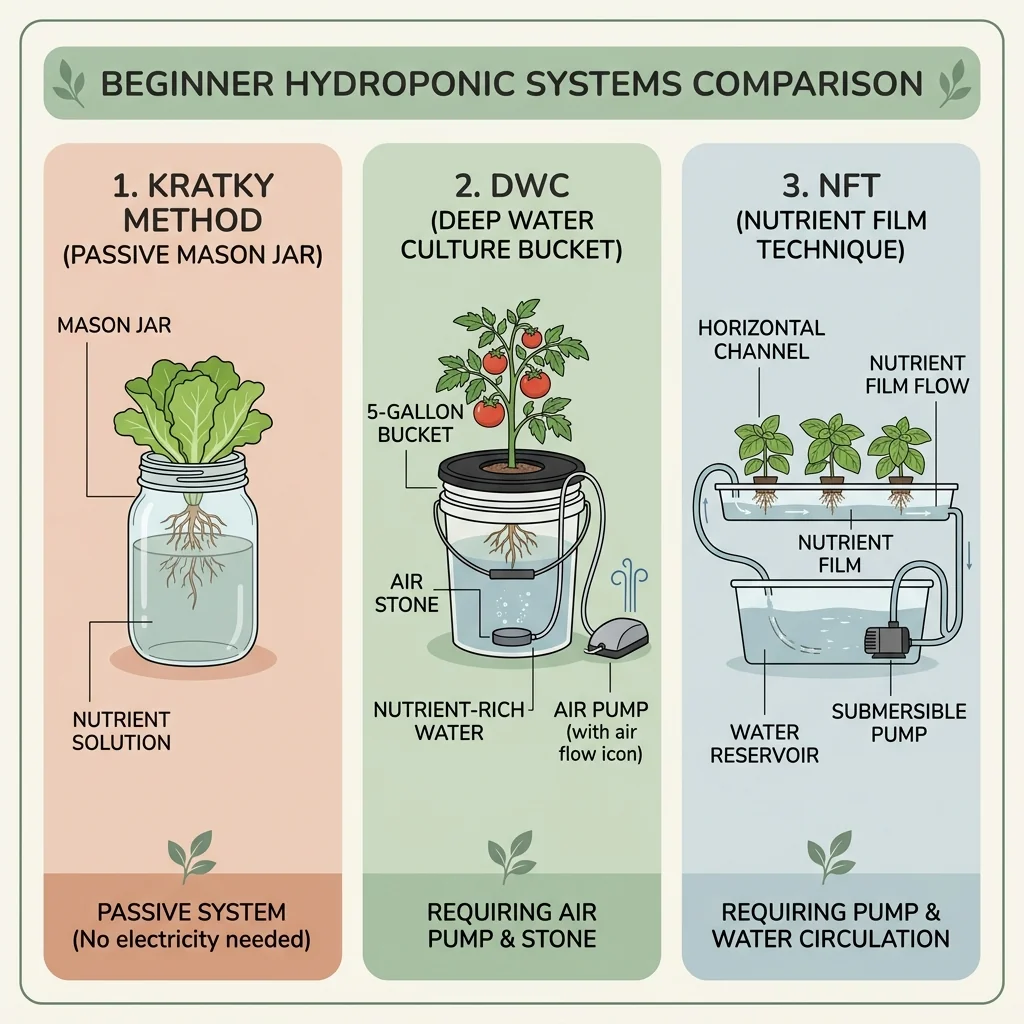
NFT vs DWC vs Kratky: which should a beginner pick?
Three systems dominate small-space hydroponics: Kratky, DWC, and NFT. This comparison shows how they differ and which one a beginner should actually start with.
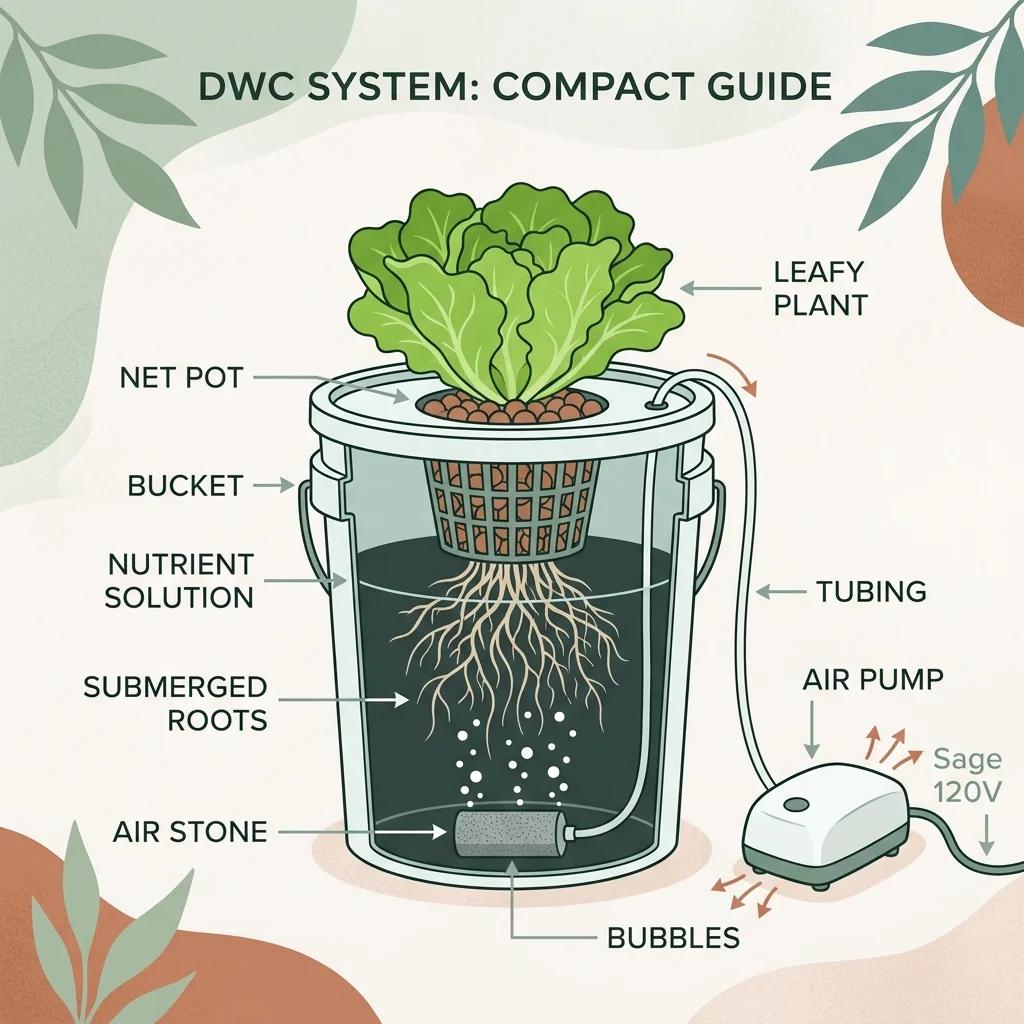
What is DWC? Deep water culture for small spaces
DWC suspends roots in aerated nutrient solution for fast growth. It is one of the best active systems for a small space, as long as you manage oxygen and heat.
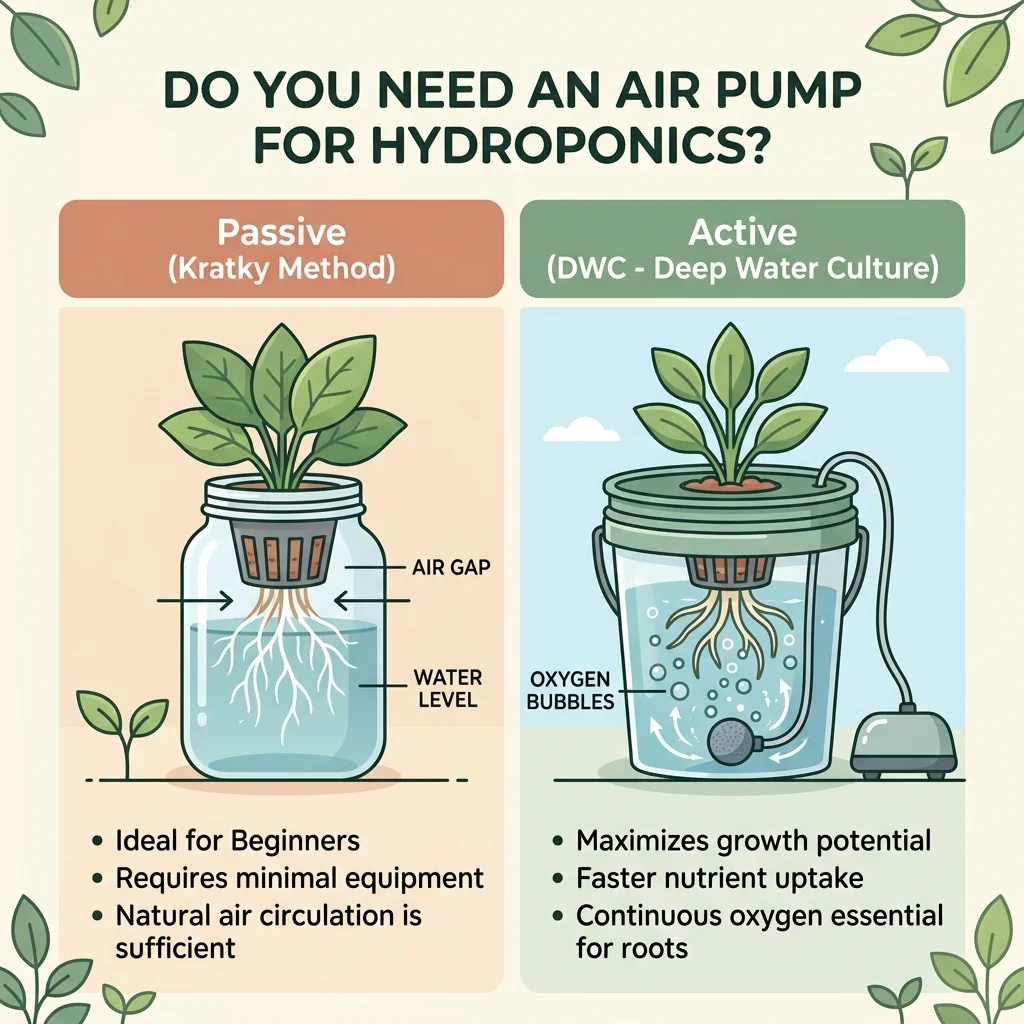
Do you need an air pump for hydroponics?
If you search for hydroponic tutorials, you will see a maze of air pumps, plastic tubing, and bubbling airstones. But do you actually need electrical aeration to grow plants in water? Here is the science of passive vs. active hydroponic setups.