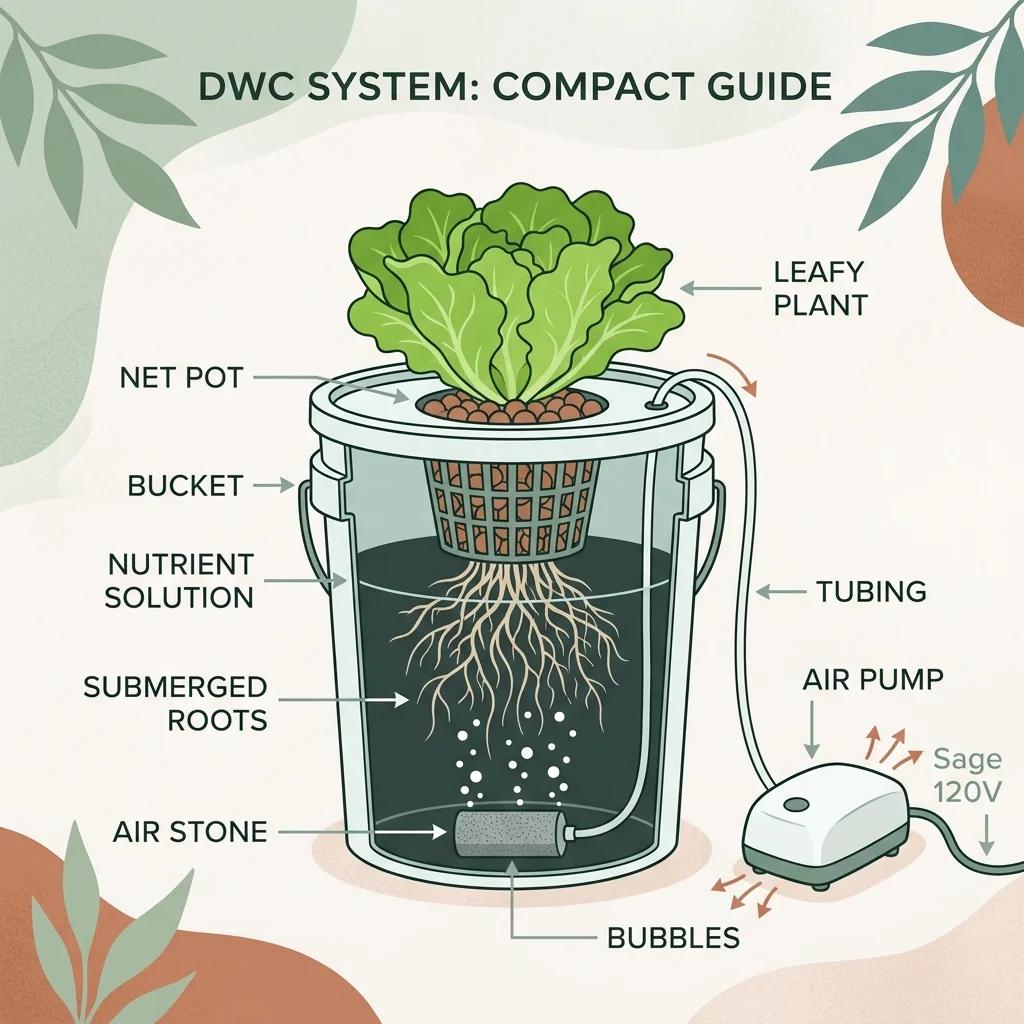
Small-space DWC at a glance
| Element | What to use | Why it matters |
|---|---|---|
| Reservoir | Opaque bucket or tub | Blocks light and algae |
| Aeration | Air pump + air stone, always on | Keeps roots alive |
| Net pot + media | Clay pebbles or rockwool | Holds the plant above the water |
| Water temp | Below 70°F (21°C) | Prevents root rot |
Deep water culture (DWC) is one of the best active hydroponic systems for a small space. As a quick answer: plant roots hang in a reservoir of nutrient solution that is kept oxygenated by an air pump and air stone, which gives fast growth in a single bucket or tub. The two things to manage are oxygen and water temperature. If nutrients are new, start with hydroponic nutrient basics.
How DWC works
A net pot holds the plant above the nutrient solution while roots grow into it. An air pump and diffuser promote gas exchange. DWC can support rapid growth when oxygen, temperature, nutrition, light, and spacing are adequate; the system type alone does not guarantee a yield advantage.
A simple small-space build
- Reservoir: an opaque bucket or tub (light drives algae).
- Aeration: an air pump and diffuser sized for the reservoir and run continuously in a conventional home DWC setup; see do you need an air pump for hydroponics?.
- Net pot and media: clay pebbles or rockwool to hold the plant.
- Nutrient solution: mixed to your crop’s target, following how to mix hydroponic nutrients.
The main risk: root rot
DWC’s submerged root zone makes loss of aeration or excessive heat consequential. Warm water holds less dissolved oxygen, but brown roots are not automatically disease because some nutrients stain them. Inspect firmness, odour, new root tips, crop response, pump output, and temperature together. See hydroponic root rot prevention.
Size for failure margin
A larger reservoir changes more slowly and gives more time to notice a problem, but it is heavier and more costly to replace. Measure usable volume after the lid, net pots, and equipment displace water. Keep the air pump above the waterline or install a suitable check valve so a power outage cannot siphon solution backward.
For valuable crops, two air outlets or a spare pump reduce the consequence of one failed component. Bubble appearance is not a dissolved-oxygen measurement; monitor roots and water temperature, and add a calibrated dissolved-oxygen meter only when the extra precision is justified.
Build for cleaning and electrical safety
- choose food-compatible, opaque material with a removable lid;
- route cables with drip loops and keep connections above spills;
- support plants independently instead of overloading a thin lid;
- make the diffuser and pump intake accessible around mature roots;
- label usable volume and maximum fill line.
Cover unused net-pot holes with opaque, cleanable inserts. Avoid loose covers that can fall into the reservoir or obstruct equipment.
Keep a minimum DWC log
Record level, top-up volume, EC, pH, water temperature, pump status, root observation, and one crop note at consistent times. An EC rise while level falls can mean water is leaving proportionally faster than ions; a falling EC can mean a different uptake balance. Neither trend authorises an automatic nutrient dose without the crop program and source-water baseline.
If pH changes unusually fast, confirm meter calibration, root health, source-water alkalinity, and reservoir age. Change one input at a time: simultaneously adding nutrient, pH adjuster, peroxide, and microbes destroys the diagnostic signal and may create incompatible treatments.
DWC vs other systems
DWC is more hands-off than it looks once running, but it depends on power and aeration. If you want the simplest possible passive option, compare it with the Kratky method and NFT in NFT vs DWC vs Kratky. If you would rather buy a ready-made unit than assemble a bucket, see Best hydroponic systems for beginners.
Sources and further reading
If you are setting up DWC, also read
These guides connect deep water culture to air supply, root health, and system comparison.
Common questions
What is deep water culture (DWC)?
DWC is an active hydroponic method where plant roots hang directly in a reservoir of nutrient solution that is kept oxygenated by an air pump and air stone. It is known for fast growth and simple, low-cost builds.
Does DWC need an air pump?
Yes. Constant aeration is what keeps the submerged roots alive. Without an air pump and air stone the water loses oxygen and the roots quickly suffocate and rot.
Why do my DWC roots turn brown and slimy?
That is root rot, usually from warm water or a stopped air pump. Keep the reservoir cool, below about 70°F (21°C), and make sure aeration runs continuously.
Is DWC good for beginners in a small space?
Yes. A single bucket or tub DWC system is one of the easiest active setups and fits a small space well, especially for lettuce, greens, and herbs.
Related guides
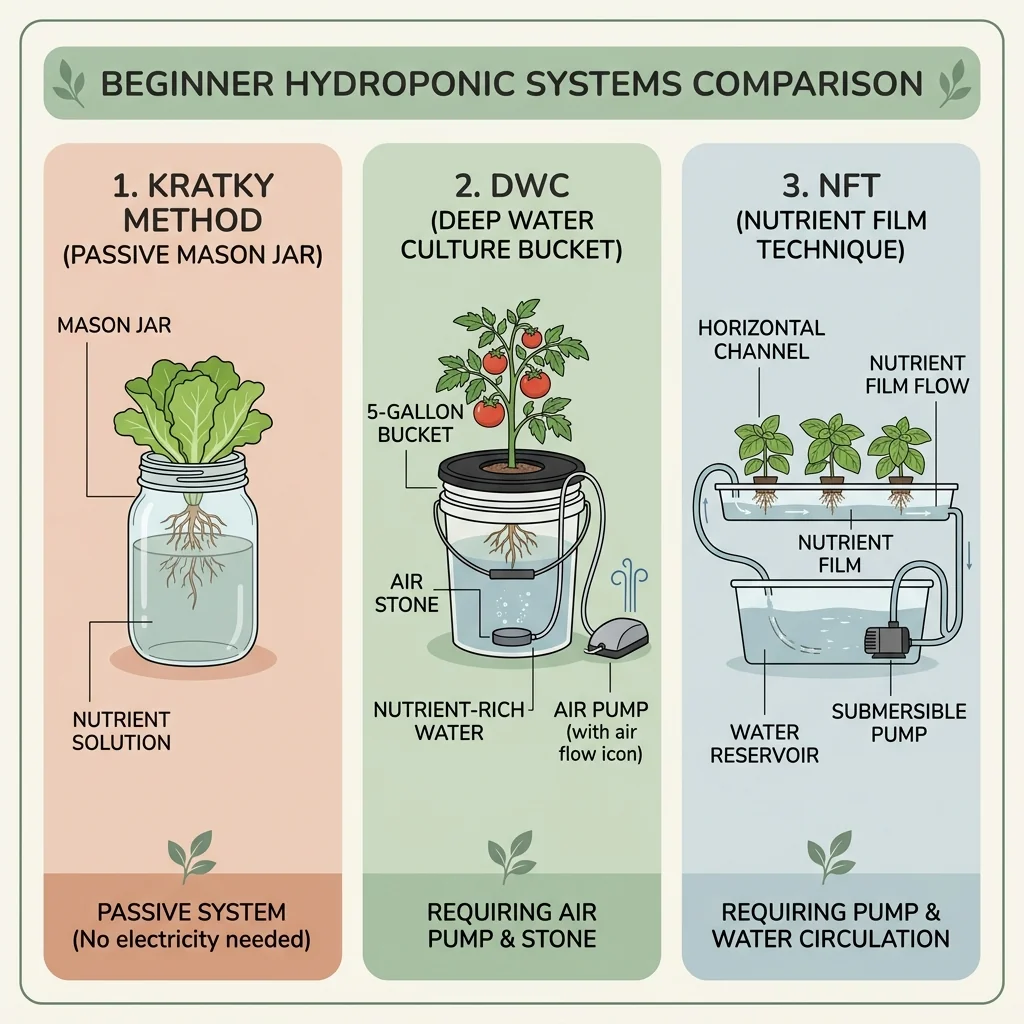
NFT vs DWC vs Kratky: which should a beginner pick?
Three systems dominate small-space hydroponics: Kratky, DWC, and NFT. This comparison shows how they differ and which one a beginner should actually start with.
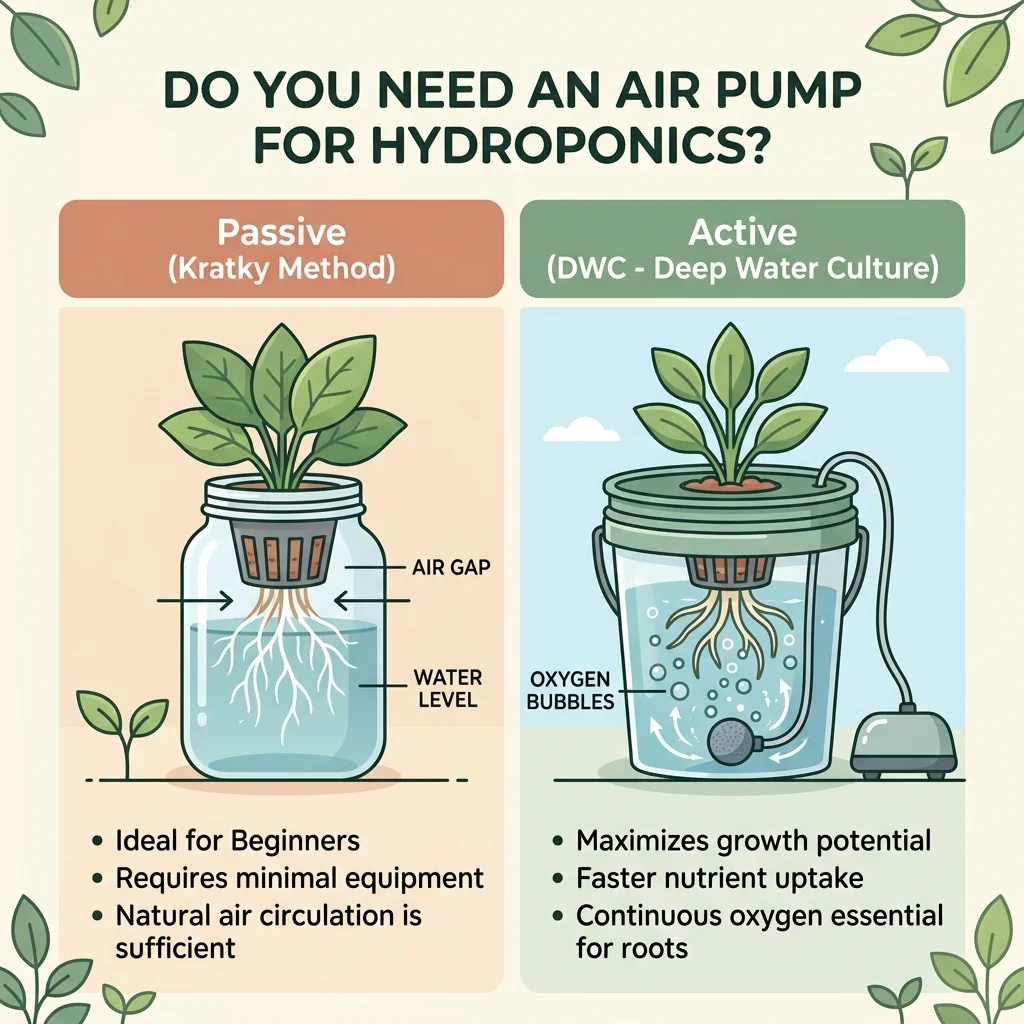
Do you need an air pump for hydroponics?
If you search for hydroponic tutorials, you will see a maze of air pumps, plastic tubing, and bubbling airstones. But do you actually need electrical aeration to grow plants in water? Here is the science of passive vs. active hydroponic setups.
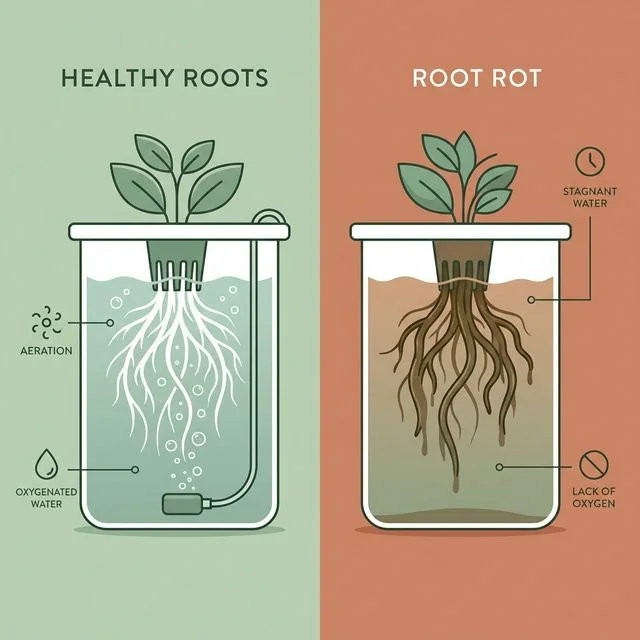
Hydroponic root rot: how to spot it early and stop it
Brown, slimy or swampy-smelling roots mean root rot. Catch it early and fix the conditions behind it — warm water, low oxygen and stagnant flow.