Planting density by system (University of Kentucky Extension)
| System | Plants per ft² | Plants per m² |
|---|---|---|
| DWC / floating raft | 3–4 | 35–40 |
| NFT channel | ~2 | ~30 |
| Drip | 1–2 | 20–25 |
| Ebb-and-flow | ~2 | ~25 |
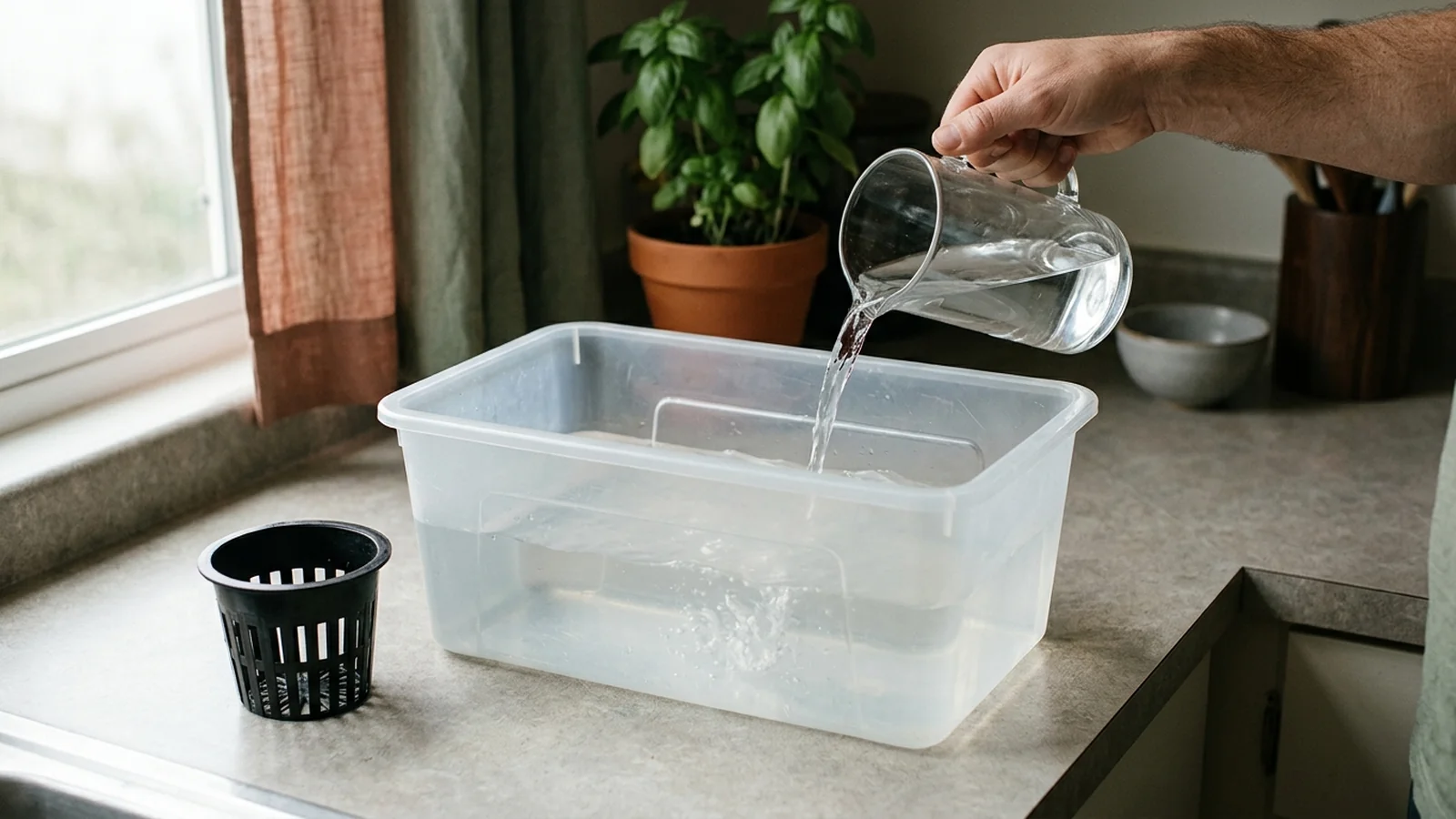
A deep water culture reservoir needs more than 4 litres — more than 1 gallon — of nutrient solution for every plant it holds, according to the University of Kentucky’s Center for Crop Diversification. Kentucky publishes that floor for deep water culture and float beds; the flowing systems are sized differently, from channel volume and pump flow. NFT, drip, and ebb-and-flow reservoirs feed a recirculating channel rather than storing each plant’s full water ration, so sizing one starts from plant count and channel footprint instead of a litres-per-plant target. The system comparison guide covers which of the four fits your space before you build one.
How many plants fit, before you size the tank
Reservoir size is downstream of plant count, and plant count is downstream of your system’s planting density. The University of Kentucky’s Center for Crop Diversification publishes density figures for four common systems: DWC and floating rafts hold 3 to 4 plants per square foot (35 to 40 per square metre); NFT channels run lighter, at about 2 plants per square foot (30 per square metre); drip systems hold 1 to 2 plants per square foot (20 to 25 per square metre); and ebb-and-flow sits at about 2 plants per square foot (25 per square metre). Multiply your growing area by the figure for your system and you have a plant count before you have bought a single fitting. Cornell’s commercial pond runs the same crop at two densities — plants go in tight and are re-spaced on Day 21 from 97 plants per square metre to 38, close to Kentucky’s 35 to 40 — so size the reservoir for the finishing density, not the density you transplant at.
| System | Plants per ft² | Plants per m² |
|---|---|---|
| DWC / floating raft | 3–4 | 35–40 |
| NFT channel | ~2 | ~30 |
| Drip | 1–2 | 20–25 |
| Ebb-and-flow | ~2 | ~25 |
Virginia Cooperative Extension’s own raft design gives a concrete check on that range. Its standard raft is 2 feet by 4 feet with plant spacing 8 inches apart, which works out to 18 plant positions on a panel that Kentucky’s density figure would put at 24 to 32. Neither number is wrong; they answer different questions. Use the spacing figure once you know your net-pot layout, and the density figure while you are still planning the panel.
Calculate your reservoir
Live estimate
Enter your growing area and pick a system. The litre figure only applies to DWC and floating rafts; the other systems are sized from channel volume and pump flow instead.
Minimum reservoir volume
—
Fill in the fields to calculate.
- Growing area
- —
- Plants at that density
- —
To do this by hand: multiply your growing area by the planting-density figure for your system to get a plant count, then, for DWC or a floating raft, multiply that plant count by 4 litres (or 1 gallon) to get the minimum reservoir volume. A DWC panel of 8 square feet at the University of Kentucky’s 3 to 4 plants per square foot holds 24 to 32 plants, so at that same source’s more-than-4-litre-per-plant minimum, the reservoir underneath it needs at least 96 to 128 litres (24 to 32 gallons) of solution.
The 4-litre rule, and why DWC is the system that has one
DWC and floating rafts are the systems where every plant’s roots sit directly in a shared body of solution, so the reservoir has to hold enough water to keep roots covered and buffer the gap between top-ups. That is likely why Kentucky publishes a per-plant floor for this system and not for the flowing ones.
Translating that volume into a container shape has its own guidance. A DWC frame needs to be at least 12 inches deep to hold the required volume without an unreasonably large footprint, per the University of Kentucky’s Center for Crop Diversification. Virginia Cooperative Extension’s raceway designs run 4 to 12 inches deep depending on the volume being built for. A shallow, wide reservoir and a deep, narrow one can hold the same litres once the volume is fixed — pick the shape that fits your space. The NFT vs DWC comparison covers the volume and density trade-off between the two systems head to head. Once the volume is settled, the DWC for small spaces guide walks through the air pump, air stone, and the rest of the build.
For a single plant, a 5-gallon bucket — about 19 litres — clears the 4-litre minimum comfortably and is the standard beginner build. University of Minnesota Extension’s only requirement for the container itself is that it be clean and food-safe, and sized to the canopy of the mature plant, which for a lettuce head or a bushy herb means leaving room for the roots and the crown rather than filling the bucket to the rim with foliage.
Sizing NFT, drip, and ebb-and-flow reservoirs
Kentucky’s more-than-4-litre rule is specific to DWC. NFT, drip and ebb-and-flow are sized from channel volume and pump flow rather than from a litres-per-plant figure — the tank feeds a pump, and the channel or tray itself holds only a thin film or a timed flood. Kentucky still ranks the three by volume: NFT is low volume, with the thin film doing the work rather than a standing reservoir, while drip and ebb-and-flow sit in the middle. The ebb-and-flow guide covers flood frequency for that system, and the NFT vs DWC comparison covers the volume difference between a channel and a standing reservoir.
Two real builds give a sense of scale instead of a rule. University of Minnesota Extension’s tabletop NFT design fits six 4-foot channels and 36 plant spaces into a 55 by 55 by 31 inch footprint, and its own trial found 8 to 10 ounces of solution per minute the right flow rate for lettuce, running from a 25-gallon reservoir. Neither figure is a per-plant target; they describe one working system, not a formula. Use them as anchors if you are building a channel system from scratch and have nothing sourced to size against, then adjust once you see how fast your own channel drains between pump cycles.
Sizing a Kratky jar or other passive container
A Kratky jar or tote does not carry a sourced volume-per-plant figure either, and for a different reason: it works from a falling water level rather than a held one. As the plant drinks, the level drops and the growing air gap above the roots supplies oxygen without a pump. University of Minnesota Extension’s version of that rule is proportional, not volumetric — keep the roots one-third to one-half submerged once they outgrow the net pot — so there is a starting depth and a finishing depth to aim for, not a litre count.
Kentucky’s DWC minimum is the nearest volume figure a passive jar has, but it was measured on an aerated system, so treat it as the top of the useful range rather than a target. The Kratky method guide covers container choice and starting depth for that system in full.
Reservoir size and how fast your solution drifts
Reservoir size affects more than plant count; it also affects how fast the nutrient solution’s concentration moves. Cornell University’s hydroponic lettuce handbook describes the two forces acting on it: concentration falls as plants take up nutrients, and rises as evaporation and transpiration remove water from the tank. Uptake is set by how many plants are drinking, not by how much water sits under them, so the same daily draw is a smaller fraction of a large tank than of a small bucket — a bigger reservoir drifts more slowly, even though it is not immune to drifting.
University of Minnesota Extension’s own monitoring advice reflects a related but separate distinction: it checks pH weekly on a running NFT system, where the working volume moving through the channel at any moment is genuinely small, while noting that a small passive container’s pH is unlikely to change substantially over a period of weeks. Recirculation matters as much as size — a static container behaves differently from a flowing one even at a similar volume.
Once the tank is sized, the EC and pH target still depends on what is growing in it. Oklahoma State University Extension’s 27-crop table is the fullest per-crop reference available for that, and the hydroponic EC chart by crop walks through it. For reading a swing once you have one, EC rising or falling and when to change the whole solution cover what to do next; sizing the tank correctly just means you see fewer of those swings.
Common sizing mistakes
- Undersizing a DWC reservoir below the 4-litre floor. The level falls fast, roots dry out faster between checks, and the small volume swings in EC and pH quicker than a properly sized tank.
- Sizing by container availability rather than plant count. A tote that happens to be in the garage is not automatically the right size for the density of plants sitting on it.
- Borrowing the DWC litres-per-plant figure for NFT, drip, or ebb-and-flow. Those reservoirs are sized to channel volume and pump flow. Undersizing the pump-side tank makes it run dry between refills rather than starving individual plants of solution the way an undersized DWC bucket does.
- Topping up without matching concentration. University of Minnesota Extension’s rule is that any water added should carry nutrients at the same concentration as the original mix — if the label calls for one teaspoon per gallon, every added gallon gets a teaspoon — with pH checked again afterward.
If your reservoir runs warm, check it against the hydroponic water temperature guide rather than assume a bigger tank fixes it on its own; volume changes how fast a solution drifts, not the temperature it drifts at.
Sources
- University of Kentucky Center for Crop Diversification, CCD-CP-63: Hydroponic Lettuce Production in Controlled Environments
- Virginia Cooperative Extension SPES-464: Hydroponic Production of Edible Crops — Deep Water Culture (DWC) Systems
- University of Minnesota Extension: Small-scale hydroponics
- Cornell University CEA Program: Hydroponic Lettuce Handbook
- Oklahoma State University Extension HLA-6722: Electrical Conductivity and pH Guide for Hydroponics
Pick and build the system this reservoir feeds
These guides cover the systems the calculator sizes for, and what to do once the reservoir is running.
Common questions
How many litres of water does a hydroponic plant need in its reservoir?
University of Kentucky Extension states that deep water culture needs more than 4 litres, or more than 1 gallon, of nutrient solution per plant. That figure is specific to DWC and floating-raft systems; NFT, drip, and ebb-and-flow are sized differently, because their reservoirs feed a recirculating channel rather than storing each plant's full water supply.
How big should a DWC bucket be for one plant?
A single 5-gallon bucket, about 19 litres, clears the more-than-4-litre minimum by a wide margin for one plant, which is why it is the standard beginner DWC container. University of Minnesota Extension notes that any clean, food-safe container works, as long as it is sized to the canopy of the mature plant.
Does a bigger reservoir need less monitoring?
Not on its own. University of Minnesota Extension checks a small passive container's pH every few weeks but a running NFT system's EC and pH weekly, and that gap is mostly about recirculation, not volume. A larger tank does dilute a given day's evaporation and nutrient uptake into a smaller percentage change, so it drifts more slowly, but it still needs a schedule.
Can I use the DWC litres-per-plant rule for a Kratky jar?
Treat it as the top of the useful range, not a target. The more-than-4-litre figure comes from an aerated DWC system; a passive Kratky container works from a falling water level and a growing air gap rather than a fixed volume, so follow the passive method for how full to fill it and use the DWC figure only as a ceiling.
Related guides
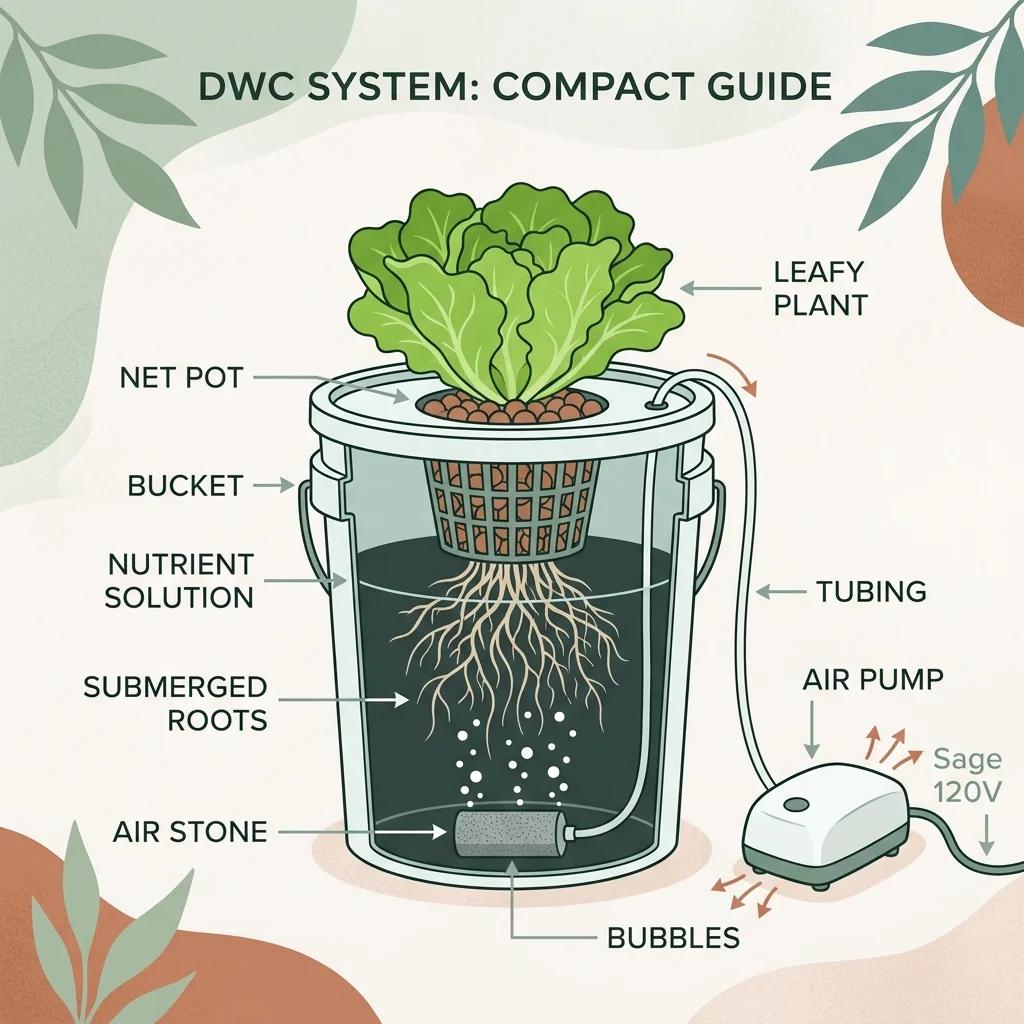
What is DWC? Deep water culture for small spaces
DWC suspends roots in aerated nutrient solution for fast growth. It is one of the best active systems for a small space, as long as you manage oxygen and heat.
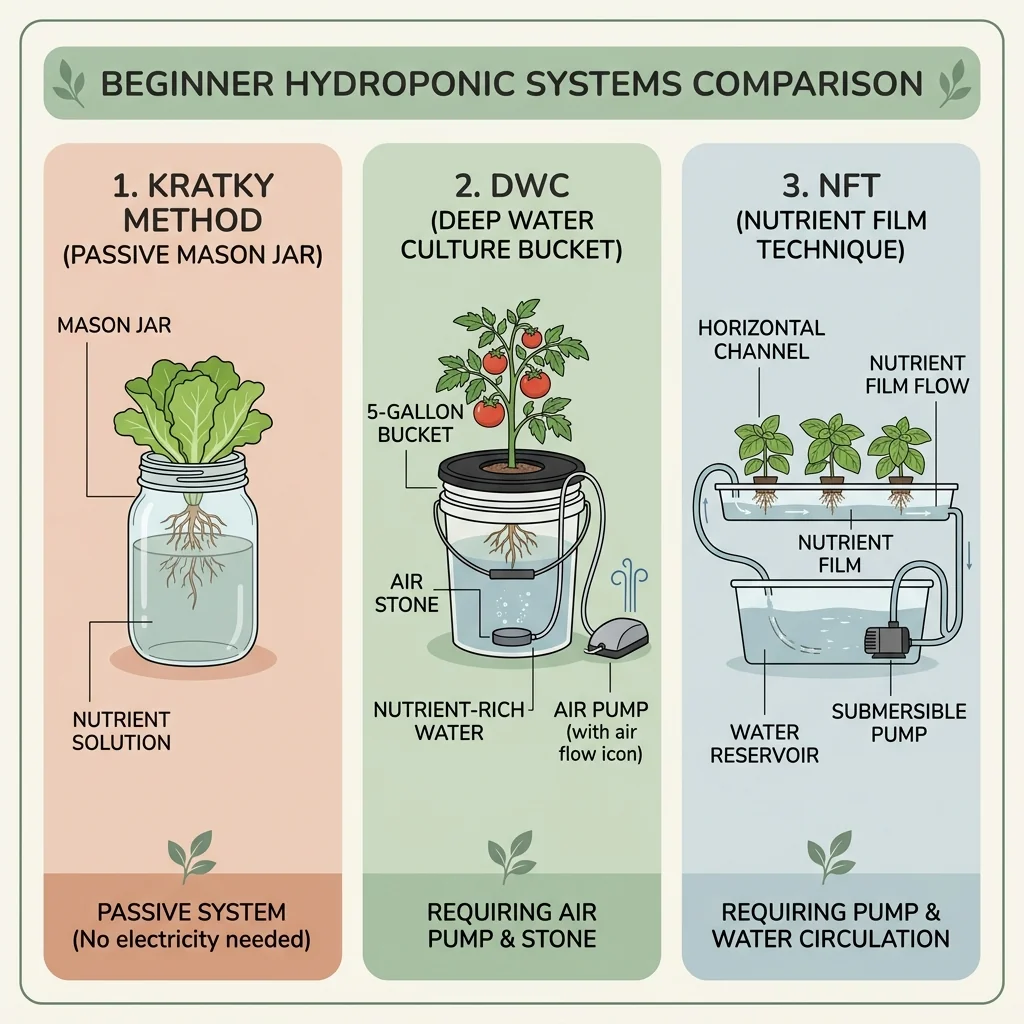
NFT vs DWC vs Kratky: which should a beginner pick?
Three systems dominate small-space hydroponics: Kratky, DWC, and NFT. This comparison shows how they differ and which one a beginner should actually start with.
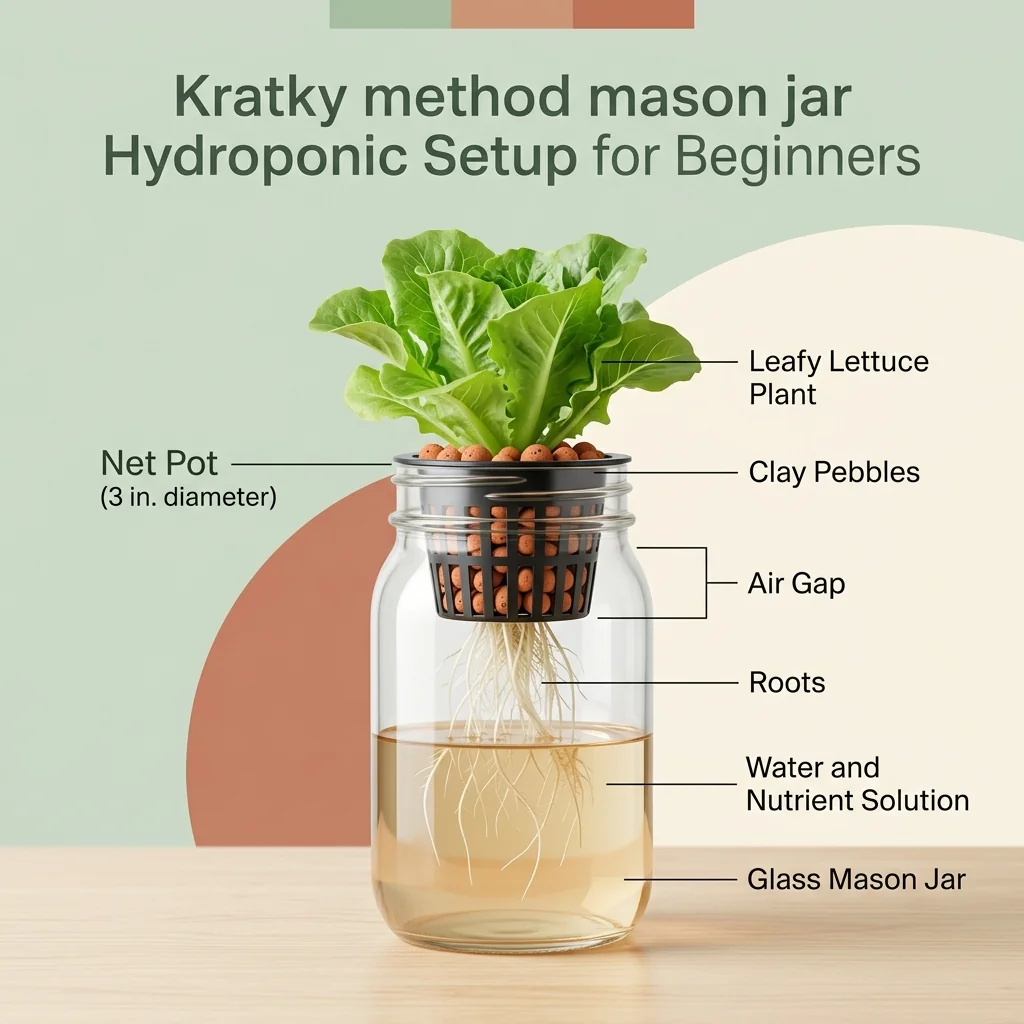
The Kratky method: passive hydroponics for beginners
The Kratky method is the simplest way into hydroponics: a container of nutrient solution, a net pot, and no pump or power. Here is how it works and its limits.