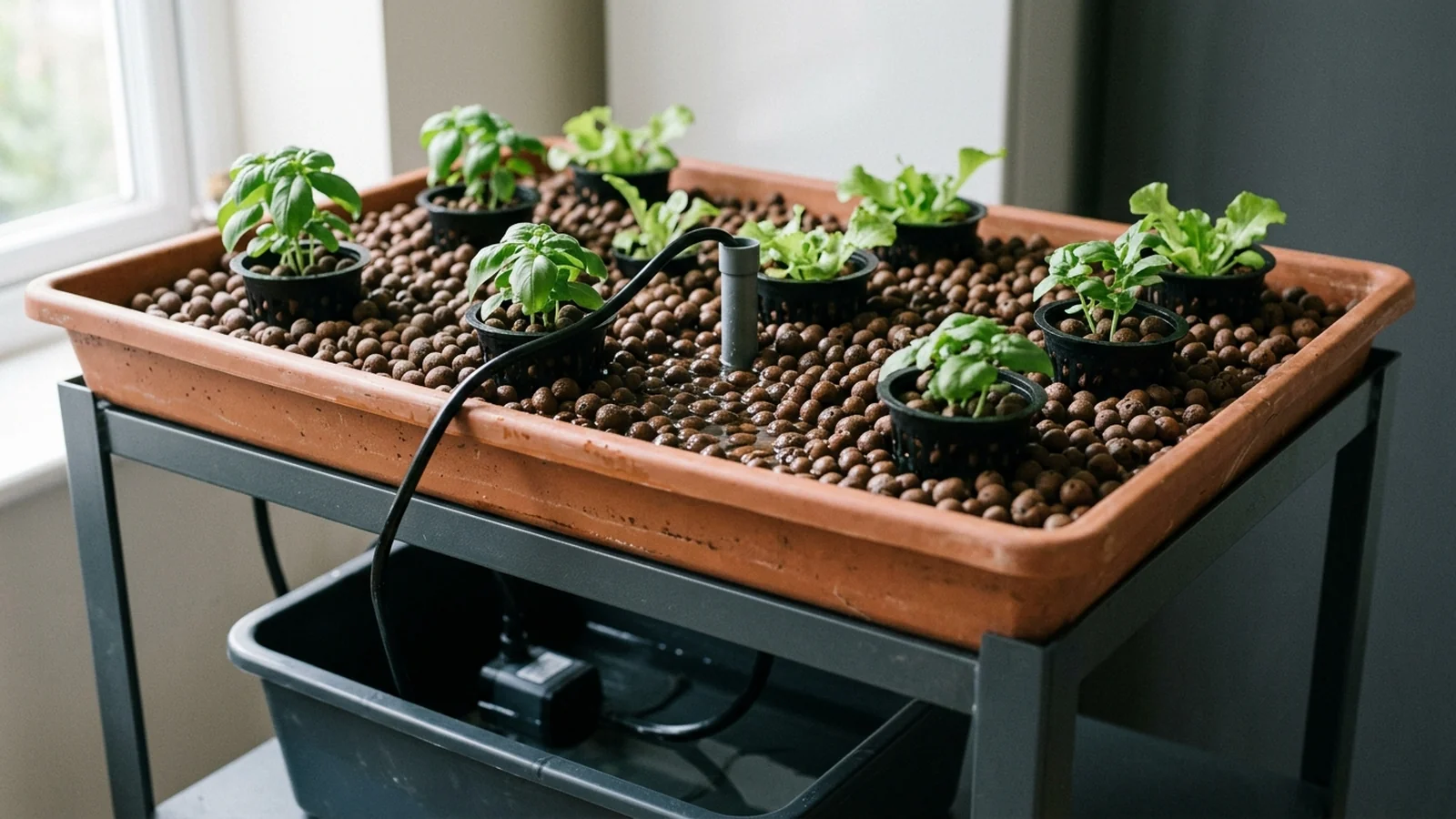
Cornell's commercial rockwool-plug bench: a flood-cycle reference point
| Growth stage | Flood frequency | Flood duration |
|---|---|---|
| Days 0-6, freshly seeded plugs | Every 12 hours | 15 minutes (a quarter hour) |
| After day 6, established plugs | Four times a day (every 6 hours) | 15 minutes |
Ebb and flow, also called flood and drain, floods a grow tray of medium with nutrient solution on a timer, holds it around the roots briefly, then drains it back to the reservoir. If you haven’t picked a system yet, compare NFT, DWC, and Kratky first. If you already know you want flood and drain, here is the build: the timer cycle, the medium, the drainage, and the two ways it fails.
How flood and drain actually works
A submerged pump sits in a reservoir below the grow tray. A timer switches the pump on at set intervals. While it runs, solution is pushed up a fill line into the tray, rising through the medium until it reaches the top of a standpipe. Once the pump switches off, gravity takes over: solution drains back down through the same standpipe, out of the tray, and into the reservoir.
The cycle does two things a passive system can’t. The flood pushes fresh nutrient solution past every root, and the drain that follows pulls fresh air down into the medium behind the retreating water. Roots that were briefly submerged spend most of their time in damp, oxygenated medium rather than standing water, which is the trade-off flood and drain is built around. The University of Kentucky Center for Crop Diversification classifies ebb-and-flow, along with drip, as a system that gets its root oxygen from air space in the substrate; deep water culture, by contrast, needs an air pump and air stones to reach 6-8 ppm dissolved oxygen. That’s why a flood table’s own reservoir doesn’t normally need an air pump the way a DWC bucket does.
What you need to build one
- A reservoir sized to your tray, holding the nutrient solution between floods.
- A submerged pump rated to lift solution to tray height on your fill line.
- A mechanical or digital timer that controls the pump.
- A grow tray with a drain fitting and a standpipe (or bulkhead fitting) that sets the flood height.
- Growing medium that fills the tray around the plants’ root balls.
- Tubing for the fill line and, usually, a second line back to the drain fitting.
Kentucky ranks ebb-and-flow’s water demand as moderate — more than NFT’s thin film needs, less than the more-than-4-litres-per-plant a DWC bucket holds. For the sizing method itself, how many litres your reservoir needs covers systems, like this one, that don’t have a per-plant litre figure.
Sizing the tray itself starts with how many plants you’re growing: University of Kentucky Extension gives roughly 2 plants per square foot (25 per square meter) as the planting density for ebb-and-flow lettuce, a reasonable starting point for a first grow tray.
Mix the reservoir to the crop’s nutrient target before the first flood, not after; hydroponic nutrient, EC, and pH basics covers how to set that up if it’s new to you.
Setting the timer: how often and how long
There isn’t one flood schedule that fits every tray, because it depends on medium, tray depth, and how fast your particular setup dries between cycles. Cornell’s own commercial ebb-and-flow bench, which grows rockwool-plug seedlings before they move to a raft system, runs on this schedule:
| Growth stage | Flood frequency | Flood duration |
|---|---|---|
| Days 0-6, freshly seeded plugs | Every 12 hours | 15 minutes (a quarter hour) |
| After day 6, established plugs | Four times a day (every 6 hours) | 15 minutes |
Treat that as a starting reference, not a rule to copy exactly. Cornell’s numbers describe rockwool plugs on a commercial nursery bench, not a home tray of clay pebbles or a mixed media bed. What generalizes is the shape of the schedule: shorter, less frequent floods while roots are small, moving to more frequent floods as the root mass and its water demand grow.
Start conservative. If the medium is still wet when the next flood is due, you’re flooding more often than the tray needs. If it’s bone dry with hours left before the next cycle, move the interval up. Check the medium by hand between floods for the first week while you tune the schedule.
Choosing media that drains between floods
The medium’s whole job in this system is to hold moisture briefly, then let it go. University of Missouri Extension groups perlite, expanded clay, gravel, highly lignified coconut fibre, and rockwool as inert media, where the reservoir’s own EC and pH apply directly to the root zone. Organic media such as peat or wood fibre behave differently: the root zone’s own pH and EC can diverge from the reservoir and need separate testing.
For a first build, inert media is the easier choice, and within that group the drainage speed varies:
- Expanded clay pebbles drain quickly once the flood ends and can be reused between crops, but University of Minnesota Extension’s rule is to clean and sanitise reused substrate before replanting, not just rinse it.
- Rockwool cubes hold more water for longer after a flood, which buys margin in a hot or dry room but means the flood interval needs to be longer, not shorter, to avoid keeping the cube saturated. Rockwool also generally requires soaking in a pH buffer solution to remove its natural alkalinity before use, UF/IFAS Extension notes; Cornell moistens its own rockwool with a solution at a relatively low pH, around 4.5, for the same reason.
- Perlite or a perlite-vermiculite mix sits between the two: lighter and faster-draining than rockwool, messier to handle than clay pebbles.
Whichever you pick, match the flood interval to how long that specific medium takes to drop back to just-damp, not to a number copied from a different medium.
Drainage: the standpipe and the overflow
The standpipe height is what sets your flood level, not the timer. Cut or set it too tall and the tray floods higher than the medium needs, wasting solution and risking a spill over the tray’s edge; too short and the flood barely wets the bottom of the root zone. Size it to flood to roughly the same depth each cycle, with a little headroom below the tray’s rim as an overflow margin in case the pump keeps running past its normal cutoff.
Keep the standpipe screen and the pump’s own intake screen clear. UF/IFAS Extension and University of Minnesota Extension both describe hard-water mineral build-up clogging drip emitters and NFT tubing. The same deposits collect on a flood table’s fill line and drain screen. An algae film does the same job faster; shading the reservoir and any exposed tubing, the standard advice for algae in a hydroponic reservoir, keeps both the fill line and the standpipe screen clearer for longer.
What goes wrong: pump timing and media that stays too wet
Flood and drain fails in two directions, and they produce opposite problems:
A timer or valve stuck in the flood position keeps the tray full instead of draining it on schedule. The medium stops returning to damp-with-air-gaps and stays saturated instead. University of Minnesota Extension’s description of the underlying mechanism applies directly here: add too much water to a system and the roots can’t get oxygen and develop root rot. University of New Hampshire Extension puts it more bluntly — a plant kept wet without a return to air is being deprived of oxygen at the roots for an extended period. Watch for roots turning soft or discoloured; root rot in hydroponics covers the signs and what to do once it starts. The mechanism is the same one behind dissolved oxygen in small hydroponic systems: warm, stagnant solution around the roots simply runs out of oxygen faster than it’s resupplied.
A pump or timer that stops triggering produces the opposite failure: the medium dries out between cycles and keeps drying, because nothing refloods it. A fast-draining medium like clay pebbles shows this within hours; a slower-draining rockwool cube buys more time before the roots notice. Either way, the fix is the same first step — check the tray, not just the reservoir, when something looks off, since a full reservoir with a dry tray means the fault is in the timer or the fill line, not the water supply. If the pump has actually failed rather than just mistimed, what happens when a hydroponic pump fails walks through how much time that buys you before it matters.
Both failures are easier to catch early than to fix late. A visible flood cycle you can watch run once a day, and a habit of touching the medium between floods for the first week or two, catches a stuck timer or a clogged line long before the roots do.
Keeping the system clean between crops
Mineral build-up and biofilm accumulate on a flood table the same way they do in any recirculating system, and the standard bleach-and-rinse sequence — sanitizing a hydroponic system between crops — applies to the tray, the fill line, and the standpipe along with the reservoir. Doing that between crops, rather than only when the flow slows down, keeps the fill line and drain screen from being the first thing that fails on the next run.
Sources
- Cornell University CEA Program — Hydroponic Lettuce Handbook
- University of Kentucky Center for Crop Diversification CCD-CP-63 — Hydroponic Lettuce Production in Controlled Environments
- University of Minnesota Extension — Small-scale hydroponics
- University of Missouri Extension G6984 — Hydroponic Nutrient Solutions
- University of New Hampshire Extension — Hydroponics at Home
- UF/IFAS Extension HS1422 — Growing Lettuce in Small Hydroponic Systems
Get the flood cycle right
These guides cover the oxygen mechanism behind a flood cycle, what happens if the pump stops outright, and how to keep the system clean between crops.
Common questions
What is ebb and flow (flood and drain) hydroponics?
It is an active hydroponic system where a submerged pump, controlled by a timer, floods a grow tray full of medium with nutrient solution several times a day. The solution sits around the roots briefly, then drains back to the reservoir through a standpipe once the pump switches off or the timer cuts power.
How often should the flood cycle run?
Cornell runs a commercial rockwool-plug bench at a 15-minute flood every 12 hours for the first six days, then four 15-minute floods a day. Treat that as a reference point and adjust from how quickly your own medium drains, since flood frequency depends on medium, tray depth, and room conditions.
What growing medium works best for flood and drain?
Media that drains fully in the gap between floods works best. Expanded clay pebbles drain fast and can be reused between crops, though University of Minnesota Extension's rule is to clean and sanitise reused substrate before replanting rather than only rinsing it. Rockwool cubes hold more moisture for longer, which can help in a hot, dry room but needs a longer gap between floods to avoid staying saturated.
What happens if the pump or timer fails on an ebb and flow system?
Two different failures can happen, and they cause opposite problems. A timer or valve stuck in the flood position keeps the medium saturated and starves the roots of oxygen. A pump or timer that stops triggering leaves the medium dry between cycles. Check the tray at the same time you check the reservoir level, since either failure shows up there first.
Related guides
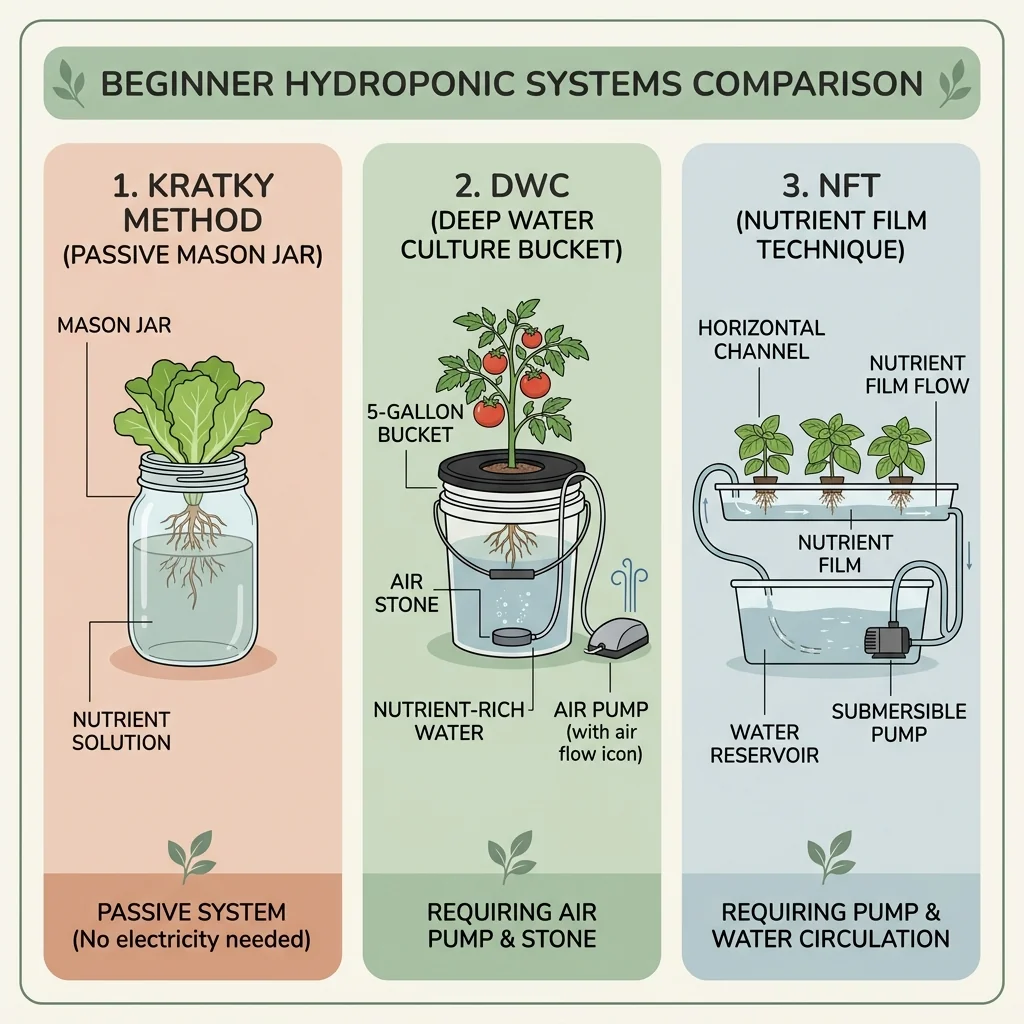
NFT vs DWC vs Kratky: which should a beginner pick?
Three systems dominate small-space hydroponics: Kratky, DWC, and NFT. This comparison shows how they differ and which one a beginner should actually start with.
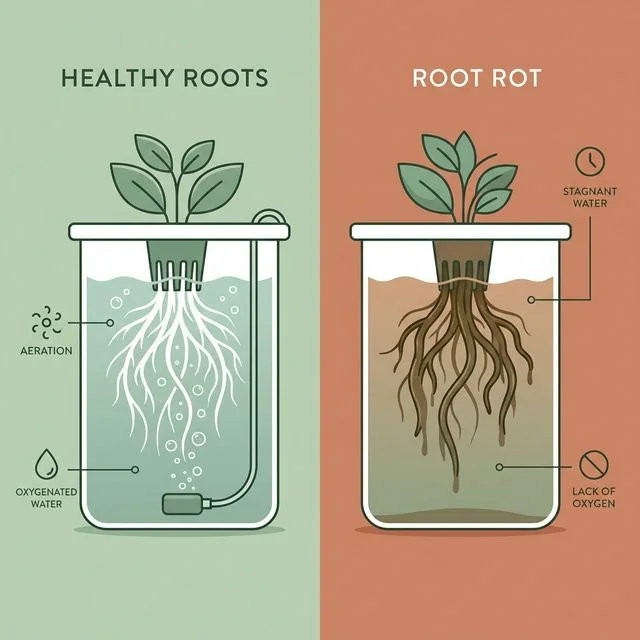
Hydroponic root rot: how to spot it early and stop it
Brown, slimy or swampy-smelling roots mean root rot. Catch it early and fix the conditions behind it — warm water, low oxygen and stagnant flow.
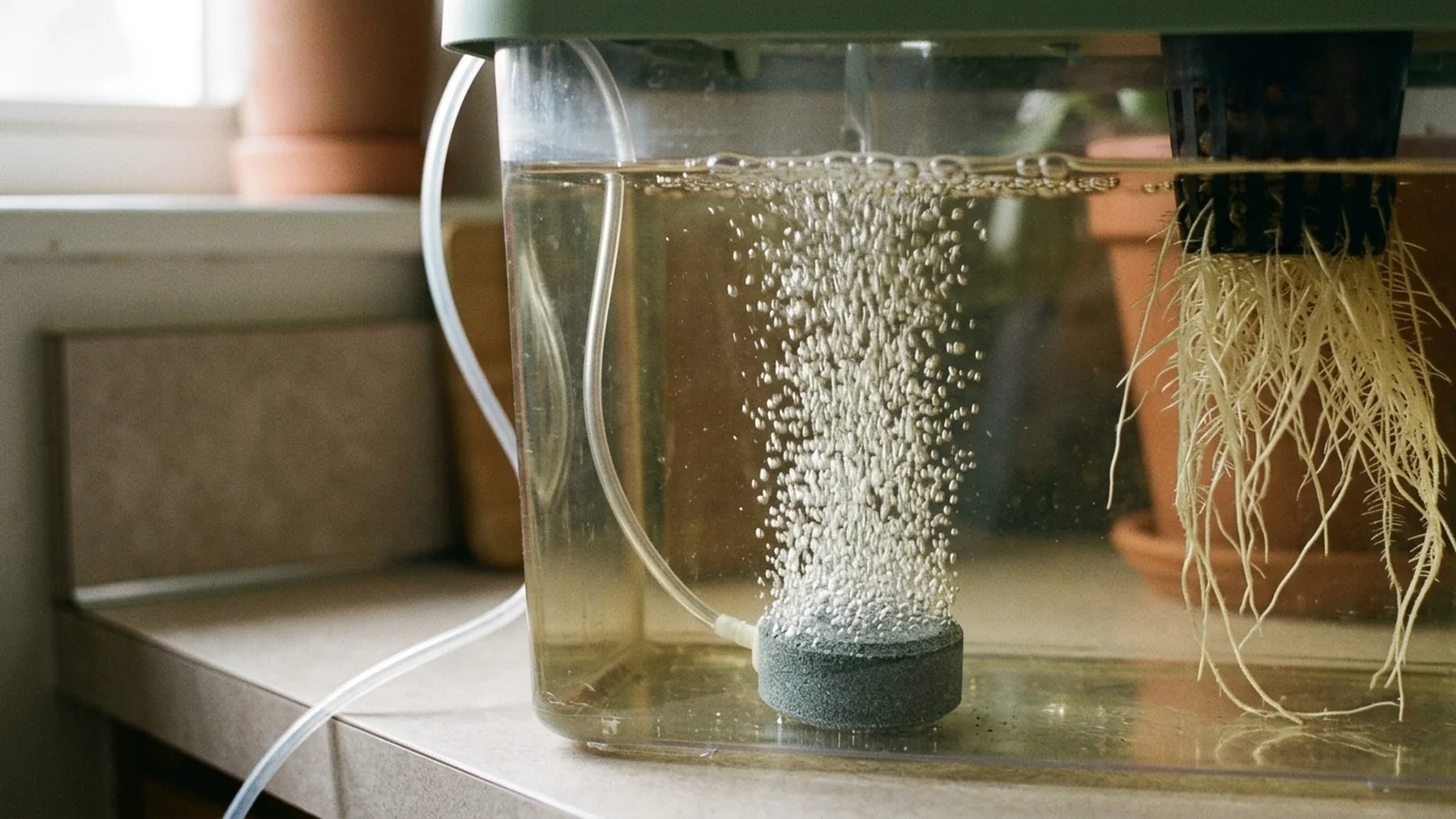
Dissolved oxygen in small hydroponic systems
Roots breathe oxygen dissolved in the water around them, not the air above it. Here are the actual targets, what temperature really does to that oxygen, and how to check yours without a lab meter.