Is a wick system right for your crop?
| Crop type | Wick fit | Why |
|---|---|---|
| Basil, sage, small leafy herbs | Good | Low EC demand (1.0-1.6 mS/cm) and compact roots keep pace with capillary flow |
| Lettuce, leafy greens | Fair | Fine at seedling and baby-leaf size; a full canopy can outpace the wick |
| Parsley and other stronger-feeding herbs | Poor to fair | Wants EC 1.8-2.2 mS/cm, a demand a passive wick struggles to sustain |
| Tomatoes, peppers, cucumbers | Poor | Fruiting crops need far more water, nutrients, and root oxygen than a small wick setup supplies |
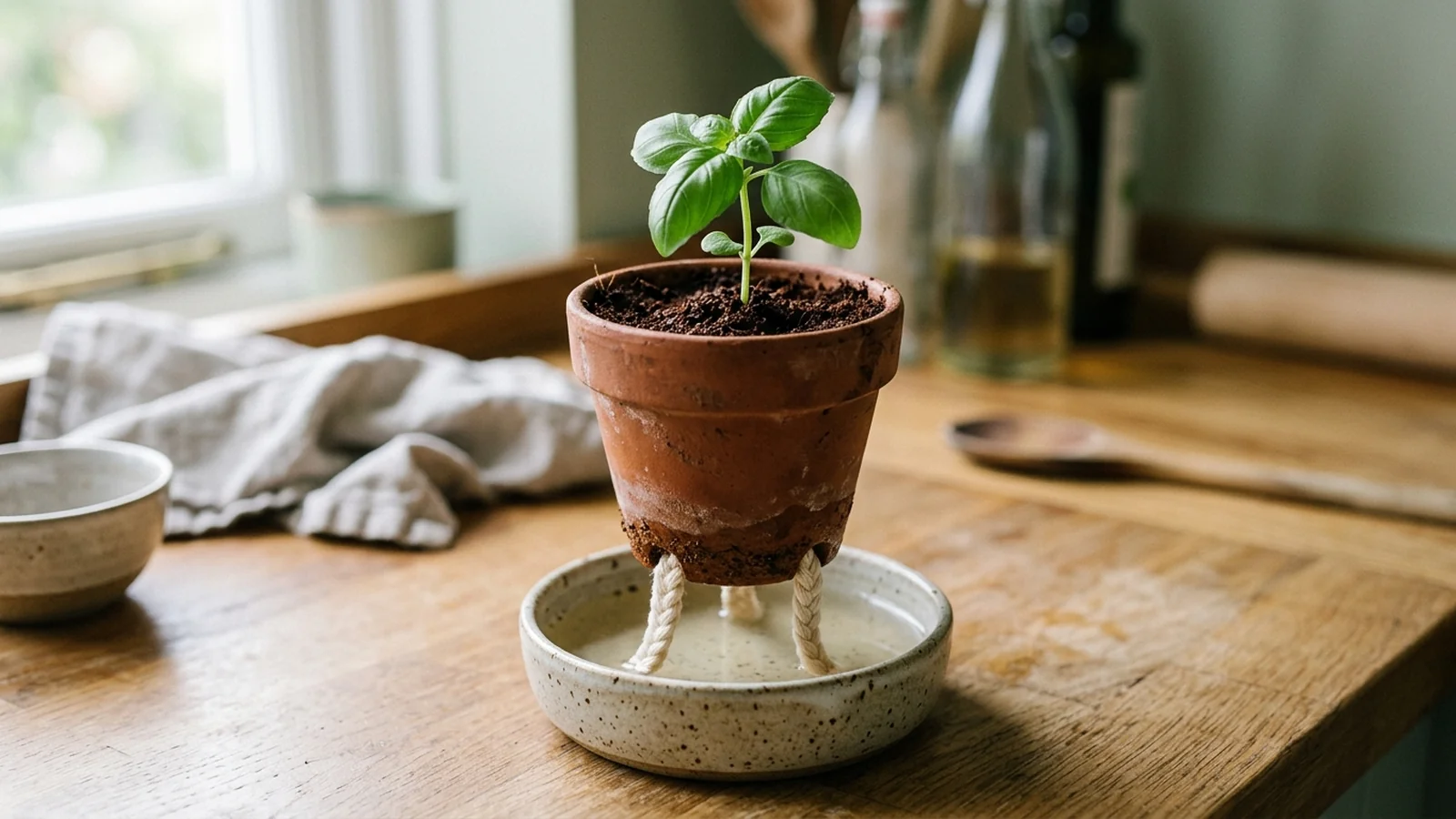
A wick hydroponic system is the plainest version of hydroponics there is: a reservoir of nutrient solution, a length of cord or felt running up from it, and a pot of growing medium the wick feeds by capillary action alone. It is a genuinely good fit for small, low-demand herbs, and a poor one for anything that grows fast or feeds heavily — the same wick that quietly keeps a basil plant fed cannot speed up when a tomato needs far more water. If you already know the Kratky method, the comparison below tells you where wick differs and why that difference matters for what you plant.
How a wick system actually moves water
There is no pump, no timer, and no float valve. A wick — usually nylon rope, cotton cord, or a strip of capillary felt — runs from the reservoir below up into the growing medium (perlite, vermiculite, or coco coir are the common choices) that packs around the plant’s roots. The wick material and the medium both hold water in their pore spaces, and capillary action pulls solution from the wet reservoir into the drier medium above, the same physics that lets a paper towel soak up a spill.
That flow rate is fixed by the physical setup: the wick’s material, its thickness, how far it has to climb, and how well the medium holds and spreads what arrives. It does not respond to the plant. A seedling and a mature, leafing-out specimen pull on the exact same wick at the exact same rate of supply, which is the detail that explains both why this system is so forgiving early on and why it eventually runs out of road.
Where wick differs from Kratky
Both are passive and pump-free, which is why they get confused. The mechanism is not the same. In the Kratky method, the plant’s roots grow directly down into an open reservoir, and as the plant drinks, the water level drops and leaves a growing air gap above the surface — that gap is what supplies oxygen to the upper roots. A wick system does not develop that gap. The medium stays consistently moist because it is being fed continuously from below, and the roots sit inside that medium rather than hanging in open air over a shrinking reservoir.
The practical result is that a wick setup is less self-limiting than Kratky. Classic Kratky is designed to finish roughly when its reservoir runs dry; a wick system, fed continuously, keeps trying to supply a plant whose demand has outgrown it, which is why the reservoir can be full and the plant still short of water at the roots.
What a wick system is genuinely good for
Small, slow, low-demand herbs are the strongest match. Oklahoma State University Extension’s electrical conductivity and pH guide puts both basil and sage at EC 1.0 to 1.6 mS/cm, basil at pH 5.5 to 6.0 and sage a touch wider at 5.5 to 6.5. Those are modest targets, and a compact plant with a small root system asks for correspondingly little volume — well within what a short, well-maintained wick can resupply.
Wick systems also earn their keep in settings where a pump is the wrong answer entirely: a windowsill herb pot with no outlet nearby, a classroom demonstration, a single cutting you are rooting before it goes anywhere bigger, or a backup setup for when you are away and cannot check a pump-dependent reservoir. There is nothing to fail electrically, which is a real advantage even though it is a narrow one.
For crop selection generally, the hydroponic herbs guide covers which herbs perform best under any hydroponic method; the same low-EC herbs it recommends for beginners are the ones a wick handles most comfortably.
Where it runs out of capacity
Capacity is the first failure mode, but it is not the only one. A wick’s steady, unhurried delivery rate is exactly what a fast-growing or heavy-feeding crop overwhelms. Oklahoma State’s table gives parsley an EC of 1.8 to 2.2 mS/cm, noticeably stronger than basil or sage, and lettuce 1.2 to 1.8 mS/cm — both are asking for more concentrated feeding and more total volume than a compact wick reliably supplies once the plant is past the seedling stage.
Fruiting crops are a clearer mismatch still. The same table gives tomatoes 2.0 to 4.0 mS/cm, peppers 0.8 to 1.8 mS/cm, and cucumbers 1.7 to 2.0 mS/cm. The EC numbers alone do not tell the whole story — a pepper’s target is not far from an herb’s — but the water volume a fruiting plant pulls through its roots in a day, and the root mass it needs to support that, are well beyond what a small wick reservoir and a single cord were built to move. University of Minnesota Extension lists tomatoes, cucumbers and peppers as summer crops, and names herbs and leafy greens as the choices for indoor winter production. University of New Hampshire Extension is blunter about the reason — fruiting plants with high light requirements need supplemental lighting.
University extension guides for small-scale hydroponic systems, including those from the University of Minnesota and the University of Florida, list drip, NFT, raft or deep water culture, ebb-and-flow, and vertical towers as the options for a countertop or windowsill setup. None of them covers a wick system.
Building and running one
- Medium: perlite, vermiculite, and coco coir all hold and spread water well and are the usual choices; a medium that channels water down one path rather than spreading it sideways will leave roots at the edges dry regardless of what the wick delivers.
- Wick: nylon rope, cotton cord, and capillary felt strips are the common materials. A wick sitting permanently in solution eventually degrades, so check it when you top up the reservoir.
- Reservoir: keep it opaque or shaded. An uncovered reservoir in a bright spot grows algae for the same reason it would in any other hydroponic setup — light reaching standing nutrient solution feeds it, regardless of whether the water is moving.
- Number of wicks: one wick struggles to keep a wide pot evenly moist; two or more wicks spaced around the container spread the supply and reduce dry pockets.
- Topping up: refill the reservoir before it runs dry rather than after, since a wick pulling from a nearly empty reservoir slows before the reservoir is visibly low.
The nutrient basics guide covers mixing a solution to the right EC and pH before it ever reaches the wick; get that right first; a perfectly wicked delivery of the wrong concentration does not help the plant.
One mechanism carries over directly from every other passive hydroponic setup: as the plant takes up nutrients the solution’s EC falls, and as water evaporates or is drawn off, EC rises. Cornell University’s hydroponic lettuce program describes exactly this drift in its own reservoirs, and it applies here too — check the reservoir’s EC periodically rather than assuming a wick’s slow, steady draw keeps the solution stable on its own.
The medium itself is a separate concern from the reservoir. University of Missouri Extension splits growing media in two: in inert media such as perlite, expanded clay and highly lignified coconut fibre, the reservoir’s own pH and EC apply directly at the root zone, while in organic media such as peat or wood fibre the root zone drifts away from the solution and has to be measured separately. Even in an inert medium, though, a wick system does not drain the way a fed-and-drained substrate setup does, so whatever salts the plant does not take up stay behind in the medium as water leaves it, and they concentrate there over time.
Diagnosing a struggling plant
Because there is no falling water level or shrinking air gap to read, a wick system gives you fewer visual cues than Kratky. Work through this order:
- Check the reservoir level first. If it has run low or dry, that is the simplest explanation and the easiest to fix.
- Check the wick itself. A cord that has come loose from the reservoir, dried and hardened, or rotted through will stop moving water even with a full reservoir underneath.
- Check the medium for channeling. Squeeze it in a few spots around the pot; if one area is soaked and another bone-dry, water is following a single path through the medium rather than spreading, and the fix is usually more wicks or a medium that holds moisture more evenly.
- If all of that checks out, suspect demand. A plant that has outgrown a wick’s delivery rate looks the same as one with a mechanical problem: wilting despite water being technically present in the system. At that point, the plant has outgrown the setup rather than developed a fixable fault in it.
- Check root-zone EC and pH. Pour water through the medium and test what runs out the bottom. University of Kentucky Extension’s substrate thresholds — pH below 5.5 or above 7.0, EC below 0.8 or above about 2.5 mS/cm — flag a medium that needs a nutrient or irrigation adjustment even when the reservoir itself reads fine.
When to move on from wick
A wick system is worth leaving behind once you are troubleshooting demand rather than mechanics — when the plant is bigger, thirstier, or hungrier than a passive cord can keep up with. The Kratky method is the next step for the same low-maintenance, no-power philosophy, with a reservoir sized to the whole crop cycle instead of a continuous wick feed. For anything beyond herbs and small greens, the system comparison guide walks through Kratky, DWC, and NFT side by side so you can pick based on how much power, plumbing, and monitoring you are willing to take on. If you are choosing your very first setup rather than upgrading from a wick, the countertop hydroponic herbs guide covers what to buy and what to skip.
Sources
- Oklahoma State University Extension HLA-6722 — Electrical Conductivity and pH Guide for Hydroponics
- University of Minnesota Extension — Small-scale hydroponics
- UF/IFAS Extension HS1422 — Growing Lettuce in Small Hydroponic Systems
- Cornell University CEA Program — Hydroponic Lettuce Handbook
- University of New Hampshire Extension — Hydroponics at Home
- University of Missouri Extension G6984 — Hydroponic Nutrient Solutions
- University of Kentucky Center for Crop Diversification CCD-CP-63 — Hydroponic Lettuce Production in Controlled Environments
If you are considering a wick system, also read
These guides cover the passive method a wick system is most often compared with, the crops that suit it, and where to go once one runs out of headroom.
Common questions
What is a wick hydroponic system?
It is the simplest passive hydroponic setup: a reservoir of nutrient solution sits below a pot of growing medium, and one or more wicks (cord, rope, or felt strips) run between them. Capillary action draws the solution up through the wick and into the medium, so the plant's roots stay moist without a pump, timer, or any moving part.
Is a wick system the same as the Kratky method?
No, even though both are passive and pump-free. In the Kratky method, roots grow directly down into an open reservoir, and a shrinking air gap forms above the water line as the plant drinks, which is what supplies oxygen. A wick system instead draws water up into a growing medium that surrounds the roots the whole time; there is no falling water level and no air gap doing that job.
What can you grow in a wick hydroponic system?
Small, low-demand herbs are the best fit. Oklahoma State University Extension gives basil and sage an EC target of 1.0 to 1.6 mS/cm, which a compact wick setup can generally keep up with. Stronger feeders such as parsley (1.8 to 2.2 mS/cm in the same table), full-size lettuce, and any fruiting crop like tomatoes or peppers ask for more than a wick reliably delivers.
Why is my plant wilting in a wick system even though the reservoir is full?
A full reservoir does not guarantee the medium is receiving it fast enough. Check whether the wick has dried out, packed down, or lost contact with either the solution or the medium; a wick that has channeled a single dry path through the medium can leave roots dry a few inches away from the wet reservoir below. If the wick and contact points look fine and the plant is still falling behind, the crop is probably asking for more water and nutrients than the setup can supply, which is a sign to move to a system with a pump.
Related guides
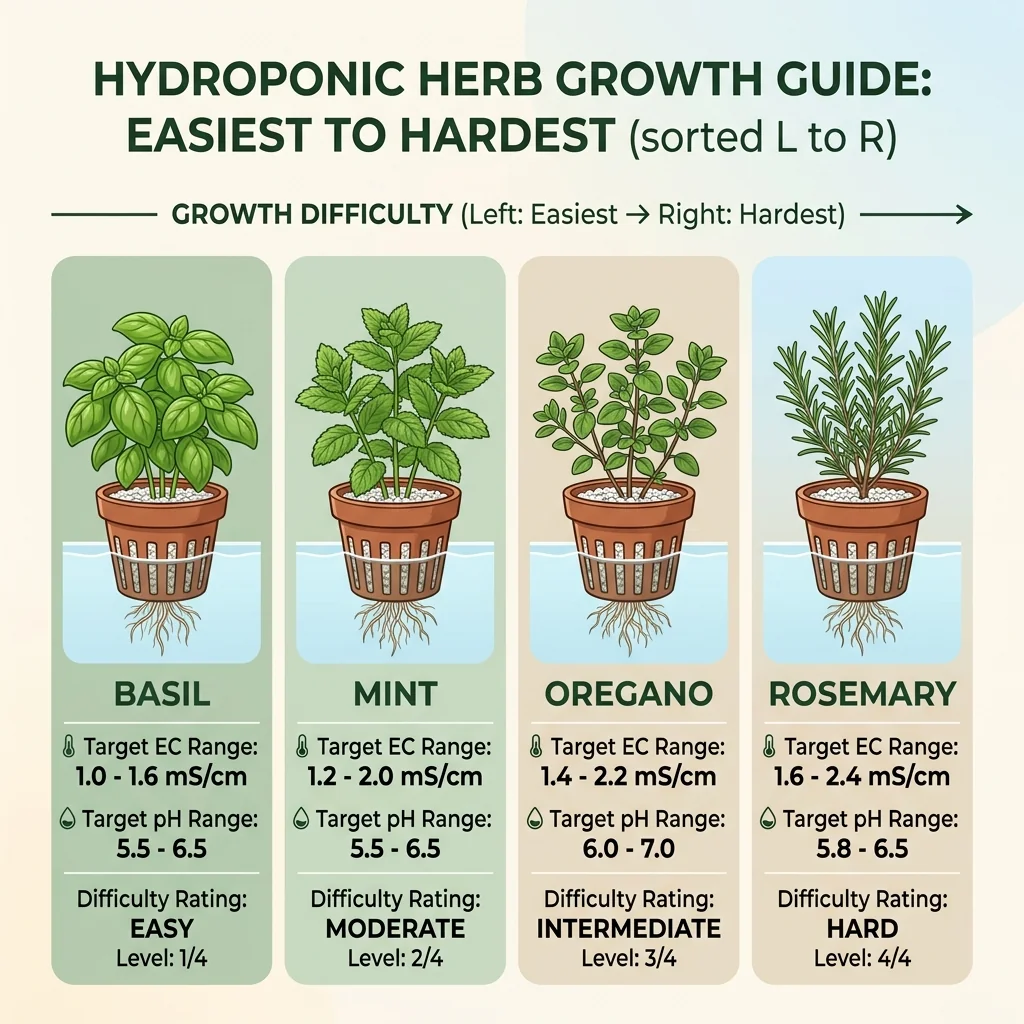
Hydroponic herbs: which grow best and how
Most soft, leafy herbs thrive in hydroponics, while woody Mediterranean herbs are trickier. Here is a ranked guide to which herbs grow best and how to set them up.
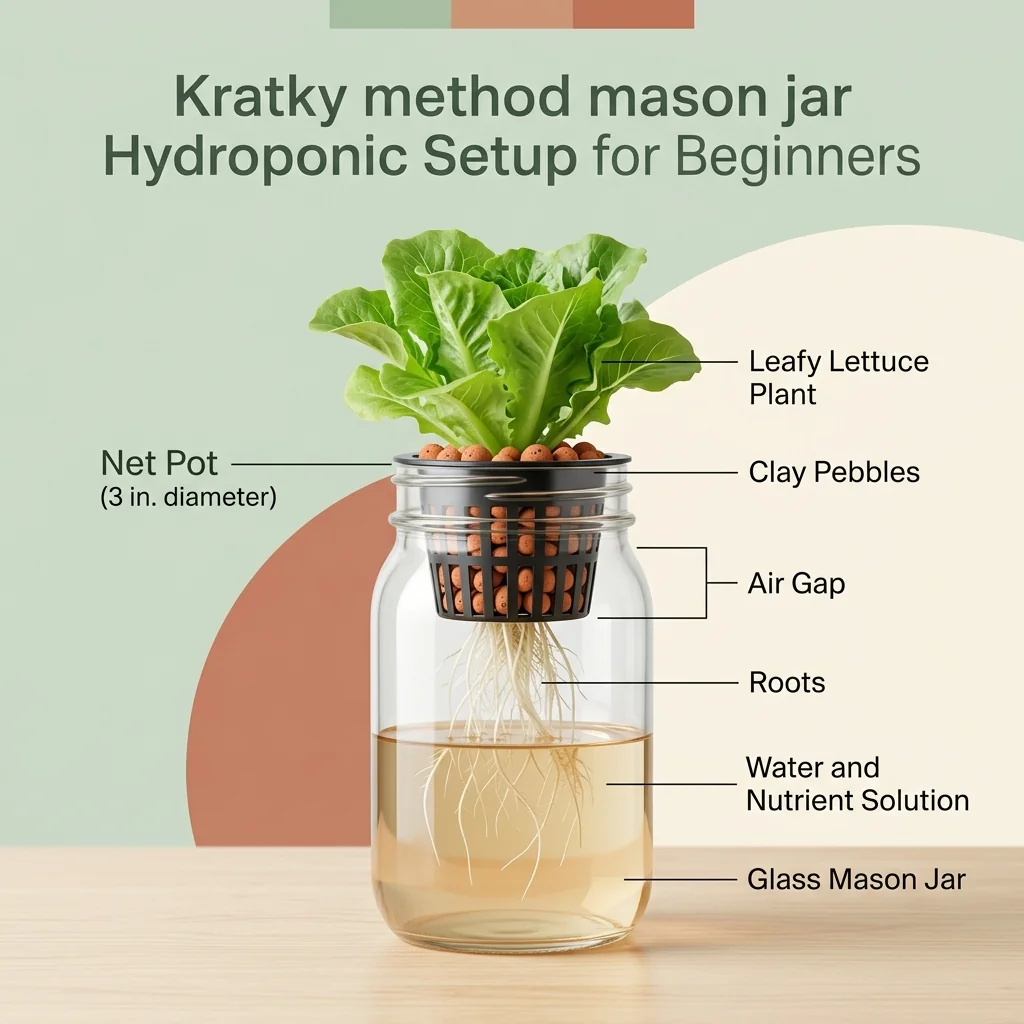
The Kratky method: passive hydroponics for beginners
The Kratky method is the simplest way into hydroponics: a container of nutrient solution, a net pot, and no pump or power. Here is how it works and its limits.
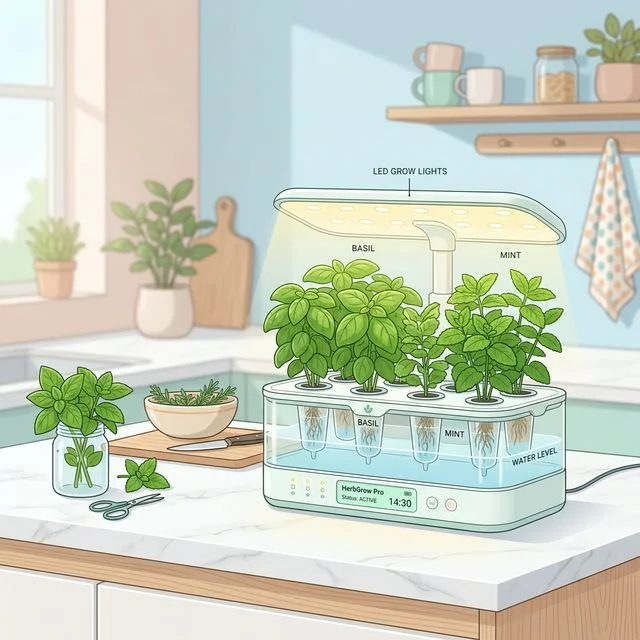
Countertop hydroponic herbs for beginners: what to buy and what to ignore
Countertop hydroponic systems can work very well for herbs, but only if you treat them as small growing systems rather than decorative appliances.