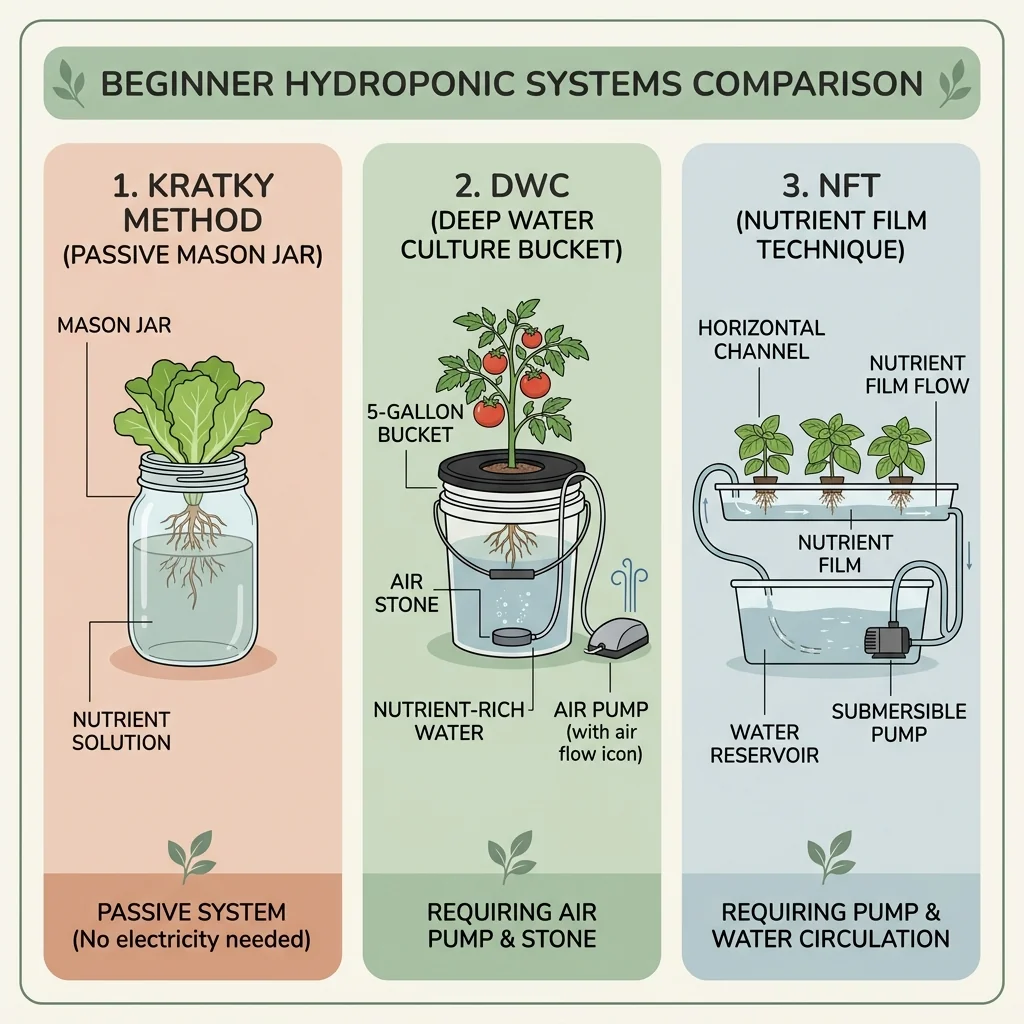
NFT vs DWC vs Kratky
| System | How it works | Pump? | Best for |
|---|---|---|---|
| Kratky | Passive; static reservoir with an air gap | No | Cheapest, simplest first system |
| DWC | Roots in aerated standing water | Air pump | Easiest active system; fast growth |
| NFT | Thin film flows past roots in channels | Water pump | Scaling up to many plants |
Three systems dominate small-space hydroponics, and the right first choice depends on how much you want to fiddle. As a quick answer: start with the Kratky method (passive, cheapest) or a single DWC bucket (easiest active system), and leave NFT until you want to scale up. All three grow lettuce, greens, and herbs well. If nutrients are new, start with hydroponic nutrient basics.
The three systems in plain terms
- Kratky — passive. A sealed reservoir with an air gap; no pump, no power. The simplest possible start, covered in the Kratky method.
- DWC — active and simple. Roots sit in standing water kept oxygenated by an air pump; fast growth from one bucket, covered in DWC for small spaces.
- NFT — active and scalable. A thin film of nutrient solution flows past the roots in sloped channels using a water pump. Efficient for many plants, but more parts to manage and more vulnerable to a pump failure.
Which should a beginner pick?
For a first system, simplicity wins:
- Want the cheapest, no-power start? Kratky.
- Want fast growth and do not mind a small pump? A single DWC bucket.
- Already comfortable and want more plants? NFT.
The biggest beginner mistake is starting with a large, multi-part NFT build before learning how nutrients and pH behave. Master those on a jar or bucket first; the countertop hydroponic herbs guide is a good entry point. If you would rather buy a ready-made kit than assemble parts, Best hydroponic systems for beginners compares the easiest starter units.
What they share
All three depend on getting EC and pH right and keeping the water cool and clean. None is well suited to large fruiting crops in a small space; they are at their best with lettuce, leafy greens, and herbs. Whether you need aeration depends on the system, covered in do you need an air pump for hydroponics?.
Compare the failure, not only normal operation
| System | Power failure | Main hidden risk | Recovery question |
|---|---|---|---|
| Kratky | No pump to stop | Reservoir too small or air gap lost | Are aerial roots still exposed? |
| DWC | Aeration stops | Siphon, warm water, single pump | How long was oxygenation interrupted? |
| NFT | Flow stops | Roots dry quickly in channels | Can flow be restored without flooding? |
An NFT channel may scale neatly, but one blocked line or pump can affect many plants. DWC gives each bucket more buffer but adds air equipment. Kratky removes moving parts while fixing the reservoir/air-gap design for a limited crop cycle.
Score the system for your constraints
Give each system 0–2 points for repairability, cleaning access, noise, power resilience, reservoir stability, crop fit, and safe spill management. Weight the criteria that could end the project: an apartment grower may care more about noise and leaks; a remote setup may care more about power resilience.
Run one crop before scaling
Use the same lettuce cultivar, nutrient program, light footprint, and harvest definition for a genuine comparison. Record build cost, active minutes per week, electricity, solution replaced, failures, crop days, and usable harvest. Without those controls, saying one system grows “faster” confuses system with light, temperature, and operator attention.
Sources and further reading
Compare the systems in detail
These guides go deeper on each system and the equipment they need.
Common questions
Which hydroponic system is best for beginners?
The Kratky method or a single-bucket DWC system. Kratky is passive and needs no power, while DWC is the easiest active system. NFT is powerful but more complex, so it is better as a second step.
What is the difference between NFT, DWC, and Kratky?
Kratky is passive with a static reservoir and no pump. DWC keeps roots in aerated standing water with an air pump. NFT flows a thin film of nutrient solution past the roots in channels using a water pump.
Which system grows the most before I have to refill?
NFT and DWC are easier to top up and run continuously, so they suit ongoing harvests. Classic Kratky is a one-and-done reservoir designed to finish with the crop.
Can these systems grow tomatoes or peppers?
In a small space, not well. All three are best for lettuce, greens, and herbs. Large fruiting crops need bigger reservoirs, more support, and more oxygen than a compact beginner system provides.
Related guides
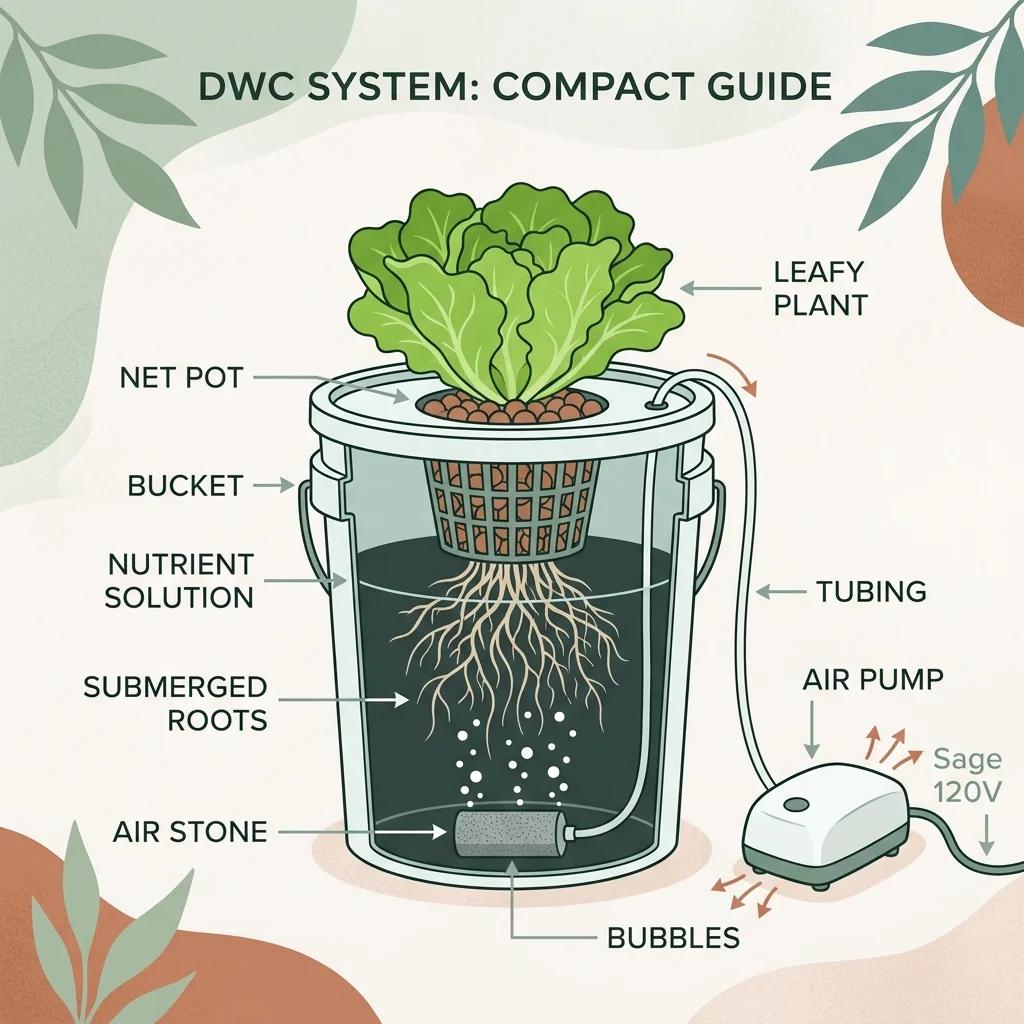
What is DWC? Deep water culture for small spaces
DWC suspends roots in aerated nutrient solution for fast growth. It is one of the best active systems for a small space, as long as you manage oxygen and heat.
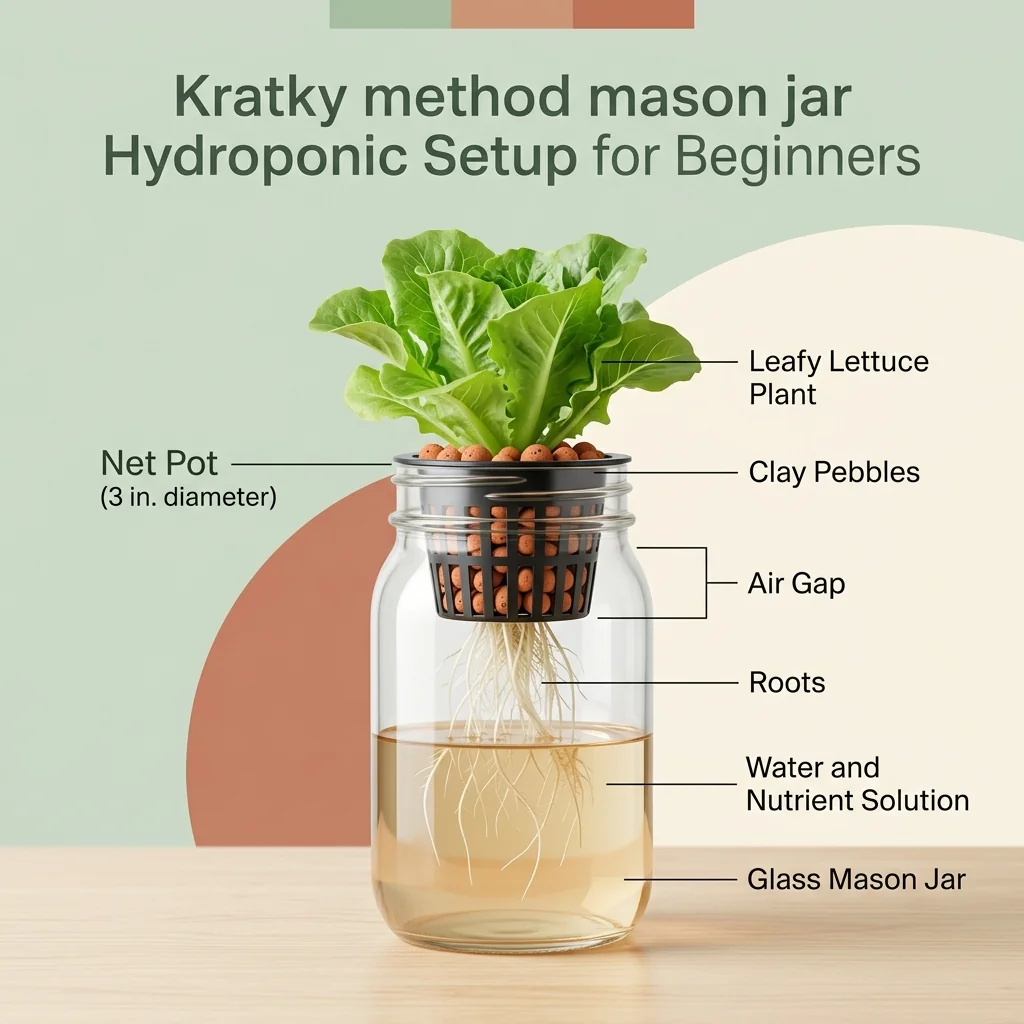
The Kratky method: passive hydroponics for beginners
The Kratky method is the simplest way into hydroponics: a container of nutrient solution, a net pot, and no pump or power. Here is how it works and its limits.
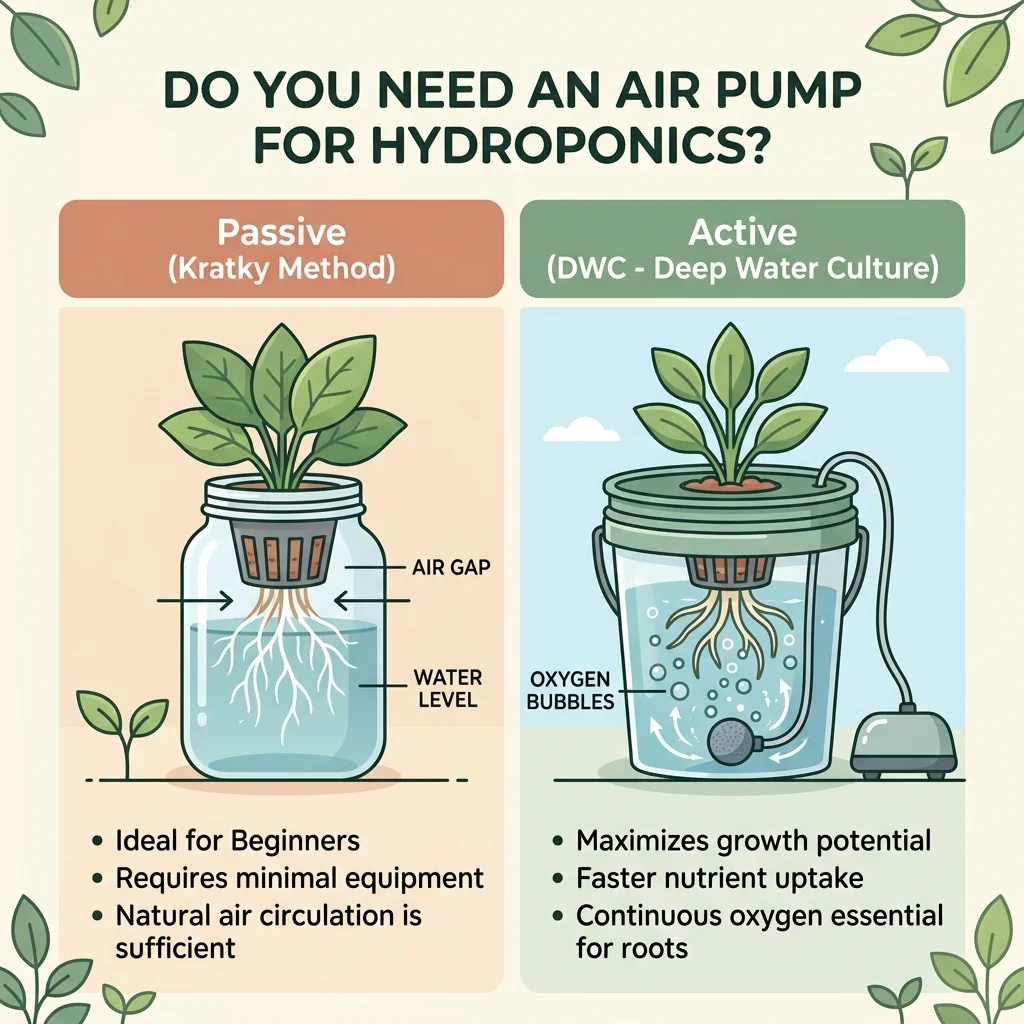
Do you need an air pump for hydroponics?
If you search for hydroponic tutorials, you will see a maze of air pumps, plastic tubing, and bubbling airstones. But do you actually need electrical aeration to grow plants in water? Here is the science of passive vs. active hydroponic setups.