Sprouts and microgreens compared
| Factor | Sprouts | Microgreens |
|---|---|---|
| Medium | Seed soaked in water, then rinsed and drained in a jar | A growing medium such as potting mix or a pad |
| Light | Grown in the dark (Nebraska Extension keeps the jar dark at 68-72 °F) | Covered for the first days, then grown in light (see the [blackout period guide](/blog/microgreens/microgreens-blackout-period-by-crop/)) |
| Time | Three to six days after the soak (Nebraska Extension) | 7 to 21 days after germination (Penn State Extension) |
| What you eat | The whole sprout: seedling, root and often the seed remains | The shoot, cut at the base just above the medium |
| Food-safety class | Higher risk (University of Tennessee Extension) | Generally lower risk, with a hydroponic exception (University of Tennessee Extension) |
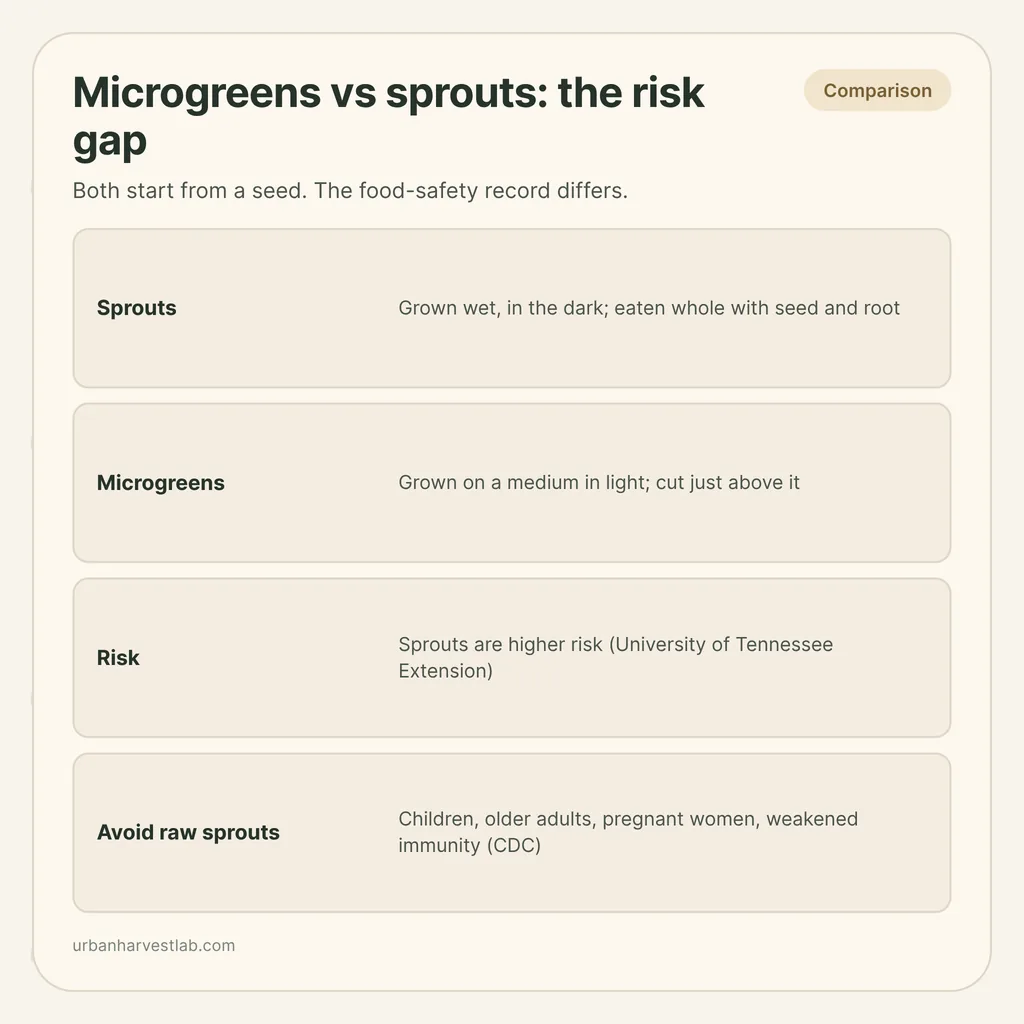
Sprouts are seeds soaked and grown wet, usually in the dark, and eaten whole with the seed and root. Microgreens grow on a medium in light and are cut just above it. The practical difference is risk: University of Tennessee Extension classes sprouts as a higher food-safety risk than microgreens, and FDA and CDC advise some people to avoid raw sprouts altogether. CDC, FDA and University of Maine Extension advise children, older adults, pregnant women and people with weakened immune systems to avoid raw sprouts. Tennessee rates microgreens generally lower risk, and warns similar risks remain for hydroponic microgreens whose leaves touch recirculating water.
What separates them
Penn State Extension draws the line this way: sprouts are “produced by germinating seeds that have been soaked in water, often in the dark”, and “the edible portion is constituted by the whole sprout, including the seedling, the radicles, and often what remains of the seeds”. Microgreens are harvested by “cutting the young seedlings at the base right above the growing medium”.
How the growing differs
A sprout grows in its jar from start to finish. Nebraska Extension has you soak the seed for 12 to 16 hours, drain it, then rinse it two to four times a day while it sits in a dark place at 68-72 °F. That takes three to six days, depending on the seed and the length you want. The method, step by step, is in sprouting seeds in a jar.
A microgreen is a small plant. The seed goes onto a medium, stays covered for the first days, then moves into a bright window or under a light. Penn State Extension gives 7 to 21 days from germination to harvest. Setup, trays and timing live in the beginner’s guide to growing microgreens.
So the two differ on all three practical counts. Sprouts are fast, need no light and no soil, and give you a crunchy, root-on product. Microgreens take longer, need a tray and light, and give you stems and leaves. Wheatgrass, grown in soil and juiced, is a third thing, compared in wheatgrass vs microgreens.
Why sprouts carry more risk
University of Tennessee Extension gives the reasons in one sentence. Sprouts are a higher food-safety risk than microgreens “because sprout seeds are typically fully submerged in water for the first 12 to 16 hours of growth and grown without light, and the final product includes semi-germinated seed and root”. It adds that seeds can carry pathogens and, once in water, “can easily spread pathogens to an entire lot of sprouts”.
FDA adds that bacteria in sprout seed are “nearly impossible to wash out” and can grow to high levels even under clean conditions, and University of Maine Extension says growing sprouts at home “doesn’t increase safety”. The sanitation side is in the microgreens food safety guide.
Why microgreens carry less, and when they do not
Tennessee’s explanation for the lower risk is the cut. Microgreens are generally lower risk “because, if harvested following proper food safety protocols, any pathogens present in the seed will remain in the soil after harvest”. A sprout is eaten with its seed and root. A microgreen is cut above them.
That separation has an exception. The same Tennessee publication warns that “similar risks for sprouts remain for microgreens and baby greens grown hydroponically if leaves and stems come into contact with recirculating water.” If you grow on a pad that sits in standing or recirculated water, the water becomes the shared route, much as in a sprout jar.
Lower risk is not no risk. Seed, growing medium and water are what to control on a tray, and the microgreens food safety guide covers sanitizing trays, buying seed and handling water. Penn State Extension’s seed advice applies to both methods: buy seed marketed for sprouts and microgreens, which should have been produced and processed to high food-safety standards, not a packet meant for outdoor planting.
Who should avoid raw sprouts
CDC says children, older adults, pregnant women and people with weakened immune systems should avoid raw or lightly cooked sprouts of any kind. University of Maine Extension goes further for those groups: “All sprouts should be avoided”. FDA gives pregnant women the same advice and says thorough cooking “significantly reduces the risk of illness”. The full advice, with the cooking and storage guidance, is in sprouting seeds in a jar.
These sources are written about sprouts. For microgreens, the sources used here describe a lower risk, not a rule that any group may eat them raw without concern; if you are in one of these groups and unsure, ask your doctor or midwife.
Which one to grow
| If you want | Choose |
|---|---|
| A household that includes a child, an older adult, a pregnant person or someone immunocompromised | Avoid raw sprouts (CDC, FDA, Maine); if you grow microgreens, follow the sanitation guide and ask your doctor |
| A crunchy, root-on addition to stir-fries and soups | Sprouts, cooked thoroughly |
| Raw sprouts on a sandwich | Only if no one eating it is in the groups above |
| Leaves and stems with no jar to rinse | Microgreens |
| A crop that takes three to six days after the soak | Sprouts, if the risk fits your household |
| A first project you can repeat each week | Microgreens: tray, medium, light and a pair of scissors |
Sprouts ask for a jar and rinsing several times a day. Nebraska Extension stores finished sprouts one to two weeks in the refrigerator, and University of Maine Extension says to keep them at 40 °F or below. Microgreens ask for a tray, a medium and a light. Neither is complicated; the difference is that one of them is eaten with the seed and root.
Microgreens are also the one people ask about for nutrition. What is and is not shown is in are microgreens healthy.
Sources
- Penn State Extension: The ABCs of microgreens
- University of Tennessee Extension W1261: Regulatory considerations for marketing sprouts, microgreens and baby greens
- Nebraska Extension in Lancaster County: Growing edible sprouts at home
- FDA: Fruits, veggies and juices (food safety for moms-to-be)
- CDC (archived, 2018): Salmonella Montevideo infections linked to raw sprouts, advice to consumers
- University of Maine Cooperative Extension: Sprout safety
Sprouts, microgreens and the safety gap
The jar method for sprouts, the sanitation routine for trays, and a first tray of microgreens.
Common questions
What is the difference between microgreens and sprouts?
Penn State Extension defines sprouts as seeds soaked in water and germinated, often in the dark, where the whole sprout is eaten: seedling, radicle and often what is left of the seed. Microgreens grow on a medium in light, and the edible part is the young shoot cut at the base just above the growing medium.
Are microgreens safer than sprouts?
University of Tennessee Extension calls microgreens generally a lower food-safety risk, because if they are harvested following proper protocols, pathogens present in the seed stay in the soil after harvest. Sprouts are eaten with the seed and root, so they do not get that separation. Lower risk is not zero risk.
Who should avoid raw sprouts?
CDC says children, older adults, pregnant women and people with weakened immune systems should avoid eating raw or lightly cooked sprouts of any kind. FDA gives pregnant women the same advice and says to cook sprouts thoroughly. University of Maine Extension says all sprouts should be avoided by those groups.
Does rinsing or growing sprouts at home make them safe?
No. FDA says bacteria that get into sprout seed through cracks in the shell are nearly impossible to wash out, and that sprouts grown in the home are also risky if eaten raw. University of Maine Extension says growing sprouts at home does not increase safety.
Related guides

Sprouting seeds in a jar: the method, and who should skip it
A jar sprout is grown wet and dark and eaten whole, root and seed included. Here is the rinse routine, and the FDA and CDC advice on who should cook theirs or skip them.
Microgreens food safety: sanitizing trays, seed, and water
Sprout recalls do not automatically make microgreens risky. The harvest method is what separates them, and one hydroponic setup can erase that gap.

Are microgreens healthy: what the nutrition evidence actually shows
The number gets repeated everywhere, usually stripped of the two words that make it accurate: one nutrient, one crop. Here is what the underlying study actually found, and what that does and does not tell you about eating microgreens.