Troubleshoot the system before you change the inputs.
Symptoms
- A visible trail of ants on the stem, the pot rim, or the soil surface of one particular pot.
- Sticky residue on leaves or on the surface beneath the pot, sometimes with a black sooty coating.
- A cluster of small, soft insects on new growth or leaf undersides once you look closely.
Possible causes
- Aphids, mealybugs, soft scale, or whiteflies are feeding on the plant and producing the honeydew the ants are farming.
- The pot sits along an existing outdoor ant trail or near a gap that gives foragers easy access to the soil.
- Ants are passing through the pot for food or moisture with no honeydew producer actually present.
Quick fixes
- Check stems, growing tips, and leaf undersides for the insect producing the honeydew before treating the ants.
- Take the container outside, away from other plants, before working on it.
- Use a bait station rather than a contact spray so foragers carry it back to the colony.
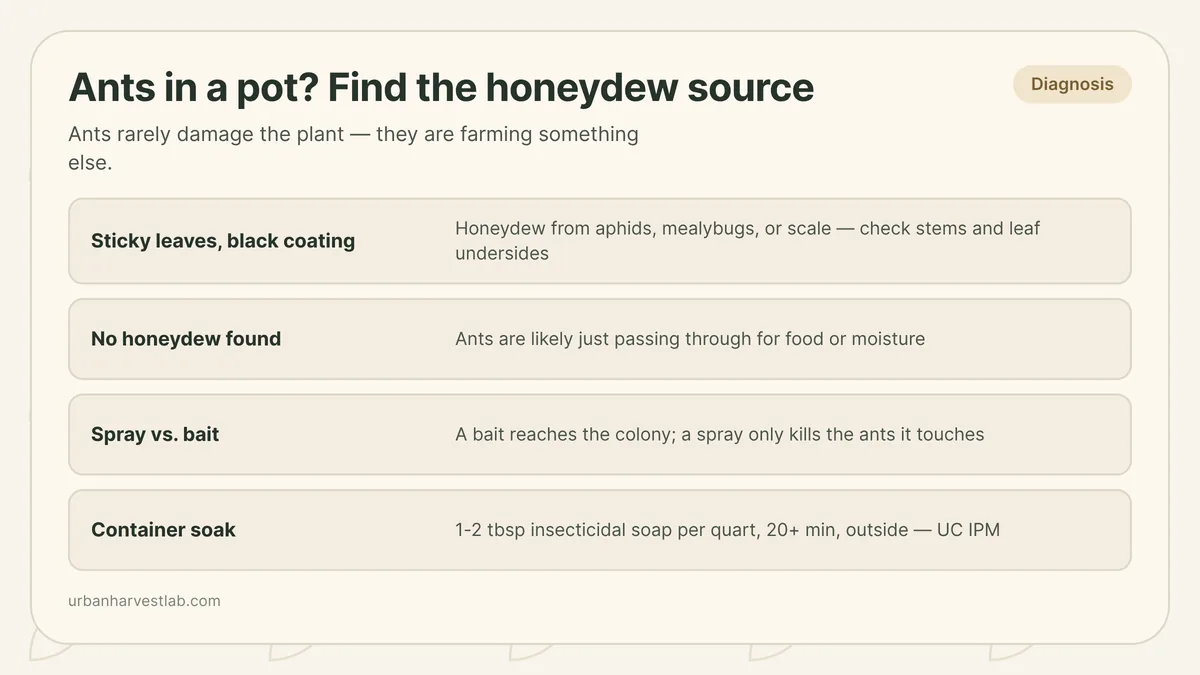
A trail of ants on a potted plant is almost always chasing honeydew left by another insect, not attacking the plant itself. Before you treat the ants, look for aphids, mealybugs, soft scale, or whiteflies on the stems and leaf undersides. Clear that insect and the ants usually move on; spray only the ants and they tend to come straight back. If nothing checks out after a real search, see the broader potted herb problem guide for other reasons a plant looks off.
Why ants show up in a pot that otherwise looks fine
Ants are not eating your basil. UC IPM’s pest notes on ants put the mechanism plainly: indoors, ants are drawn to the honeydew that soft scales, mealybugs, and aphids produce. Honeydew is the sugary waste these insects excrete after feeding on plant sap, and ants collect it the way they would collect nectar.
The relationship goes further than simple foraging. UC IPM also notes that outbreaks of scales and aphids frequently occur specifically because ants are tending them for that honeydew, since the ants protect the honeydew producers from the natural enemies that would otherwise keep the population down. An anthill in a pot can be a sign that a small pest colony has been allowed to grow undisturbed for weeks.
None of this means every ant on a plant proves an infestation. Ants forage widely for food and moisture and will walk across a pot that has nothing wrong with it, especially one near an outdoor trail or a crack in a patio. The difference is what you find when you look closely at the plant itself.
Find the honeydew source before you treat anything
Work from the top down: growing tips, the undersides of the youngest leaves, stem junctions, and anywhere leaves touch. A hand lens helps, since several of these insects are genuinely small. If the bullets below do not settle it, the pest identification chart compares all four side by side.
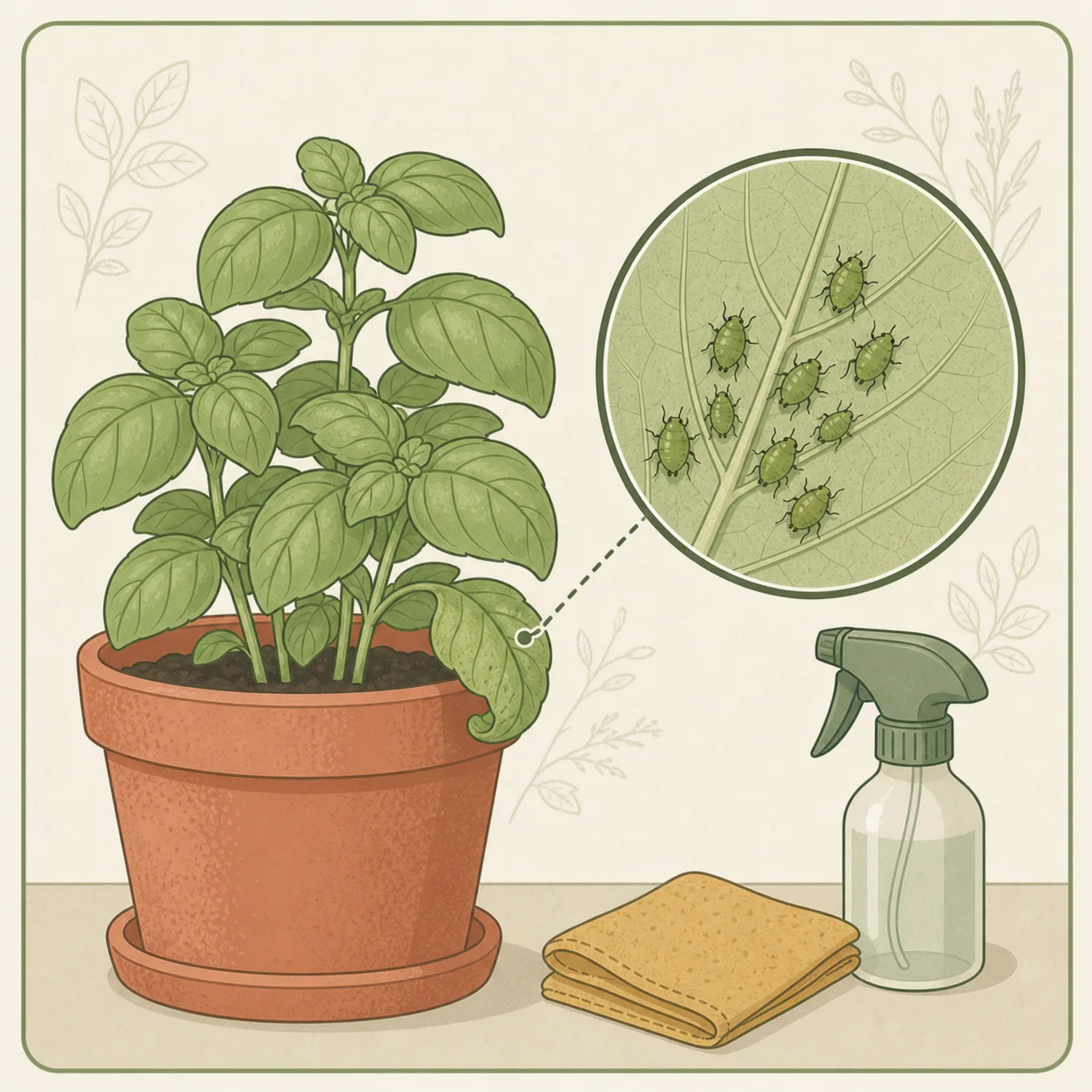
- Aphids have soft, pear-shaped bodies in colors from green to black, and UC IPM identifies them by a pair of tubelike structures, called cornicles, projecting backward from the rear of the body, a feature no other insect on a houseplant has. The full identification and control routine is on the aphid page, including how to tell old curl damage from an active colony.
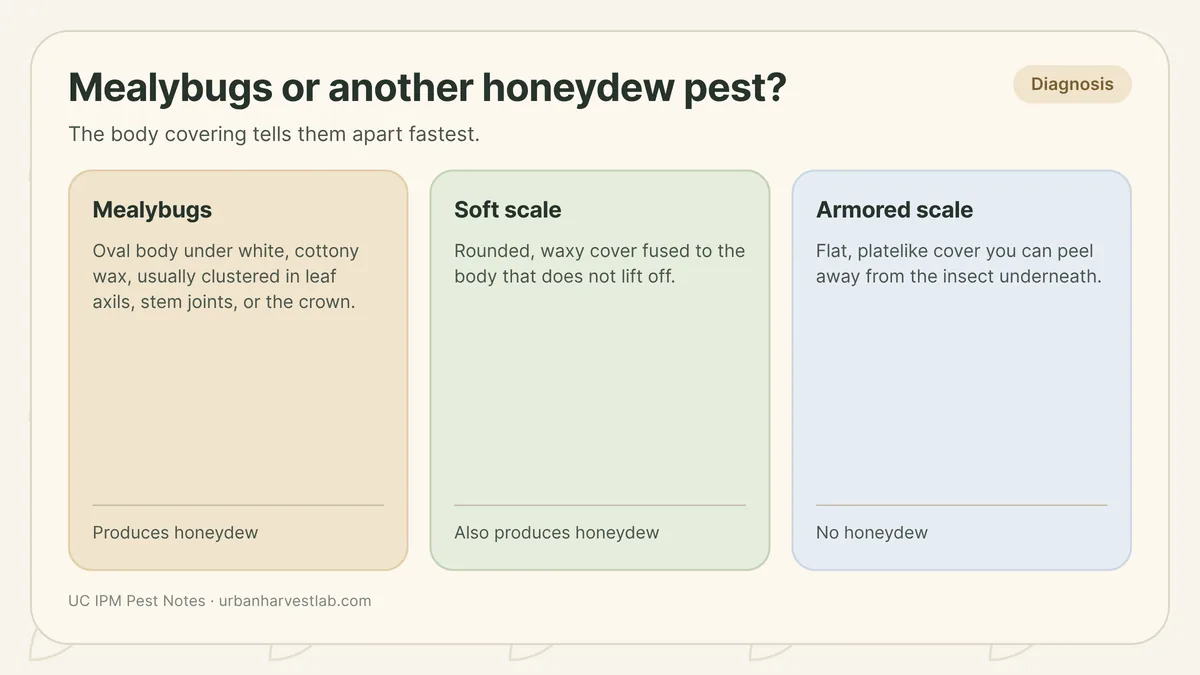
- Soft scale looks like small, waxy bumps stuck to a stem or leaf midrib. UC IPM distinguishes soft scale from armored scale by exactly this trait: soft scale excretes honeydew and its cover does not lift off the body, while armored scale has a cover that can be removed and does not produce sticky honeydew at all. If the leaves are sticky, you are not looking at armored scale. The scale insects page covers monitoring with sticky tape and telling a dead scale from a live one.
- Mealybugs show up as small, cottony, wax-covered clusters, often tucked into the crown of the plant, in branch crotches, or where a leaf touches the stem. See the mealybug page for where they hide and how to spot-treat them.
- Whiteflies scatter as tiny white insects when the plant is disturbed and can also leave sticky residue behind. The whitefly page covers monitoring with yellow sticky cards.
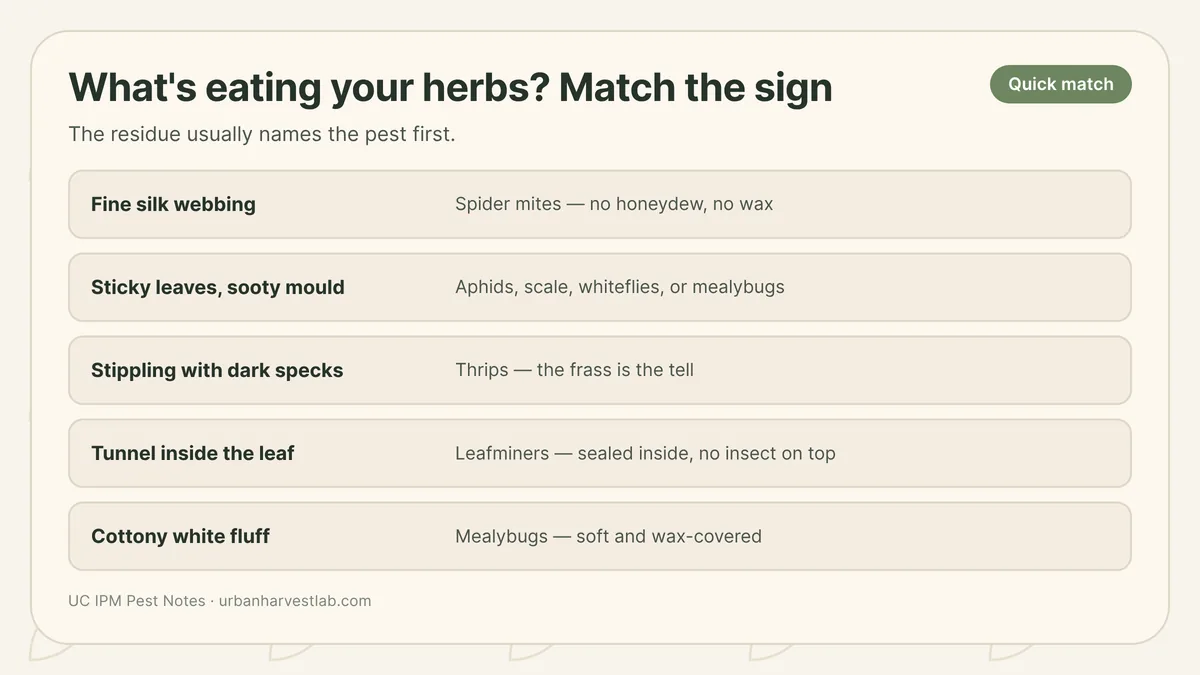
Sticky leaves, a shiny film on the pot rim, or a black sooty coating on foliage are all honeydew signs even before you spot the insect making it; UC IPM notes that honeydew often turns black as a sooty mold fungus grows on it. That black coating is cosmetic on its own, but it marks exactly where to look harder.
When there really is no honeydew producer
Sometimes a careful check turns up nothing: no insects, no stickiness, no sooty film, just ants moving through the pot. In that case the ants are probably passing through for food, moisture, or nest access rather than farming anything on the plant, and the fix is about the ants’ route rather than the plant’s health. Moving the pot off a wall, off the ground, or away from an outdoor trail often ends the traffic on its own without any treatment at all.
Deal with the ants without harming the plant
Once you know what you are dealing with, treat the ants and the honeydew producer as two separate problems.
For the ants, UC IPM’s guidance favors baits over sprays: properly used, baits are more effective and safer than sprays, because a contact spray kills only the ants that happen to be out foraging when it hits them and leaves the colony and its queens untouched. A bait carried back to the nest reaches ants a spray typically misses.
For a container that has become a real ant problem, UC IPM gives one specific procedure: take the container outside, away from other plants, then soak it for 20 minutes or more in a solution of insecticidal soap and water at a rate of 1 to 2 tablespoons of insecticidal soap per quart of water. That figure is a container soak aimed at the ants themselves, not a foliage spray, and Colorado State University Extension notes that some plants are sensitive to insecticidal soap sprays and may be injured. If you also need to treat the honeydew-producing insect on the foliage, use a product labeled for that pest and follow its own listed dilution, not the pot-soak rate.
For the insect itself, start with the least invasive option. UC IPM recommends knocking aphid populations off a sturdy plant with a strong stream of water or by shaking it, which is worth trying before reaching for any product. Colorado State University Extension explains why coverage matters if you do escalate to insecticidal soap: soap acts strictly as a contact killer with no residual effect, so it has to touch the insect directly, which usually means spraying the undersides of leaves as well as the tops. Colorado State also warns that dish soap is not a substitute, since dish detergents can injure plants, damage soil, and contaminate waterways.
Read the label before you spray anything you plan to eat
If the honeydew producer is on a culinary herb, the label decides what you can legally do next. The EPA states that using a pesticide “in a manner inconsistent with its labeling” is a violation of federal law, and the National Pesticide Information Center is specific about what that means for a kitchen windowsill: if the crop you intend to eat is not listed on the label, you cannot apply that product to it, no matter how mild the product seems.
Pre-harvest intervals do not carry over between products either. NPIC notes that wait times for the same fruit or vegetable can differ from one labeled product to the next, and some products list a zero-day interval, meaning there is no single number to memorize for insecticidal soap or neem oil in general. Read the interval on the container you are actually holding.
Keep it from starting again
Clemson Extension frames prevention as the real fix for houseplant pests generally, not just for ants: most infestations arrive on plants that were recently purchased or that spent the summer outdoors, and a stressed plant is more susceptible to begin with. It is almost always easier to prevent an infestation than to eliminate one that has already established.
In practice that means checking new plants before they join the rest of your collection, giving pots enough space that you can actually see the undersides of leaves during normal watering, and treating an ant trail as a prompt to look closely rather than as a nuisance to spray away and forget.
Sources
- UC IPM Pest Notes 7411, “Ants”
- UC IPM Pest Notes 7404, “Aphids”
- UC IPM Pest Notes 7408, “Scales”
- Colorado State University Extension 5.547, “Insect Control: Soaps and Detergents”
- National Pesticide Information Center, “Preharvest Interval”
- US EPA, “Introduction to Pesticide Labels”
- Clemson HGIC, “Common Houseplant Insects & Related Pests”
Find what the ants are farming
Ants follow honeydew, not the plant itself. These are the insects most likely to be producing it.
Common questions
Do ants damage the plant itself?
Ants showing up in a pot are usually foraging for honeydew rather than feeding on the plant, so the insect making that honeydew, often aphids, mealybugs, or scale, is the one doing the actual damage. Treating the ants alone leaves that insect in place.
Will spraying the ants get rid of them?
A contact spray kills only the ants it touches while they are out foraging and leaves the colony and queen untouched, so ants often reappear within days. A bait that ants carry back to the nest reaches more of the colony and is generally more effective.
Is it safe to use insecticidal soap on a potted herb I plan to eat?
Only if the label lists that herb and the setting you are using it in. A crop that is not named on the label cannot legally be treated with that product, and how long you must wait before harvest is set by the specific label, not by one fixed rule for insecticidal soap in general.
Can I use the same soap-and-water mix to soak the pot and to spray the leaves?
No. The stronger soak rate used to submerge a pot against ants is a container soak for a different purpose, not a foliage spray dilution, and Colorado State University Extension notes that some plants are sensitive to insecticidal soap sprays and may be injured. Use a product labeled for foliar use at its own listed rate instead.
Related guides
Mealybugs on indoor herbs: identify them and stop the spread
Mealybugs show up as white, cottony masses tucked into leaf axils and stem joints, and they keep coming back until every hiding spot and every generation has been treated.
Aphids on indoor herbs: identify, isolate, and control them
Aphids are manageable when you find the colony, isolate the plant, remove most insects physically, and repeat inspections through the next generation.
What's eating your herbs? Match the signs to the pest
Every common herb pest leaves its own tell before you ever spot the insect itself. Pick out what you are actually seeing, then go straight to the page that treats it.