
Troubleshoot the system before you change the inputs.
Symptoms
- Brown or grey spots on the lowest tomato leaves, spreading upward over a few weeks.
- Spots with a yellow ring around them, or leaves yellowing and dropping around the spots.
- Dark, sunken, scabby or corky marks on the fruit near the stem.
Possible causes
- Early blight, a fungus: brown spots with concentric rings.
- Septoria leaf spot, a fungus: small grey spots with dark borders and tiny black dots.
- Bacterial spot, a bacterium: small spots with yellow halos, no rings, sometimes with the centre fallen out.
Quick fixes
- Pick off the worst leaves and bag them.
- Water the soil rather than the leaves, and mulch to stop splash.
- Open the plant up by pruning the lowest branches and staking so air moves through.
- Spray only with a product whose label lists tomato.
Early blight, septoria and bacterial spot compared
| Sign | Early blight | Septoria leaf spot | Bacterial spot |
|---|---|---|---|
| Cause | Fungus | Fungus | Bacterium |
| Spot | Brown, enlarging, concentric rings (bull's-eye) | Small, round, grey or tan centre, dark border, tiny black dots | Small, brown or black, circular or angular, yellow halo, no rings |
| Where it starts | Oldest leaves | Lowest leaves, often when first fruit forms | Often lower leaves; centre may drop out |
| Fruit | Dark, leathery, sunken spots near the stem | Not affected | Small raised, scabby or corky spots |
| Best check | Rings under a hand lens | Black dots under a hand lens | No rings, no black dots, halo present |
Look at the inside of the spot with a hand lens. Concentric rings mean early blight, tiny black dots in a grey centre mean septoria, and small spots with a yellow halo and no rings mean bacterial spot. All three are common on tomatoes in pots, and in the first weeks the fix is the same: take off the infected lower leaves and stop splashing water onto the foliage.
If the marks are on a basil or mint plant rather than a tomato, the cause list is different and black spots on herb leaves covers it.
Read the spot
The comparison table above sets the three diseases side by side. The notes below add what each extension source says about each one.
Early blight
The University of Maryland Extension describes the lesions as developing a bull’s-eye pattern of concentric rings that you can see with a hand lens. Penn State Extension says the same ring pattern makes early blight the easiest of the three to recognise, and adds that a yellow halo often surrounds the lesion. Clemson Extension puts the first symptoms on the older foliage.
The disease can move on to stems and fruit. Penn State describes fruit that becomes dark, leathery and sunken, usually where the stem attaches.
Septoria leaf spot
Maryland describes septoria as starting on the lower leaves as small, circular grey spots with dark borders, usually when the first fruit begins to form. The giveaway is in the middle of each spot: Maryland notes tiny black fruiting bodies you can see in the lesions, and Penn State calls them pimple-like. The black dots are the sign to look for.
Clemson says the fruit is not infected by septoria. Heavily infected leaves yellow, dry and drop, which can leave the lower plant bare. Spotted fruit therefore points away from septoria.
Bacterial spot
The University of Minnesota’s fruit and vegetable team describes small brown circular spots, less than 1/8 inch across, with a yellow halo, no concentric rings, and often a centre that falls out and leaves a small hole. Clemson describes numerous small, angular, water-soaked spots on the leaves. On the fruit, Maryland lists small raised brown spots, larger than those of bacterial speck, a close relative with much smaller spots.
Bacterial spot and septoria are easy to confuse. Penn State says both often start low on the plant and that symptoms alone can be unreliable. Look for the black dots: if they are there, it is septoria. If you are still unsure, Penn State recommends asking a local extension educator or sending a sample to a diagnostic lab.
Two diseases at once is normal. Maryland notes that early blight often co-occurs with septoria.
What to do first, whichever one it is
These steps work for all three, and they cost nothing.
- Remove infected lower leaves. Maryland recommends removing infected leaves during the season and all infected plant parts at the end of it. Clemson says to trim off and dispose of infected lower branches and leaves.
- Water the soil. Maryland’s advice is to water at the base and avoid wetting foliage. Clemson adds that overhead watering should be avoided for septoria and bacterial spot, and recommends drip irrigation for the bacterial disease. A watering can with the spout held under the leaves does the job on a balcony.
- Mulch the pot surface. Maryland: keep plants well mulched to minimise soil splashing. Splash is how spores and bacteria from the soil surface reach the lowest leaves.
- Open the canopy. Maryland suggests pruning the lowest three or four branches and spacing plants for air circulation. The University of Minnesota adds staking and tying so the plant stays dry.
- Clear the pot at the end of the season. Maryland says the early blight fungus overwinters in soil and on plant debris, and that the bacteria behind bacterial spot overwinter on crop residue and can be seed-borne. Take out every dead leaf and root piece. Whether the mix itself should be reused depends on what grew in it; crop rotation in pots covers why refreshing the mix does the work that rotation does in a bed.
Clemson also recommends avoiding areas planted with tomatoes or peppers the previous year for bacterial spot, and the University of Minnesota suggests waiting two to three years before planting solanaceous crops again. In a single pot, the equivalent is fresh mix and a cleaned pot.
When a spray comes into it
Cultural steps slow all three diseases, and they do not clear a heavy infection. Several extension pages list fungicides. Maryland mentions a synthetic fungicide or an organic fungicide, fixed copper, applied according to label directions for early blight and septoria. Clemson describes copper as giving fairly good control of bacterial spot. Clemson also says bacterial spot “is difficult to control once it appears in the field”.
Two limits matter more than the product choice:
- Fungicides are preventative. The University of Minnesota says to treat at the first hint of disease. A spray started after heavy leaf loss is late by Minnesota’s own advice.
- Bacteria can be resistant. The same Minnesota page says different strains of bacterial spot are resistant to copper. That makes removal and dry foliage the dependable part of the response to bacterial spot.
On an edible crop the label settles whether you may spray at all. The US EPA states that using a product inconsistently with its labeling violates federal law, and the National Pesticide Information Center says that if your fruit or vegetable is not listed on the label, you cannot apply the product to it. The wait between spraying and picking is set by the label for that product and that crop. Choosing a pest treatment for plants you are going to eat walks through reading a label, and Clemson’s own advice is to read and follow the label directions on each product.
If the leaves are yellowing without clear spots
Spots without rings, dots or halos, or a plant where whole leaves turn yellow, usually belong to a different cause. Start with tomato leaves turning yellow, and if the plant is also drooping, tomato plant wilting.
Sources
- University of Maryland Extension, Septoria leaf spot of tomatoes
- University of Maryland Extension, Early blight of tomatoes
- University of Maryland Extension, Key to common problems of tomatoes
- University of Minnesota Extension, Spotty tomato leaves
- Penn State Extension, Scouting and identifying tomato diseases
- Clemson Cooperative Extension, Tomato diseases and disorders
- US EPA, Introduction to pesticide labels
- National Pesticide Information Center, Preharvest interval
Before you spray anything
What the label allows on edible crops, and how disease carries over from one season to the next in a pot.
Common questions
What causes brown spots on tomato leaves?
Most often one of three diseases. Early blight and septoria leaf spot are fungal. Bacterial spot is bacterial. Early blight spots are brown with concentric rings, septoria spots are small and grey with dark borders and black dots in the centre, and bacterial spot spots are small and brown with yellow halos and no rings.
Does leaf spot affect the tomatoes themselves?
Clemson Extension says the fruit is not infected by septoria. Defoliation can still reduce fruit size and quality, Clemson adds. Early blight can leave dark, sunken spots near the stem, and bacterial spot can leave raised, scabby spots.
Will baking soda or neem fix tomato leaf spot?
Neither appears in the Maryland, Minnesota, Penn State or Clemson guidance on these three diseases, which centres on removing infected leaves, keeping foliage dry and mulching the soil. Any product you do apply to a tomato must list tomato on its label, and the label also sets the wait before harvest.
Can I reuse the potting mix after tomatoes with leaf spot?
The University of Maryland says early blight overwinters in soil and on plant debris, and that the bacteria behind bacterial spot overwinter on crop residue. Remove every dead leaf and root fragment, and refresh or replace the mix before planting tomatoes or other nightshades again.
Related guides
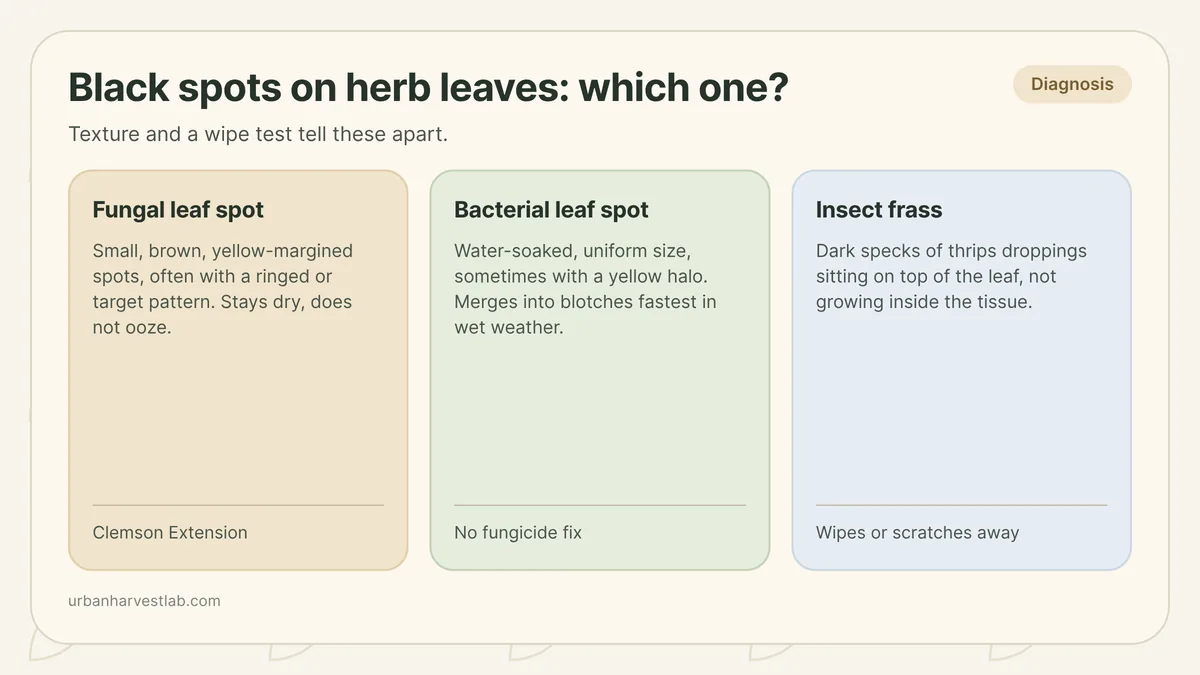
Black spots on herb leaves: fungus, bacteria, or frass
Black spots on herbs can be a fungal disease, a bacterial disease, or just insect droppings sitting on the leaf, and each one calls for something different.

Tomato plant wilting even though you water it: heat, roots, or disease
Midday droop that clears by evening is usually heat. Wilt that stays after watering points to rotting roots or a vascular disease, and a cut stem tells you which.
Choosing a pest treatment for plants you are going to eat
Once you know which pest you have, the next question is what you can treat it with without compromising the food. The answer is a ladder of methods, and the label on any product you buy sets the legal limits of the top rung.