Troubleshoot the system before you change the inputs.
Symptoms
- Irregular holes chewed through a leaf, sometimes leaving only the network of veins behind, with damage that keeps spreading day by day.
- A shiny, silvery slime trail on the leaf, the stem, or the soil surface near the damage.
- A seedling missing whole leaves, or chewed off at the stem overnight.
Possible causes
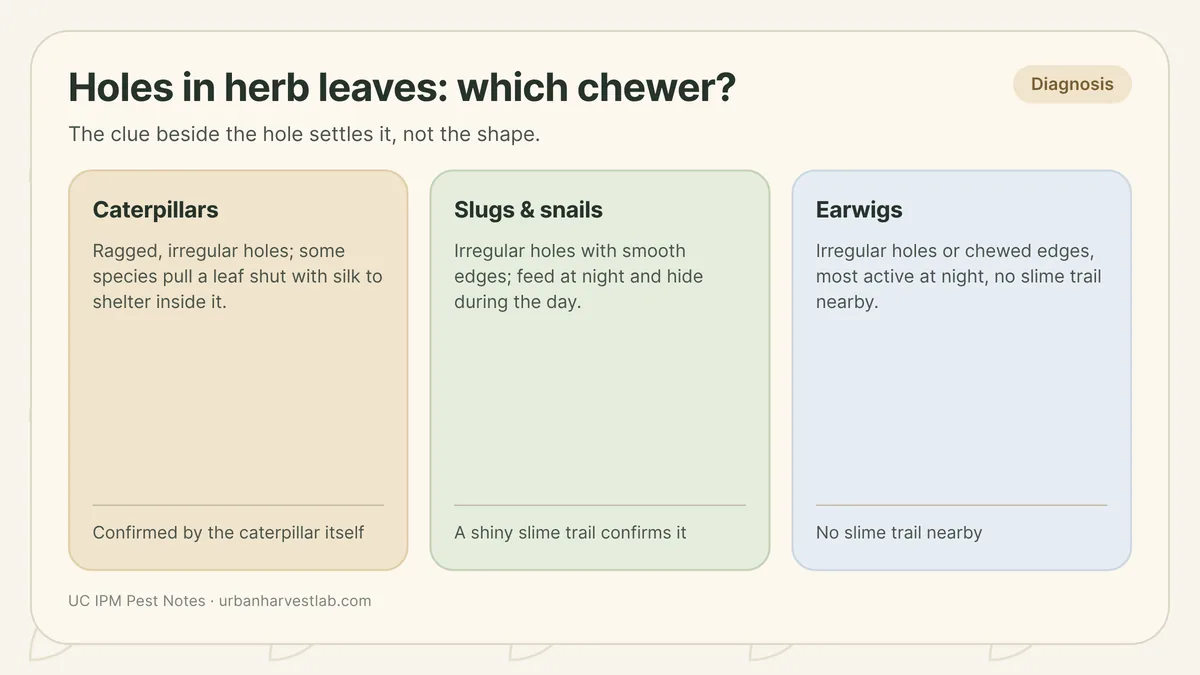
- Caterpillars are chewing ragged holes, and some are folding or rolling a leaf shut with silk to shelter inside it.
- Slugs or snails are scraping smooth-edged holes at night and leaving a slime trail behind.
- Earwigs are chewing irregular holes at night with no slime trail anywhere nearby.
Quick fixes
- Check the plant after dark with a flashlight; slugs, snails and earwigs feed most actively at night, and cutworms hide in soil by day and feed then too.
- Look for a slime trail before assuming a night-time hole came from an earwig rather than a slug or snail.
- Confirm which insect is actually present before treating anything, since a spray that works on one does nothing for the other two.
Holes in herb leaves: three chewers, three clues
| Clue | Caterpillars | Slugs and snails | Earwigs |
|---|---|---|---|
| Hole shape | Ragged, irregular edges | Irregular, but the edges are smooth | Irregular, or chewed around the edge |
| When they feed | Many species by day; cutworms hide in soil by day and feed at night | Night; hide during the day | Most active at night |
| Confirming sign | The caterpillar itself, or a leaf pulled shut with silk | A shiny slime trail on the leaf, stem, or soil | No slime trail nearby; look for the pincer-tailed insect itself |
Something is chewing actual holes through your herb leaves, and the fix depends on which of three insects is doing it: caterpillars, slugs and snails, or earwigs. The shape of the hole alone will not settle it. What settles it is checking for the insect itself, or for the specific evidence each one leaves behind — a slime trail, a leaf pulled shut with silk, or nothing at all nearby except the hole.
If holes are only part of what your potted herb is doing — pale color, wilting, slow growth alongside the damage — the common potted herb problems guide walks through light, root stress, and container issues in a fixed order before you narrow in on a chewing pest specifically.
First, make sure it’s actually a hole
Three other kinds of leaf damage get mistaken for chewed holes, and each one has a different cause and a different page.
A leaf miner does not chew through a leaf at all. Clemson Cooperative Extension describes the damage as “winding discolored trails or irregular blotches” that stay sealed between the two leaf surfaces — “unsightly but rarely serious.” Hold the leaf up to the light: if you can see a pale trail running through the tissue rather than an actual opening, that is a mining larva, not a chewing insect, and the leaf miners on basil and greens guide covers confirming it and why most sprays fail against it.
Spider mites do not chew holes either. UC IPM describes their damage as “stippling of light dots on the leaves,” sometimes with a bronze cast, and fine webbing as the confirming sign once an infestation is advanced. If what you are seeing is a fine, even speckling rather than a hole, the spider mites on indoor herbs guide covers identification and control.
Aphids and thrips distort and curl new growth as they feed rather than punching through it. If the leaf is twisted or cupped instead of missing tissue, the curling herb leaves guide separates pest-caused curl from heat stress and underwatering.
Three insects that actually chew through a leaf
UC IPM’s pest notes describe three chewing insects that leave real, open holes in garden and houseplant foliage, and each one has its own confirming sign.
Caterpillars: ragged holes, and some pull the leaf shut with silk
UC IPM describes caterpillar feeding plainly: they “chew irregular holes in foliage or blossoms or entirely consume seedlings, young shoots, buds, leaves, or flowers.” Some species go further, folding or rolling a leaf together with silk to build a shelter to feed inside. A young seedling can be stripped down to almost nothing overnight if a caterpillar population is large enough.
Cutworms are the caterpillar most likely to fool you into thinking a different pest is at work, because UC IPM notes they “hide in the soil during the day, emerging to feed at night” — the same schedule as a slug, a snail, or an earwig. The confirming sign for any caterpillar is the insect itself, usually visible on the underside of a damaged leaf or curled inside a silk-tied shelter, or a cutworm found in the soil right at the base of a chewed seedling.
Slugs and snails: smooth-edged holes and a slime trail
Snails and slugs feed by scraping at leaf tissue with a rasp-like tongue, and UC IPM describes the result as “irregular holes with smooth edges on leaves and flowers.” They feed at night and hide during the day, so the damage often appears with no insect anywhere in sight by the time you notice it.
The confirming sign is the “shiny slime trails snails and slugs leave behind,” which UC IPM points to as the way to distinguish their damage from every other night-feeding chewer. For monitoring, UC IPM recommends checking daily at first; once you have handpicked the population down, “weekly hand-picking can be sufficient” to keep it there.
Earwigs: a night feeder that looks like slug damage, minus the trail
Earwigs are reddish-brown insects about 3/4 inch long with a pair of forceps-like pincers at the tail end, according to UC IPM. Their feeding damage looks a great deal like a slug’s: “numerous irregular holes or chewed around the edges,” and a badly hit seedling can turn up “missing all or parts of their leaves and stem.” They are also most active at night.
UC IPM gives the exact way to tell an earwig from a slug or snail: check for the slime trail. If the hole is there but the trail is not, an earwig is the more likely cause, and the insect itself — reddish-brown, narrow-bodied, with those visible pincers — confirms it if you find one under a leaf or in the mulch nearby.
Earwigs are not purely a pest to eliminate on sight. UC IPM notes they are “voracious feeders on soft-bodied insects such as aphids and insect eggs and can exert significant biological control,” so a few earwigs sharing a pot with light leaf damage may be doing your herb more good than harm. Reserve control for a population doing real, ongoing damage rather than for the first one you spot.
What about beetles?
Beetles do chew on herb foliage, and extension sources describe beetle larvae as a distinct feeding group from soft-bodied pests — Colorado State University Extension notes that “larger insects, such as caterpillars, sawflies, and beetle larvae, are generally immune to soap sprays,” which matters if you are deciding what to spray once you know what you are dealing with. UC IPM’s damping-off guidance names flea beetles among the chewing pests — alongside cutworms, earwigs, snails and slugs — that can fell a seedling outright, though UC IPM’s snail, earwig and caterpillar pest notes each give a damage description and the flea beetle equivalent is not one of them. If you suspect a beetle, the fastest route is the same one that works when a hole’s shape alone is not conclusive: check the plant at different times of day and look for the insect itself rather than trying to read the outline of the damage. A felled seedling rather than a holed leaf points toward the herb seedlings dying guide.
Confirm the culprit before you treat anything
Slugs, snails and earwigs all feed at night, and cutworms hide in the soil by day and emerge after dark, so a flashlight check after dark is the single most useful diagnostic step. Many other caterpillars feed in daylight, so check the leaf undersides while it is light too. Look at the damaged leaves directly, and check the soil surface and pot rim for a slime trail before you decide what did it.
If you want to trap rather than just observe, UC IPM describes a simple earwig trap: a rolled-up newspaper, a piece of corrugated cardboard, a bamboo tube, or a short length of hose, placed on the soil near the plant just before dark. Shake whatever collects into a pail of soapy water the next morning. Slugs and snails are usually easier to simply handpick once you know to look at night.
Getting the identification right changes what you should reach for. The soap-spray limitation above is one reason: a product effective on soft-bodied insects will not touch a caterpillar or a beetle larva. UC IPM gives Btk-type products as an effective caterpillar control instead, working best while the caterpillars are still small. Once you know it is a slug or snail, the slugs and snails in container gardens guide covers control options in more depth, and if the damage turns out to be none of the three above, the herb pest identification chart covers the wider range of chewing and sucking pests. And whatever the culprit turns out to be, if you are reaching for a plant-based oil or any other product on a herb you plan to eat, the neem oil on herbs guide covers what the label actually has to say about edible crops before you spray anything.
Common mistakes
- Assuming a ragged edge means a caterpillar and a smooth edge means a slug, without checking for a slime trail or the insect itself.
- Killing every earwig on sight instead of weighing the light damage against the aphids and eggs it may also be eating.
- Spraying insecticidal soap on a caterpillar problem because it worked on a past aphid infestation.
- Treating a leaf miner’s tunnel or a spider mite’s stippling as though it were a chewed hole.
- Checking the plant only in daylight, when slugs, snails and earwigs do most of their feeding at night.
Sources
Rule out the other damage patterns first
Holes are one specific damage pattern. These guides cover the tunnels, stippling, and curling that get mistaken for them.
Common questions
What's eating holes in my basil leaves?
Usually one of three insects. Caterpillars chew ragged, irregular holes and sometimes pull a leaf shut with silk to hide inside it. Slugs and snails scrape smooth-edged holes at night and leave a shiny slime trail behind. Earwigs chew irregular holes at night too, but leave no slime trail. Check the leaf and the soil surface after dark with a flashlight, and let the slime trail, the silk, or the insect itself settle which one it is.
How do I tell caterpillar damage from slug or snail damage?
Look for a slime trail. A shiny trail on the leaf, stem, or soil means a slug or snail; UC IPM gives that trail as the specific way to separate slug and snail damage from earwig damage. Caterpillar damage looks different from either: a leaf pulled shut with silk, or the caterpillar itself resting on the underside of a leaf during the day, confirms a caterpillar instead.
Are the holes in my herb leaves from leaf miners?
Probably not, if you can see all the way through the leaf. Leaf miner damage is a winding, pale tunnel that stays sealed between the two leaf surfaces; a true hole means something chewed all the way through from outside. If you are seeing a trail or blotch rather than an actual opening, that is a different pest with a different fix.
Should I kill every earwig I find in a herb pot?
Not automatically. Earwigs are also predators of aphids and insect eggs, so a low number of earwigs sharing a pot with light leaf damage may be doing more good than harm. Reserve control for cases where damage is heavy or seedlings are being consumed outright.
Related guides
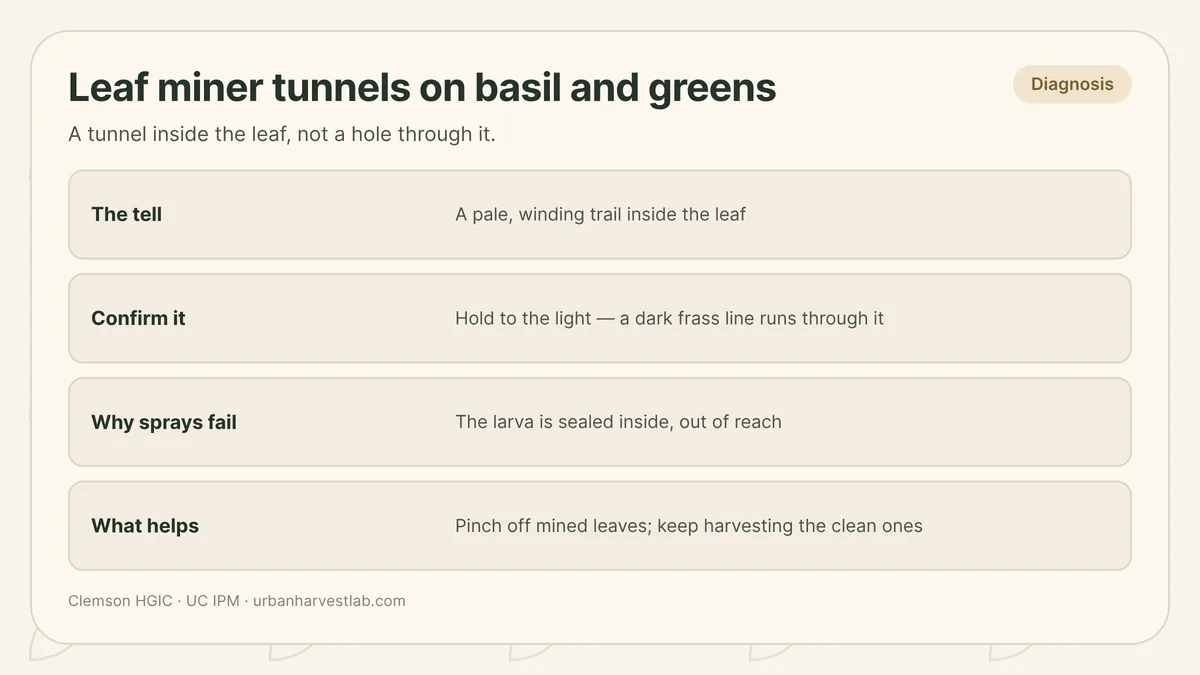
Leaf miners on basil and greens: reading the tunnels
Leaf miner damage on basil and leafy greens shows up as a pale, winding tunnel inside the leaf tissue itself, and most sprays cannot reach the larva causing it.
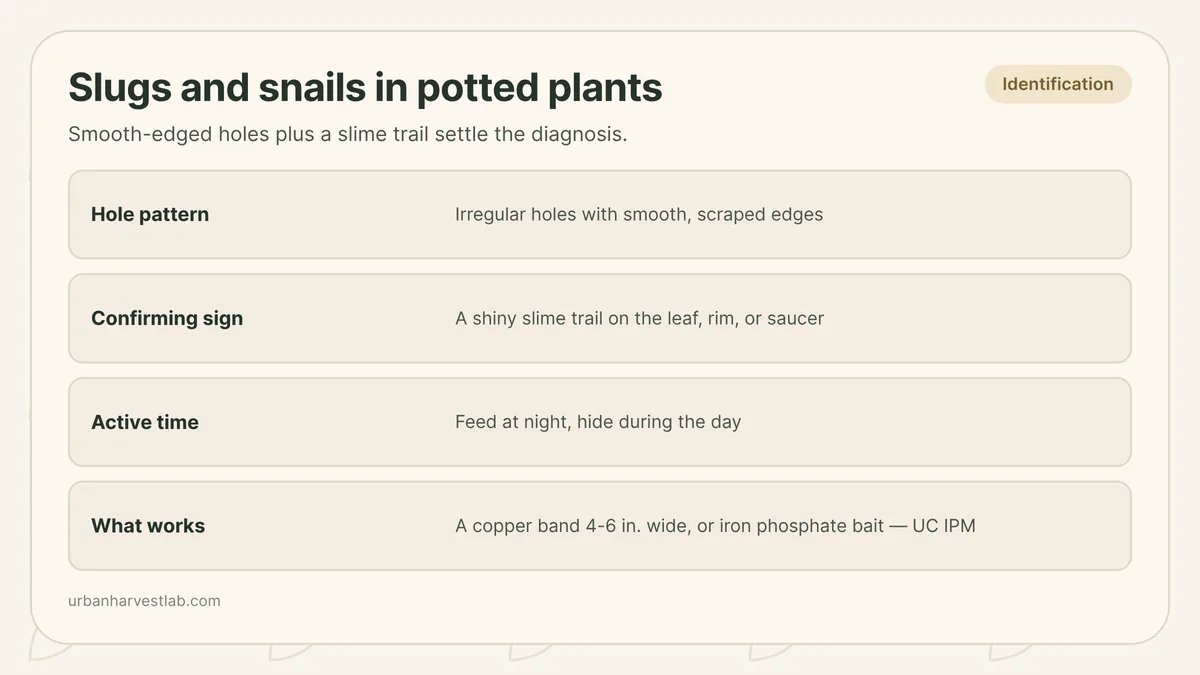
Slugs and snails in potted plants: barriers that actually work
Smooth-edged holes and a shiny trail on a potted herb point to slugs or snails. A copper barrier, iron phosphate bait, and checking after dark are the responses with evidence behind them.
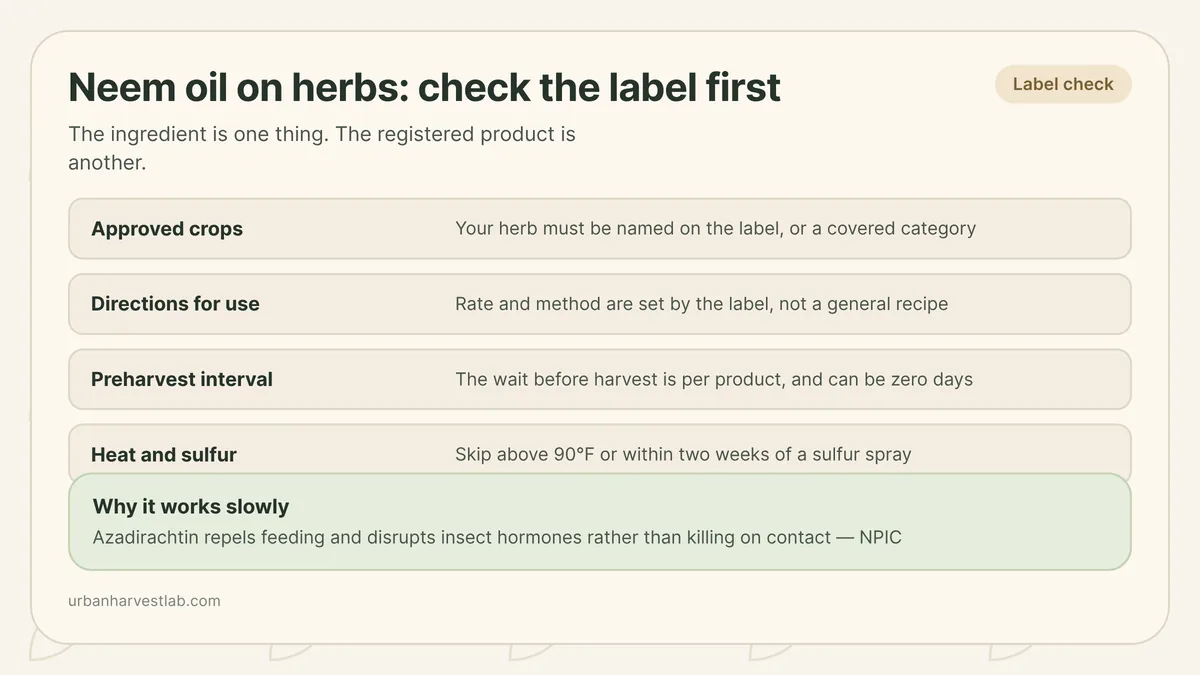
Neem oil on herbs: what the label decides before you spray
Whether neem oil is safe for a herb depends on the product's label, not on neem oil as an ingredient — and the label also sets the wait time before harvest.