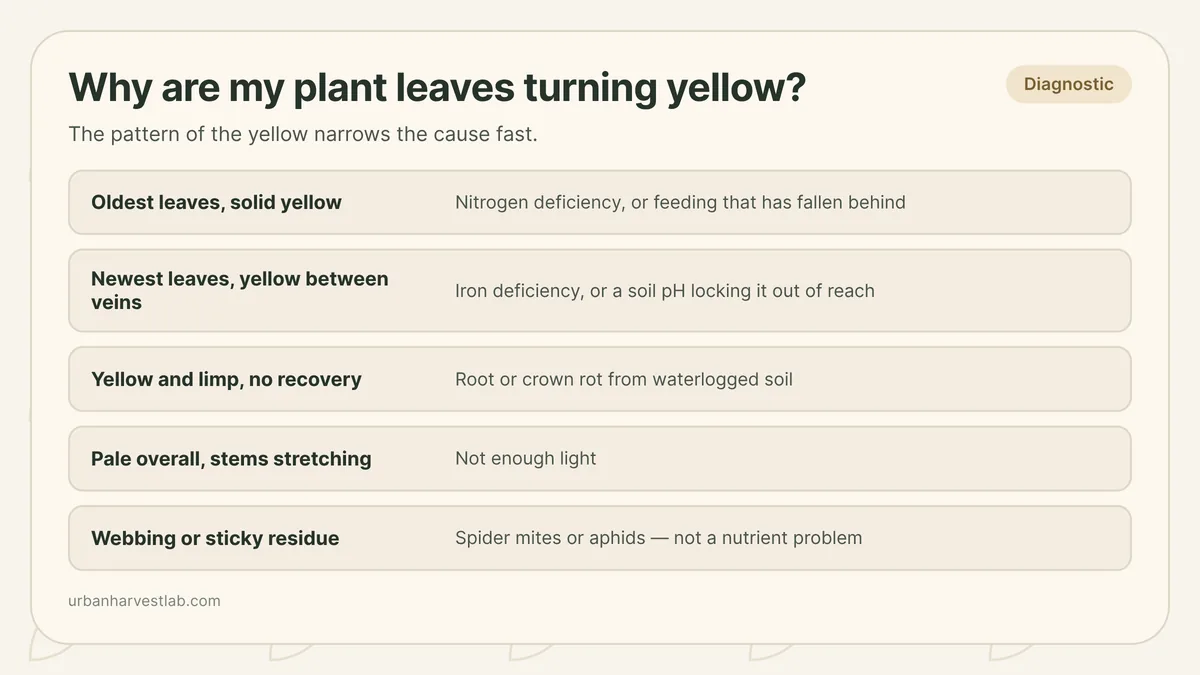
Yellow leaves have a short list of real causes, and the pattern is what tells them apart: which leaves are affected, whether the yellow sits solid or trapped between the veins, and what else is visible on the plant. Work through the four signals below, in order, and the list narrows fast.
Yellowing is one symptom among several covered in common potted herb problems, but it carries more diagnostic weight than wilting or leggy growth, because the exact shape of the yellow separates a dozen different causes rather than just confirming that something is wrong. The signals below are what actually do that separating.
Match your plant’s pattern
Answer what is visible and leave a question on “not sure” rather than guessing — the result folds in every cause consistent with what is actually known.
Match the pattern
Pick what fits, skip what you are not sure of, and check any extra signs you can see.
Most likely cause
Answer at least one question to begin
- Read next
- —
Read the five signals in order
Which leaves are yellow first
Nutrients move through a plant at different speeds, and where the yellow shows up first reflects that. UC IPM describes nitrogen deficiency as uniformly pale green to yellowish, appearing on older leaves first while new growth stays sparse and undersized, and potassium deficiency the same way, with older foliage turning yellowish or brown at the tips and margins before anything else changes. Both are mobile nutrients: the plant pulls them out of old tissue to build new growth, so the oldest leaves show the shortage first.
Iron and zinc work the opposite way. UC IPM describes iron-deficient new foliage as undersized and yellow to whitish except for green along the veins, and zinc-deficient new growth as uniformly yellowish or pale between the veins, with narrow, undersized leaves — neither element moves easily out of old tissue once it has settled there. New-leaf yellowing with green veins usually means a micronutrient problem or a soil pH blocking uptake, not a straightforward feeding gap.
Solid yellow, or yellow trapped between the veins
A solid, uniform yellow across the whole leaf points at a mobile-nutrient shortage or general low vigor. Yellow that stays between green veins — interveinal chlorosis — points at iron, manganese, or zinc, or at a soil pH pushing those elements out of reach. Illinois Extension gives the mechanism for iron specifically: iron is absorbed as a usable ion only when soil pH sits between 5.0 and 6.5, and it becomes steadily less available as pH climbs above 6.5. Test the pH at the root zone before feeding a plant that shows this pattern — adding more of a nutrient that is already present but locked out does not change anything. Container soil pH covers testing and correcting it.
Whether the plant recovers after watering
Wilting is not evidence of thirst, and neither is yellowing while the soil feels wet. Clemson’s extension service states plainly that the symptoms of overwatering and underwatering are similar, because both damage root health rather than affecting the canopy directly. The discriminator is not leaf color; it is what happens after watering. A plant that perks back up within a few hours was dry. A plant that stays limp or gets worse was not, and UC IPM notes that Phytophthora root and crown rot can establish in soil that has stayed saturated for as little as 4 to 8 hours. Once that infection is established, recovery is uncommon even with better watering afterward, so the root zone decides the next step, not the calendar.
Whether the plant is simply short on light
Pale, evenly faded leaves with stems stretching between them, rather than a solid or interveinal yellow, usually points to light rather than a nutrient or watering problem. Clemson HGIC’s indoor light figures set the scale of the gap: a well-lit home averages under 100 foot-candles against more than 10,000 outdoors, and maintaining an indoor plant takes roughly 100 foot-candles for twelve hours a day just to hold steady. Feeding a light-starved plant does not fix this — Clemson’s own fertilizing guidance sets at least 200 foot-candles for 12 hours a day as the light level foliage plants need before feeding does any good. How much light herbs need covers judging and correcting a windowsill’s actual light level.
Whether anything else is living on or under the leaf
Insects and fungi cause yellowing too, and they usually leave a second sign beside the color change. UC IPM notes that large aphid populations can turn leaves yellow and stunt shoots, and the honeydew they leave behind often turns black with sooty mold. Spider mite damage shows as light stippling that can turn a leaf bronze, and the one unambiguous mite sign is fine webbing across the foliage, which UC IPM describes as covering leaves, twigs, and even fruit in a heavy infestation. On basil specifically, Clemson describes an early downy mildew symptom as yellowing whose spread is limited by the leaf’s major veins, confirmed by purplish-gray sporulation on the underside of the same yellowed patch — a pattern that gets fed by mistake because the first symptom looks exactly like underfeeding. Mint’s most distinctive yellowing cause is rust, which the Royal Horticultural Society describes as producing orange-brown pustules, usually on the underside of the leaf, and no fungicide is available to home gardeners for treating culinary mint once it appears.
Where extension services disagree
Manganese deficiency is where the pattern above breaks down. UC IPM groups manganese with iron and zinc, placing its symptoms on new foliage. Illinois Extension places manganese, along with zinc, on the inner or older leaves first, developing there before it progresses outward. Two extension services describe the same deficiency showing up on opposite ends of the same plant. The practical response holds either way: a soil or tissue test confirms manganese as the cause, not a guess based on leaf position.
Pattern, cause, and where to go next
| Pattern you see | Most likely cause | Read next |
|---|---|---|
| Oldest leaves solid yellow first, new growth thin and pale | Nitrogen deficiency, or feeding that has fallen behind the plant’s growth | Nutrient lockout and soil pH |
| Newest leaves yellow between green veins | Iron deficiency, or soil pH locking a micronutrient out of reach | Nutrient lockout and soil pH |
| Yellow and limp, soil stayed wet, no recovery after watering | Root or crown rot from waterlogged soil | Overwatered vs underwatered |
| Pale overall, stems stretching between leaves | Not enough light | How much light herbs need |
| Yellow patches bounded by the leaf’s major veins, purple-gray fuzz underneath | Basil downy mildew | Basil downy mildew |
| Orange-brown pustules on the underside of the leaf | Mint rust | Mint leaves turning yellow |
| Yellow with fine webbing across the leaf | Spider mites | Spider mites on indoor herbs |
| Yellow, sticky, clustered soft-bodied insects on new growth | Aphids | Aphids on indoor herbs |
| Pale and stunted, growing in a hydroponic reservoir | Nutrient lockout, pH drift, or low dissolved oxygen at the roots | Hydroponic lettuce yellow leaves |
When yellowing means the plant needs rescuing, not feeding
Overwatering and underwatering produce a nearly identical set of yellowing symptoms, so color and texture alone do not separate the two. The recovery-after-watering test settles it faster than any leaf color: a plant that perks up within a few hours was dry; one that does not has a root problem, and overwatered vs underwatered carries the finger test, the weight test, and the full comparison. A pot that has clearly dried out and stayed dry for an extended time yellows its lower leaves first, then wilts and eventually drops those leaves, which is a different repair than drainage.
Woody, drought-tolerant herbs carry the same waterlogging risk with a shorter fuse, since their native soil is usually sharp and fast-draining rather than moisture-retentive. A stem that comes up soft and dark near the soil line, on a plant that has been sitting wet, is a rot sign rather than a feeding gap.
Common mistakes that make the pattern harder to read
- Fertilizing a plant with interveinal yellowing on new growth, when the nutrient is often present but locked out by pH rather than missing from the soil entirely.
- Watering a wilted, already-wet plant more, when the wilting is a root-damage sign that additional water makes worse.
- Judging recovery by old leaves. Damaged, yellowed leaves rarely green back up; watch the new growth that comes in after a fix instead.
- Reaching for a spray before confirming which signal is actually present — a mite treatment does nothing for a fungal disease, and a fungicide does nothing for aphids.
- Applying one universal rule across every herb. Mint’s most distinctive yellowing cause is rust; basil’s is downy mildew; a nutrient or watering problem can affect either one the same way a houseplant would show it.
Sources
- UC IPM: Common Nutrient Deficiency Symptoms
- Illinois Extension: Chlorosis
- UC IPM: pH Problems
- UC IPM Pest Notes: Phytophthora Root and Crown Rot in the Garden
- UC IPM Pest Notes: Aphids
- UC IPM Pest Notes: Spider Mites
- Clemson HGIC: Indoor Plants – Watering
- Clemson HGIC: Houseplant Diseases & Disorders
- Clemson HGIC: Basil
- Missouri Botanical Garden: Overwatering
- RHS: Mint Rust: Causes & Treatment
Go straight to your plant
Once a probable cause is clear, these guides carry the fix specific to what is growing.
Common questions
The oldest leaves on my plant are yellow but the new growth looks fine. What does that mean?
Old-leaf yellowing usually means a mobile nutrient such as nitrogen is moving out of older tissue to feed new growth, or that the plant has been kept too dry for an extended stretch. Check root-zone moisture before assuming it needs feeding.
The new leaves are yellow between the veins, but the veins stay green. Is that a nutrient problem?
That pattern usually points to iron, or to soil pH high enough to lock iron and other micronutrients out of reach. Test the pH at the root zone rather than adding more fertilizer to a plant that may already have enough nutrient sitting unavailable in the soil.
Why did my plant stay yellow and limp after I watered it?
A plant that does not perk up within a few hours of watering usually has damaged or rotting roots, not a thirst problem. Waterlogged soil starves roots of oxygen, and recovery becomes less likely the longer that lasts.
Is yellowing on mint the same problem as yellowing on basil?
No. Mint has one yellowing cause the others do not: rust, which the RHS describes as orange-brown pustules on the underside of the leaf. Pot size, nitrogen, and wet soil are mint's more common causes. Basil has its own distinctive cause too: a downy mildew whose spread is limited by the leaf's major veins, which Clemson describes as the disease's first symptom. Check the plant-specific signs rather than assuming one cause covers every herb.
Related guides
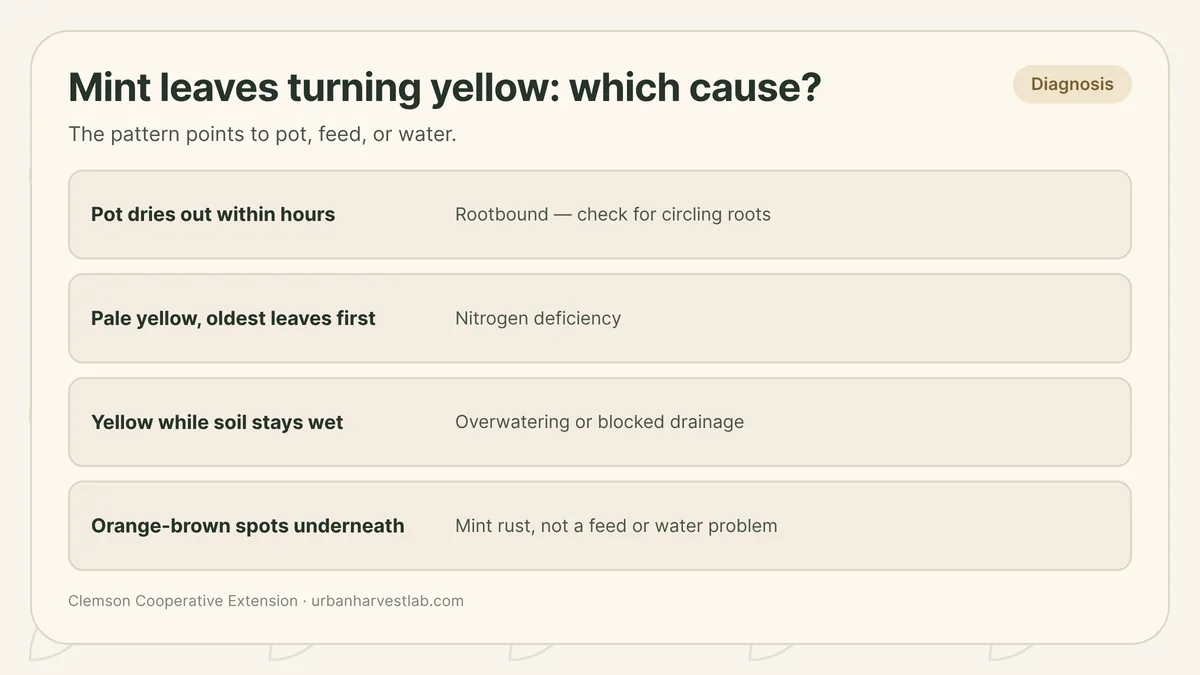
Mint leaves turning yellow: pot size, feeding, or water
Yellow mint leaves have three usual sources: a pot the roots have outgrown, short nitrogen, or soil that stays too wet. The pattern tells you which.
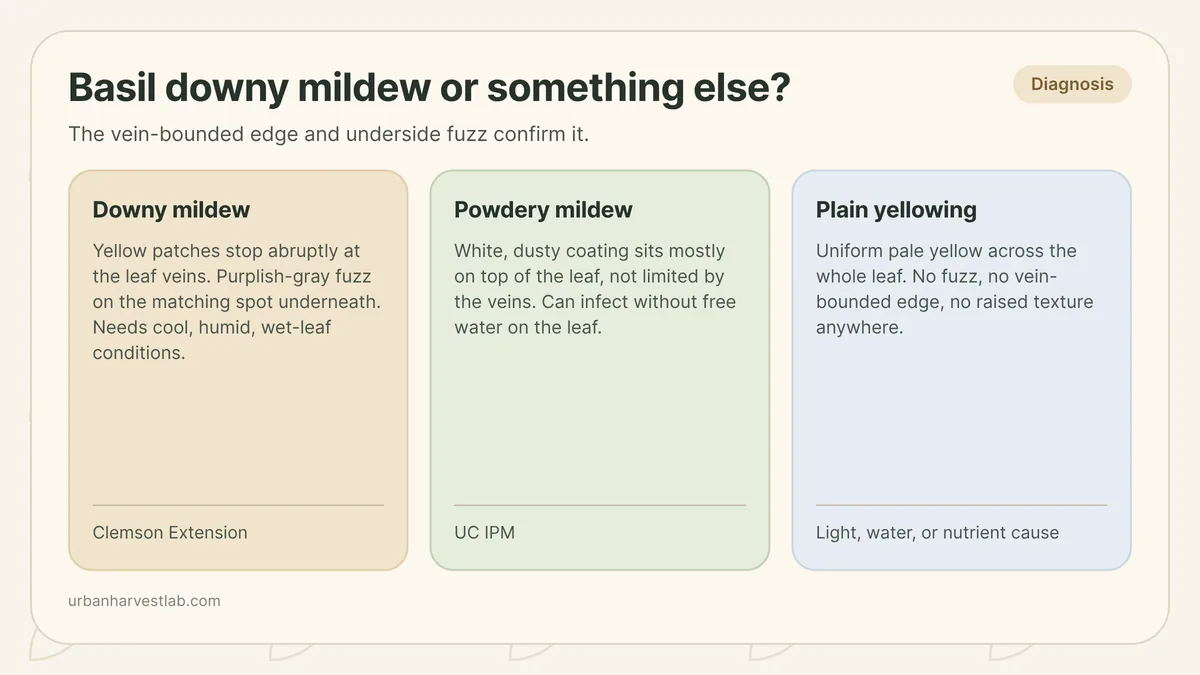
Basil downy mildew: reading the vein-bounded yellowing
Vein-bounded yellowing on top with purplish-gray fuzz underneath means downy mildew, not a feeding problem and not powdery mildew.
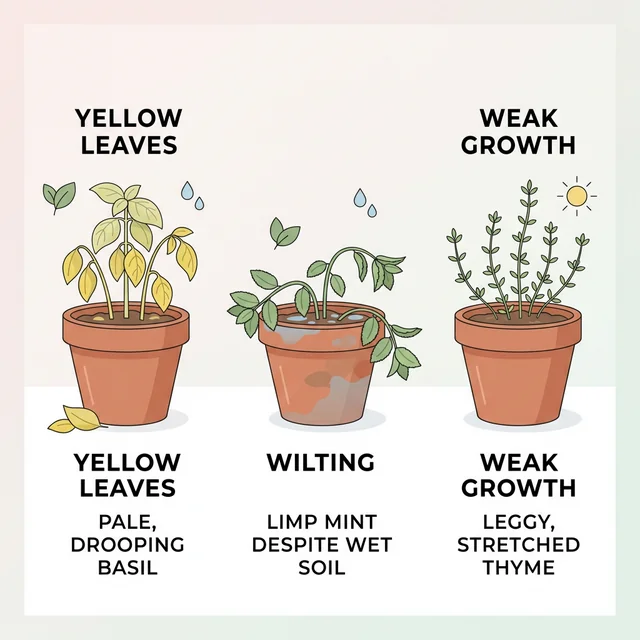
Common potted herb problems: yellow leaves, wilting, and weak growth
Common potted herb problems usually show up as yellow leaves, wilting, or weak growth, but the useful diagnosis starts with light, drainage, and root stress.