
Troubleshoot the system before you change the inputs.
Symptoms
- Lower or inner leaves turn yellow and fall in the first weeks after the pot comes inside, while the stems and growing tips stay firm.
- The soil stays damp for many days between waterings, or the pot dries out unusually fast after the heating comes on.
- Leaf edges go brown and crisp on a plant sitting near a vent, radiator or draughty door.
Possible causes
- The drop in light between outdoors and an indoor window is large, and the plant sheds leaves it can no longer support.
- Summer watering habits continue indoors, where growth has slowed and the soil stays wet far longer.
- Winter indoor air is far drier than outdoor air, and drafts or vents dry or chill the foliage.
- Pests carried in from outside, such as spider mites or whiteflies, are feeding on the leaves.
Quick fixes
- Move the pot to the brightest south or west window available, or add supplemental light.
- Water only when the top inch of soil is dry, and empty the saucer.
- Move the plant away from vents, radiators and drafts, and stop fertilizing until growth restarts.
- Look under leaves and at stems for pests, and keep the plant apart from your other plants for several weeks.
Plants that drop leaves after coming indoors are mostly reacting to a large fall in light, and some leaf loss is common even when you do everything right. Treat the move as a light problem first, a watering problem second and a dry-air problem third. If the stems are firm and new growth looks healthy, you are watching an adjustment, not a death. Plants being overwintered dormant on purpose behave differently; for those, see the pepper overwintering guide and the rosemary and thyme guide.
Why the light change causes it
Illinois Extension puts it bluntly: light levels indoors are much lower than outdoors, even compared with shaded areas, and the reduction often results in yellowing leaves and leaf drop. Eventually the plant begins to produce new leaves. Nebraska Extension describes the same thing as a common occurrence after plants come back indoors.
The plant is doing something sensible. It built leaves for a bright patio, and those leaves cost more to keep than a dim room can repay. It sheds some and regrows foliage suited to the new conditions.
Clemson gives numbers for how big the gap is. A well-lit home averages under 100 foot-candles, against over 10,000 outdoors, and maintenance of a foliage plant takes about 100 foot-candles for 12 hours a day. A windowsill is the best light most rooms offer, and it is still a fraction of a balcony. The guide to how much light herbs need covers what that means for edible plants in particular.
What helps
- Choose the brightest window. Illinois Extension recommends the sunniest window, typically south or west facing, and supplemental lighting if that is not enough.
- Add light if you can. Nebraska Extension says giving a plant all available natural light, or adding fluorescent tubes, should reduce or prevent leaf loss. Kansas State adds that no grow light matches the sun, so plants still need to be moved gradually.
- Step down before the move, if it is not too late. Kansas State suggests a week in a lower-light spot before the plant comes inside, then the brightest indoor position, then a slow move to its final winter place. Illinois Extension suggests a shaded spot outdoors for a week, then a day or two indoors, building up the time.
If the plant is already inside and shedding, none of that is wasted: the brightest window is still the move. The reverse trip in spring needs its own care, covered in plants scorched after moving outside.
Watering: the habit that follows the plant in
Growth slows when light drops, so the plant uses less water. Kansas State warns that it is easy to overwater simply because you watered more often outside. Nebraska Extension gives a feel for the change: a plant that needed water once a day in July and August may need it once a week or less in the house in winter, and it suggests watering when the top inch of soil is dry rather than on a schedule.
Wet roots also cause yellowing and drop, so this cause hides inside the light story. The pot weight and the root check in overwatered vs underwatered separate the two. Then go the other way: Kansas State notes that pots dry out faster once the furnace is running, so a routine set in October may be wrong by December.
Check roots at the same time. Nebraska Extension says a large mass of circling roots with little soil visible means a plant that outgrew its pot over summer needs a larger one; the signs of a root-bound herb are the same.
Dry air, drafts and heat
Illinois Extension says winter humidity indoors can be as low as 10-20%, much lower than what the plant had outside. For houseplants, it suggests daytime temperatures between 65 and 75 °F, about 10 degrees cooler at night, and keeping plants away from drafts and heat vents. Illinois gives a cooler 40-60 °F, with bright light, for tender perennials such as peppers and rosemary held dormant through winter; those plants are covered in the pepper overwintering guide and the rosemary and thyme guide.
Clemson lists hot, dry air as one of four causes of brown leaf tips; the others are improper watering, insect feeding and salt accumulation. The brown tips guide sorts them.
To raise humidity, Illinois Extension lists a humidifier, plants grouped together, a shallow tray of gravel and water with the pot kept above the waterline, and kitchens or bathrooms if they get enough light. It also says misting raises humidity only for minutes, so it is a poor use of time.
Pests that rode in with the plant
Leaf drop that does not match the light story deserves a close look at the undersides of leaves. Illinois Extension names aphids, whiteflies, mealybugs, scale and spider mites as common outdoor hitchhikers, and says indoor populations can increase rapidly. Clemson’s houseplant pest list includes early leaf drop as a thrips symptom. Fine stippling or webbing points to spider mites.
Keep the plant separate from your others. Illinois Extension says that after 3-4 weeks without pests it should be safe to move the plant closer to the rest, and Nebraska Extension agrees that isolation makes problems easier to see and treat. Preventing pests on indoor herbs covers the routine.
Feeding and what to leave alone
Stop fertilizing. Illinois Extension says to stop until spring for most plants. Nebraska Extension explains why: fertilizing a plant that is not actively growing builds up salts that can damage roots. Nebraska adds an exception for plants in a very bright south or west window or under supplemental light, which may keep growing and can be fed as active plants.
Clemson puts the point where feeding helps a foliage plant at about 200 foot-candles for 12 hours a day, twice the maintenance level, so a plant that is shedding for lack of light gains nothing from fertilizer. Clemson’s indoor fertilizer guidance also says to give none during winter dormancy.
Clemson advises against repotting ailing or dormant plants, so hold off on a plant that is dropping leaves unless the roots are clearly circling.
When leaf drop is not just adjustment
Look at the stems. Firm green stems with growth at the tips fit an adjustment to light. Soft, dark or collapsing stems fit a root problem from wet soil, so check the roots before assuming light is the cause. If the yellowing is the main sign, the yellow leaves cause finder separates the common causes. For a citrus tree specifically, see citrus leaves yellow indoors, and for herbs that you want to keep producing over winter, growing herbs indoors in winter.
Sources
- Illinois Extension, “Tips for moving houseplants indoors and overwinter care”
- Nebraska Extension in Lancaster County, “Bringing Houseplants Indoors”
- K-State Extension, Butler County, “Bringing Houseplants Inside in the Fall”
- Clemson HGIC, “Indoor Plants – Cleaning, Fertilizing, Containers & Light Requirements”
- Clemson HGIC, “Indoor Plants – Transplanting & Repotting”
- Clemson HGIC, “Houseplant Diseases & Disorders”
- Clemson HGIC, “Common Houseplant Insects & Related Pests”
Keep plants going through winter
Crop-specific winter routines and the neighbouring problems that look like leaf drop.
Common questions
How long does leaf drop last after bringing plants inside?
Illinois Extension says that after the light-driven yellowing and leaf drop, plants eventually begin to produce new leaves, and it does not give a number of weeks. Keep the plant in its brightest spot and judge by the stems and growing tips: firm and green means it is adjusting, while soft or collapsing stems point to a watering or root problem.
Can I stop leaf drop completely?
Not reliably. Kansas State Extension says a slow move to lower light can prevent leaf drop and yellowing, and Nebraska Extension says all the natural light possible, or fluorescent light added to it, should reduce or prevent leaf loss. Neither promises it: Kansas State says a slow move can prevent it and Nebraska says light should reduce or prevent it, so a few lost leaves on a plant moved in a hurry are not a sign you did something wrong.
Should I mist the plant to fix dry air?
Misting is a weak fix. Illinois Extension says it raises humidity only for minutes, and suggests a humidifier, a pebble tray kept below the pot base, grouping plants, or a kitchen or bathroom window as better options if the light there is good enough.
Should I fertilize a plant that is dropping leaves?
No. Illinois Extension advises stopping fertilizer until spring for most plants brought indoors, and Nebraska Extension says feeding a plant that is not actively growing builds up fertilizer salts that can damage roots. Clemson puts the point where feeding helps a foliage plant at about 200 foot-candles for 12 hours a day, twice the maintenance level, so a plant shedding for lack of light gains nothing from fertilizer. A plant under strong supplemental light or in a very bright window may still be growing and can be treated as an active plant.
Related guides
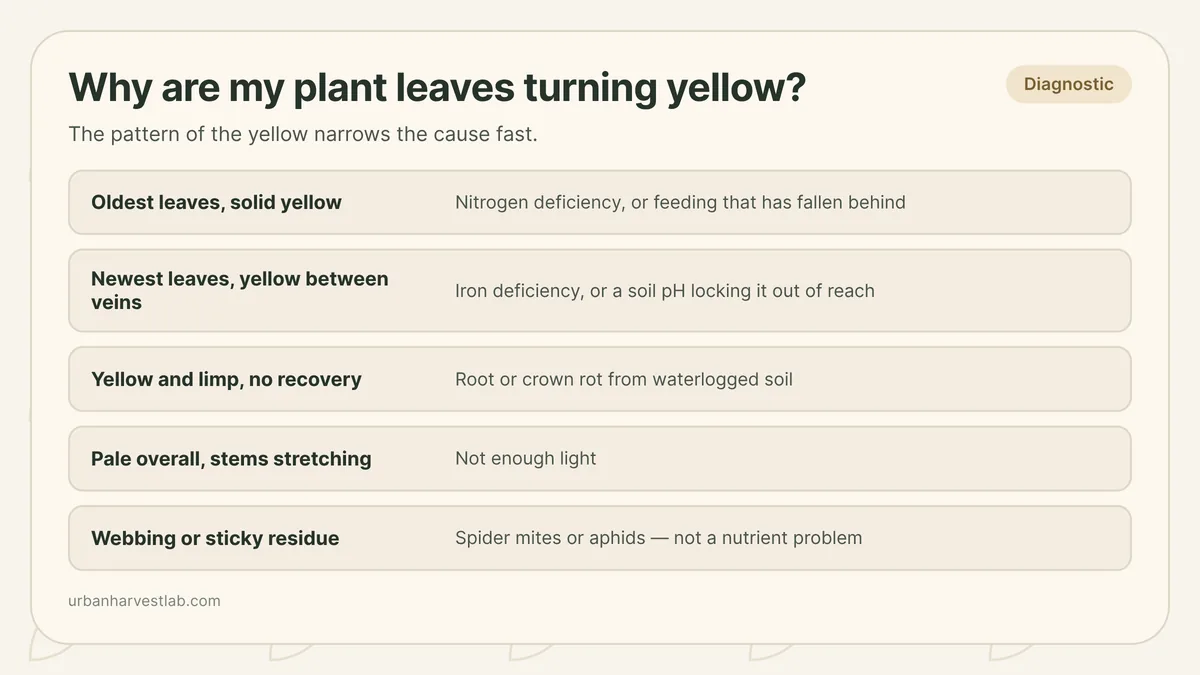
Why are my plant leaves turning yellow? Find the likely cause
Yellow leaves have a short list of real causes, and the pattern of the yellowing narrows it fast, once you know what to look for.

Overwintering pepper plants: how to carry one through to spring
Frost kills a pepper plant back every winter, but the plant itself is not actually an annual. Here is the tender-perennial method for carrying one over instead of starting from seed again.
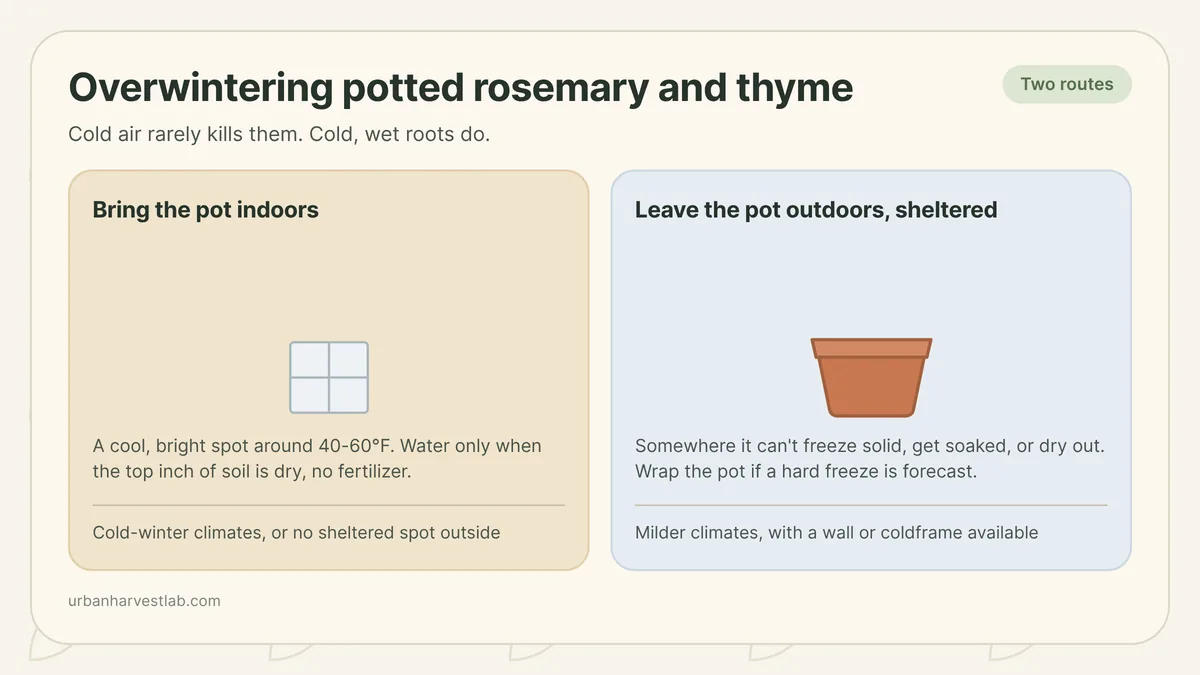
How to overwinter rosemary and thyme in pots
Winter kills more potted rosemary and thyme through mistimed watering and cold-wet roots than through cold air alone. Here is what to do indoors and out.