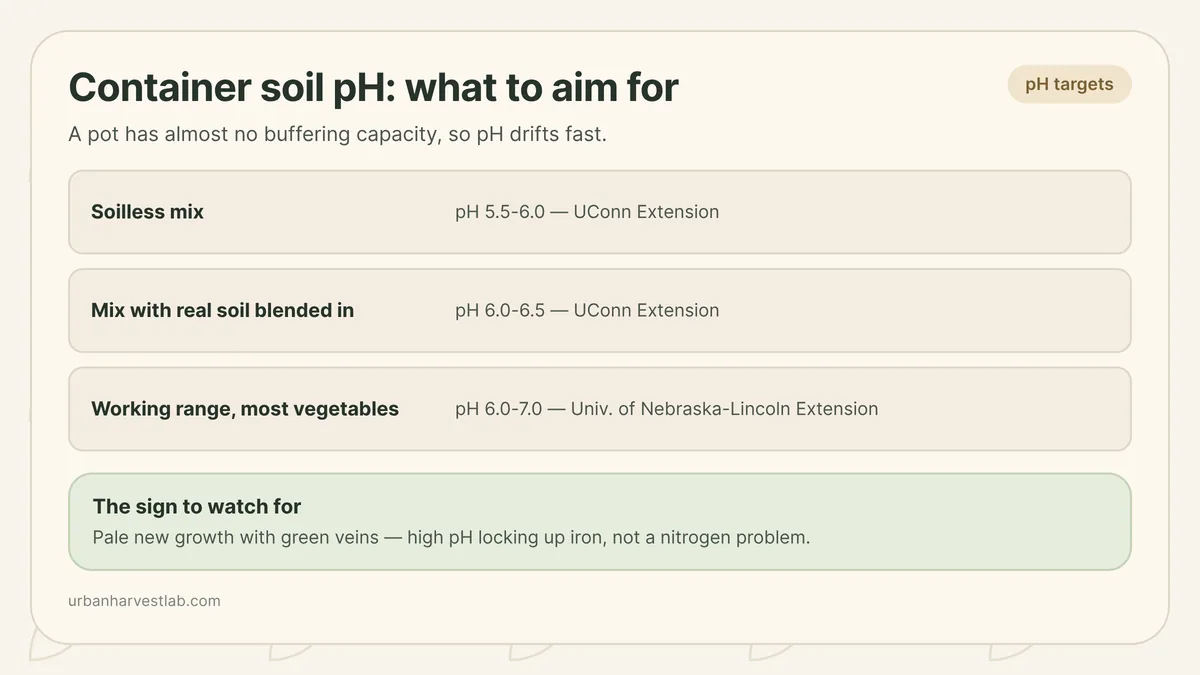
Container mix pH matters more, and drifts faster, than pH in open ground, because a few quarts of soilless mix has almost none of the mineral buffering capacity that a garden bed has. Fertilizer, hard tap water, and the peat or lime already in the bag can push a pot’s pH away from where your plant needs it within a season, not years. Test it when growth stalls or new leaves come in pale with green veins, aim for pH 5.5-6.0 in a soilless mix or 6.0-6.5 in a mix with real soil, per UConn Extension — the mid-6s suit most container herbs and vegetables — and correct it with the right amendment rather than a garden-bed dose guessed down to pot size.
Why a pot behaves differently from a garden bed
Garden soil has clay particles, organic matter built up over years, and a large mineral reservoir that resists a pH swing — add sulfur or lime to a bed and the surrounding soil dilutes and buffers the change. A container mix works on entirely different physics already: it is a small, isolated volume of peat, bark, and perlite with little clay and no surrounding reservoir. Whatever you water in — fertilizer salts, alkaline tap water, an acidic peat base — has an outsized effect because there is so much less material to absorb it.
That is also why the same pot can drift in either direction depending on what feeds it. Peat-based mixes start acidic on their own; hard, mineral-heavy tap water pushes the other way over repeated waterings. A raised bed with real soil mixed in has more buffering than a pure soilless mix, but still far less than open ground.
What pH range to aim for
The right target depends on what is actually in the container. UConn Extension gives two different numbers for two different products: a soilless mix (peat, perlite, vermiculite, no mineral soil) is typically maintained at pH 5.5-6.0, while a mix that incorporates real soil runs 6.0-6.5. Penn State Extension’s own greenhouse-grade standard for soilless mix lands in the same neighborhood, pH 5.5-6.5, alongside a soluble-salts target of 1.5-3 mmhos/cm measured by the saturated paste method — a reminder that pH and salt buildup are tracked as two separate numbers, not one reading.
For the vegetables and herbs most container gardeners grow, University of Nebraska-Lincoln Extension gives a general ideal of pH 6.5, with 6.0-7.0 described as the working range for most crops; that source considers active correction necessary only once soil falls below pH 5.5 or climbs above 7.5. Utah State University Extension’s own range is close but not identical — 6.0-7.2 as optimal for most plants, with 7.0-8.0 tolerated by many drought-adapted Western species. Both land in the mid-6s, so treat anything from 6.0 to 7.0 as in range and only act on a reading outside it.
| Mix or target | pH range | Source |
|---|---|---|
| Soilless potting mix | 5.5-6.0 | UConn Extension |
| Mix with real soil blended in | 6.0-6.5 | UConn Extension |
| Greenhouse-grade soilless mix standard | 5.5-6.5 | Penn State Extension |
The sign that points at pH specifically
The one symptom that points specifically at pH is interveinal chlorosis: new leaves turn light green or yellow while the veins stay green. Utah State University Extension describes this as the classic result of high pH making iron unavailable to roots, and calls it “a very common problem” wherever soil pH runs high. Nutrient lockout and soil pH covers the full zone-by-zone picture of which nutrients lock out at which pH.
A white, crusty deposit on the mix surface or pot rim is not a pH symptom. That’s salt buildup from accumulated fertilizer and mineral residue, an osmotic problem that responds to leaching, not to a pH amendment — testing pH won’t explain a salt crust, and adding sulfur or lime won’t fix one.
How to test it
A soil pH meter with a probe, or a home soil test kit, both give a usable reading for a container. Test the mix while it’s moist, not bone dry or freshly watered, and sample from a couple of spots in the pot rather than relying on one probe placement near the surface — mix pH is not always uniform through the full volume, especially after repeated fertilizing has concentrated salts near the top. A county extension office can also run a lab test on a mailed sample if you want a number you can compare across seasons.
Test before you assume a nutrient problem is a feeding problem. If a plant is pale despite a reasonable fertilizing routine, and especially if new growth shows the green-veined chlorosis pattern above, checking pH before adding more fertilizer saves you from feeding a mix that can’t use what’s already in it.
How to correct it — and where the numbers stop applying to a pot
Two amendments handle the two directions, and both are sourced at garden-bed scale, which is the trap for a container gardener.
To raise pH, add lime. Clemson Cooperative Extension’s calculator-based rate is reduced by about a third for sandy soil and increased by about half for clay soil, and recommends applying two to three months before planting so the reaction finishes. Iowa State University Extension’s own worked example: a soil with a buffer pH of 6.0 needs 147 lb of pure fine calcium carbonate per 1,000 sq ft (at 6-inch depth) to reach a target of 6.5. That is a bed-scale figure — there is no sourced container conversion, so the practical move for a pot is to choose or mix a medium already in the range you need rather than liming a planted container by eye.
To lower pH, add elemental sulfur, which oxidizes slowly into sulfuric acid. Here the sourced rates disagree on units in a way that’s easy to misread: Utah State University Extension gives 6-10 lb per 1,000 sq ft applied annually; Iowa State University Extension gives 8-18 lb per 1,000 sq ft to move pH 7.0 down to 6.0 in a sandy loam to clay loam soil, with 3-6 months of warm soil needed for the reaction to complete. Clemson Cooperative Extension’s figures are stated per 10 sq ft instead — 0.3 lb to move pH 7.0 to 5.5, 0.6 lb for 8.0 to 5.0 in a loamy soil. Aluminum sulfate acts faster, within days to weeks rather than months, but at a much higher rate (2.1-4.2 lb per 10 sq ft for the same shifts) and carries a real risk of root injury if misapplied.
None of those rates were measured for a 2-gallon or 10-gallon container, and scaling a bed rate down by pot area is not something any of these sources actually tested. That’s why Utah State University Extension’s own container-specific advice sidesteps the math rather than solving it: for an acid-preferring species, plant it in a box or half-barrel heavily amended with acidic organic matter from the start, rather than trying to swing a small volume’s pH repeatedly through the season. For most container gardeners, that translates to a simpler rule than any lime or sulfur calculation — buy or build a mix already formulated for the range your plant needs, using a potting mix chosen for the crop, and reserve small-scale sulfur or lime corrections for a mix that tests only slightly outside range rather than one that needs a large shift.
Container pH versus hydroponic pH
Hydroponic growing manages pH in a completely different system: a nutrient solution with no solid buffer at all, where pH can drift within hours and gets corrected with pH-up or pH-down solution and daily monitoring, as covered in raising and lowering pH in a hydroponic reservoir. A container mix moves on a much slower clock — weeks to months, not hours — because the solid medium itself, and whatever organic matter or lime it contains, acts as a buffer a hydroponic reservoir doesn’t have. That slower drift is exactly why container pH gets tested occasionally rather than daily, and corrected with a solid amendment rather than a liquid dosed by drops.
Sources
- UConn Extension, Home Garden Education Office — Potting Media
- Penn State Extension — Potting Media and Plant Propagation
- University of Nebraska-Lincoln Extension, G945 — Fertilizers for Vegetables in Home Gardens
- Utah State University Extension — Solutions to Soil Problems II: High pH
- Clemson Cooperative Extension, HGIC — Changing the pH of Your Soil
- Iowa State University Extension, Yard and Garden — How to Change Your Soil’s pH
Get the root zone right before you adjust pH
pH sits on top of the same container chemistry as feeding and mix choice — these cover the rest of it.
Common questions
What pH should potting soil be?
A soilless potting mix is typically kept at pH 5.5 to 6.0, while a mix that includes real soil runs 6.0 to 6.5, according to UConn Extension. Most vegetables tolerate a working range of roughly 6.0 to 7.0, with 6.5 given as a general ideal by University of Nebraska-Lincoln Extension.
How do you test the pH of potting soil in a container?
Use a soil pH meter probe or a home soil test kit, sampling from a few spots in the pot rather than one, since mix pH is not always even through the volume. A county extension office can also run a lab test on a mailed sample.
How do you lower the pH of soil in a pot?
Elemental sulfur is the standard slow-acting amendment; Clemson Cooperative Extension and Iowa State University Extension both publish rates, but as pounds per square foot of garden bed, not per container, so scale down carefully and retest rather than guessing a pot-sized dose. For an acid-loving plant in a small pot, Utah State University Extension recommends starting with a mix already amended with acidic organic matter rather than repeatedly correcting pH in place.
Can I use garden lime in a potted plant?
Garden lime is the standard amendment for raising pH, but published rates from Clemson Cooperative Extension and Iowa State University Extension are again given per square foot of bed and depend on soil texture and buffer pH, not on target pH alone. Match a container mix formulated for the range your plant needs instead of estimating a bed-scale lime rate down to pot size.
Related guides
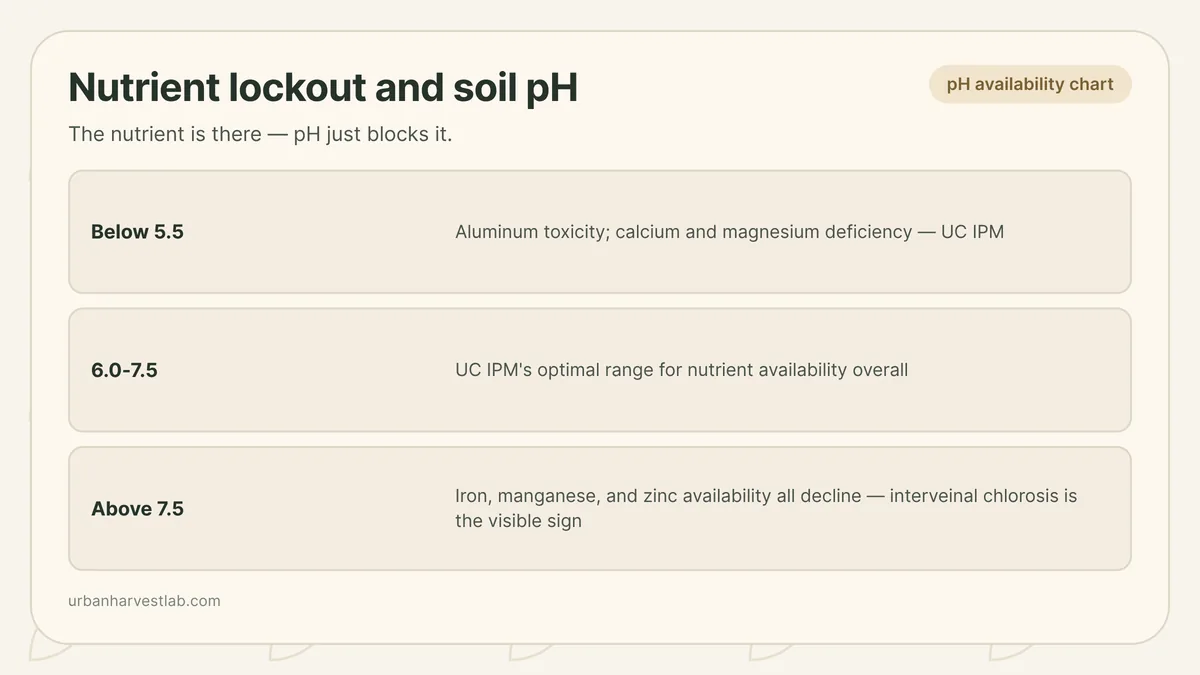
Nutrient lockout and soil pH: why pH blocks nutrients that are already there
A fertilizer that tests complete on the label can still leave a plant starving if the mix's pH is wrong. Here is what pH does to nutrient availability, zone by zone, and why it isn't a salt problem.
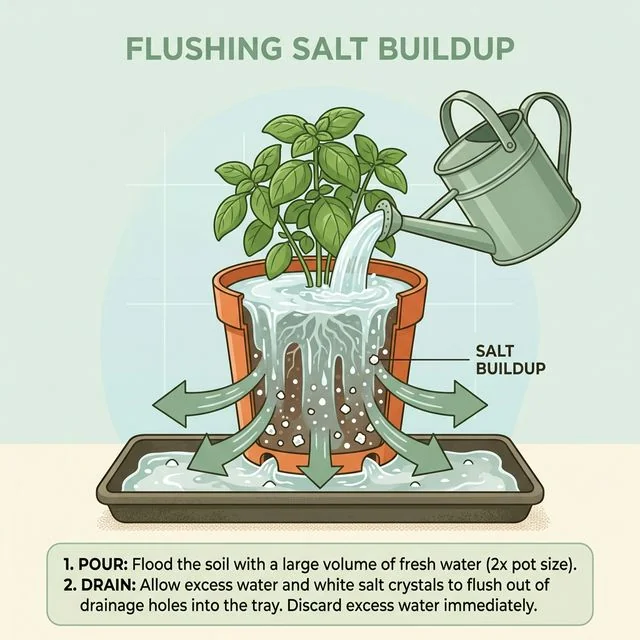
Salt buildup in herb pots: when to flush and when to repot
Every time you water your plants with liquid fertilizer, you are leaving heavy chemical salts behind. If you don't periodically wash them out, your herbs will suffer from chemical burn and nutrient lockout.
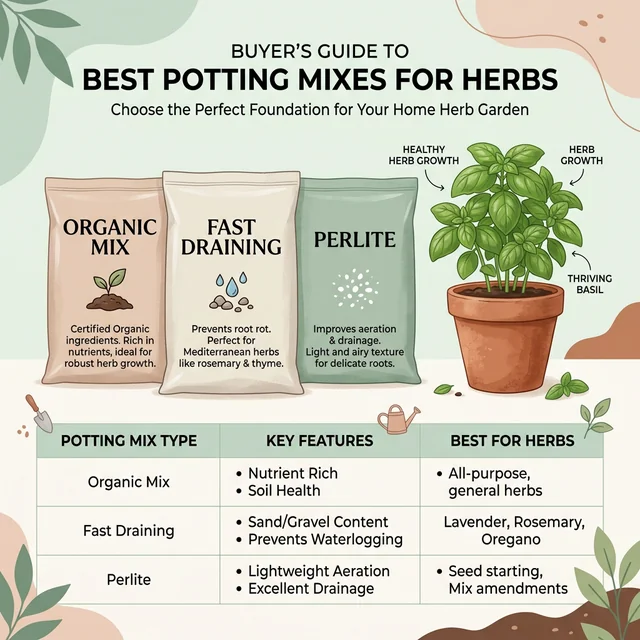
Best potting soil for potted herbs: how to pick the right mix
A practical buyer's guide to choosing potting mix for potted herbs, from richer blends for basil and parsley to faster-draining options for rosemary and thyme.