Troubleshoot the system before you change the inputs.
Symptoms
- Small yellow beetles with stripes or spots on seedlings, leaves or inside the flowers.
- Holes in leaves, or leaves with the lower surface eaten and a brown, papery top layer.
- Seedlings chewed at the seed leaves or at the stem, stunted or dead.
- One leaf or a few leaves flag, then the neighbouring leaves, then the whole vine.
Possible causes
- Cucumber beetle feeding, which is cosmetic on a well-established plant.
- Bacterial wilt, spread when beetles feed and open the leaf to the bacterium.
- Squash vine borer or root trouble, if the beetles are absent and the stem base is damaged or soft.
Quick fixes
- Cover young plants from planting day and remove the cover when flowers open.
- Squash any small orange-yellow egg groups you find near the base of the plant.
- Cut a wilted stem and pull the halves apart; if strings of sap form, remove the plant.
- Clear plant debris at the end of the season so adults have less shelter.
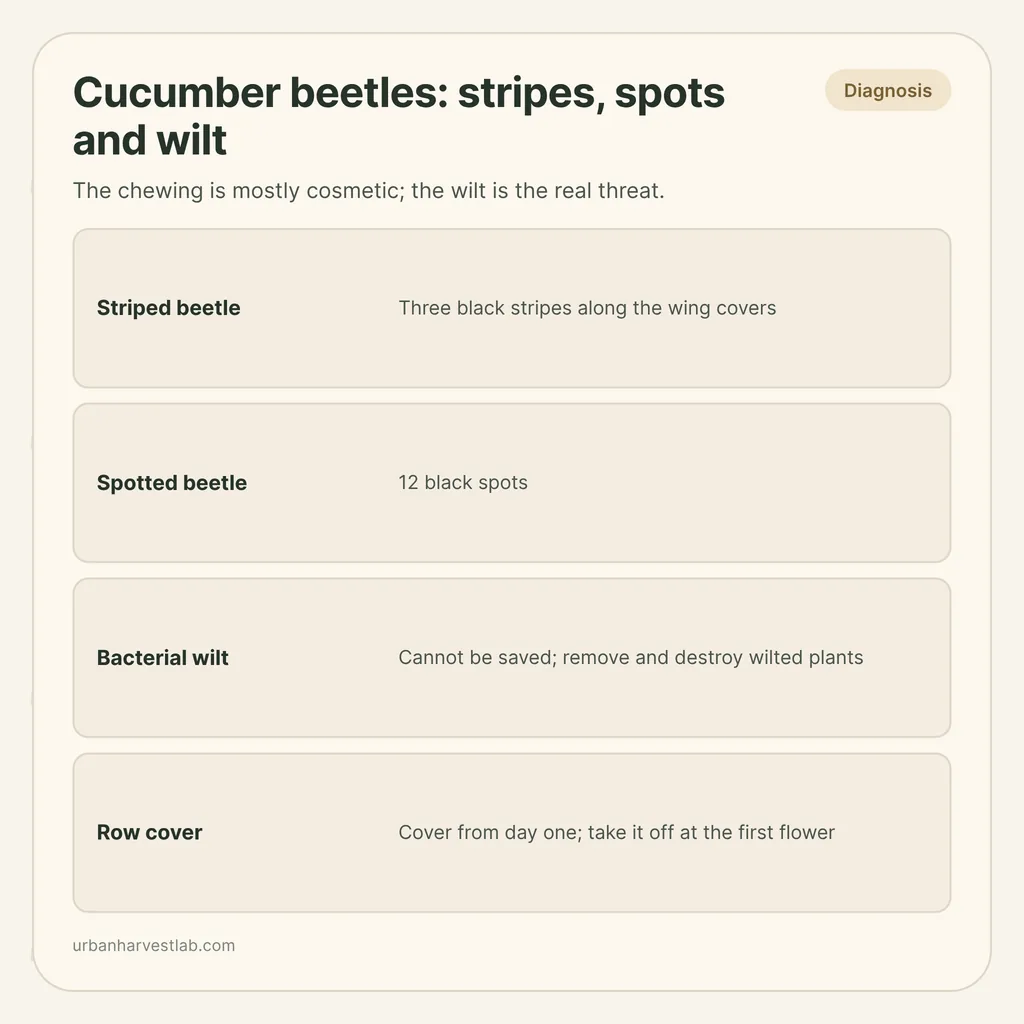
A quarter-inch yellow beetle with three black stripes or twelve black spots on your cucumber is a cucumber beetle. The chewing is mostly cosmetic on an established plant. What matters is that the beetles can pass on bacterial wilt, and that seedlings are the easiest to lose. Keeping the beetles off in the first weeks is the fix that works.
Which beetle is it
Illinois Extension gives adults as yellowish and about 1/4 inch long. The striped cucumber beetle has three distinct black stripes running the whole length of its wing covers. The spotted cucumber beetle has 12 black spots. Wisconsin Extension describes the spotted one as bright yellow-green with a black head and legs, and the striped one as pale yellow with a black head.
Two look-alikes turn up on cucurbit flowers. Wisconsin Extension names the western and northern corn rootworm beetles, which appear in the middle to late season and have probably little impact on cucurbits. Kentucky points out that the stripes on a striped cucumber beetle are straighter than those of the western corn rootworm, and that its hind-leg tibia is yellow where the rootworm’s is black.
The two species also behave differently. Wisconsin says adult striped beetles feed almost exclusively on cucurbits, while the spotted beetle feeds on a wide range of plants, with more than 200 alternate hosts including beans, corn and potatoes. The spotted beetle also arrives two to four weeks later, because it migrates north each year.
What the chewing does
Wisconsin Extension says established cucumber, melon and squash plants can sustain a lot of foliage feeding without losing yield. Three situations are worse:
- Seedlings. The beetles can kill or severely stunt young plants by feeding on the seed leaves, and can girdle stems by gnawing the tender shoots.
- Flowers. Severe feeding on flowers can result in poor fruit set, Wisconsin says. The University of Vermont adds that beetles in flowers can interrupt pollination.
- Fruit. Both species will feed on soft fruit and leave scars, according to Wisconsin.
On leaves, Illinois describes “window-panning”: the beetle eats the lower surface and the inside of the leaf and leaves the upper surface intact, which then turns brown. The larvae feed on roots, but Illinois and Kentucky both say that damage is minor.
Bacterial wilt is the real threat
Wisconsin Extension names the bacterium as Erwinia tracheiphila and says it overwinters in the gut of some striped cucumber beetles. Once beetles have it, they spread it through feces or on their mouthparts, and their feeding opens the leaf to entry. Kentucky adds that beetles are attracted to infected plants and carry the bacterium to healthy ones.
Susceptibility varies by crop. The University of Vermont says cucumbers and muskmelons are highly susceptible, while watermelons, squash and pumpkins are very tolerant or resistant. Vermont also says the disease can cause rapid collapse in young, fast-growing plants, especially before the five-leaf stage. Wisconsin says seedlings are more susceptible, both to feeding damage and to infection.
Recognising it. Kentucky describes the first symptom as flagging of lateral and individual leaves. Then the neighbouring leaves wilt, and then the whole vine. It notes that beetle feeding is not always obvious on the wilted leaves. To test, cut the stem and squeeze both cut ends. A sticky sap oozes out, and if you press the ends together and slowly pull them apart, strings form when the bacteria are present.
What to do about it. Kentucky and Wisconsin both say there is nothing you can do to save an infected plant. Wisconsin advises removing and destroying wilted plants, because other beetles can pick up the bacterium from them. For squash, see a zucchini that wilts.
If your plant is wilting, you see no beetles and the stem test is negative, work through why cucumber leaves turn yellow and how big the pot needs to be, since wilting has more than one cause.
Keeping them off
Cover from day one. The University of Vermont says floating row covers placed as soon as transplants are in the ground, or after direct seeding, help exclude striped cucumber beetles. Wisconsin names row cover, screens or cones as effective for home plantings. University of Maryland Extension says insect netting is the better choice because it does not trap heat. If you need some, browse insect netting on Amazon.
Take the cover off at the first flower. Illinois and Vermont both say it has to come off as plants begin to bloom so bees can pollinate. Wisconsin is blunt: otherwise there will not be any fruit set. Maryland adds that once fruits start to develop, plants tend to be less susceptible to infection. Illinois says protecting plants in their early growth delays disease transmission and may allow at least a few weeks of harvest even if beetles transmit the pathogen later.
Plant later and bigger. Vermont says setting out larger transplants later gives seedlings a better chance to withstand attack. University of Maryland Extension says that, in Maryland, delaying planting of squash and cucumber transplants until mid-June may evade the host-seeking adults; elsewhere the right date shifts with your local season.
Squash the eggs. Vermont says the small orange-yellow eggs are laid in groups near the base of the plant and can be squished. Illinois says females lay eggs in the soil around the base of cucurbits.
Clean up in autumn. Maryland says more than one generation can occur per year, so clearing garden debris in autumn denies the remaining adults shelter. Vermont says adults overwinter in plant debris. In a pot, that means emptying the old mix and the dead vine rather than leaving them on the balcony.
Sprays are a weak tool here. Wisconsin says foliar insecticides may not kill beetles quickly enough to stop transmission of bacterial wilt. Illinois says to read and follow all label directions and, once plants bloom, to apply late in the day to avoid spraying pollinators. A product can only be used on cucumbers if its label says so; choosing a treatment for edible plants covers how to read one. Squash bugs need a different approach, covered in squash bugs on zucchini in pots.
Common mistakes
- Leaving the cover on through bloom. No bee access means no fruit.
- Treating a wilted vine as thirsty. Watering does not help bacterial wilt; do the stem test first.
- Keeping an infected plant. Beetles pick the bacterium up from sick plants and carry it on.
- Waiting for beetles to be numerous. Illinois says more than one beetle per plant is often enough to transmit bacterial wilt to a large portion of plants in a garden.
Sources
- University of Illinois Extension, Cucumber Beetle
- University of Wisconsin Extension, Cucumber Beetles
- University of Kentucky Entomology, ENTFACT-311: Cucumber Beetles
- University of Vermont Extension, The Striped Cucumber Beetle
- University of Maryland Extension, Maryland Grows: Why do my cucumber and zucchini plants wilt?
Cucumber problems
Rule out the look-alikes and set the plant up to cope.
Common questions
What do cucumber beetles look like?
Illinois Extension describes adults as yellowish and about 1/4 inch long. Striped cucumber beetles have three black stripes running the full length of the wing covers, and spotted cucumber beetles have 12 black spots. Wisconsin Extension adds that the spotted one has a black head and legs and is yellow-green.
Do cucumber beetles kill cucumber plants?
They can kill or stunt seedlings by eating the seed leaves and girdling the stem, according to Wisconsin Extension. On older plants the bigger risk is bacterial wilt, which the University of Kentucky says has no rescue once the plant is infected.
When should I take the row cover off?
When the plants begin to flower. The University of Vermont and Illinois Extension both say the cover has to come off then so bees can reach the flowers, and Wisconsin Extension warns there will be no fruit set otherwise.
Can I spray cucumber beetles?
Wisconsin Extension says foliar insecticides may not kill beetles quickly enough to stop bacterial wilt from spreading. If you decide to spray, the label of the product has to list cucumbers and say how and when it may be used, Illinois Extension says that when plants begin to bloom, insecticides should be applied late in the day to avoid spraying pollinators, and to read and follow all label directions.
Related guides
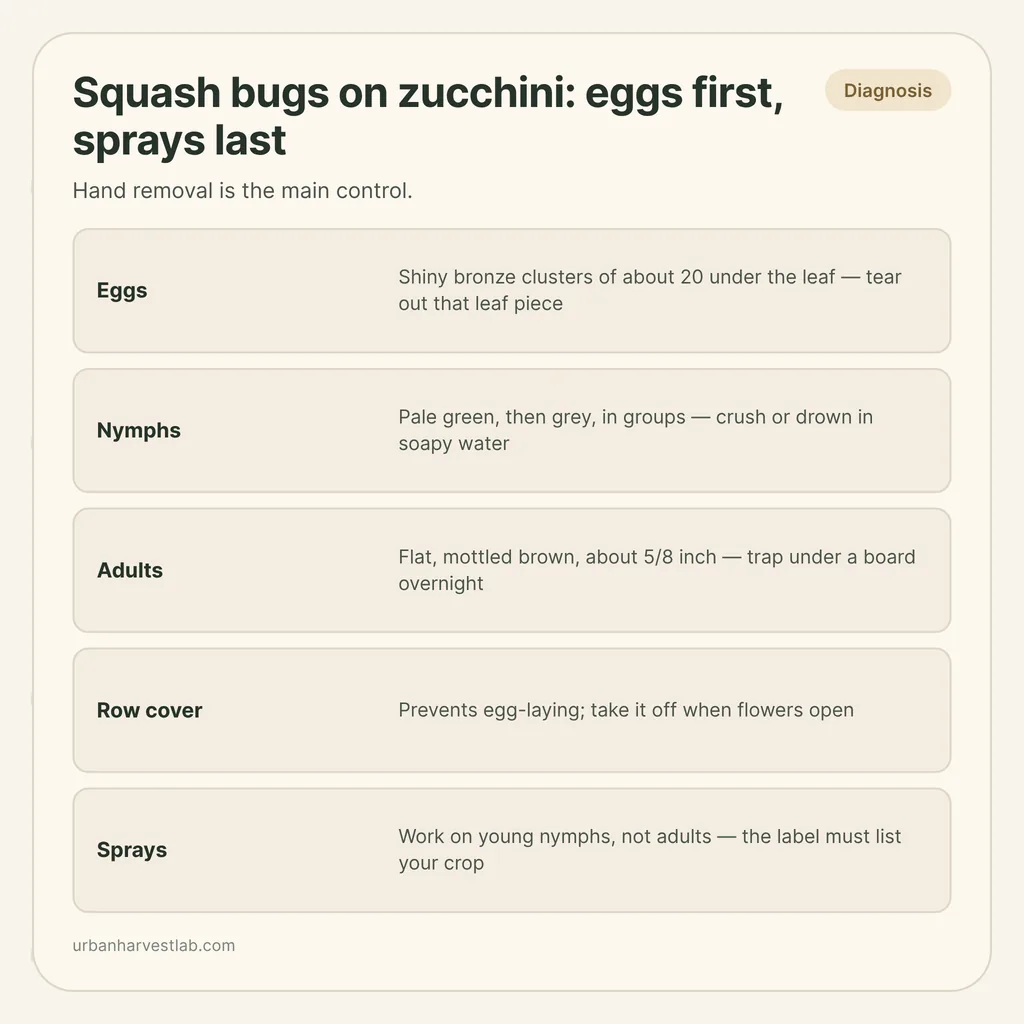
Squash bugs on zucchini in pots - find the eggs, trap the adults
Squash bugs hide at the base of the plant and lay bronze eggs under the leaves. Hand removal, boards and row cover do most of the work, and sprays only help against young nymphs.

Cucumber leaves turning yellow in pots: which cause fits
Where the yellow starts and what it looks like tells you whether a potted cucumber is hungry, waterlogged, mildewed or infested.
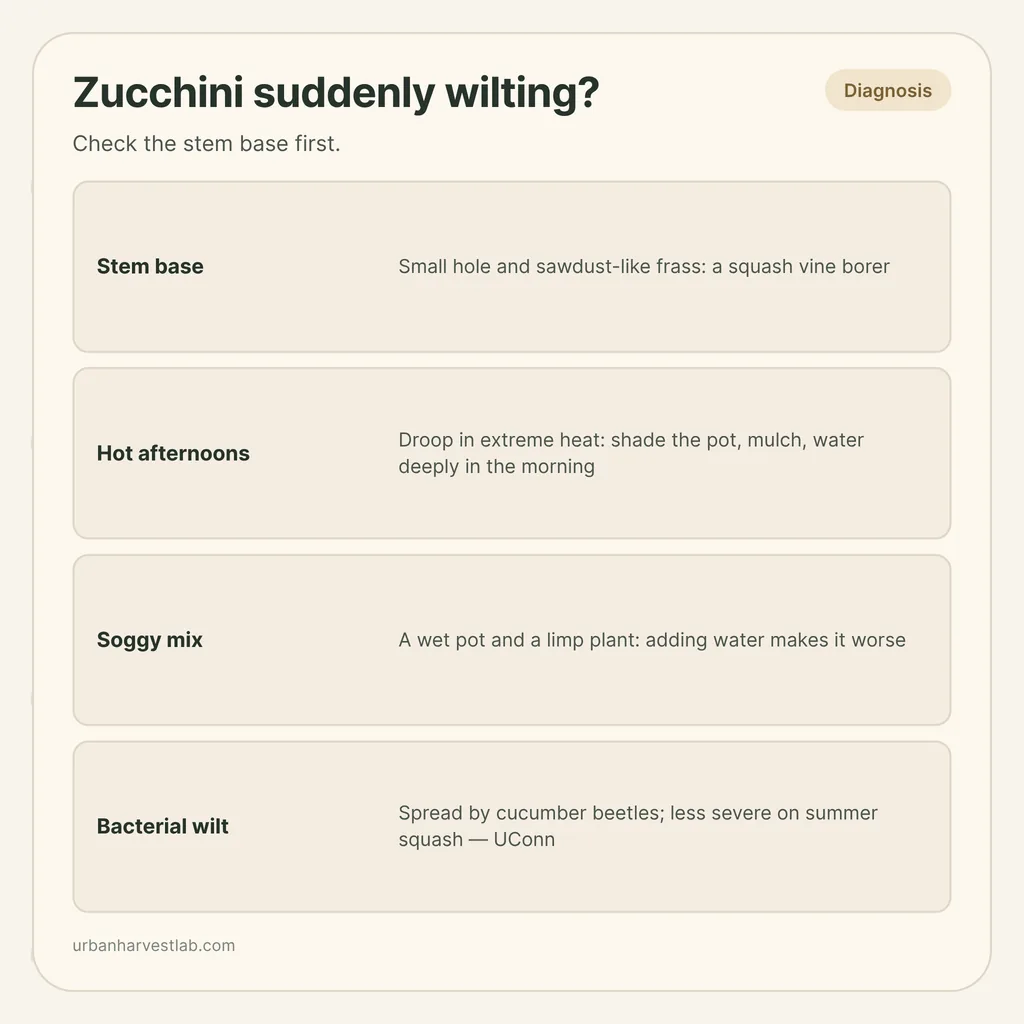
Zucchini plant suddenly wilting? Check the stem base first
A healthy-looking zucchini that collapses in days often has a borer in the stem. Heat, soggy roots and bacterial wilt are the other suspects, and the stem base tells them apart.