Troubleshoot the system before you change the inputs.
Symptoms
- Small yellow or white specks on the leaves that turn brown, then tattered leaves.
- Clusters of shiny bronze eggs, or crowds of grey and pale green bugs, on the underside of the leaves.
- Flat, mottled brown bugs at the base of the stems or under the mulch that smell bad when crushed.
- Leaves that wilt even though the mix is moist.
Possible causes
- Squash bugs feeding on the leaves and stems, leaving specks and then dead patches.
- A squash vine borer in the stem, if the base of the stem has frass and the bugs are absent.
- Powdery mildew, if the marks are a white dusty coating that wipes off rather than pinprick specks.
Quick fixes
- Check the undersides of the leaves every few days and tear out any leaf piece carrying eggs.
- Crush nymphs by hand or drop them in soapy water.
- Lay a board on the ground near the pot and destroy the bugs under it each morning.
- Clear every scrap of plant debris from the pot and its surroundings at the end of the season.
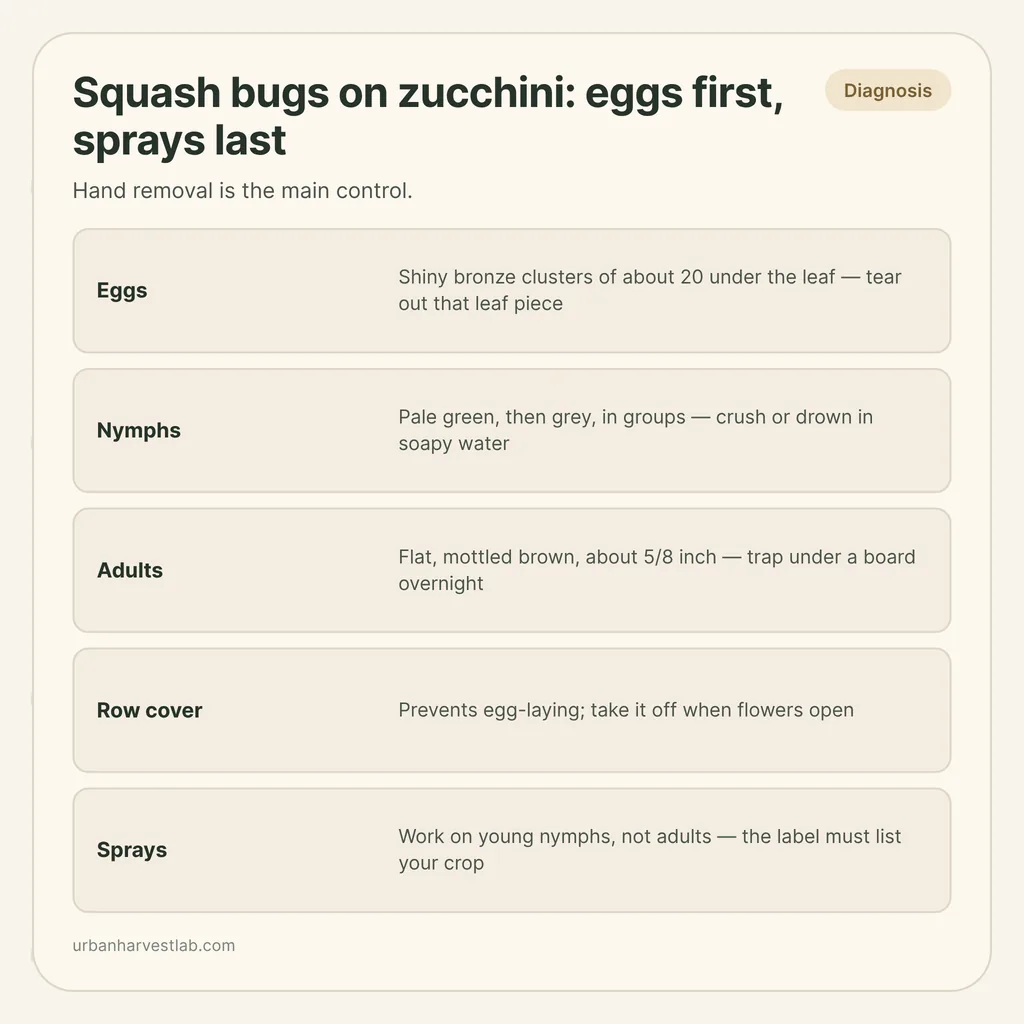
Squash bugs are flat, mottled brown bugs about 5/8 inch long that lay bronze egg clusters under zucchini leaves. Check the undersides of the leaves and the base of the stems, and remove what you find by hand: eggs torn out with the leaf piece, nymphs crushed, adults trapped under a board. Sprays are a minor tool, because they work on young nymphs and not much else.
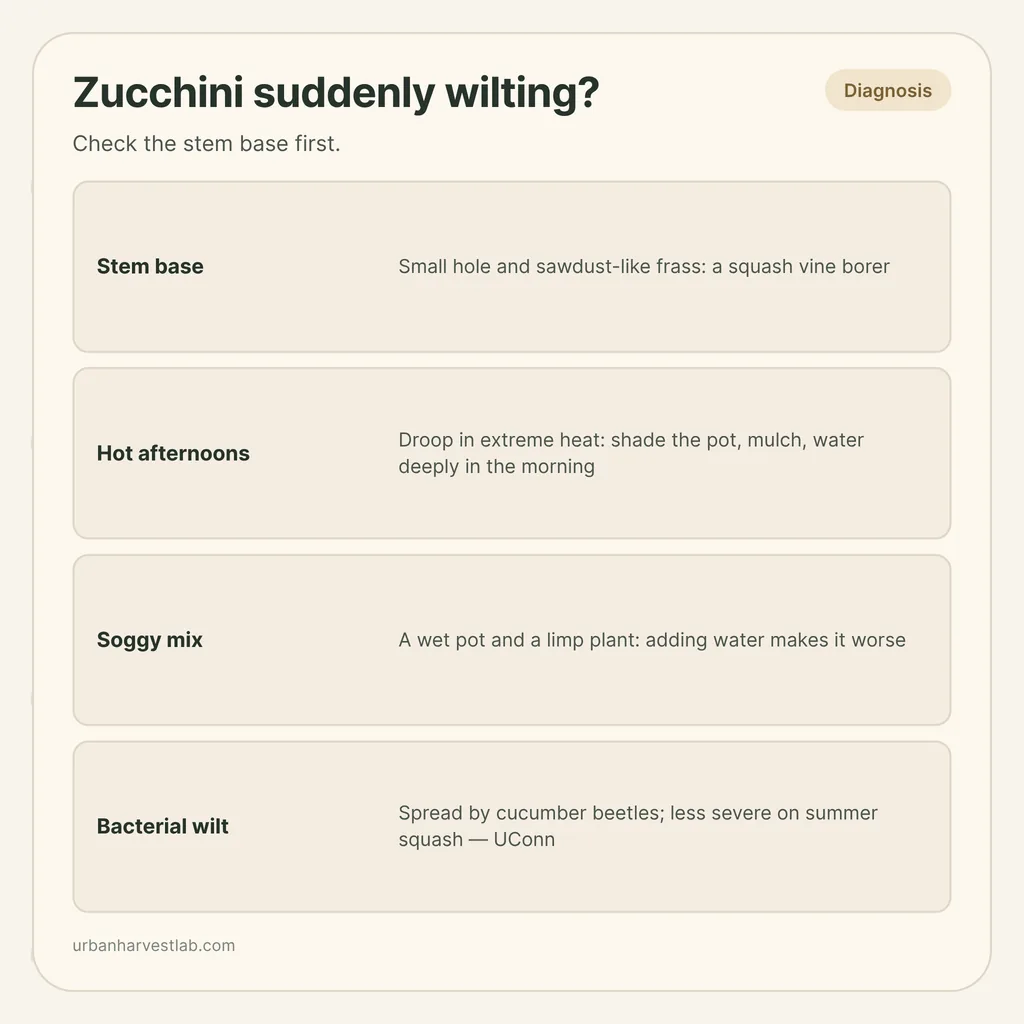
If the plant is collapsing and you have not found bugs, look at the stem base instead: a wilting zucchini is more often a vine borer than a squash bug.
What you are looking for
The three stages look different, and you usually meet them together. University of Maryland Extension notes that in midsummer it is common to see eggs, nymphs and adults at the same time.
Eggs. Maryland describes them as shiny, elliptical, rubbery and bronze, in clusters of about 20. Kentucky Extension counts groups of 12 or more, lying on their sides in the angle between leaf veins. Wisconsin Extension gives about 1/16 inch across, along the centre vein of the underside. UC IPM adds that they are laid from spring through midsummer. The eggs hatch in about 10 days, according to Wisconsin, or in one to two weeks, according to Kentucky.
Nymphs. Newly hatched nymphs are pale green with dark legs and feed together in groups, Maryland says. Older nymphs are grey. Maryland counts five growth stages over about a month; Wisconsin says four to six weeks and Kentucky five to six weeks. Young nymphs feed in dense clusters on the shaded undersides of the leaves, which makes them easy to spot once you look.
Adults. Maryland gives about 5/8 inch long, dark brownish grey and flattened, with alternating light and dark markings around the edge of the abdomen. Wisconsin gives 1/2 to 3/4 inch. Adults give off a strong smell when crushed, and they are secretive. Maryland says they hide in mulch and congregate on stems at soil level.
The damage
Squash bugs suck sap through needle-like mouthparts. Maryland says the leaves develop small white dots, known as stipples, and eventually look tattered. Wisconsin says early symptoms are yellow spotting, and that leaves may dry and turn brown or black along the edges. UC IPM says leaves develop small specks that turn yellow and then brown, and that plants may wilt and die.
Kentucky Extension says the bugs cause leaves to wilt and collapse, and that young plants may be killed. Wisconsin points out that this wilting can resemble bacterial wilt, so check the stem base even when you see bugs. Later in the season, Wisconsin says, adults also feed on developing fruit, which may stop growing and rot.
Fine white dots are not powdery mildew. Mildew is a dusty coating, covered in its own guide.
Remove them by hand
Hand work is the main control. It suits a pot or two on a balcony, where every plant can be checked in a minute.
- Turn the leaves. Maryland recommends regularly turning over leaves to find egg clusters. Check transplants and new seedlings for adults as soon as you bring them home, Wisconsin says.
- Tear out the eggs. Maryland says egg clusters are difficult to hand-crush, so tear out that portion of leaf and destroy it. Wisconsin says to look for and crush the clusters while inspecting.
- Crush or drown the nymphs. Maryland says nymphs can be hand-crushed or drowned in soapy water. Wisconsin warns that the bugs prefer the undersides of leaves and can move quickly.
- Lay a board. Both Maryland and Wisconsin describe a board near the plant. Bugs gather under it at night, and you destroy them in the morning. Wisconsin suggests dropping them into a bucket of soapy water. UC IPM gives the same trick.
- Check the mulch. Maryland says the bugs also hide under mulch, and that when numbers are high the mulch may need to be removed. A layer on the surface of the pot is a hiding place as much as a moisture saver; the mulch guide covers the trade-off.
Keep them off the plant
Maryland says row cover will prevent egg-laying on plants. Then take it off when flowers open. Wisconsin Extension’s squash vine borer sheet notes that blooming plants need bees to pollinate their flowers, so row covers must be removed during blooming.
Wisconsin also lists two cultural choices that suit a container. Trellised vine crops are less susceptible to squash bug infestations, and overwintering squash bugs prefer larger, more established plants, so planting later could help. A support for a bush or vining zucchini is covered in the renter-friendly trellis guide, and the zucchini container guide covers pot size. Maryland also suggests checking seed catalogues for summer and winter squash cultivars that are resistant to squash bugs.
When a spray is worth considering
Sprays are for nymphs. Maryland says neem, horticultural oil and insecticidal soap are effective when sprayed directly on nymphs, and that adults are very difficult to kill with the insecticides available to home gardeners. UC IPM says garden insecticides are not very effective, especially on larger bugs, and that soap or neem may control the smallest nymphs. Wisconsin says to time any spray for when eggs are hatching, because nymphs are more easily controlled than adults.
Wisconsin gives a threshold for deciding: treat seedlings if the plants are visibly wilting and squash bugs are present, and on older plants treat at one egg mass per plant during flowering. Below that, hand removal is enough.
Before you buy anything, read the label. The US National Pesticide Information Center says that if your fruit or vegetable is not listed on the label, you cannot apply the product to it, and that the label states how long the crop must stay in the garden after spraying. Look for squash or zucchini on it by name, and take any wait before harvest from the label itself. Choosing a treatment for edible plants walks through reading one, and the insecticidal soap and neem oil pages cover those two products.
Sprays reach only what they land on, and squash bugs shelter under leaves and at the base. Aim there.
Stop them coming back
Squash bugs overwinter as adults under plant debris, soil clods, rocks, log piles and buildings, Maryland says, and removing all plant debris at the end of the season is essential. UC IPM says the same. For a balcony, that means emptying dead vines, fallen leaves and surface debris from the pot and from the corners around it. Wisconsin recommends burning, burying or hot composting the material.
Wisconsin notes that squash bugs only feed on cucurbit crops, so rotating what you grow over space and time can be part of a strategy in some situations.
Sources
- University of Maryland Extension: Squash bug on vegetables
- University of Wisconsin Extension: Squash bug (XHT1135)
- University of Wisconsin Extension: Squash vine borer (Garden Facts XHT1136)
- University of Kentucky Entomology: Squash vine borer and squash bug (Entfact-314)
- UC IPM: Squash bug (Pests in Gardens and Landscapes)
- National Pesticide Information Center: Preharvest interval
Squash and zucchini in pots
Rule out the look-alikes and set the pot up so the plant copes.
Common questions
What do squash bug eggs look like?
University of Maryland Extension describes them as shiny, elliptical, rubbery and bronze, in clusters of about 20. Wisconsin Extension gives the size as about 1/16 inch across and says they sit on the underside of the leaf along the centre vein. Kentucky Extension says they lie on their sides, often in the angle between veins.
How do I get rid of squash bugs on zucchini?
Start by hand. Tear out leaf pieces that carry eggs, crush or drown nymphs, and trap adults under a board overnight. University of Maryland Extension says row cover prevents egg-laying. Sprays are a last step aimed at young nymphs, and the product label has to list squash or zucchini.
Will insecticidal soap or neem kill squash bugs?
On the youngest nymphs, yes. University of Maryland Extension says neem, horticultural oil and insecticidal soap are effective when sprayed directly on nymphs, and UC IPM says soap or neem may control the smallest ones. Neither is described as working on adults, and the label of the product you buy sets the crops it may be used on and any wait before harvest.
Can squash bugs kill a zucchini plant?
They can. UC IPM says plants may wilt and die, and University of Maryland Extension says large numbers cause leaves to yellow and die and can significantly reduce growth and yield. Young plants are the most at risk, according to Wisconsin Extension.
Related guides
Zucchini plant suddenly wilting? Check the stem base first
A healthy-looking zucchini that collapses in days often has a borer in the stem. Heat, soggy roots and bacterial wilt are the other suspects, and the stem base tells them apart.
Insecticidal soap on vegetables: which pests, what damage, what the label decides
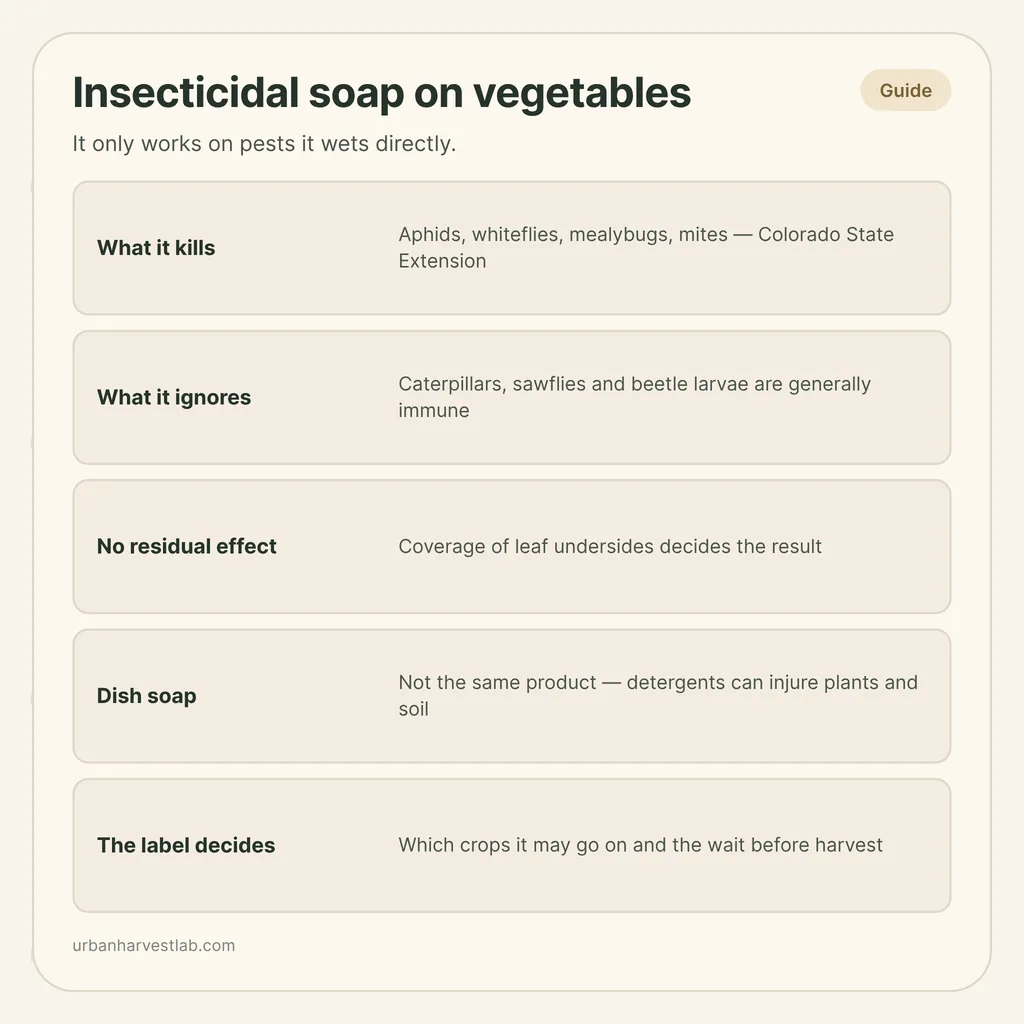
Soap sprays work on aphids, whiteflies, mealybugs and mites that you wet directly, and fail on caterpillars. Dish soap is a different and riskier thing.
Neem oil on herbs: what the label decides before you spray
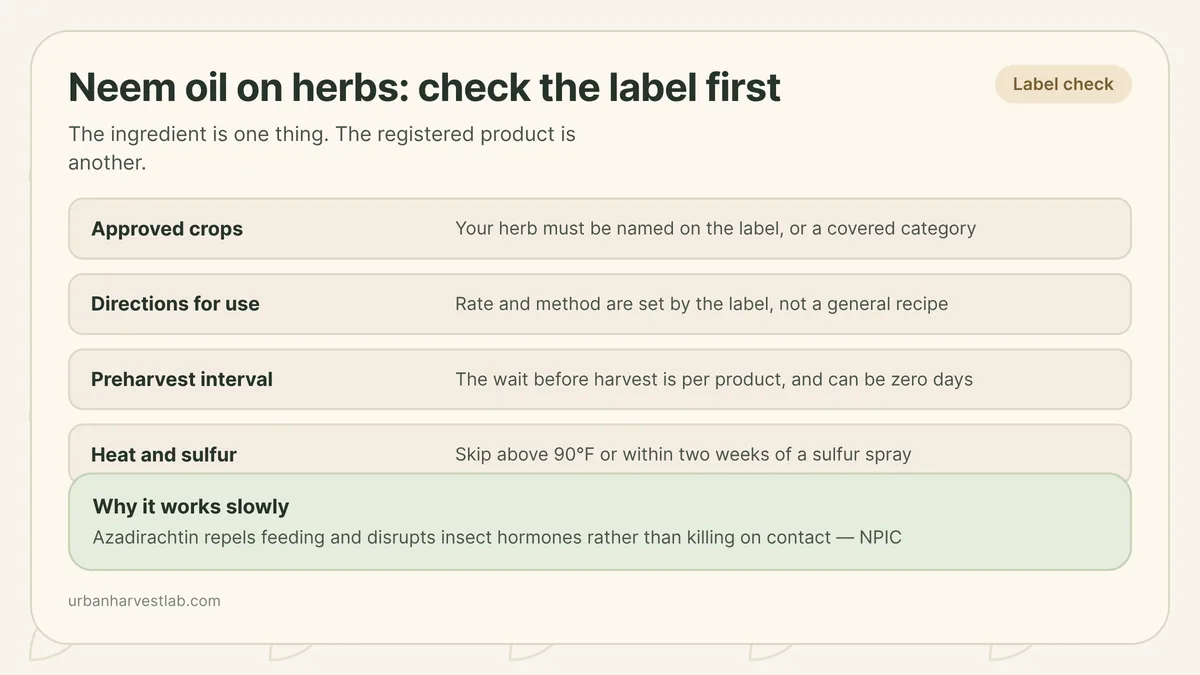
Whether neem oil is safe for a herb depends on the product's label, not on neem oil as an ingredient — and the label also sets the wait time before harvest.