Troubleshoot the system before you change the inputs.
Symptoms
- One runner, or the whole plant, wilts within days while the leaves are still green.
- The plant droops every afternoon and may or may not be upright again by morning.
- Wilting continues in wet mix, or a dull, limp plant does not lift after a drink.
Possible causes
- A squash vine borer larva tunnelling through the stem near the base and cutting off water flow.
- Heat and a pot that dries faster than the roots can supply the large leaves.
- Waterlogged mix, where roots run short of oxygen and stop delivering water.
- Bacterial wilt, spread by cucumber beetles feeding on the leaves.
Quick fixes
- Check the lowest stretch of stem for entrance holes, sawdust-like frass and a mushy patch.
- If you find frass, slit the stem lengthwise at that spot, remove the larva and mound moist mix over the wound.
- Water deeply in the morning, shade the pot in the afternoon and mulch the surface.
- Remove a plant with bacterial wilt, and keep beetles off the replacement.
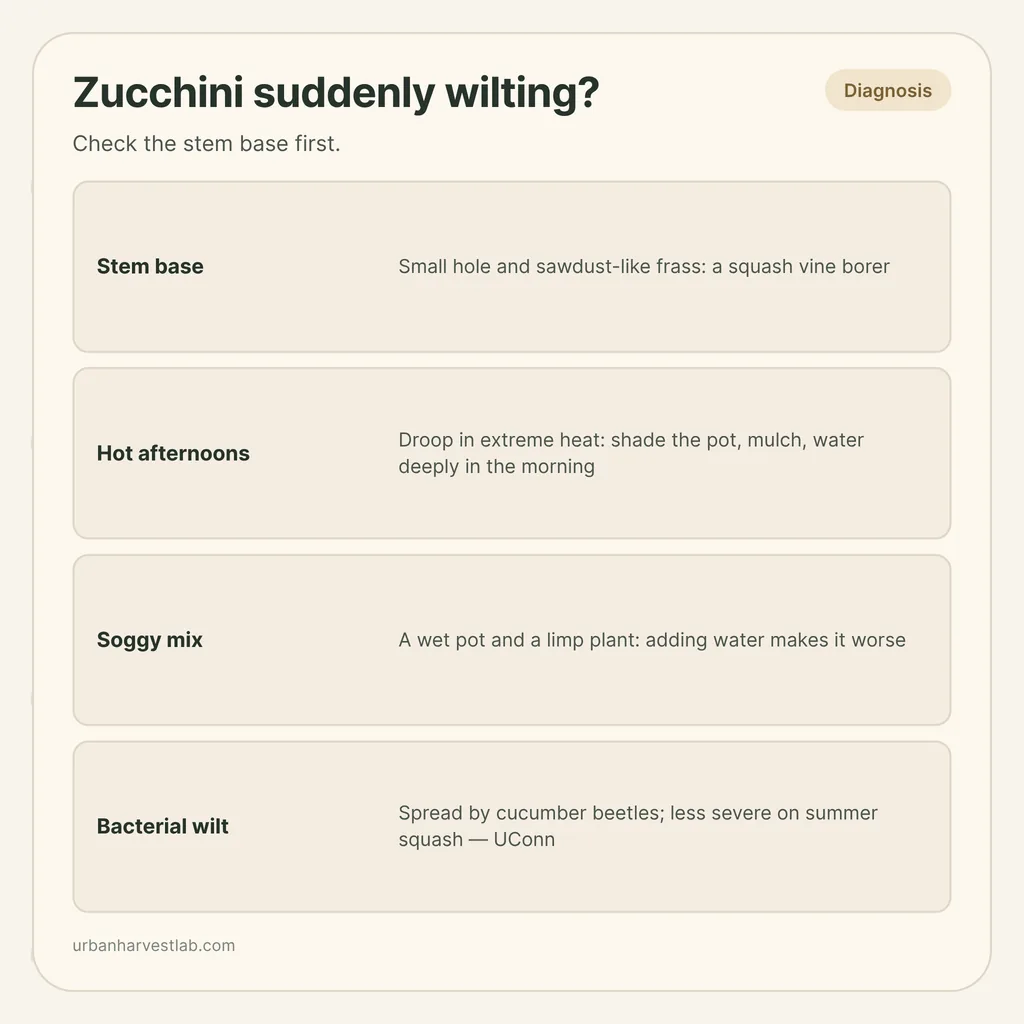
A zucchini that collapses within days, with leaves still green, most often has a squash vine borer tunnelling in the stem. Kneel down and check the lowest stretch of stem for a small hole and a pile of sawdust-like frass. If the base is clean, the cause is heat, roots sitting in wet mix, or bacterial wilt, and each has its own tell.
Tomatoes wilt for a different set of reasons; if that is your plant, see tomato plant wilting.
Check the stem base first
The borer is a moth larva. University of Maryland Extension says the larvae bore into the stem and feed for up to 4 weeks, and that more than one is often present. The larva is a wrinkly, cream-coloured, hairless caterpillar with a dark head, up to 1 inch long.
You rarely see the caterpillar. You see what it leaves. Maryland describes it this way: tunnelling larvae push greenish-white sawdust-like frass out the entrance hole, and the stem near the hole feels mushy. Kentucky Extension calls that frass near the base “the best evidence of squash vine borer activity.”
Why the plant wilts: South Dakota State Extension says the feeding blocks water and nutrient flow to the rest of the plant. Kentucky Extension describes a long runner or an entire plant wilting suddenly in mid-summer, with infested vines usually dying beyond the point of attack.
Run your fingers over the lowest part of every stem, including the crown where stems meet the mix. Part the leaf stalks. Look for a pinhole, the frass, or a soft patch.
Confirm before cutting. Wisconsin Extension says to split the stem lengthwise when frass is present, to confirm there are larvae inside.
If you find one. Both Maryland and Kentucky give a hands-on method for home gardeners: make a vertical slit up the stem from where the frass appears, cutting halfway through with a sharp blade, and remove the borer. Maryland then says to mound soil over the wound to induce supplemental rooting. Kentucky says to cover the stem immediately with earth. In a pot that means moist mix pulled up around the base. Check the rest of the stem afterwards, because Maryland notes more than one larva is often present.
Spraying is a poor rescue. Kentucky says once the borer is inside the vine, insecticidal control is ineffective, and South Dakota State says applications work only when adults are active because the larvae are protected inside the plant. South Dakota State advises removing an infested plant from the garden immediately and destroying it, which reduces the chance of larvae pupating and returning next year.
Next season, Maryland lists plant-side options: plant early or use transplants, wrap a collar of aluminum foil around the lower stems, or cover plants with floating row cover until flowering. It also notes butternut, tromboncino and cushaw are resistant and that yellow crookneck is less susceptible than zucchini.
Hot afternoons and a small pot
Zucchini leaves are huge, and a pot is small. A North Dakota State University horticulturist wrote in July 2026 that his cucumber and zucchini vines drooped every afternoon during extreme heat. He advises shade for container plants, moving them if you can, and mulch to conserve soil moisture.
His watering advice suits a pot too: irrigate deeply and infrequently, and do it in the morning after sunrise. A sip every day builds a shallow root system that cannot keep up.
Two cautions. First, the same afternoon droop is also how a borer shows itself: Wisconsin Extension calls midday wilting the first symptom of borer feeding, and Maryland says the wilting may occur first during daytime heat. So check the stem base even when it is hot. Second, a pot that droops every day is probably undersized; the zucchini container guide has the volumes, and the heatwave guide covers shading. A mulch layer and a steady watering routine for container vegetables do the rest.
Limp in soggy mix
Push a finger into the mix. If it is wet and the plant is still limp, adding water makes it worse. UC IPM says Phytophthora diseases can develop in as little as 4 to 8 hours of soil saturation, so a zucchini pot standing in a full saucer through a hot afternoon is enough. It also says that, unlike plants suffering from water stress, plants affected by Phytophthora do not recover when irrigated.
That response to watering is the best test you have: a dry plant lifts after a drink, and one with rotting roots does not. Slide the plant out and look. Overwatered vs underwatered covers the root check and repotting in full.
Beetle-spread bacterial wilt
Bacterial wilt is carried by cucumber beetles. UConn’s IPM program says the bacterium overwinters only in the beetles and spreads as they feed. It affects cucumbers and melons severely and, in UConn’s words, summer squash and pumpkin less severely; Illinois Extension likewise calls it less of a threat to squash. UConn adds that seedlings at the cotyledon to 3-leaf stage are more susceptible than older plants.
The test needs a plant you can spare. Cut a wilting stem, push the cut ends together and pull them slowly apart. Illinois Extension says that if the bacterium is present you will see sticky strands connecting the two surfaces. UConn describes a second check: stand the cut end in a glass of water, and after 15 minutes you can see bacteria streaming out.
Control means keeping beetles off. UConn says spunbonded row covers exclude them, and that copper sprays are of no value because the bacterium travels inside the plant. Infected plants are best removed. Wisconsin Extension notes covers must come off at bloom so bees can pollinate, and the rotting-on-the-end guide covers what happens to fruit when flowers go unpollinated.
Other causes
Squash bugs suck sap and, Kentucky Extension says, cause leaves to wilt and collapse. Iowa State Extension reminds growers that other disease, insect, pesticide or environmental factors can cause wilting and vine death, so a plant that fits none of the above is worth a photo and a question to your local extension service or plant clinic.
Sources
- University of Maryland Extension: Squash vine borer on vegetables
- University of Kentucky Entomology: Squash vine borer and squash bug (Entfact-314)
- University of Wisconsin Extension: Squash vine borer (Garden Facts XHT1136)
- South Dakota State Extension: What’s killing my zucchini and squash plants?
- UConn IPM: Bacterial wilt of cucurbits
- Illinois Extension: Bacterial wilt of cucurbits
- Iowa State Extension: Cucurbit bacterial wilt
- NDSU Extension: Helping gardens survive extreme heat
- UC IPM: Phytophthora root and crown rot in the garden
Sort out a wilting squash
Size the pot, steady the water and rule out the look-alikes.
Common questions
Why is my zucchini plant suddenly wilting?
The usual cause of sudden wilting in a healthy plant is a squash vine borer. University of Maryland Extension says the runner or entire vine wilts quickly from larval feeding inside the stem, and that frass pushed out of an entrance hole is the sign. If the base of the stem is clean and firm, think heat, wet roots or bacterial wilt.
Will a zucchini plant recover from wilting?
Heat droop and a plant that was simply dry usually lift once the roots catch up. Wilting from a borer can be rescued only if you reach the larva early: Kentucky entomologist Ric Bessin advises slicing the stem lengthwise at the first frass and removing the borers, then covering the stem with earth. A plant with bacterial wilt should be removed.
How do I know if it is a squash vine borer?
Look low on the stem. University of Maryland Extension describes greenish-white sawdust-like frass pushed out of an entrance hole, and a stem that feels mushy nearby. Wisconsin Extension says to split the stem lengthwise to confirm larvae when frass is present. The larva is cream-coloured with a dark head and up to an inch long.
Does zucchini wilt in the afternoon heat even when it is healthy?
It can. A North Dakota State University horticulturist describes his own cucumber and zucchini vines drooping every afternoon in extreme heat, and advises deep morning watering, shade for container plants and mulch. Afternoon droop alone does not rule out a borer, though, because University of Maryland Extension says borer wilting may appear first in daytime heat.
Related guides

Zucchini rotting on the end? Pollination failure vs blossom end rot
Zucchini rotting from the blossom end has three possible causes, and the fruit itself tells you which. Here is how to read it and what to change in a container.

Tomato plant wilting even though you water it: heat, roots, or disease
Midday droop that clears by evening is usually heat. Wilt that stays after watering points to rotting roots or a vascular disease, and a cut stem tells you which.
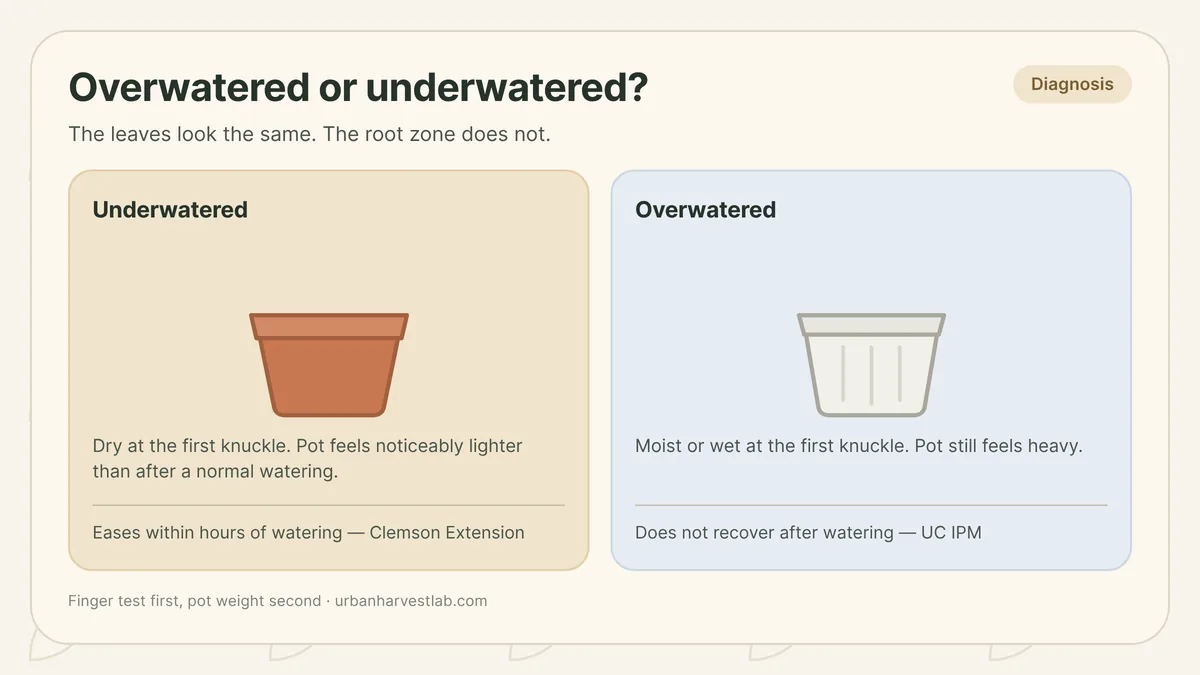
Overwatered vs underwatered: how to tell which one you have
Reading the root zone directly, with a finger test, pot weight, and how the plant responds to being watered, settles what the leaves alone cannot.