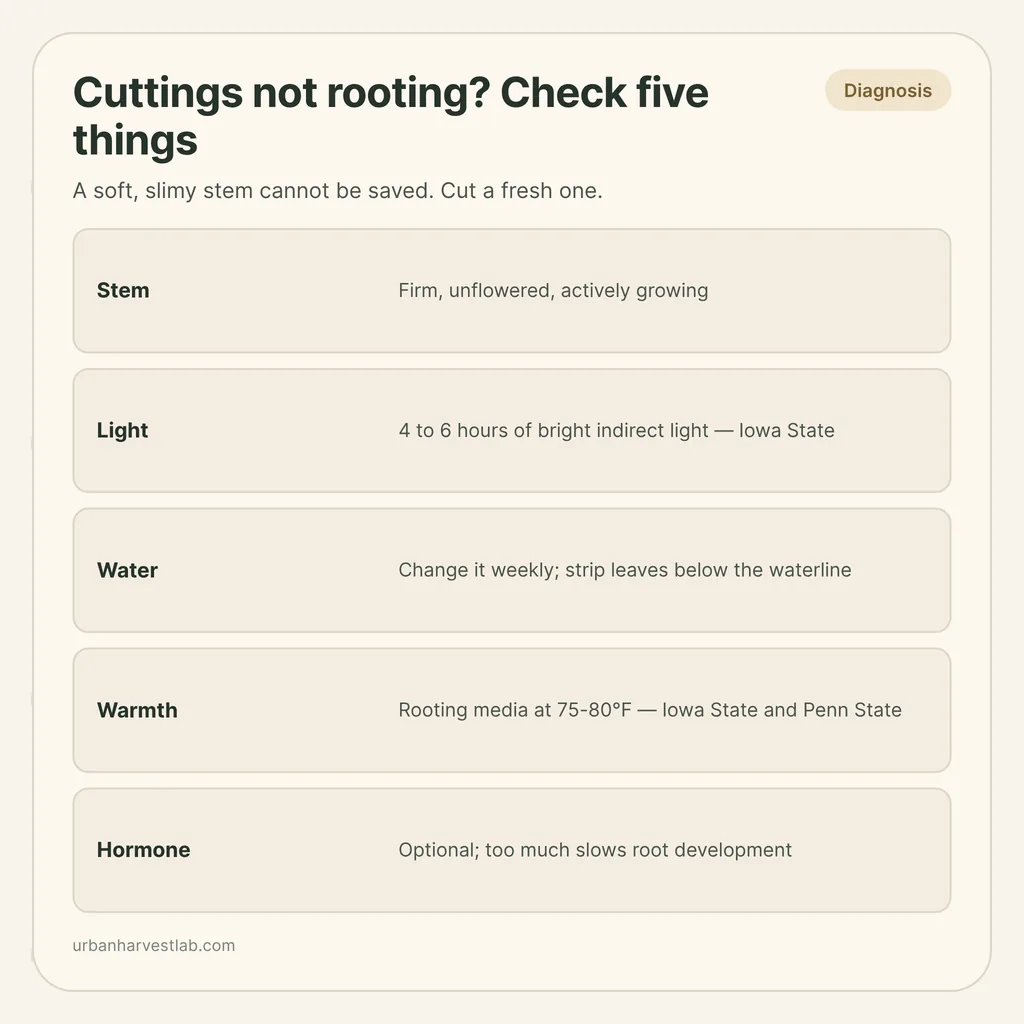
Troubleshoot the system before you change the inputs.
Symptoms
- The stem has gone soft, slimy, black or foul-smelling at or above the waterline.
- The cutting is still green after several weeks but has made no roots.
- Leaves wilt, yellow or drop soon after cutting.
- White roots formed in water, then the cutting sulked or wilted after potting.
Possible causes
- Stock stem: Montana State says to cut from a healthy plant that is actively growing but not flowering or fruiting.
- Light: Iowa State says too little light slows root formation and cuttings may rot or dry out before roots form.
- Water: Iowa State says to change the water frequently and keep the level up so roots are not exposed to air; Montana State says to change it weekly.
- Cold rooting zone: Iowa State and Penn State give 75-80°F for the rooting media.
- Hormone: both Iowa State and Penn State say too much slows root development.
Quick fixes
- Bin any soft or slimy cutting and take a new one from a healthy, non-flowering shoot.
- Strip every leaf that would sit underwater, rinse the jar, and refill with room-temperature water.
- Move the jar to bright indirect light and somewhere warm, not onto a cold sill at night.
- Pot water roots once they are about an inch long, and keep the mix moist but not saturated.
A cutting that rots has usually gone wrong in one of five places: the stem you chose, the light, the water, the warmth, or the hormone. Work through them in that order. A soft, slimy stem cannot be saved, so cut a fresh one rather than waiting.
The method itself, from the cut to the first pot, is covered in how to regrow herbs from cuttings. Start here when that method has not worked.
First, decide whether to wait or restart
Cuttings are slow. Iowa State Extension says most houseplant stem cuttings form roots in 3 to 6 weeks, and the University of Georgia gives about three to six weeks for herb cuttings. Montana State says roots in a soilless medium typically develop within two to four weeks, and 6-8 weeks for softwood cuttings.
So a green, firm cutting with no roots at day ten is not failing. A cutting that is soft, slimy or foul at the waterline is. Throw that one out and start again with a fresh cutting.
Check the stem you took
Montana State says to take cuttings from a plant that is actively growing but not flowering or fruiting, because reproductive processes redirect energy away from root development. Penn State adds that stock should be free of disease, insects and stress, and not suffering from a lack of water or high heat.
A supermarket bunch is worth checking against this list: pick the firm, unflowered stems and skip any that are limp, bruised or dark.
Woody stems
Montana State describes water rooting for herbaceous plants, which it defines as non-woody species such as houseplants and culinary herbs. Basil and mint belong there. Rosemary does not: Montana State lists it among plants that root well from softwood cuttings, taken from new growth in late spring through mid-summer, where the wood should be flexible but snap when bent quickly. That method uses a moist soilless medium with a humidity cover, not a glass of water.
If you cut the stiff, brown base of a rosemary or sage, or a basil stem that has begun to harden (see why basil stems turn brown and woody), expect it to sit and rot. Choose the soft tip growth instead.
Tomato cuttings
The University of Georgia says to select healthy tomato suckers three to four inches long, with several set in a jar and the water covering the ends by one to two inches. It says to keep them in a cool, well-lit spot until roots develop. Take them from a healthy plant. A sucker from a plant that is already showing leaf spots or wilting is carrying the problem with it.
Check the light
Iowa State Extension gives 4 to 6 hours of bright indirect light for root and shoot growth. It says too little light slows root formation and cuttings may rot or dry out before new roots form, and that too much light can burn foliage, especially under plastic bags or domes.
Put the jar on a bright sill out of the hottest direct sun, or a little back from the glass. A cutting in a dim corner may stay green for weeks and then collapse.
Check the water
Montana State’s water method is a jar of room-temperature tap water with at least one node submerged, bright indirect light, and a change of water weekly. It adds that no fertiliser is needed, because stored carbohydrates are sufficient for root development. Iowa State says to change the water one to two times each week and to keep the level up so the developing roots are not exposed to air.
Two practical points follow. Strip every leaf that would sit below the waterline, since Montana State says lower leaves are removed so they do not rot in the water. And rinse the jar when you change the water; cloudy or slimy water means start again.
An opaque jar helps, according to Montana State, because roots stay dark while the leaves get the light.
Check the warmth
Iowa State and Penn State both put the best rooting-media temperature at 75-80°F. Iowa State says cuttings root faster in warm air and warm media, with air at 65-75°F, and suggests a heat mat for the media. A glass on a cold windowsill at night works against you. The University of Georgia’s tomato-sucker advice is a cool, well-lit spot, so the extension pages differ on warmth for tomatoes; good light matters in both. A thermostat-controlled mat is covered in heat mats and thermostats for seedlings.
Montana State says to use room-temperature water; the extension pages reviewed give no reason to heat the water itself.
Check the hormone
Rooting hormone is an optional extra, not the cure for a rotting stem. Montana State says that while many houseplants root without it, some species respond well to an auxin-based powder, commonly 0.1-0.3% IBA (indole-3-butyric acid). The University of Georgia says for tomato suckers that rooting hormone is not necessary but would probably hasten the process.
If you use it, read the label, since Iowa State says to consult it for the concentration suited to the type of cutting. Use a little: Penn State says only a little is needed and excessive amounts slow root development, and Iowa State agrees that too much can slow it. Tip a small amount into a separate dish, because Iowa State warns against dipping the cutting into the original container, where disease can spread. It also says to replace hormone after about two years, as its efficacy drops.
When the roots form and then the cutting sulks
Iowa State says roots formed in water are coarser in texture and are not well adapted to potting soil, so once potted the plant may wilt, drop leaves, brown or die back at the tips. Pot cuttings when the roots are about an inch long (Iowa State), or 1-2 inches (Montana State), and keep the mix moist but not saturated, per Penn State. If the new pot’s wetness is the question, see overwatered vs underwatered.
Another route is to root straight into a sterile, well-drained medium. Penn State advises against compost and garden soil for propagation because they are likely to contain pathogens and may not be well aerated.
Not everything roots from a stem in a glass. Green onions regrow from the root end, and that has its own method in regrowing green onions.
Sources
- Iowa State University Extension: How to propagate houseplants by stem tip cuttings
- Montana State University Extension: Cloning at Home
- Penn State Extension: Propagating houseplants
- University of Georgia: Rooting tomato suckers
- University of Georgia Extension: Herbs in Southern Gardens (Bulletin 1170)
Rooting cuttings and what comes after
The method itself, a related regrow-from-scrap method, and how to tell wet from dry once the cutting is potted.
Common questions
Why are my cuttings rotting in water instead of rooting?
Usual causes are a stem that was already tired or bruised, leaves left under the waterline, stale water, and too little light. Iowa State Extension says too little light slows root formation and cuttings may rot or dry out before new roots form. Remove submerged leaves, change the water, and start again from a fresh cutting if the stem is soft or slimy.
How long should a cutting take to root in water?
Longer than many people expect. Iowa State Extension says most houseplant stem cuttings form roots in 3 to 6 weeks, and UGA gives about three to six weeks for herb cuttings. Montana State gives 6-8 weeks for softwood cuttings such as rosemary. Soft herbs such as basil and mint are usually at the faster end.
Do I need rooting hormone for herb or tomato cuttings?
Not necessarily. Montana State says many houseplants root without it, and UGA says rooting hormone is not necessary for tomato suckers but would probably hasten the process. If you use a product, follow its label, because Iowa State and Penn State both say too much slows rooting.
Can a woody herb stem root in a glass of water?
It is a poor bet. Montana State describes water rooting for herbaceous, non-woody plants, and lists rosemary under softwood cuttings, which it roots in a moist soilless medium with a humidity cover. Pick flexible new growth, not the stiff brown base.
Related guides
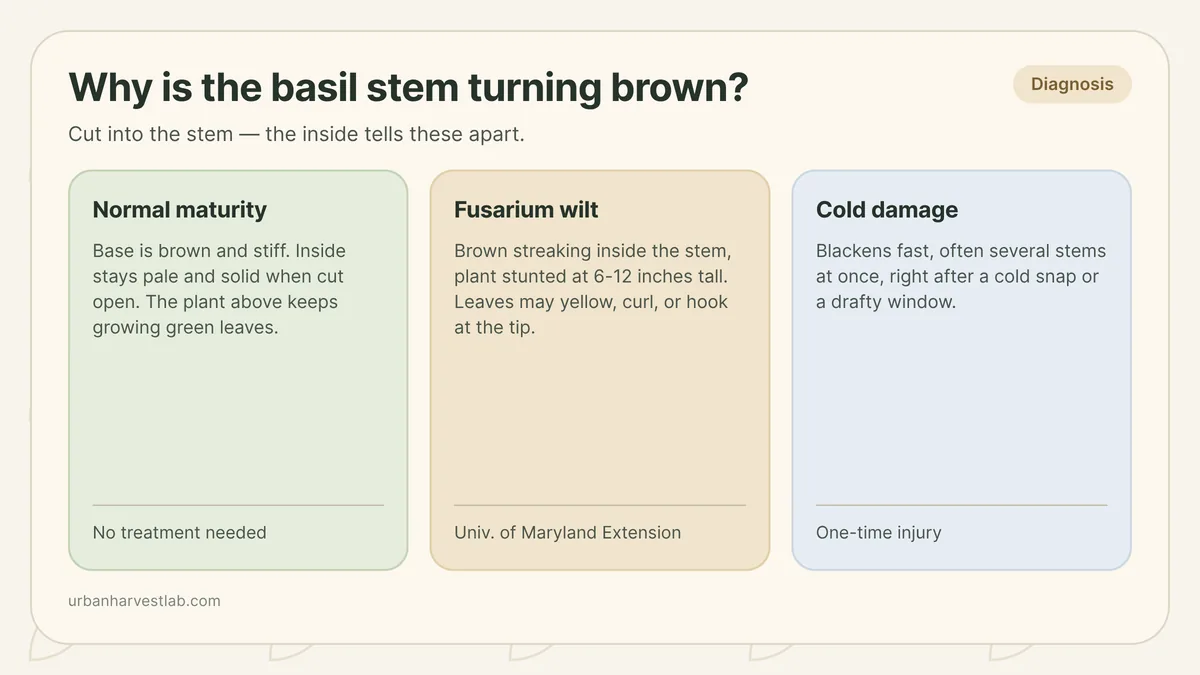
Why is my basil stem turning brown and woody?
Where the browning starts, what the stem looks like when you cut into it, and how fast it happened are the three details that tell these apart.
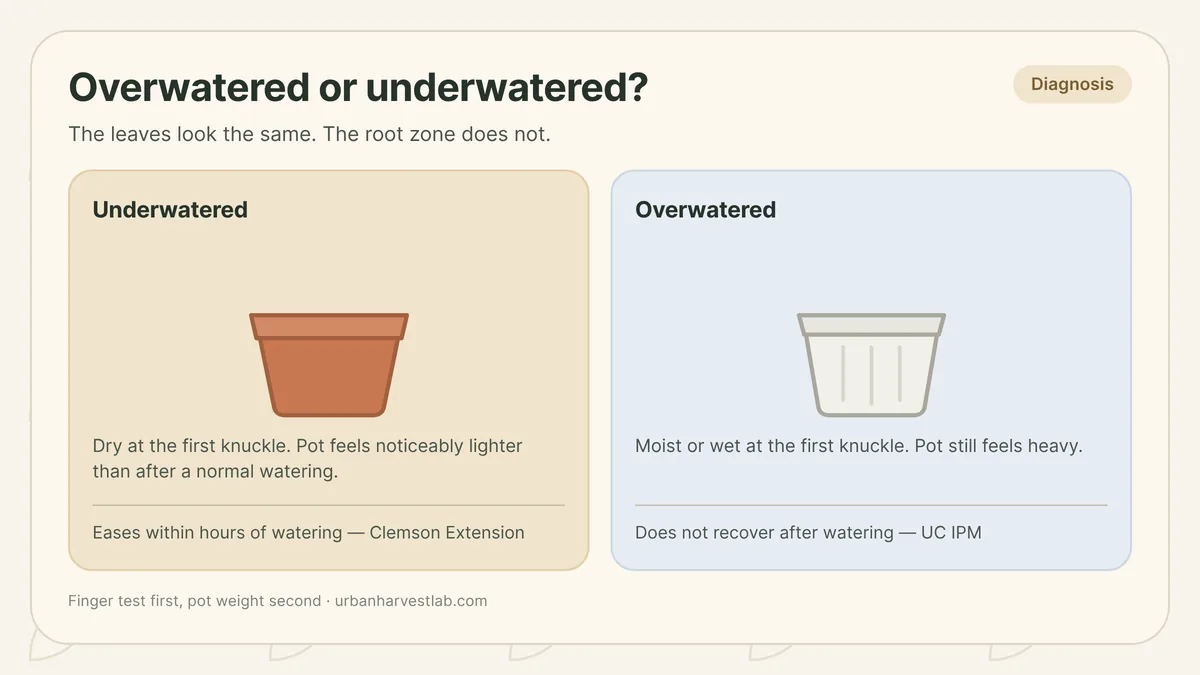
Overwatered vs underwatered: how to tell which one you have
Reading the root zone directly, with a finger test, pot weight, and how the plant responds to being watered, settles what the leaves alone cannot.
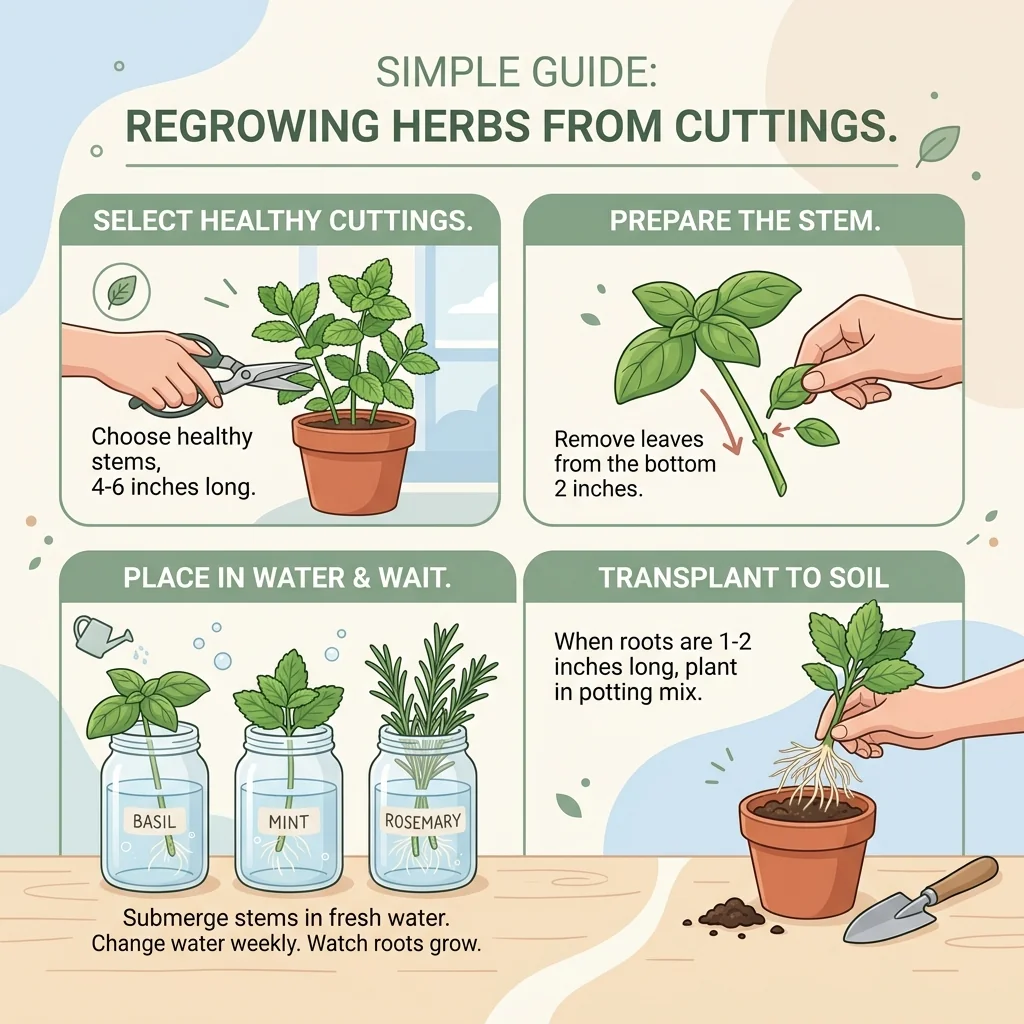
How to regrow herbs from cuttings (basil, mint, rosemary)
Many herbs root from a simple stem cutting in a glass of water. It is the cheapest way to turn one plant, or a supermarket bunch, into many.