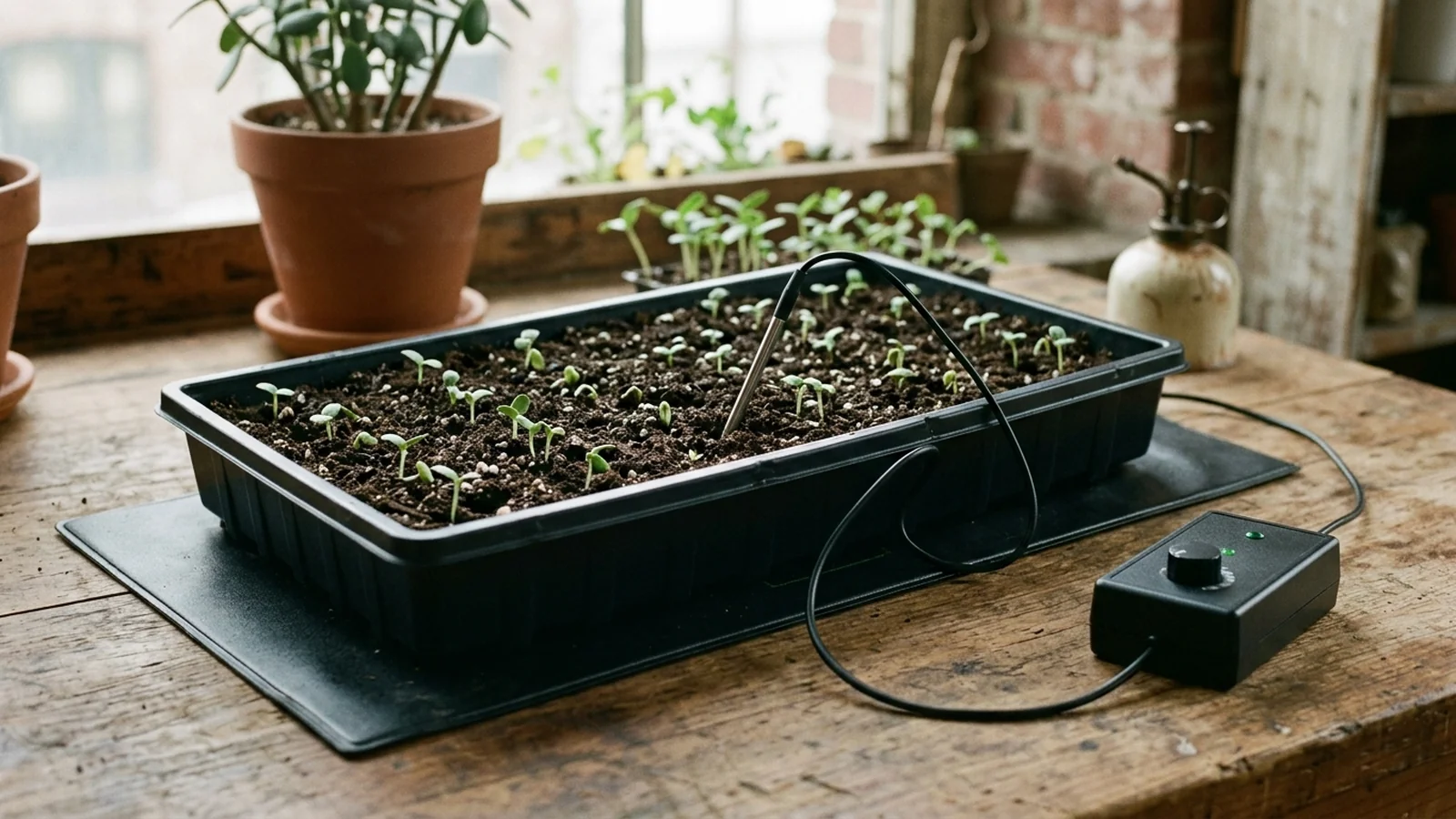
A heat mat warms the seed-starting mix a tray sits in, not the room around it, and that single fact is the whole case for using one — germination responds to the temperature of the mix, not the air a few inches above it. Without a thermostat, though, a mat cannot tell when to stop: it just adds a roughly fixed rise on top of whatever the room is already doing, which can overshoot in a warm space as easily as it helps in a cold one. And a mat is built for one stage of the job. Left running after seedlings come up, it works against them rather than for them. Timing the whole process, including when to sow relative to your last frost date, is covered separately in the seed starting calculator; this is about the temperature half of the same tray.
What a heat mat actually warms
A heat mat is a flat resistive element, usually under a waterproof cover, that a seed tray sits directly on top of. Heat moves upward from the mat through the tray and into the potting mix, which is a very different path from a space heater warming the air in a room. The distinction matters because germination is driven by the temperature the seed itself is sitting in, not the ambient temperature of wherever the tray happens to be.
Iowa State Extension puts a working range on that: most seeds germinate when the soil temperature sits between 68 and 86 degrees Fahrenheit, with each species having its own optimum somewhere inside that band and germination speeding up the closer the mix sits to it. A room can read 68°F on a wall thermometer and still leave a seed tray’s mix several degrees cooler than that, especially on a cold floor or near a drafty window — which is exactly the gap a heat mat is built to close.
The University of California’s Master Gardener Program treats this the same way in its own seed-germination guidance: the number worth checking is soil temperature, taken with a probe-type thermometer pushed into the mix, not a reading of the surrounding air. A mat only does its job where that probe goes — under the tray, in the mix, not clipped to the outside of the plastic dome.
Soil temperature and germination, by crop
Alabama Cooperative Extension System publishes minimum, optimal-range, best, and maximum soil temperatures for vegetable seed germination, crop by crop, and the spread across common warm- and cool-season vegetables is wide enough to make or break whether a mat matters for a given tray.
| Crop | Minimum | Optimal range | Best | Maximum |
|---|---|---|---|---|
| Tomato | 50°F | 70–95°F | 85°F | 95°F |
| Pepper | 60°F | 65–95°F | 85°F | 95°F |
| Eggplant | 60°F | 75–90°F | 85°F | 95°F |
| Cucumber | 60°F | 60–95°F | 95°F | 105°F |
| Squash | 60°F | 70–95°F | 95°F | 100°F |
| Lettuce | 35°F | 40–80°F | 75°F | 85°F |
| Spinach | 35°F | 45–75°F | 70°F | 85°F |
| Chard | 40°F | 50–85°F | 85°F | 95°F |
| Cabbage | 40°F | 45–95°F | 85°F | 100°F |
| Peas | 40°F | 40–75°F | 75°F | 85°F |
Read the minimum and best columns together with an ordinary indoor room in mind. A living space held around 65–70°F, in Alabama Cooperative Extension System’s own bands, sits comfortably inside the workable range for lettuce, spinach, chard and peas, and not far under their best figures — those crops do not need help from a mat to get moving. Tomato, pepper, eggplant, cucumber and squash are a different story: their best soil temperatures run from the mid-80s to the low-to-mid 90s°F, which almost no heated room reaches on its own. That gap between where a room sits and where these seeds actually want to be is what a heat mat is closing.
Without a thermostat, a mat doesn’t regulate — it just adds heat
A plain heat mat has no way to sense the temperature of the mix it is warming and no way to respond to it. Plugged straight into an outlet, it runs at a fixed output the whole time it is on, and what that produces is a roughly consistent rise above whatever the surrounding room already is — not a fixed target temperature. In a cool room that rise is exactly the boost a warm-season crop’s seed needs. In a room that is already warm — a sunny propagation shelf, a room with the heating turned up for the humans in it — the same mat is adding its usual rise on top of a higher starting point, and the mix can end up above the crop’s maximum rather than settling into its optimum.
That matters more than it sounds, because the gap between best and maximum is not always generous. Alabama Cooperative Extension System’s figures put tomato’s best at 85°F against a maximum of 95°F, and lettuce’s best at 75°F against a maximum of just 85°F. A mat that overshoots by even a modest margin in a warm room can push a tray past the top of a crop’s range rather than into it, and the same Alabama guidance is direct about what that means: soil temperatures outside the optimal range slow emergence and reduce it, not speed it up.
A thermostat is what closes that loop. Instead of a mat running blind, a probe goes into the actual mix, and the thermostat switches the mat on and off to hold the mix near a chosen figure — the kind pulled straight from the table above, set for whichever crop is on the tray. That is the difference between a heater and a control: one adds warmth in one direction only, the other reads what is actually happening in the mix and responds to it.
A mat is for germinating, not for raising seedlings on
A heat mat’s job ends at emergence. Once seeds are up, University of Maine Cooperative Extension’s guidance is to pull the tray off bottom heat once roughly half the seeds sown have sprouted, rather than leaving it running for the rest of the tray to catch up.
There is a real reason to follow that timing rather than leaving the mat on for convenience. Iowa State Extension’s own figures show the temperature a seedling actually wants after germination running about 10 degrees Fahrenheit cooler than its germination optimum — the opposite direction from what a mat still running underneath it is doing. A heat mat left on past emergence keeps the mix warmer than the seedling’s own growing-on stage calls for, and University of Massachusetts Amherst Extension names that continued warmth directly as a cause of stretched, leggy growth, alongside weak light: seedlings “stretch to become leggy and weak without enough light, or if the temperature is too warm.” A mat still running under an already-emerged tray also keeps drying the mix from underneath faster than the seedling is using water at that stage, on top of the stretch risk.
The fix is simple once the mechanism is clear: once a good share of a tray has sprouted, move it off the mat and onto whatever setup is running the growing-on stage — usually under lights, at ordinary room temperature. A tray of seedlings that is stretching sideways toward a window rather than growing upright and sturdy has more than one possible cause, and working through the rest of them, including light distance and duration, is covered separately in why are my herb seedlings dying.
When you don’t need a heat mat at all
The table above answers this directly. Lettuce, spinach, chard and peas all sit with a minimum soil temperature at or below 40°F and a best figure in the 70s on Alabama Cooperative Extension System’s numbers — well inside what an ordinary heated room already provides without any equipment added. Sowing these on a countertop or windowsill at normal room temperature is not a compromise; it is inside the range the seed is built for.
Where a mat earns its place is the crop list on the other side of that same table — tomato, pepper, eggplant, cucumber, squash — whose best soil temperatures run from the mid-80s to the mid-90s°F, and a second case that cuts across all crops: a genuinely cold growing space. An unheated porch, a drafty spare room, or a tray sitting on a cold tile floor in winter can pull even a cool-season crop’s mix below its own minimum, and that is worth fixing with warmth regardless of which seed is in the tray. Outside those two situations — a warm-season crop, or a cold room — the mat is solving a problem the tray does not have.
Electrical safety near a watered tray
A heat mat, like a thermostat and any timer feeding it, sits in the one part of the house where water gets added on purpose and on a schedule. The same ordinary care that applies to any electrical hardware near watering — keeping cords, plugs and the mat’s own controller out of splash range, and checking the load rating printed on a shared power strip before plugging in more than one device — applies here too. Grow light safety works through that setup in more detail, and the same routing and mounting habits transfer directly to a heat mat and thermostat sitting on the same shelf.
Setting one up so it does only its job
Put the probe where the seed actually is — pushed into the mix at the depth the seeds are sown, not resting on the mat’s surface or taped to the outside of a humidity dome. Set the target from the crop’s own best figure in the table above rather than a single number used for every tray. Check the mix daily rather than assuming the thermostat is holding steady on its own, since a probe that has worked loose reads the air instead of the mix and stops doing its job without any obvious sign. And once a tray is mostly up, move it off the mat rather than leaving it running out of habit — the seedlings on it now want a cooler, not a warmer, few weeks ahead.
Sources
- Alabama Cooperative Extension System, “Soil Temperature Conditions for Vegetable Seed Germination”
- Iowa State University Extension, “How to Successfully Start Seed Indoors”
- University of Massachusetts Amherst CAFE, “Starting Seeds Indoors: Caring for Your Seedlings”
- University of Maine Cooperative Extension, “When should you remove the bottom heat when starting seeds indoors?”
- UC Master Gardener Program, “Seed Germination Temperature and Timing”
Once your sowing dates and temperatures are set
A heat mat controls one variable in seed starting. These cover the rest: when to sow, and how to wire the setup safely.
Common questions
Does a heat mat warm the air around my seed trays?
Barely, and that is not the point of it. A heat mat is a flat heating element under the tray, built to raise the temperature of the potting mix sitting directly on it. Iowa State Extension gives most vegetable seeds a soil temperature band of 68 to 86 degrees Fahrenheit for germination, and that figure is about the mix a seed sits in, not the room. A thermometer held in the air a few inches above the tray will not tell you what the seed is actually experiencing; a probe pushed into the mix will.
Do I need a thermostat with a seedling heat mat, or does the mat alone do the job?
A mat alone has no way to know when to stop. Without a thermostat it runs continuously and adds roughly the same temperature rise no matter what the room is doing, so a warm propagation room can push the mix above a crop's germination maximum instead of into its optimum range. A thermostat with a probe set into the mix reads the actual temperature there and cycles the mat on and off to hold it near a target, which is what turns a plain heating element into something you can actually set for a given crop.
When should I take seed trays off a heat mat?
Once seeds are up. University of Maine Cooperative Extension advises removing the tray from bottom heat once about half the seeds sown have sprouted. Leaving the mat running under an emerged tray keeps pushing the mix warmer than a seedling wants at that stage - Iowa State Extension notes the growing-on temperature that suits a seedling actually runs about 10 degrees Fahrenheit cooler than its germination optimum, not the same or warmer - and University of Massachusetts Amherst Extension lists too-warm temperature as a cause of stretched, leggy growth alongside weak light.
Which seeds actually need a heat mat to germinate well?
Warm-season crops mostly, and cold rooms generally. Alabama Cooperative Extension System's germination figures put tomato, pepper, eggplant, cucumber and squash at their best in soil running from the mid-80s to the mid-90s Fahrenheit, which most indoor rooms do not reach on their own. Cool-season crops such as lettuce, spinach, chard and peas germinate well inside a normal room's temperature range on the same table, so a mat is optional for them rather than a fix for a real problem.
Related guides
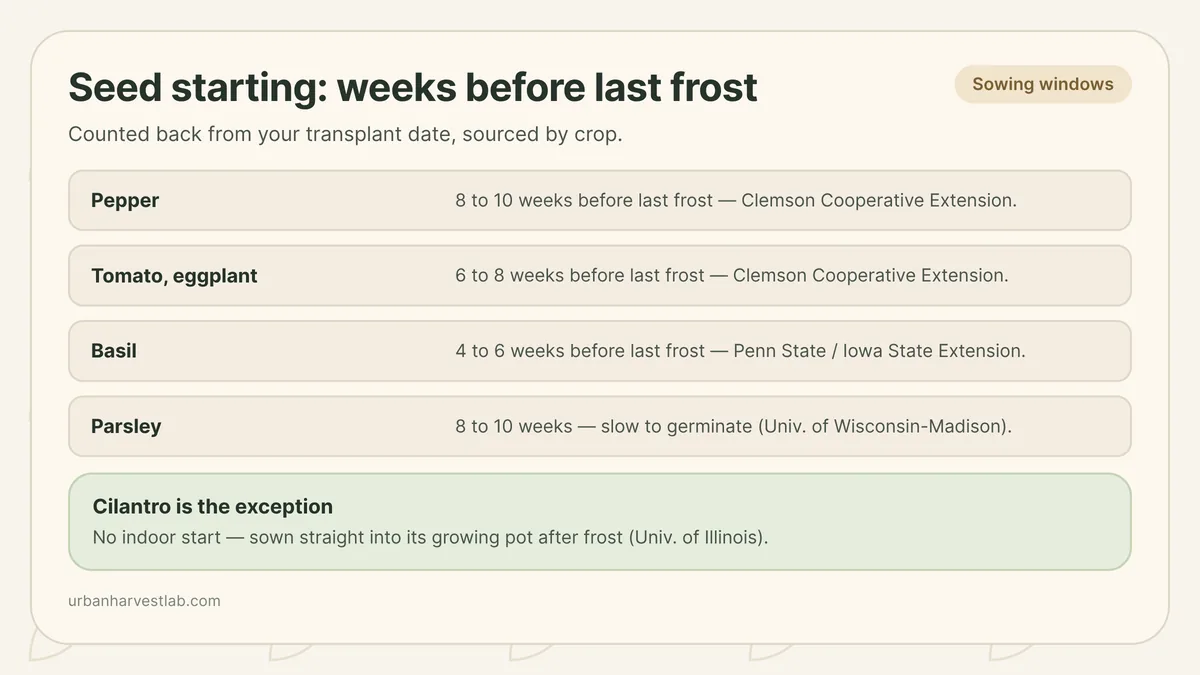
Seed starting calculator: sowing dates from your last frost date
A last frost date is only useful once you count backward from it. This works out that count crop by crop, instead of applying one week figure to everything in the seed drawer.
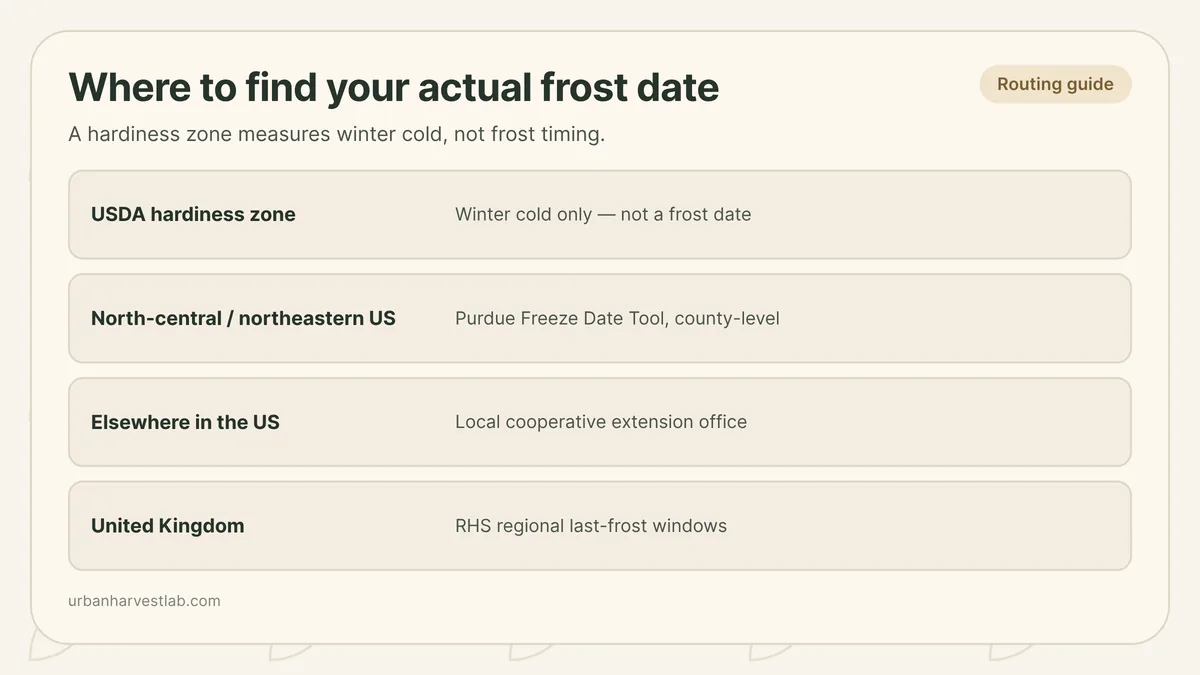
First and last frost dates for a balcony: start with your zone
Your hardiness zone tells you how cold winter gets, not when frost starts or ends. Look up the zone's temperature band, then use the tools built to answer the date question directly.
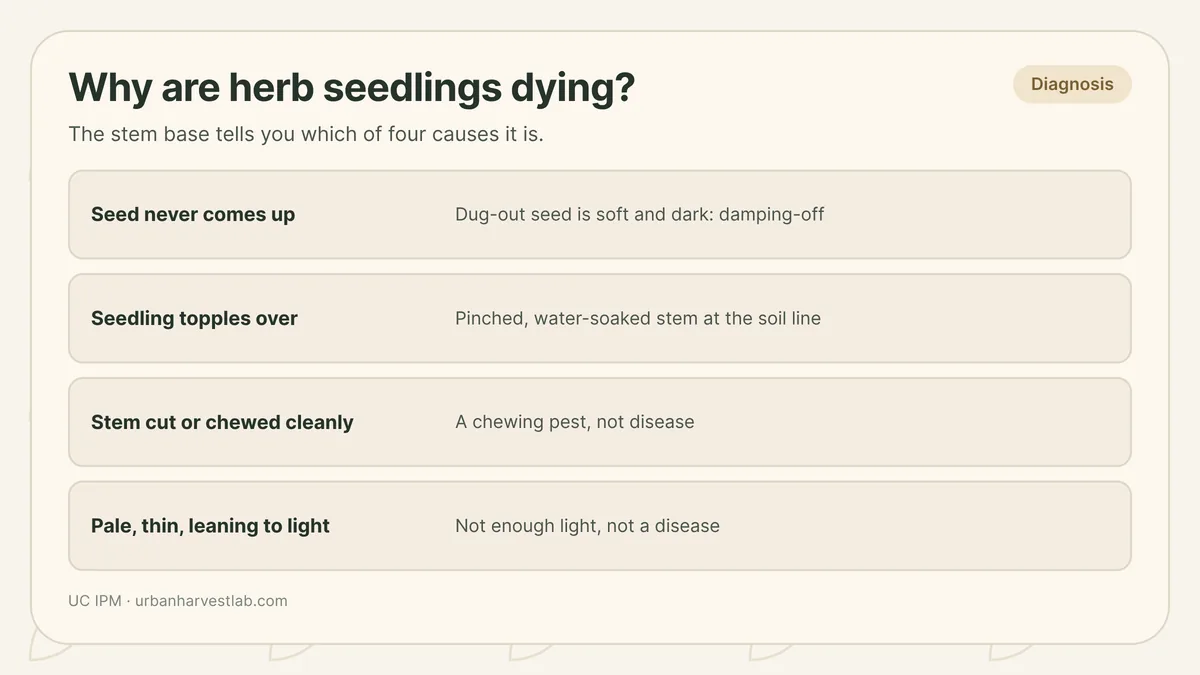
Why are my herb seedlings dying?
A tray of herb seedlings can fail three or four different ways, and they do not all look the same up close. The stem base and the seed itself tell you which one you have.