What each kind of diatomaceous earth product is for
| Product type | What the sources say | Use on garden pests |
|---|---|---|
| Labelled for pest control (pesticide label, EPA registration number) | Evaluated as a pesticide; the label gives directions, precautions and any required dust mask | The only type NPIC suggests choosing for pests; check the label lists your crop |
| Sold as food grade, no pest claim on the label | NPIC: not checked for pest control-related risks; risks and effectiveness untested and unknown | Not recommended for pest control |
| Swimming-pool filter grade | Oklahoma State and UC Master Gardener: altered by heat or processed differently, does not control insects | Skip it |
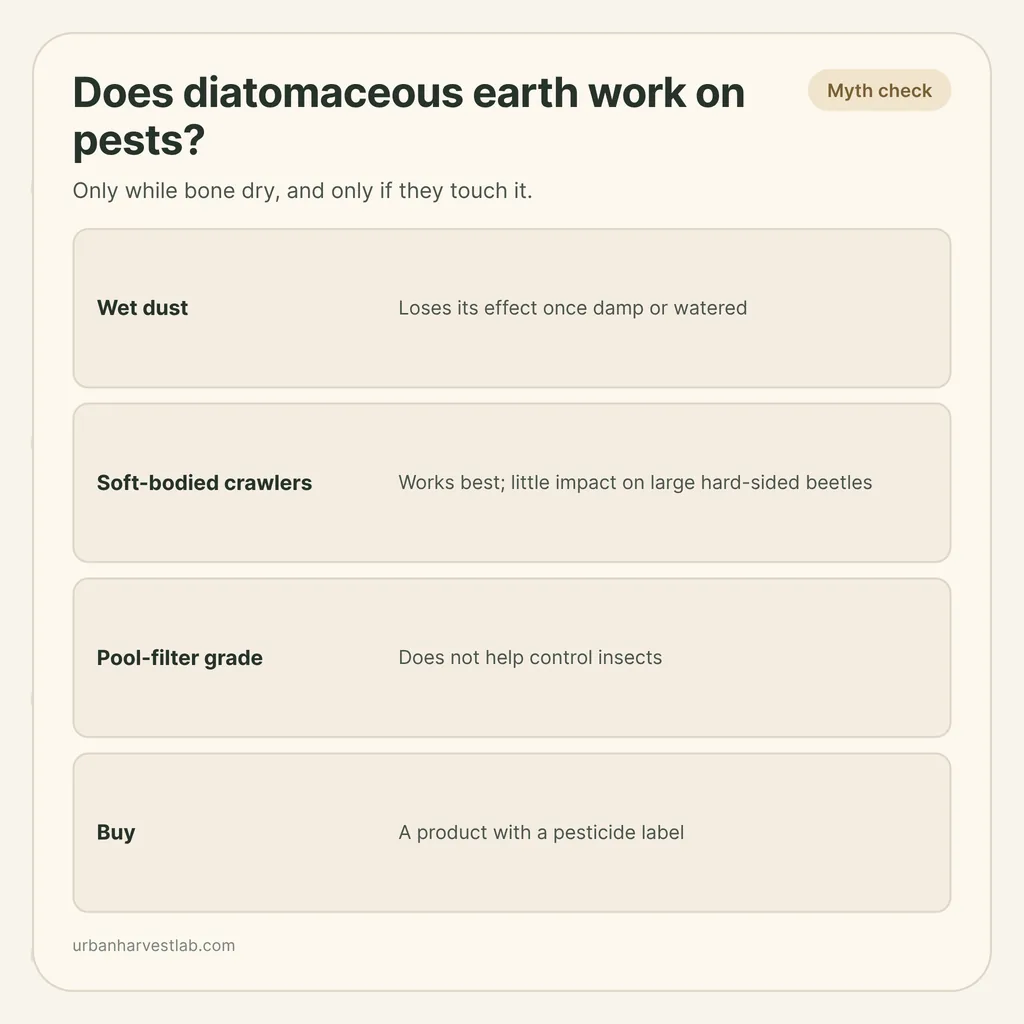
Diatomaceous earth works only while it is bone dry, and only on pests that walk through it. It does best on soft-bodied crawlers, does little to big hard-shelled beetles, and loses its punch the moment a pot gets watered. If you use it, buy a product with a pesticide label and skip pool-filter dust.
That is a narrower verdict than the one you will find on most gardening forums, where the powder is a cure for everything from fungus gnats to aphids. University extension pages are far more cautious. The deciding facts are how the dust kills, what water does to it, which pests it can reach and which bag you are holding.
If you are weighing several options, the guide to choosing a pest treatment for plants you will eat puts them in order. The question here is narrower: whether this dust belongs on that list at all.
How it kills, and why that matters in a pot
Diatomaceous earth is the ground-up fossil shells of tiny aquatic organisms called diatoms. According to the National Pesticide Information Center (NPIC), which is run by Oregon State University with the US EPA, it causes insects to dry out and die by absorbing oils and fats from the cuticle of the insect’s exoskeleton. Its sharp edges are abrasive, which speeds that up. It is not a stomach poison, and an insect does not have to eat it.
Two consequences follow. The insect has to touch the dust, so a pest that does not cross a treated surface is untouched. And the dust is a physical absorber, so anything that fills it with water takes the effect away. University of California Master Gardeners add that pests will avoid it if they can and that it kills slowly, sometimes taking a few days. A light, wide layer that is hard to walk around beats a heap that is easy to step over.
Why it fails when wet
NPIC says the dust remains effective as long as it is kept dry and undisturbed. University of California IPM, describing a dry diatomaceous earth band used against snails and slugs, says barriers like that lose their effectiveness after becoming damp, making them difficult to maintain and not very useful in most garden situations. University of Minnesota Extension says to reapply after rain, watering or dew, and that foot traffic and compaction also hurt it. A 2021 review in the journal Molecules puts the cause plainly: because the dust absorbs so strongly, its efficacy depends heavily on relative humidity and moisture.
A pot on a balcony is close to the worst case. You water it, the soil surface stays moist, and dew or a rain shower reaches an open rim. Dust on the soil is damp most of the time. University of Minnesota Extension notes that some studies found it does very little in humid environments and that its success rate against many of the state’s most annoying garden insects is low.
Which pests it can reach
University of Minnesota Extension says diatomaceous earth works best on softer-bodied pests and is unlikely to have a major impact on a large, hard-sided potato beetle or Japanese beetle. Oklahoma State Extension also describes it as a scratch to the waxy or oily layer of soft-bodied insects, and notes that some insects will not crawl on or feed on foliage sprinkled with it, so it can act as a barrier or repellent as well as an abrasive.
For crawling pests that you can actually dust, the University of California Master Gardener article lists cockroaches, ants, earwigs, silverfish, crickets, millipedes, centipedes and bedbugs, though that article is about the house rather than the garden. A broader review in Molecules says diatomaceous earth is mainly adopted against stored-product pests, with use against some household insects living in a dry environment.
Where to go for specific pests:
- Slugs and snails. University of California IPM calls a dry band 1 inch high and 3 inches wide around the garden potentially effective, then rates it not very useful in most garden situations because it is hard to keep dry. The slug and snail guide covers what else to try.
- Fungus gnats. The larvae live in the damp potting mix, which is exactly where this dust loses its effect. The fungus gnat page covers what to do in the pot.
- Ants in pots. See ants in plant pots for what they signal before you dust anything.
- Aphids, mites and other pests on leaves. Insecticidal soap on edibles covers a spray that is applied on contact and where the label sets the limits.
Which product to buy
This is where most advice goes wrong. Three kinds of powder sit on shelves.
Pool-filter grade. Oklahoma State Extension says the type sold for swimming pool filters does not help control insects because it has been altered by high heat to make it a stable filter material. The University of California Master Gardener article reaches the same conclusion: that type of DE is processed differently and does not work for pest management.
Food grade. It is tempting to assume that safe to eat means safe to spray. NPIC says otherwise. Food-grade products are purified, and the National Pesticide Information Center notes the Food and Drug Administration generally recognizes diatomaceous earth as safe when up to 2% is added to food. But NPIC also says some products, including food-grade ones, are not checked for pest control-related risks, so their risks and effectiveness are untested and unknown. Pest control also typically spreads a more concentrated product, so breathing in the dust may be of greater concern.
Pesticide-labelled. These products say on the package that they kill, repel or help get rid of a pest and carry an EPA registration number. The label gives directions and precautions, including any dust mask that is required. NPIC advises selecting a product with a pesticide label and following it. Oklahoma State Extension adds that you should look for the insect control formulation, since some brands are not labeled for vegetables. If you are dusting near edibles, read the label for your crop and for the number of days to wait before harvest, as University of Minnesota Extension reminds gardeners.
Handling the dust safely
Most diatomaceous earth is amorphous silicon dioxide, but NPIC says it can contain very low levels of the crystalline form. NPIC says long-term inhalation of the crystalline form is associated with silicosis, chronic bronchitis and other respiratory problems, while the amorphous form is only associated with mild, reversible lung inflammation. Short-term, breathing the dust can irritate the nose and nasal passages, and the dust can also irritate eyes and skin.
The practical rules come straight from the sources. NPIC lists a dust mask, eye protection and long clothing, and keeping children and pets away while you apply. Oklahoma State Extension says gardeners must wear a dust mask when applying it to plants. University of Minnesota Extension notes that powdered formulations can be harmful if breathed in and some require a respirator, and tells you to follow the label. University of California Master Gardeners add gloves and goggles. If you need a mask, browse dust masks on Amazon and match it to what your product label specifies.
Does it hurt the good insects?
Oklahoma State Extension says it may also kill beneficials such as ladybugs. A dust that works by scratching and drying cuticle does not know a pest from a predator, so keep it off flowers and foliage where lacewings, ladybugs and pollinators feed, and dust the specific path or crevice a pest uses instead. The beneficial insect guide helps you recognise the larvae you do not want to treat.
A decision rule
Use it when the pest is a soft-bodied crawler, the place is dry and sheltered, you can lay a thin barrier it must cross, and you have a pesticide-labelled product that lists your use. Skip it for fungus gnats in damp mix, for flying pests, for big hard beetles, and anywhere you cannot keep it dry. Start with the lower-risk steps in the pest treatment guide first.
Sources
- National Pesticide Information Center: Diatomaceous Earth General Fact Sheet
- National Pesticide Information Center: Is food grade diatomaceous earth okay for pest control?
- University of California IPM: Pest Notes, Snails and Slugs
- University of California Master Gardeners: Diatomaceous Earth for Pest Control
- University of Minnesota Extension: What is diatomaceous earth?
- Oklahoma State University Extension: Earth-Kind Gardening Series, Mechanical Pest Controls
- Zeni et al. 2021, Molecules: Diatomaceous Earth for Arthropod Pest Control, Back to the Future
Pest control choices for container gardens
Compare treatments, deal with fungus gnats and slugs, and keep sprays and dusts safe on edibles.
Common questions
Does diatomaceous earth actually work on garden pests?
On contact and while dry, yes, mostly on soft-bodied pests. The National Pesticide Information Center says it makes insects dry out by absorbing oils and fats from the cuticle. University of Minnesota Extension says it works best on softer-bodied pests, is unlikely to have a major impact on large hard-sided beetles, and has a low success rate against many common garden insects. Oklahoma State Extension adds that it is less effective in humid weather.
Does diatomaceous earth still work when it gets wet?
Not while it is wet. University of California IPM says dry diatomaceous earth barriers lose their effectiveness after becoming damp, and University of Minnesota Extension says to reapply after rain, watering or dew. In a pot you water, that means the dust needs to sit where water and dew do not reach it, or it has to be replaced after each watering.
Can I use pool filter diatomaceous earth in the garden?
No. Oklahoma State Extension says the pool-filter type does not help control insects because heat has altered it, and a University of California Master Gardener article says it is processed differently and does not work for pest management. The National Pesticide Information Center also notes that crystalline silica, which long-term inhalation links to silicosis, can be present at very low levels in diatomaceous earth products.
Is food-grade diatomaceous earth safe to use as an insecticide?
The National Pesticide Information Center says products sold as food grade are not checked for pest control-related risks, so their risks and effectiveness are untested and unknown. It advises choosing a product with a pesticide label and following those instructions. The label tells you where it may be used, including whether it is cleared for vegetables.
Related guides
Choosing a pest treatment for plants you are going to eat
Once you know which pest you have, the next question is what you can treat it with without compromising the food. The answer is a ladder of methods, and the label on any product you buy sets the legal limits of the top rung.
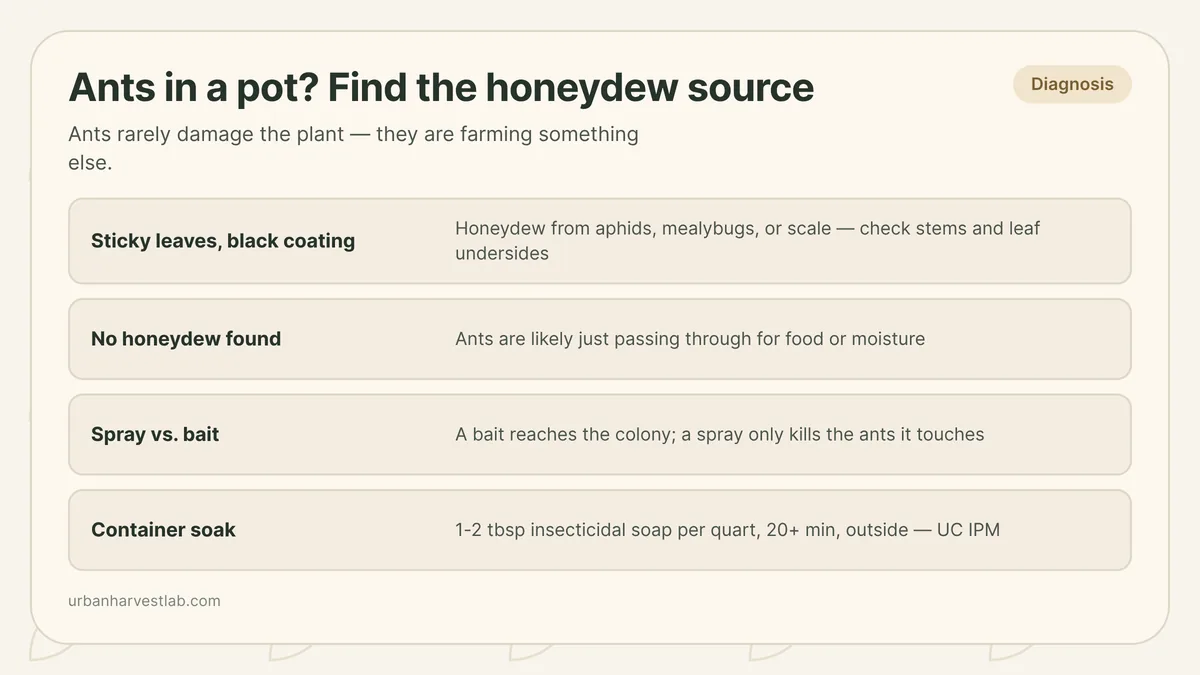
Ants in potted plants: what they mean and how to stop them
A trail of ants on a potted plant is almost always chasing honeydew from another pest, not damaging the plant itself, so the fix starts with finding that pest.
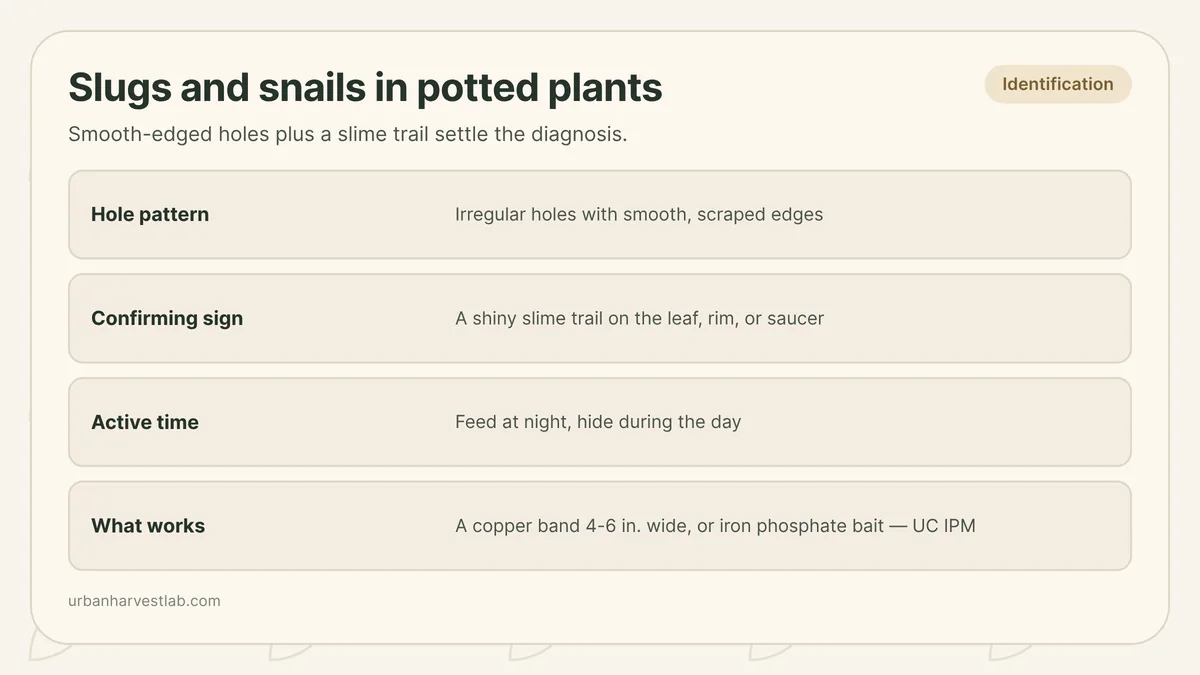
Slugs and snails in potted plants: barriers that actually work
Smooth-edged holes and a shiny trail on a potted herb point to slugs or snails. A copper barrier, iron phosphate bait, and checking after dark are the responses with evidence behind them.