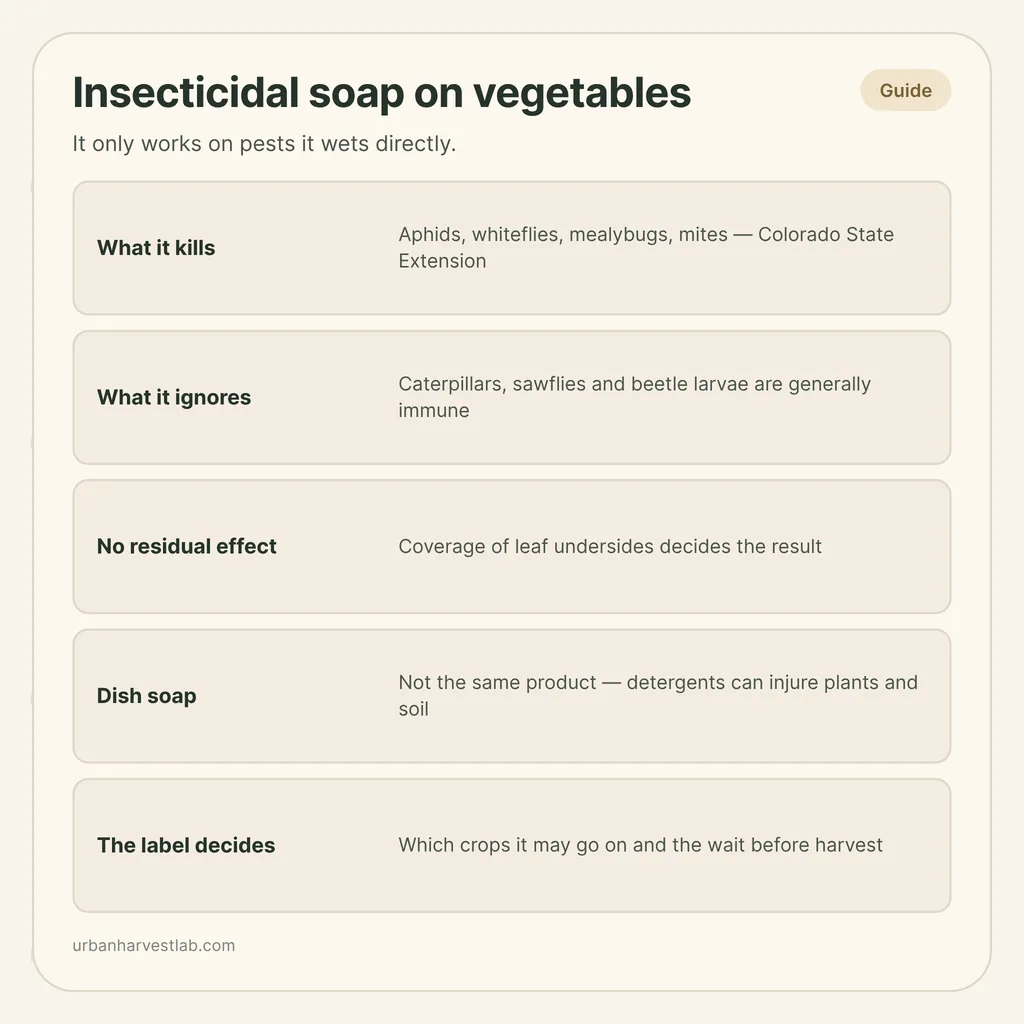
Insecticidal soap kills small, soft-bodied pests such as aphids, whiteflies, mealybugs and mites, but only the ones you wet directly, and only on the day you spray. It does nothing to caterpillars, it can scorch sensitive plants, and a dish-soap mix is not the same product. On anything you will eat, the label of the registered product you bought decides which crops it may go on and how long to wait before harvest.
If you are still deciding whether to spray at all, choosing a pest treatment for edible plants walks through the order of options. Here the subject is soap alone.
What soap kills, and what it ignores
Colorado State University Extension says insecticidal soaps kill by disrupting cell membranes, so the insect dies of rapid dehydration. It describes them as effective against small, soft-bodied arthropods: aphids, young scales, whiteflies, psyllids, mealybugs and mites. It adds that both beneficial and pest mites are affected.
The same page says larger insects such as caterpillars, sawflies and beetle larvae are generally immune. Large adult flying insects with stronger exoskeletons, lady beetles and bees among them, are generally not affected, although larval stages may be susceptible. So a leaf chewed into lace by caterpillars is not a soap problem; cabbage worms on kale have their own fixes.
| What you see | Soap a reasonable tool? | Why |
|---|---|---|
| Clusters of aphids on stems and leaf undersides | Yes, if you can wet them | Soft-bodied; UC IPM puts a strong stream of water first on sturdy plants |
| Whitefly nymphs under leaves | Yes, with thorough underside coverage | UC IPM says good coverage is essential and repeats may be needed |
| White cottony mealybugs in crowns | Yes, where the spray reaches them | Colorado State lists mealybugs as susceptible; only insects it wets are affected |
| Stippling and fine webbing from mites | Yes, if wetted | Colorado State lists mites as susceptible |
| Holes and chewed edges from caterpillars | No | Generally immune |
| Aphids inside tightly curled leaves | No | Colorado State: insects that cannot be completely wetted will not be controlled |
Why one spray rarely finishes the job
Colorado State University Extension states that soaps act strictly as contact insecticides with no residual effect, and UC IPM says they kill only the aphids present on the day of spraying. How often to repeat belongs to the product label. Choosing a pest treatment for edible plants covers the repeat reasoning in full.
Water comes first on sturdy plants: UC IPM recommends a strong stream, as described in aphids on indoor herbs. Soap also affects beneficial mites, so for potted herbs see spider mites on indoor herbs, and for predators see releasing ladybugs for aphids.
How soap damages plants
Colorado State University Extension says certain plants are sensitive to insecticidal soap sprays and may be injured. Its advice when in doubt is to test a small area a day or two before treating a larger one. UC IPM gives similar guidance for soaps and oils: they may be phytotoxic to some plants, so check the label and test on a portion of the foliage several days before a full treatment.
UC IPM also says not to use soaps or oils on water-stressed plants or when the temperature exceeds 90°F. In practice that means watering a wilting tomato first and spraying in the cooler part of the day, not in midday sun on a balcony.
Why dish soap is a different thing
Colorado State University Extension addresses homemade mixes directly. It says insecticidal soaps are chemically similar to liquid household soaps, but commercial products are designed to kill insects, tested for efficacy, selected to minimize plant injury and compliant with pesticide labelling law. Homemade pesticides, it says, are not consistently formulated or tested, so there is no evidence to support whether they control pests.
Dish soaps, it says, contain powerful detergents that can injure plants, damage soil and contaminate waterways. That is a harm to the plant, the pot mix and the water, before any question of whether it kills the pest.
Colorado State also calls household soaps used as pesticides of questionable legality. Its conclusion is simply that homemade soap solutions are not recommended for insect control. If you want a soap spray on food plants, buy a registered product and follow its directions.
What the label decides on edibles
The National Pesticide Information Center says that if your fruit or vegetable is not listed on the label, you cannot apply the product to it. A soap labelled only for ornamental plants is not a lettuce product. So before buying, find the crop list on the label and look for your vegetable or herb by name. A food-crop listing and an ornamental-only listing are different products in law, whatever the bottle looks like.
NPIC also says it is against the law to use a pesticide in any manner other than those listed on the label. The directions for use on your container, not a figure from another gardener or another product, set how much to mix and how often. The same label sets the pre-harvest interval: NPIC defines it as the wait between application and harvest, says wait times for the same crop can differ between products, and notes that some labels list zero days or no time at all. Harvesting before the interval is illegal.
Neem is a separate product category with its own label questions; neem oil on herbs covers those.
Sources
Pick the right control for the pest
Soap is one option among several, and the pest you have decides whether it is the right one.
Common questions
Which pests does insecticidal soap kill on vegetables?
Small, soft-bodied ones that the spray actually wets: aphids, young scales, whiteflies, psyllids, mealybugs and mites, according to Colorado State University Extension. It does not control caterpillars, sawflies or beetle larvae.
Can I make insecticidal soap with dish soap?
Colorado State University Extension does not recommend it. It says homemade pesticides are not consistently formulated or tested, that dish soaps contain detergents that can injure plants and soil, and that household soaps used as pesticides are of questionable legality.
Can insecticidal soap burn my plants?
Yes, on sensitive plants. Colorado State University Extension says certain plants are injured by soap sprays and that leaf damage can accumulate with repeated exposure, and UC IPM advises against spraying water-stressed plants or when the temperature exceeds 90°F.
How long should I wait to eat vegetables after spraying soap?
Read the pre-harvest interval on the label of the product you bought. The National Pesticide Information Center says wait times differ between products, that some labels list zero days, and that harvesting before the interval is illegal.
Related guides
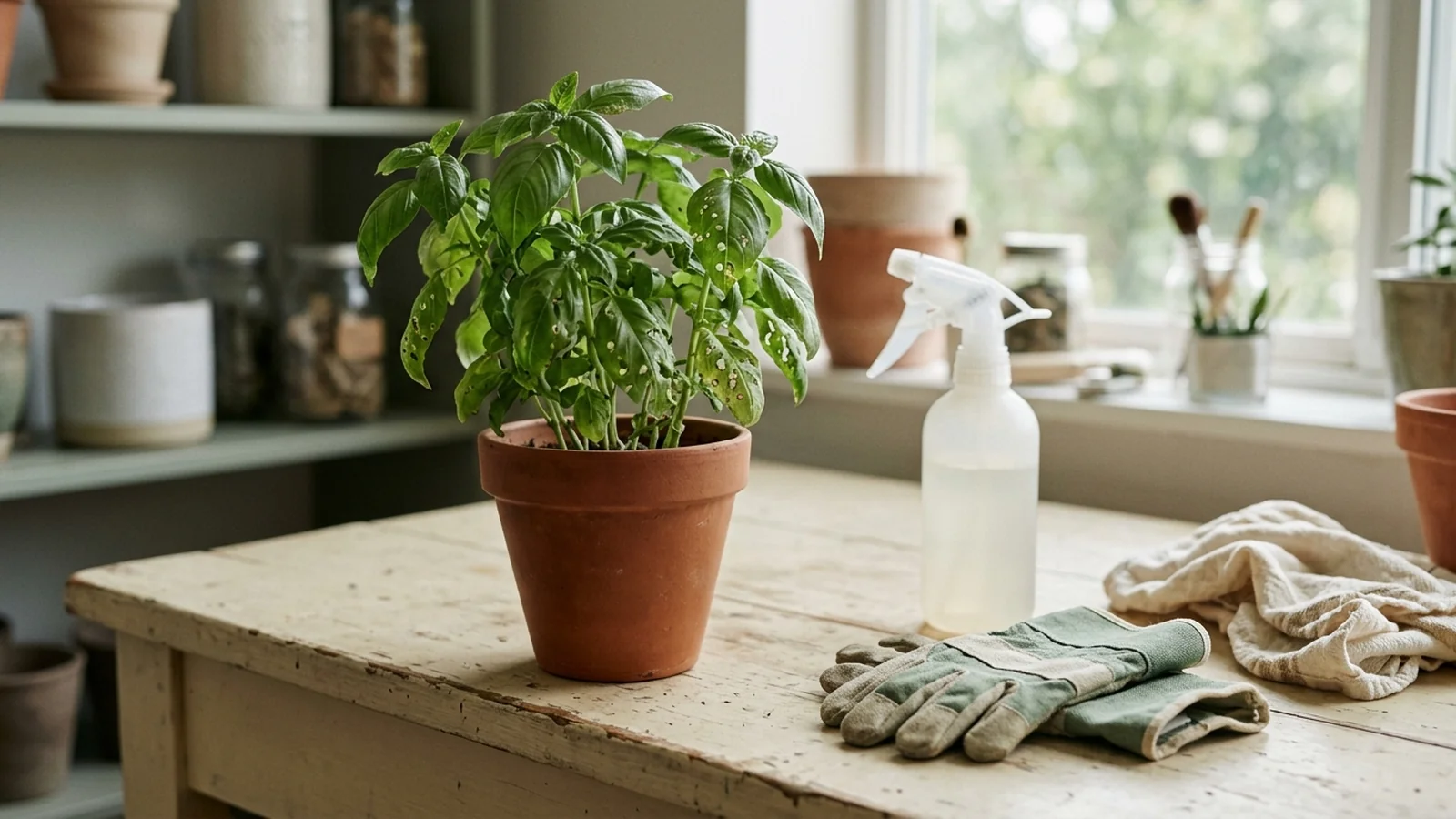
Choosing a pest treatment for plants you are going to eat
Once you know which pest you have, the next question is what you can treat it with without compromising the food. The answer is a ladder of methods, and the label on any product you buy sets the legal limits of the top rung.
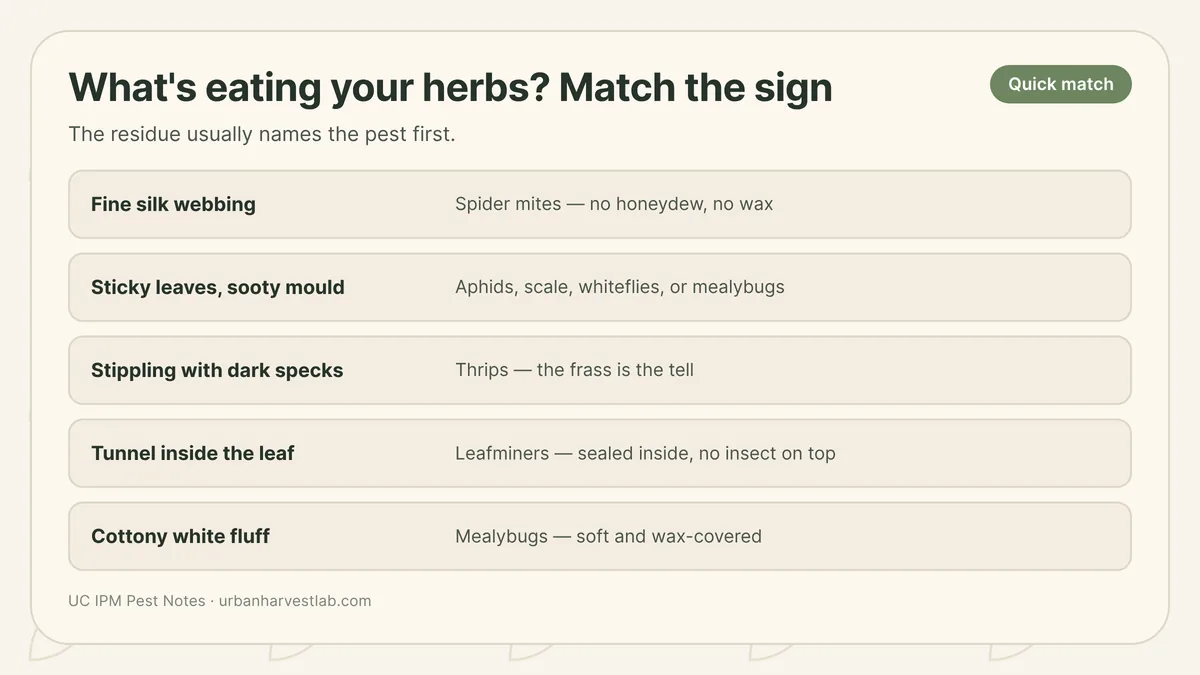
What's eating your herbs? Match the signs to the pest
Every common herb pest leaves its own tell before you ever spot the insect itself. Pick out what you are actually seeing, then go straight to the page that treats it.
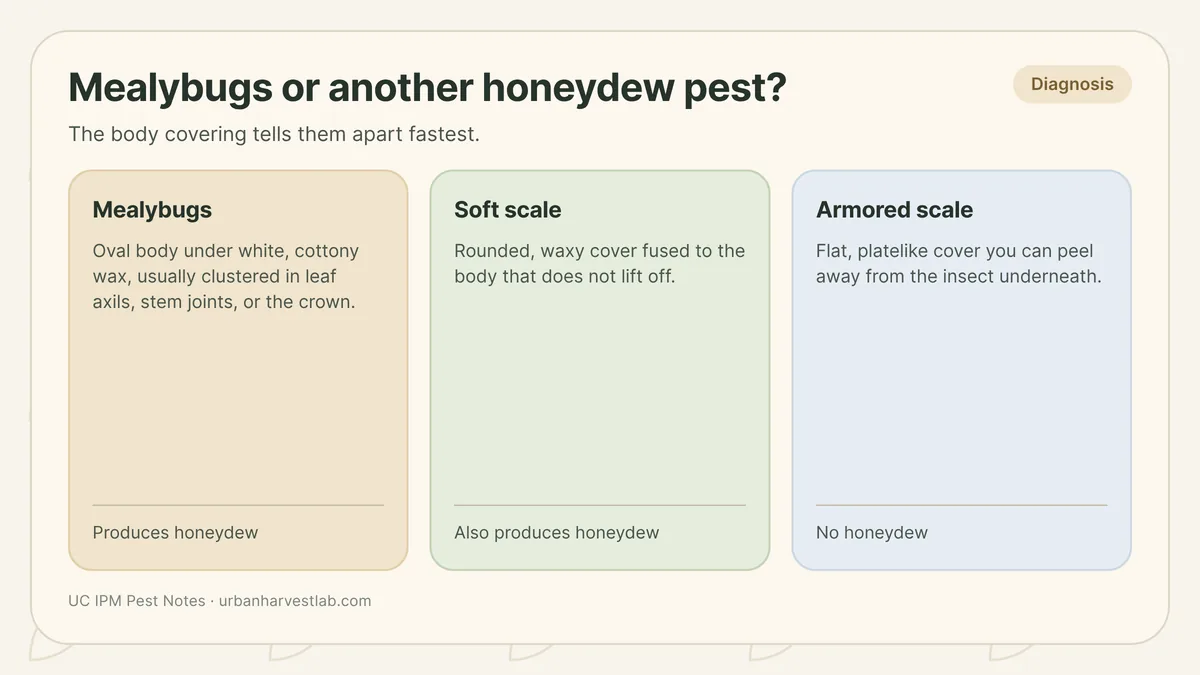
Mealybugs on indoor herbs: identify them and stop the spread
Mealybugs show up as white, cottony masses tucked into leaf axils and stem joints, and they keep coming back until every hiding spot and every generation has been treated.