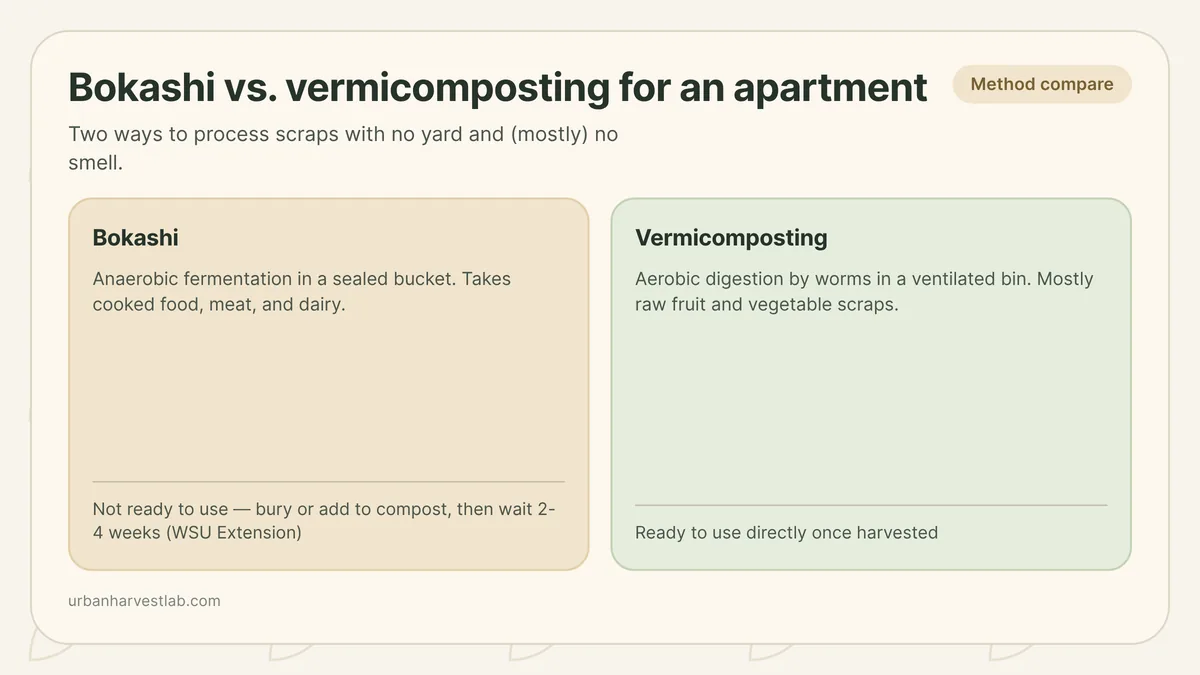
Bokashi fermentation versus vermicomposting for an apartment
| Question | Bokashi | Vermicomposting |
|---|---|---|
| Process | Anaerobic fermentation by bacteria and yeast in a sealed bucket | Aerobic digestion by worms in an open, ventilated bin |
| Food scraps allowed | Cooked food, meat, dairy, citrus, and most kitchen waste | Mostly raw fruit and vegetable scraps; meat, dairy and oily or heavily cooked food attract pests and rot before worms can process them |
| Ready to use when finished? | No — must be buried or added to a compost pile and left 2-4 weeks first | Yes — harvested vermicompost is usable directly |
| Odor management | Sealed lid; a working batch smells sour and pickled, not rotten | Ventilated bin; odor signals overfeeding, not the process itself |
Bokashi composts kitchen scraps by fermenting them, not by letting them rot. Scraps go into a sealed, airtight bucket layered with an inoculated bran, and lactic-acid bacteria, yeasts, and phototrophic bacteria pickle the material instead of decomposing it in open air. Washington State University Extension describes the finished ferment as a pre-compost stage: it still needs to be buried or added to an active compost system before it breaks down enough to use around a plant.
That sealed-bucket mechanism is also why bokashi works where an outdoor compost pile does not. There is no pile, no turning, and — if the lid stays closed — very little odor, which is the main reason it fits an apartment kitchen.
What actually happens inside the bucket
Bokashi is fermentation, the same broad process behind pickles and sauerkraut, applied to mixed food scraps instead of one vegetable. WSU Extension’s Kitsap County office describes the system as an inoculated bran — wheat bran or rice hulls carrying lactic-acid bacteria, yeasts, and phototrophic bacteria — layered with scraps inside a sealed bin. Oxygen defeats the process, so the bucket has to stay closed between additions.
That distinction matters more than it sounds. A garden compost pile or an open worm bin relies on aerobic organisms — bacteria, fungi, and in a worm bin’s case, worms — that need oxygen and generally will not touch meat, dairy, or heavily cooked, oily food. Bokashi’s bacteria and yeasts do not have that limitation, and there is no animal in the bucket to protect from an unbalanced diet. That is the practical reason a bokashi bucket accepts cooked leftovers, meat scraps, and dairy that would foul an open bin or a worm colony. Vermicomposting in an apartment covers the digestion side of that contrast and what an indoor worm bin can and cannot take.
Setting up and running the bucket
Follow WSU Extension’s process:
- Layer scraps with bran. Add a layer of food scraps, then a handful of the inoculated bran, repeating as scraps accumulate.
- Compact each layer. Press it down to push out air pockets before sealing the lid. Air is the enemy of the fermentation, not the food.
- Keep the bucket sealed between additions. Opening it briefly to add scraps is normal; leaving it open is not.
- Drain the liquid every few days. A bokashi bucket produces a liquid byproduct — sometimes called bokashi tea — that collects at the bottom and needs draining periodically so it does not sit in contact with the solids.
- Ferment sealed once the bucket is full. WSU Extension gives about two weeks of sealed fermentation once the bucket has stopped taking new scraps, before the material moves to the next stage.
Reading the smell, and what it tells you
WSU Extension gives the smell as the working diagnostic. A sour, tangy, pickled, vinegar-like smell signals a successful ferment. A foul, rotten, or putrid smell means something went wrong, usually from air getting into the bucket — a loose lid, scraps not compacted enough, or the bucket opened too often.
Surface mold reads the same way. White mold on top is normal and part of a working ferment. Green, black, or blue mold signals contamination, not a successful batch, and that material should not go on to the next stage.
That sour-versus-rotten test is a useful contrast with finished compost, which is judged by a different smell entirely. Utah State University Extension describes mature compost as smelling “earthy,” and Penn State Extension’s own marker for finished compost is a sweet smell, against sour, ammonia-like, or rotten for unfinished material. A bokashi ferment succeeding at “sour and pickled” and a compost pile succeeding at “sweet and earthy” are not the same test, because they are not the same process — one is intentionally acidic fermentation, the other is aerobic decomposition. Neither one is judged as finished by a rotten smell.
The ferment is not finished compost yet
This is the step that gets skipped, and it is the one WSU Extension is explicit about: the fermented material “won’t decompose completely” sitting in the bucket. It has been preserved and acidified, not broken down into a soil-ready amendment. Spreading it on the surface of a pot or using it as mulch is the wrong move — WSU Extension states plainly that surface application does not work.
Instead, the finished ferment needs to go into one of a few places to complete decomposition:
- Buried in soil, dug into an existing garden bed or a large container.
- Worked into an active compost pile, where it becomes one input among others rather than the whole batch.
- Held, sealed, until one of those options is available.
Once buried, WSU Extension gives two to four weeks, depending on soil temperature, before planting into that spot. Warmer soil finishes the breakdown faster than cold soil, which is the same temperature dependency that governs decomposition generally.
For an apartment grower without a garden bed, that usually means burying finished bokashi into a large container of soil that is not currently growing anything, or adding it in modest amounts to an active bin, then waiting before planting. Once it has broken down, treat the result like any other compost-derived amendment: how much compost to add to a potting mix covers the dose, and safe compost for edible containers covers what to check before it goes anywhere near food crops.
Building a bokashi habit around one bucket
A single bucket cycle looks like this in practice: fill it over however long your kitchen takes to produce that much scrap, draining liquid every few days as it accumulates, then seal it for the roughly two-week fermentation WSU Extension describes once it is full. That means a one-bucket household needs somewhere to bury or bin the previous batch before the current one finishes, or a second bucket to fill while the first ferments.
The bucket produces a liquid byproduct that has to be drained every few days. WSU Extension’s process description gives no dilution rate for applying it to plants, so unless the kit you bought came with its own instructions for the liquid, drain it and pour it down the sink rather than onto soil at a guessed strength. Some bokashi kits sold with their own bran sell a matching “tea” for this purpose with its own dilution instructions on the packaging — that instruction sheet, not a generic ratio, is the one to follow if you have it.
Do not judge a batch mid-ferment by how it looks. A sealed bucket a few days in can look wet and unremarkable; the smell test at the two-week mark is what tells you whether it worked. Two buckets running in rotation — one fermenting while the other fills — solves the timing problem better than trying to speed up or shortcut the two-week window, since WSU Extension’s process depends on that fermentation time rather than on how full the bucket gets. If no burial site is available when a bucket finishes, WSU Extension’s held-and-sealed option keeps the ferment stable until one is.
Sources
If you are dealing with food scraps in a small space
These guides cover the neighboring decisions once the ferment comes out of the bucket.
Common questions
What is bokashi composting?
Bokashi is an anaerobic fermentation method for food scraps. Scraps are layered with an inoculated bran carrying lactic-acid bacteria, yeasts, and phototrophic bacteria inside a sealed, airtight bucket, and the mix ferments for about two weeks instead of decomposing in open air, per Washington State University Extension.
Does bokashi smell?
A working batch smells sour, tangy, and vinegar-like, similar to pickling, not like rotting food. WSU Extension's sour-versus-rotten test: a foul, rotten, or ammonia-like smell means the batch failed, usually because the bucket was opened too often or not sealed well.
Can you use bokashi straight from the bucket?
No. The fermented material has not finished breaking down and is not a usable soil amendment on its own. It needs to be buried in soil, worked into a garden bed, or added to an active compost pile, then left for two to four weeks — WSU Extension's range, depending on soil temperature — before planting into it.
Is bokashi better than vermicomposting for an apartment?
They solve different problems. Bokashi ferments scraps, including cooked food, meat, and dairy, in a sealed bucket with no live animals to manage. Vermicomposting relies on worms digesting scraps aerobically, which rules out meat, dairy, and most cooked or oily food, but produces a soil amendment that is ready to use once it is harvested, without a separate burial step.
Related guides
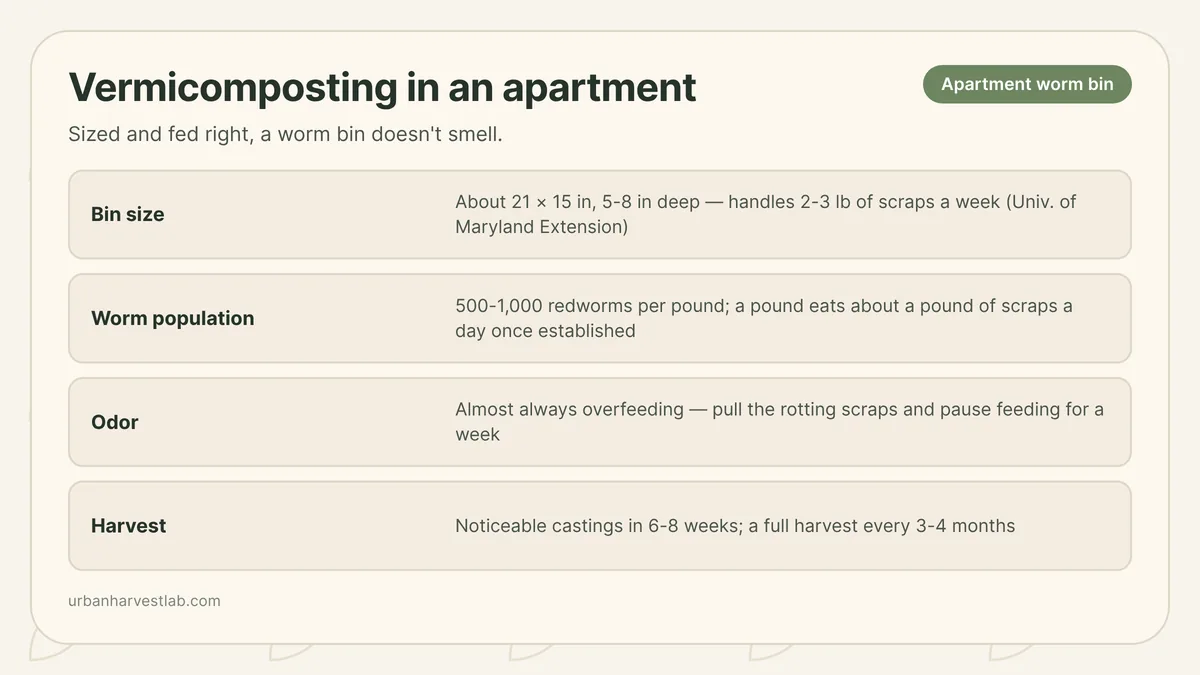
Vermicomposting in an apartment: bin setup, feeding, and harvest
A worm bin sized and fed correctly runs in a closet or under a sink without odor. Here is the setup, the feeding rules, and how to harvest the castings.
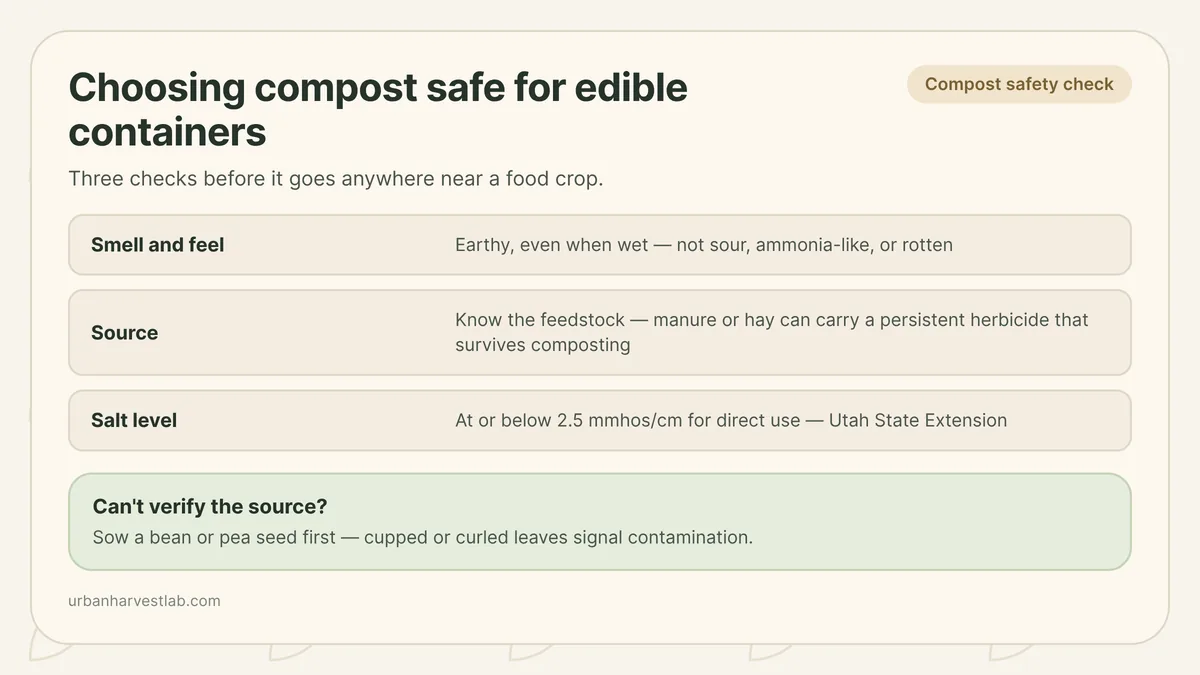
Choosing compost that's safe for edible containers
A pile or a bag that looks like good compost can still carry a persistent herbicide or too much salt for a small pot. Three checks catch most of it before you plant.
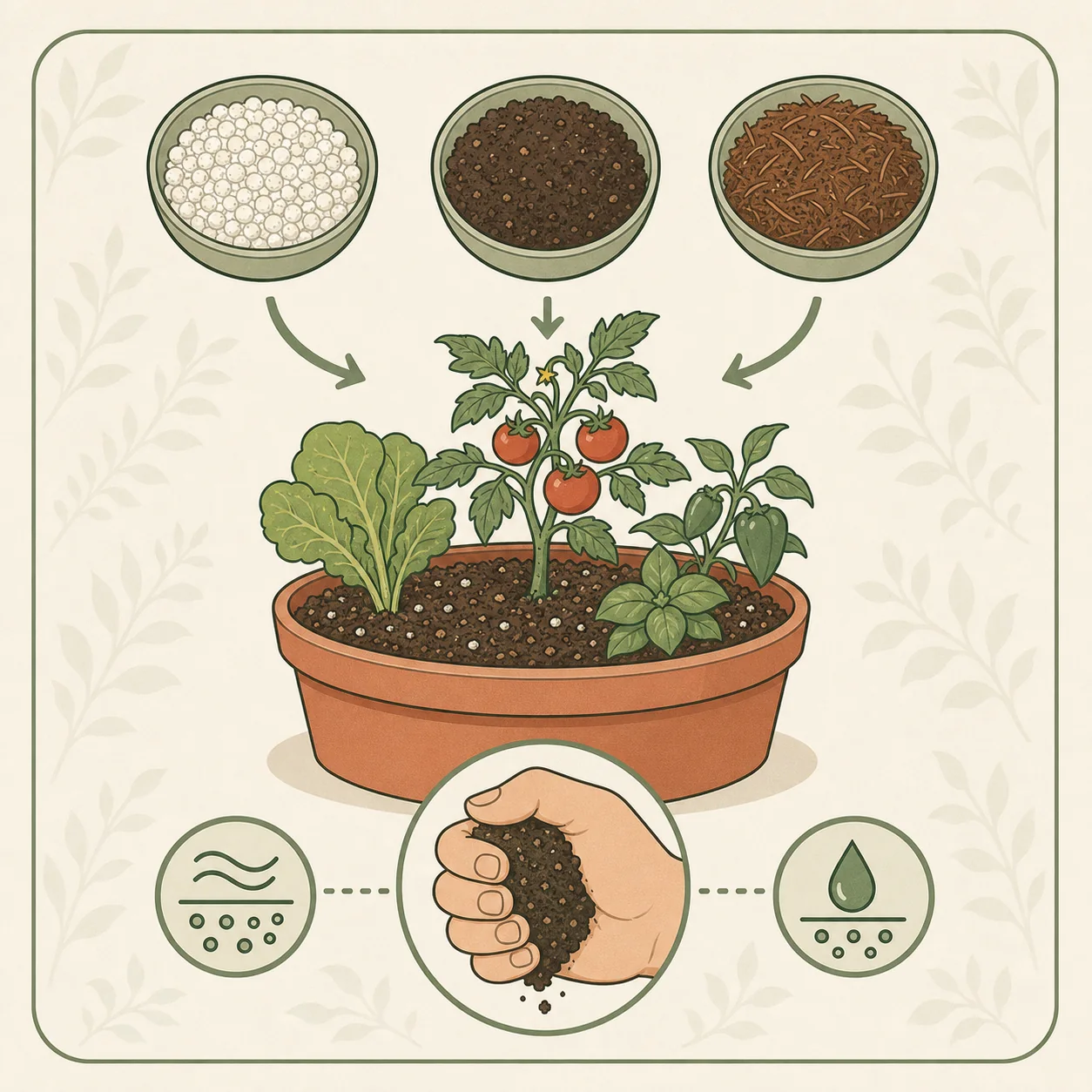
How to make potting mix for container vegetables
A useful potting mix recipe describes the job of each ingredient and gives you a way to correct the result. The goal is stable air and moisture, not a magic ratio.