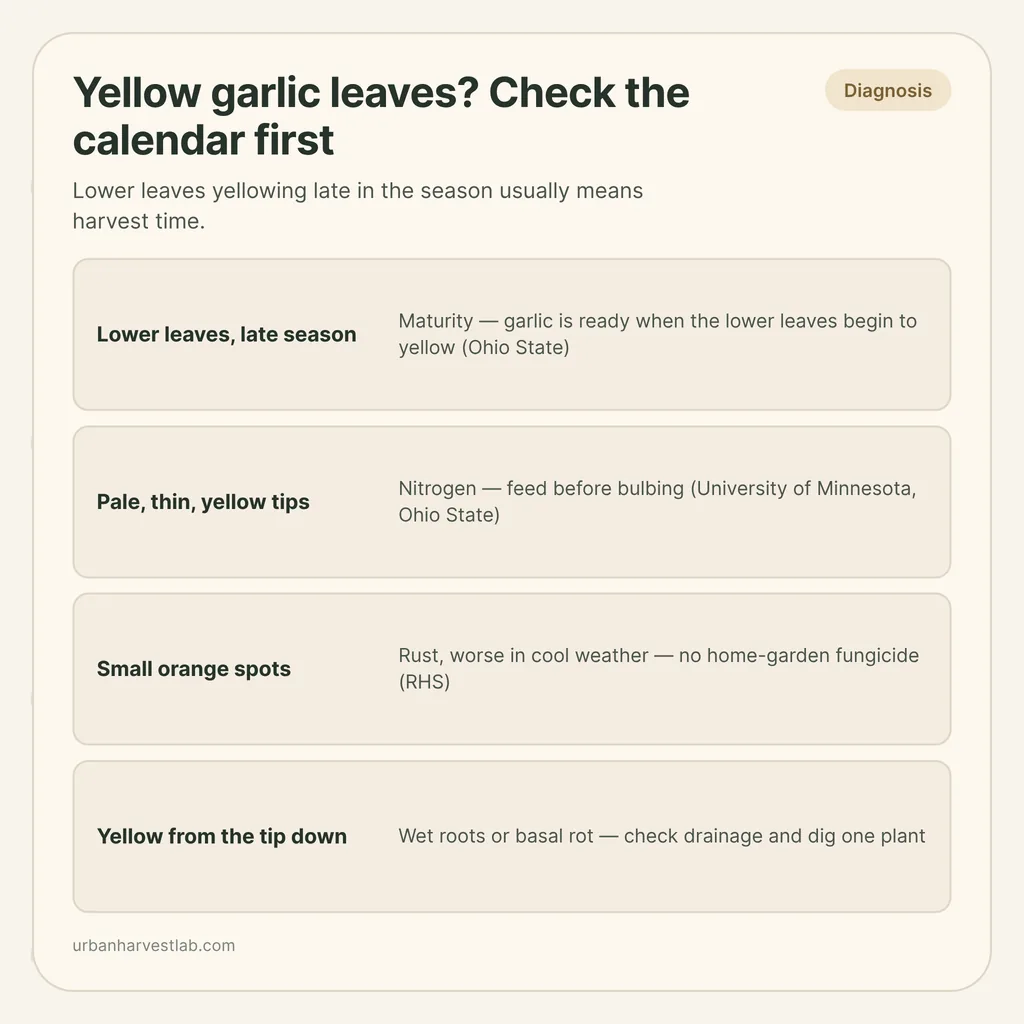
Troubleshoot the system before you change the inputs.
Symptoms
- Leaves turn yellow, starting at the bottom of the plant or at the tips.
- Small orange spots appear on the leaves and stems.
- Leaves yellow and wilt while the pot stays wet, or the base of the plant is soft.
Possible causes
- Normal maturity: the lower leaves yellow as the bulb finishes.
- Nitrogen shortage, made worse by heavy rain or over-watering washing nutrients out.
- Garlic rust, a fungal leaf disease active in cool weather.
- Waterlogged mix, root damage or a basal rot such as Fusarium, pink root or Botrytis neck rot.
Quick fixes
- Check the date and which leaves are yellow before treating anything.
- Look closely at the leaves for orange spots.
- Lift the pot, check every drainage hole and let the mix dry more between waterings.
- Dig one plant to look at the bulb and roots if the cause is unclear.
Yellow garlic leaves: which cause fits
| What you see | Likely cause | First move |
|---|---|---|
| Lower leaves yellow from the bottom up in late spring or summer, top leaves green | Maturity | Cut back watering and dig a test bulb |
| Whole plant pale, leaf tips yellow, thin stems, earlier in the season | Nitrogen shortage | Feed before bulbing, and check the pot is not waterlogged |
| Small orange spots on leaves and stems | Rust | Do not crowd plants, keep leaves dry when watering, go easy on nitrogen |
| Yellow from the tip down, leaves wilting, base soft or rotting | Root or basal rot | Check drainage, dig one plant and inspect the base |
| Yellow streaks at the base of young leaves, crinkled foliage | Onion yellow dwarf virus | Check for green peach aphids |
Garlic leaves turning yellow from the bottom up in late spring or early summer usually means the crop is finishing, not failing. Yellowing earlier in the season, or with orange spots, a pale thin plant or a soggy pot, points to a cause you can act on. Check which leaves are yellow and when, then match the pattern below.
Start with the calendar and the pattern
Ohio State Extension says garlic is ready for harvest “when the lower leaves begin to yellow”, and explains why: the leaves are connected to the bulb wrappers below. NC State sees this in mid-June in its region, and Utah State says to harvest when the tops begin to yellow or start to fall over, but before they are completely dry. If your lower leaves are yellowing in that window while the upper leaves stay green, you are almost certainly looking at maturity.
If the yellowing is earlier, hits the whole plant, or comes with spots or wilting, work through the other causes. The sections below give the detail.
Maturity: yellow lower leaves at the end of the season
This is the cause to rule in first. Penn State Extension gives a range for the harvest signal: garlic is ready when 40 to 60 percent of the leaves have yellowed, and it notes that garlic generally has six leaves. NC State is more cautious and digs a test bulb when two or three leaves on a plant are yellow.
Two things cost you if you wait too long. Ohio State warns that waiting until leaves turn brown results in rotted or missing wrappers. Penn State says bulbs harvested too late start to split open, and the RHS adds that late-lifted bulbs have a shorter storage life.
Water matters here too. Ohio State says to reduce irrigation once leaves begin to yellow, because the plant needs to dry down, and Utah State says to stop watering when the leaves start to mature. For how to read the harvest window and cure the bulbs, see growing garlic in containers.
Nitrogen: pale plants, yellow tips, thin stems
University of Minnesota Extension lists the nitrogen-deficiency pattern as yellow leaf tips, an entire plant that looks pale green to yellow, and thin stems. Cornell Cooperative Extension calls garlic a heavy feeder that requires adequate nitrogen, and Utah State side-dresses with nitrogen in spring.
Ohio State warns that over-watering or heavy rain can remove nutrients. Its advice for plants that look yellow, small-leaved or not vigorous is an additional fertiliser application before bulbing, for example a garlic or balanced vegetable fertiliser. The timing matters: the advice is for before bulbing, not for a plant that is already yellowing at maturity. Follow the label of whatever fertiliser you use. Small bulbs are a separate problem with their own causes, covered in why garlic bulbs are small.
Rust: orange spots
University of Minnesota Extension describes garlic rust as small bright orange spots on leaves and stems, with black spots developing at their edges. With many spots, leaves wilt, turn yellow and dry out, and the bulbs are small and of poor quality. UC IPM says lesions typically form first on older leaves and then spread to younger ones, and that severely affected leaves can be covered in pustules, turn yellow and then die.
The fungus is active in cool weather, between 57 and 75 °F according to UC IPM. The RHS says infection is worse on nitrogen-rich soil with low potassium, so go easy on feeding, and says not to crowd plants because crowding raises humidity. It also says no fungicide is approved for home gardeners to control leek rust, which also infects garlic. The RHS also advises avoiding wetting the leaves when you water garlic, since that can encourage fungal problems. UC IPM recommends rotating away from Allium crops for two to three years.
Rust also hits chives; see chives turning yellow for that plant.
Wet roots and rots: yellow from the tip down, wilting
Garlic in a pot that stays wet is exposed to several root and basal problems, and their leaf symptoms overlap. According to University of Minnesota Extension:
- Fusarium basal rot turns leaves yellow to brown from the tip down and wilts them, with watery brown decay at the base of the bulb.
- Pink root turns leaves yellow with a reddish tinge from the tip down because of root damage, and commonly occurs mid to late season in areas with poor soil.
- Botrytis neck rot yellows the outer leaves first, and is common in cool wet weather or in heavy wet soils.
Ohio State puts the general rule plainly: bulb rots are a problem in wet years or in poorly drained soil. So the first move is physical. Lift the pot, check every drainage hole and let the mix dry more between waterings. If the plant keeps declining, dig one and look at the roots and the base; watery brown decay at the base is the sign of Fusarium basal rot. Overwatered vs underwatered helps if you are unsure which side of watering you are on.
Pests and virus
Two less common causes are worth a glance. University of Minnesota Extension says onion maggot makes plants yellow and wilt, sometimes rapidly, with holes in the bulbs. Onion yellow dwarf virus starts as yellow streaks at the base of young leaves, spreads to all the leaves, and is spread by the green peach aphid. Confirm the pattern before putting effort into either.
If none of these fit, the broader yellow leaves cause finder covers other plants and patterns.
Sources
- Ohio State Extension, Growing garlic in the garden
- Utah State University Extension, Garlic in the garden
- Penn State Extension, Garlic production
- NC State Extension, It’s time for garlic
- Cornell Cooperative Extension Schoharie-Otsego, Guide for growing garlic
- University of Minnesota Extension, Garlic: leaves yellow then wilt
- University of Minnesota Extension, Garlic: flecks, spots, streaks or blotches on leaves
- UC IPM, Onion and garlic rust
- RHS, Leek rust
- RHS, How to grow garlic
More on garlic and yellow leaves
Growing garlic in pots, small bulbs, and the wider guides for yellowing leaves.
Common questions
Why are my garlic leaves turning yellow?
In late spring or early summer it is usually maturity: Ohio State Extension says garlic is ready for harvest when the lower leaves begin to yellow. Earlier in the season, look for pale thin plants (nitrogen), small orange spots (rust), or a wet pot with yellowing from the tip down (root or basal rot).
Should I fertilise garlic with yellow leaves?
Only before the bulb swells. Ohio State says that if plants look yellow, small-leaved or not vigorous, an additional fertiliser application before bulbing could help. Once the lower leaves are yellowing at maturity, feeding will not help, and Utah State advises stopping watering as leaves start to mature.
Does garlic rust ruin the bulbs?
University of Minnesota Extension describes rust as a leaf disease that leaves bulbs small and of poor quality. Severe infection reduces bulb size and quality, according to UC IPM.
When should I pull garlic that is going yellow?
Penn State Extension says garlic is ready when 40-60 percent of the leaves have yellowed, and NC State digs a test bulb when two or three leaves are yellow. Dig, do not pull, and do not wait for every leaf to brown.
Related guides
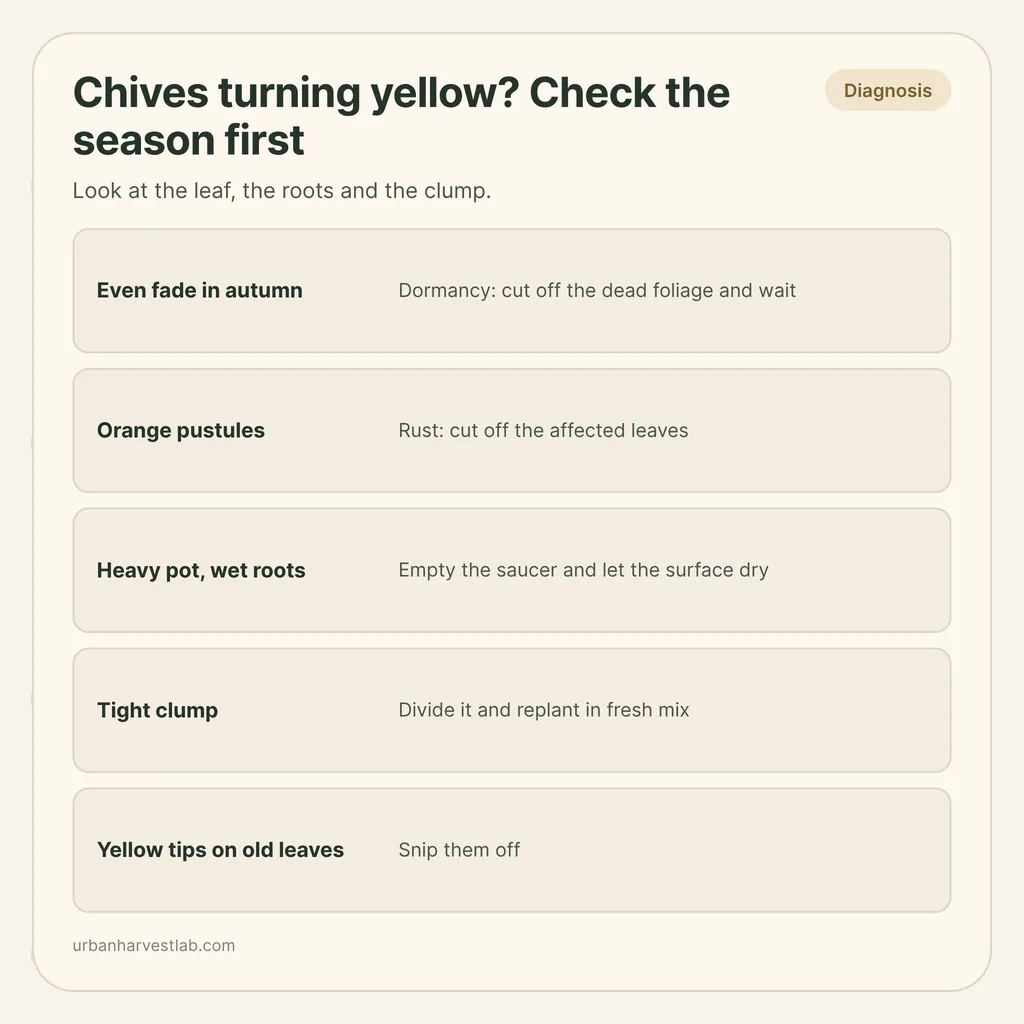
Chives turning yellow? Dormancy, rust, wet roots or hunger
Yellow chives are often just the end of the season, but orange pustules, a soggy pot or a crowded clump point to something you can fix.
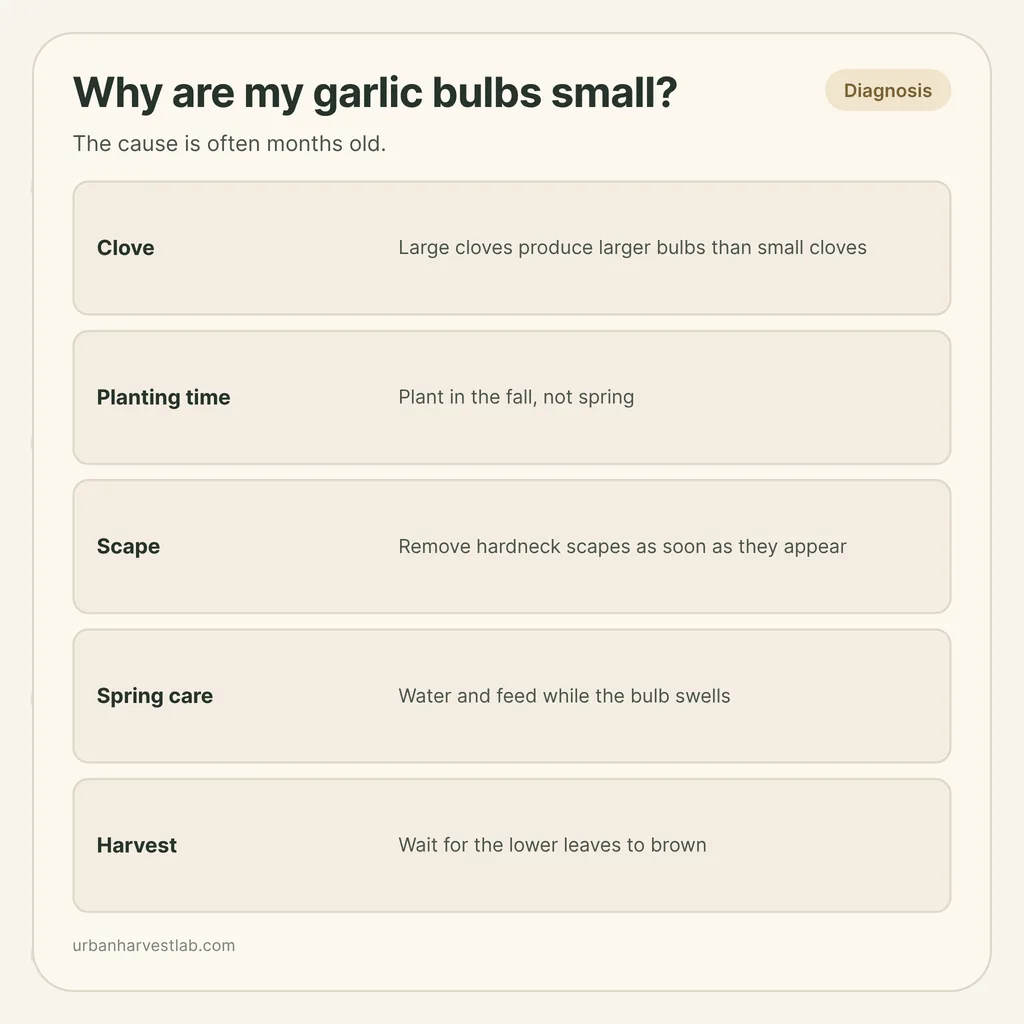
Why are my garlic bulbs small? Clove, timing, scape, and harvest
Garlic sizes up in a short spring window, and most of what limits it was decided months earlier: which clove you planted, and when. Here is how to work out which cause fits your pot.
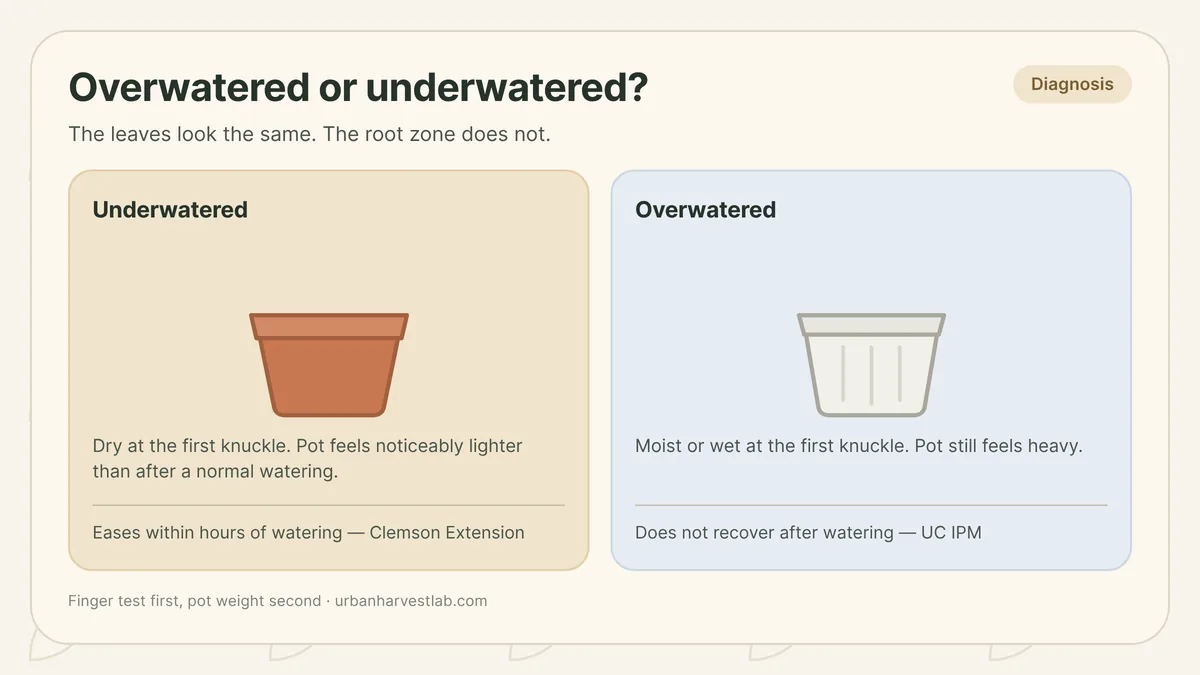
Overwatered vs underwatered: how to tell which one you have
Reading the root zone directly, with a finger test, pot weight, and how the plant responds to being watered, settles what the leaves alone cannot.