Troubleshoot the system before you change the inputs.
Symptoms
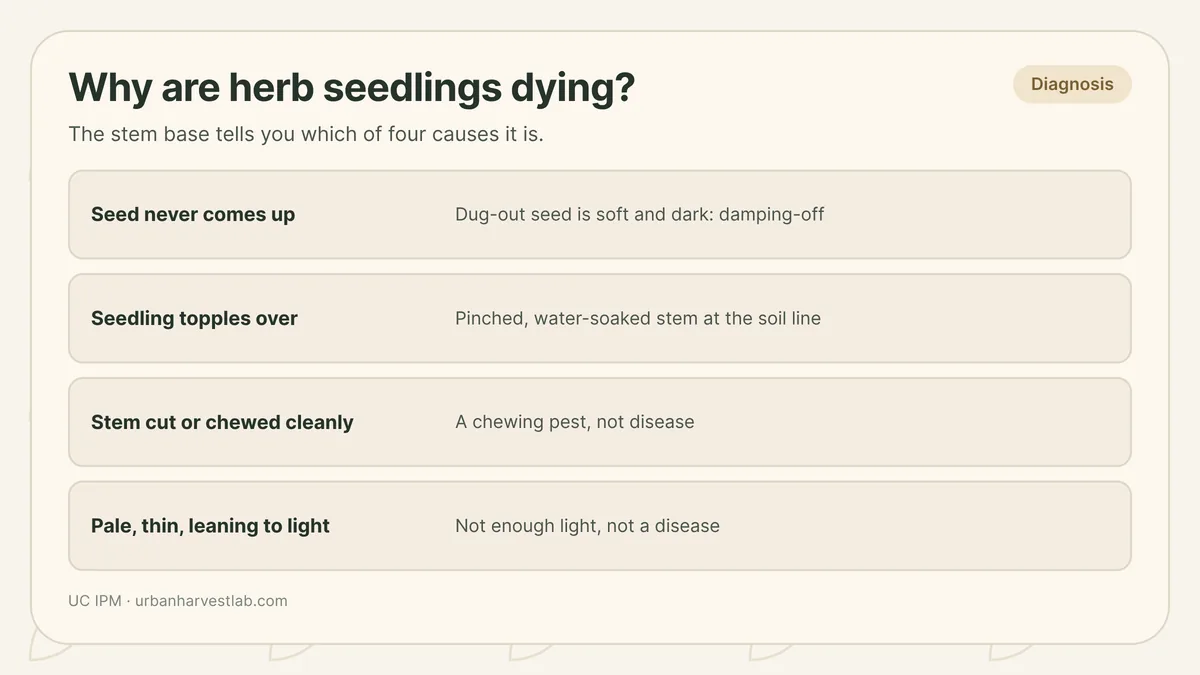
- A seed sown into a cell or small pot does not come up, and when you dig it out it is soft, dark, and falls apart rather than firm and intact.
- A seedling that had emerged normally suddenly topples over, with the stem pinched thin and water-soaked right at the soil line.
- Growth is pale, thin, and stretching sideways toward a window instead of growing sturdy and upright.
Possible causes
- Damping-off fungi - most often Pythium, along with Rhizoctonia, Fusarium, and Phytophthora - are active in a cold, wet, or crowded starting mix.
- The starting mix has stayed saturated rather than merely moist, cutting off oxygen to the roots and inviting the same rot organisms.
- Soil temperature sits below the range the seed needs to germinate quickly, so it sits vulnerable to rot for longer than it should.
- The seedling is too far from a strong, consistent light source and is stretching toward whatever light it can reach.
Quick fixes
- Dig up one unsprouted seed before writing off the cell; firm and intact just needs more time, soft and dark is already rotting.
- Switch to a fresh, sterile seed-starting mix and let the surface approach dryness between light waterings instead of keeping it saturated.
- Check the actual soil temperature rather than guessing, and warm the tray toward the seed's germination range instead of adding more water.
- Remove any collapsed seedling immediately so decay does not spread to its neighbors in the same cell tray.
Herb seedling failures, cause by cause
| What you see | Likely cause | What to check first |
|---|---|---|
| Seed does not come up; dug-out seed is soft and dark | Pre-emergence damping-off | Soil temperature and how wet the mix has stayed |
| Emerged seedling topples with a pinched, water-soaked stem | Post-emergence damping-off | Remove it immediately; check the whole tray for spread |
| Stem cut cleanly or chewed, base lying separate from the seedling | A chewing pest, not disease | Look for slime trails, frass, or the pest itself at night |
| Growth is pale, thin, and leaning hard toward the window | Insufficient or inconsistent light | Distance and duration of the grow light or window exposure |
Herb seedlings most often die from damping-off, a soilborne rot that thrives in cold, wet, crowded starting mix, and the tell is at the stem, not the leaf: a pinched, water-soaked collapse right at the soil line rather than a cleanly cut or chewed one. Overwatering on its own and stretching toward weak light can each finish off a tray that damping-off did not touch, so the fix depends on which of the three you actually have. Some of what looks like death is not: a seed that simply has not come up yet needs a different response than one that has already rotted.
This sits next to the wider common potted herb problems guide, but a seedling in its first few weeks fails in ways an established plant does not, because it has almost no root reserve and no woody stem to fall back on.
Rule out a pest before you blame disease
UC IPM’s damping-off fact sheet is explicit that the first job is elimination, not diagnosis: cutworms, earwigs, flea beetles, snails, slugs, and root maggots can all fell a seedling, and the grower has to work out whether the damage came from one of those or from a damping-off fungus. The discriminator is the stem itself. A stem that has been cleanly cut, or chewed, with the top lying separate from an intact base, is a pest. A stem that is still attached but pinched, dark, and water-soaked at the soil line is damping-off. UC IPM’s snails and slugs note gives the slime trail as the check that separates them from earwigs, and its earwig and caterpillar notes give the night-and-hide-by-day feeding pattern most of these chewers share, so checking after dark is worth doing before assuming disease. A soil pest can also be at work without cutting anything: UC IPM notes fungus gnat larvae, “when present in large numbers, can damage roots and stunt plant growth, particularly in seedlings and young plants,” while springtails may chew seedling roots and leaves but rarely cause enough damage to warrant control. Fungus gnats in herb pots and springtails vs fungus gnats cover identifying and managing either one.
Damping-off: no cure, only prevention
Once a herb seedling is down to disease, UC IPM describes two distinct pictures depending on timing. Pre-emergence damping-off happens before the seed ever sprouts: the seed itself “become[s] soft and mushy, turn[s] dark brown, and decay[s]” in the mix, and from above the result looks exactly like a cell that simply failed to germinate. Post-emergence damping-off happens after the seedling is up: stem tissue at soil level is “decayed and weakened,” and the seedling topples over even while the foliage above can still look reasonably green for a short while.
Pythium species are the most common cause, with Rhizoctonia, Fusarium, and Phytophthora also implicated, according to UC IPM. All four favor the same setup: seedlings growing slowly in cold, wet soil, plus compacted or waterlogged mix, poor drainage, overcrowded cells, and excess nitrogen. That last point matters because a struggling seedling’s instinctive fix, a dose of fertilizer, is one of the conditions that makes the disease more likely, not less.
There is no treatment for a seedling that already has it. UC IPM’s management is entirely preventive: a steam-sterilized or pasteurized starting mix, soil held at 65 to 70°F for most seeds, gentle misting rather than saturating waterings, enough spacing between cells that air can move, and pulling any infected seedling out immediately rather than waiting to see if it recovers. If your setup is dense trays of a single fast crop rather than individual herb pots or cells, the pathogen mechanism and the sanitation routine are worked through in more depth in damping-off in microgreens - the organisms are the same, but the density and the harvest timeline are different enough to change some of the advice.
Cold, wet starting mix is what sets the trap
The “cold, wet soil” half of UC IPM’s damping-off conditions is worth separating out on its own, because it is usually the first domino. Herb seeds each have a germination range, and sowing into mix that is colder than that range does not just slow things down, it stretches out the window during which a vulnerable seed is sitting in wet medium.
Penn State Extension gives basil a minimum soil temperature of 60°F for planting, with germination happening closer to 70°F, and leaf discoloration appearing below 40°F. Clemson Cooperative Extension’s basil sheet points to the same idea from a different angle: transplant only once daytime temperatures are consistently in the 70s and nights stay above 50°F. Oregon State University Extension gives cilantro a germination range of 55 to 68°F. Neither source publishes a herb-by-herb chart covering every kitchen herb, so where you do not have a figure for your specific crop, fall back on UC IPM’s 65-70°F for most seeds, checked with an actual thermometer in the mix rather than the air around it.
Parsley adds a second wrinkle: Clemson notes that its seed is genuinely slow to germinate. A bare cell while the faster herbs in the same tray are already up is not automatically a failure. Before resowing, dig one seed out and roll it between finger and thumb: one that is still firm and holds its shape, with a radicle that is pale and simply stalled, just needs more time. One that collapses or smears under light pressure, with a browned or mushy radicle, has already rotted, and the cell needs a fresh start rather than more patience.
Waterlogging alone, without a visible rot yet
Damping-off is the disease version of too much water, but plain waterlogging can weaken or kill a seedling before any fungus is even in the picture. The mechanism, per the Missouri Botanical Garden, is straightforward: roots sitting in saturated mix cannot get oxygen, and the longer that air is cut off, the greater the root damage. Dying roots stop supplying water and nutrients to the seedling above and become an easier target for rot organisms to establish in - which is exactly how a waterlogged tray turns into a damping-off outbreak if it was not one already.
It does not take long. UC IPM’s fact sheet on Phytophthora root and crown rot notes that the pathogen can establish in soil that has been saturated for as little as 4 to 8 hours, which is a useful reminder that a cell tray sitting in a saucer of standing water overnight is not a minor lapse. Let the surface of the mix approach dryness before the next light watering, and keep trays out of any runoff that has pooled underneath them.
Because seedling cells are small, the usual finger-test for judging root-zone moisture does not translate directly. Judge by weight and by what the surface looks like instead: a tray that still feels heavy and looks dark and glossy on top a day after watering is still saturated, not just moist.
Stretching toward the light is a different problem entirely
Pale, thin, leaning growth is not damping-off and will not respond to any fix above. It means the seedling is not getting enough light, or not getting it consistently, and it is reaching toward whatever source it can find. Clemson’s herb guidance is that almost all herbs grow best in an area that is “sunny for at least six hours each day,” and a seedling on a dim windowsill rarely gets that. The full setup for getting seed-starting light right, including fixture height and how it should change week to week, is in grow lights for seedlings: the complete setup. If your seedlings are up, green, and simply reaching sideways, that page is the next stop rather than anything about damping-off or watering.
Match the tray to the fix
Work through it in this order: check the stem base for a clean cut versus a pinched, water-soaked collapse; check soil temperature against your herb’s range; check whether the mix has been staying saturated rather than merely moist; and only then look at how much light the tray is actually getting. A tray can have more than one problem stacked together, most often cold, wet mix that has already tipped into damping-off, so fixing the temperature and the watering routine together is usually more useful than chasing one variable at a time. Getting the sowing depth, tray size, and timing right for your specific herbs from the start makes most of this avoidable; the seed-starting calculator works out those numbers before you sow rather than after something has already gone wrong.
Sources
- UC IPM Pest Notes 74132, “Damping-Off Diseases in the Garden”
- UC IPM Pest Notes 74133, “Phytophthora Root and Crown Rot in the Garden”
- UC IPM Pest Notes: Snails and Slugs
- UC IPM Pest Notes: Earwigs
- UC IPM Pest Notes: Fungus Gnats
- Missouri Botanical Garden, Pests and Problems - Environmental, “Overwatering”
- Penn State Extension, “Basil, A Summer Favorite”
- Clemson Cooperative Extension, HGIC — Basil
- Clemson Cooperative Extension, HGIC — Herbs
- Oregon State University Extension, “How to grow cilantro for leaves — or coriander seeds”
Get the setup right for the next batch
These guides cover the mix, light, and container decisions that make the next round of seedlings sturdier from the start.
Common questions
What does damping-off actually look like on a herb seedling?
Before the seedling ever comes up, the seed itself turns soft, mushy, and dark brown instead of germinating. After emergence, the stem right at the soil line looks pinched, thin, and water-soaked, and the seedling topples over even though the leaves above still look fine at first.
Can I save a seedling once it has damping-off?
No. Once the stem tissue at the soil line has decayed, that seedling will not recover. Remove it right away so the rot does not spread to its neighbors in the same tray, and put the effort into a clean mix and better drainage for the next sowing.
Why are my herb seeds not coming up at all?
Some herbs are genuinely slow to start - parsley in particular is well known for taking its time - so a bare cell while faster herbs in the same tray are already up is not automatically a failure. Dig one seed out and check it: firm and intact means keep waiting, soft and dark means it has rotted and the cell needs resowing in fresh mix.
Is overwatering the same problem as damping-off?
They are connected but not identical. Waterlogged starting mix cuts off oxygen to the roots and creates the exact cold, saturated conditions that let damping-off fungi establish, but a seedling can also decline from waterlogging alone, well before any visible rot appears at the stem.
Related guides
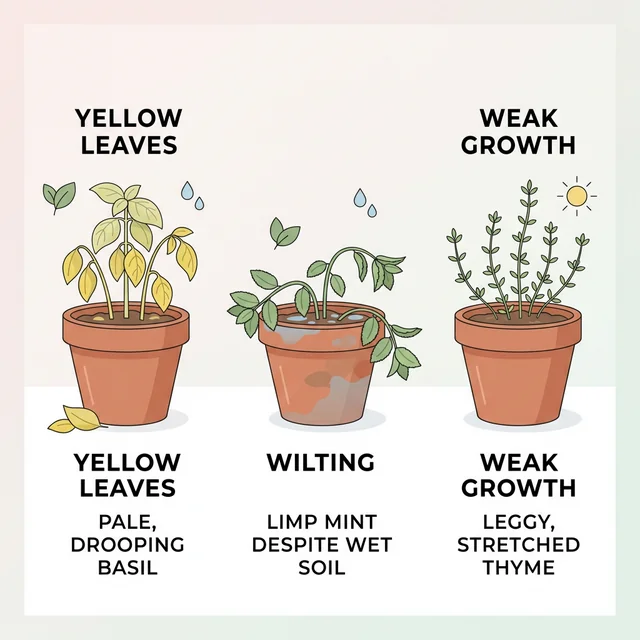
Common potted herb problems: yellow leaves, wilting, and weak growth
Common potted herb problems usually show up as yellow leaves, wilting, or weak growth, but the useful diagnosis starts with light, drainage, and root stress.

Grow lights for seedlings: the complete setup
A tray of seedlings under lights needs more than a bulb overhead. It needs the right kind of fixture, a photoperiod on a timer, and a distance that changes every week as the seedlings grow.
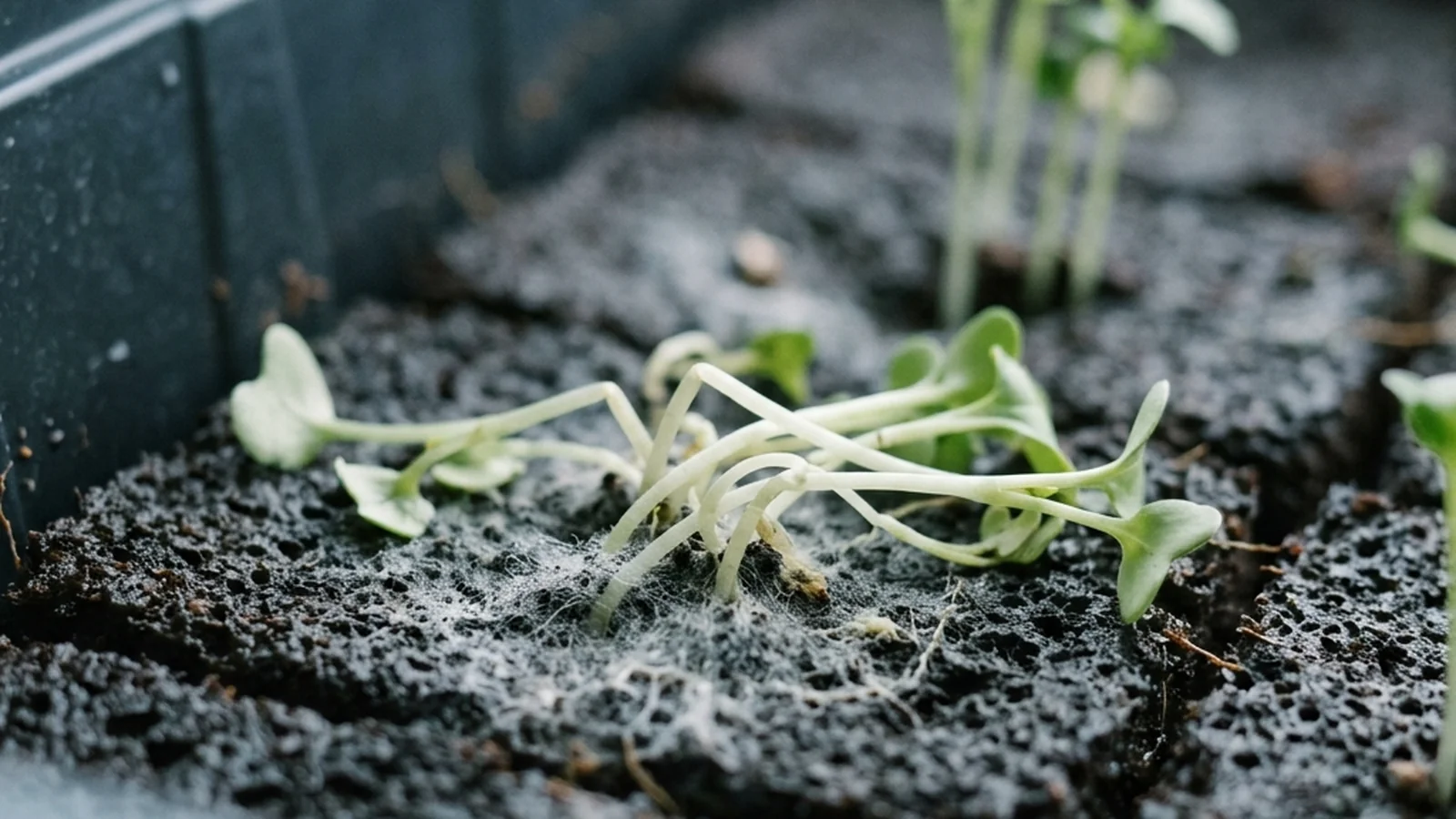
Damping-off in microgreens: symptoms and control
Damping-off attacks the seedling itself, not the tray surface. Here is how to recognize pre- and post-emergence stages and control outbreaks with sanitation, not fungicide.