Troubleshoot the system before you change the inputs.
Symptoms
- Leaves turn lacy and transparent, with the veins intact, mostly on the underside of the plant.
- Yellow, spiny grubs or copper, spotted beetles on the leaf underside.
- Clusters of bright yellow eggs standing on end beneath the leaves.
- Badly damaged leaves curl and fall; pods and stems may also be chewed.
Possible causes
- Mexican bean beetle adults that overwintered nearby and found your beans in spring or early summer.
- A second or third generation building up in July and August.
Quick fixes
- Crush egg clusters, grubs and adults by hand, checking the underside of every leaf.
- Cover the plants with row cover after planting and leave it on until harvest.
- Pull up and bag spent plants after harvest.
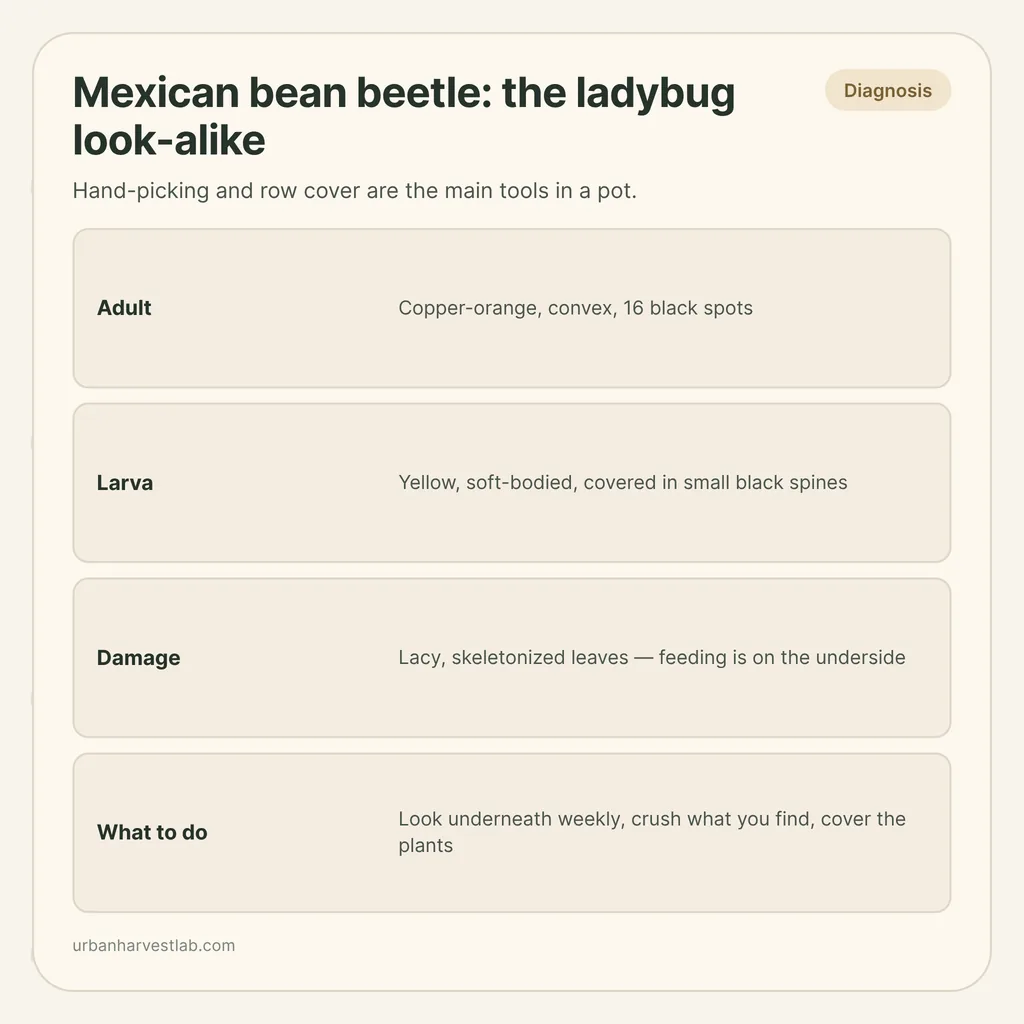
If your bean leaves have turned to lace and a spotted, ladybug-shaped beetle is sitting on them, you are looking at the Mexican bean beetle, not a helper. The adult is copper-orange with 16 black spots, the larva is a spiny yellow grub, and both eat bean leaves from underneath. Hand-picking and row cover are the main tools in a pot.
Telling the stages apart
The beetle is a lady beetle look-alike, so the mistake is easy. Maryland Extension describes the adult as a convex oval beetle like a ladybug, about 1/3 inch long, orange to copper with 16 black spots in three rows of 6-6-4. Clemson Extension gives the same count as eight spots on each wing cover and calls the colour yellow to coppery-brown.
If the insect is a grub rather than a beetle, check it against beneficial insect larvae before you squash anything: some larvae on your plants are predators.
| Stage | What you see | Source |
|---|---|---|
| Eggs | Bright yellow, standing on end in clusters on the underside of leaves. Maryland counts 40-60 per cluster; Clemson says 20 to 50. | UMD, Clemson |
| Larva | Yellow, oval, soft-bodied, covered in small black spines. About 1/3 inch when full grown. | UMD, Clemson |
| Pupa | Yellow-orange and smoother than the larva, cemented to the leaf. | UMD, Clemson |
| Adult | Copper-orange, convex, 16 black spots. | UMD, Clemson |
Adults are slow. Maryland Extension notes they drop to lower leaves or the ground when disturbed and can excrete blood from their leg joints as a defence.
The damage pattern
Both larvae and adults feed on the underside of the leaf between the veins, removing the lower surface. Maryland Extension explains that the upper surface then dies, giving a transparent, lacy look. Clemson says the veins are left between the chewed areas. Skeletonized leaves can curl and fall off, and larvae are the more damaging stage. When numbers are high, adults and larvae also chew blossoms, pods and stems.
Because the feeding is hidden underneath, the first thing you notice from above is often a pale, dry patch. Turn the leaf over. Yellowing without lace is a different problem; the page on bean leaves turning yellow covers hunger, wet roots, mites and virus.
Some loss is survivable. Maryland Extension says bean plants tolerate up to 20% defoliation before yield is reduced, so a few eaten leaves on a healthy plant do not need drastic action. A plant with most leaves skeletonized does.
When the beetles arrive
Adults overwinter, Maryland Extension says, under plant debris, in open fields or in wooded areas. They emerge in spring and lay eggs on leaf undersides; larvae hatch within two weeks. Clemson puts egg-to-adult at about a month, with usually three generations a year. Maryland gives one to three.
Clemson also observes that most damage occurs in July and August, and that quick-maturing green beans planted very early or during late summer may escape it. Its list names ‘Wade’ and ‘Black Valentine’ as resistant or tolerant snap bean varieties. If you grow beans on a balcony and this pest has been a repeat visitor, timing and variety are worth changing next season; the general growing advice is in beans in containers.
Beans are the main host: Maryland lists legumes, especially lima and snap beans, plus cowpea and soybean, with fava, lentil and mung bean less preferred.
What to do, in order
- Look underneath weekly from early summer. Maryland Extension advises inspecting leaf undersides for yellow egg clusters. Brilliant yellow larvae and coppery adults are easy to spot.
- Crush what you find. Both Maryland and Clemson recommend hand removal in the home garden: egg clusters, larvae and adults.
- Cover the plants. Maryland suggests covering entire rows with row cover after planting, and leaving it on until harvest. If you need cover, you can browse row cover on Amazon.
- Treat only if it is severe. For severe infestations Maryland names spinosad, neem or pyrethrum. Read the label for edible plants and the waiting time before harvest; the choice guide for edibles is in choosing a pest treatment.
- Finish cleanly. Maryland says badly infested plants should be sealed in plastic bags and composted a week later. After harvest, pull up and bag the plants: adults may fly away, but eggs, larvae and pupae on the plants are killed.
Maryland also lists a parasitic wasp, Pediobius foveolatus, to buy and release when larvae first appear, and describes it as most practical in large plantings or community gardens.
One more Maryland idea suits a gardener with a high-pressure yard: sow a small patch of beans early in spring so overwintered adults find it first, then pull and bag it once it is infested.
Sources
Beans, beneficial insects and yellow leaves
Growing beans in pots, telling friendly larvae from pests, and reading other bean leaf problems.
Common questions
How many spots does a Mexican bean beetle have?
Sixteen. Maryland Extension describes them as arranged in three rows of 6-6-4 on the back, and Clemson describes eight spots on each wing cover. The body is orange to copper, about a third of an inch long.
Is a Mexican bean beetle the same as a ladybug?
It is a close look-alike. Maryland Extension notes its convex oval shape is like that of ladybugs, but it feeds on bean leaves. Coppery colour, 16 spots and the lacy underside of the leaf give it away.
What do Mexican bean beetle larvae look like?
Soft-bodied, oval and yellow, covered in small black-tipped spines so they look fuzzy. Full-grown, Clemson Extension puts them at about a third of an inch long.
How do I get rid of Mexican bean beetles on potted beans?
Maryland Extension suggests crushing egg clusters, larvae and adults by hand, covering the plants with row cover from planting, and pulling up and bagging plants after harvest. For severe infestations it names spinosad, neem or pyrethrum; follow the product label.
Related guides
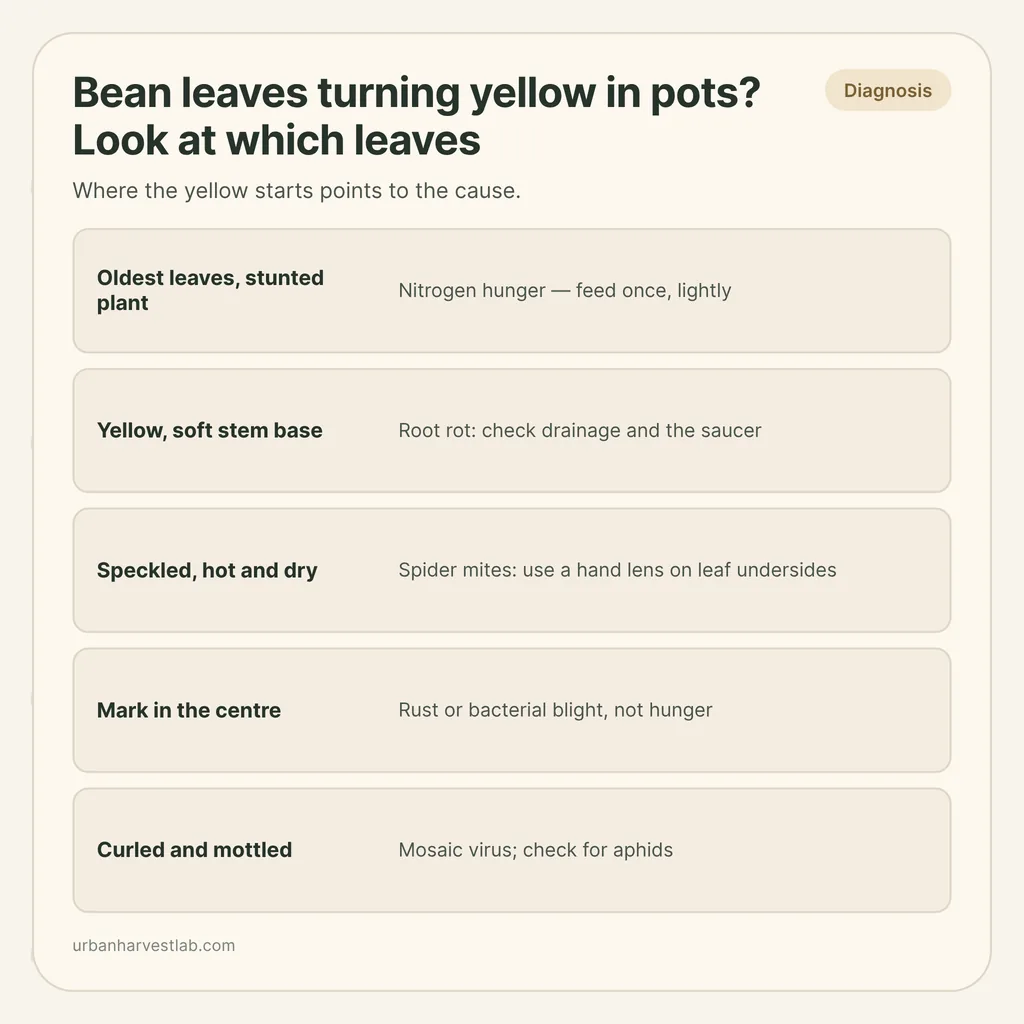
Bean leaves turning yellow in pots? Hunger, wet roots, mites or virus
Bean leaves yellow for a handful of reasons. Which leaves change first, what the roots look like and whether the pattern is even or patchy sort them out.
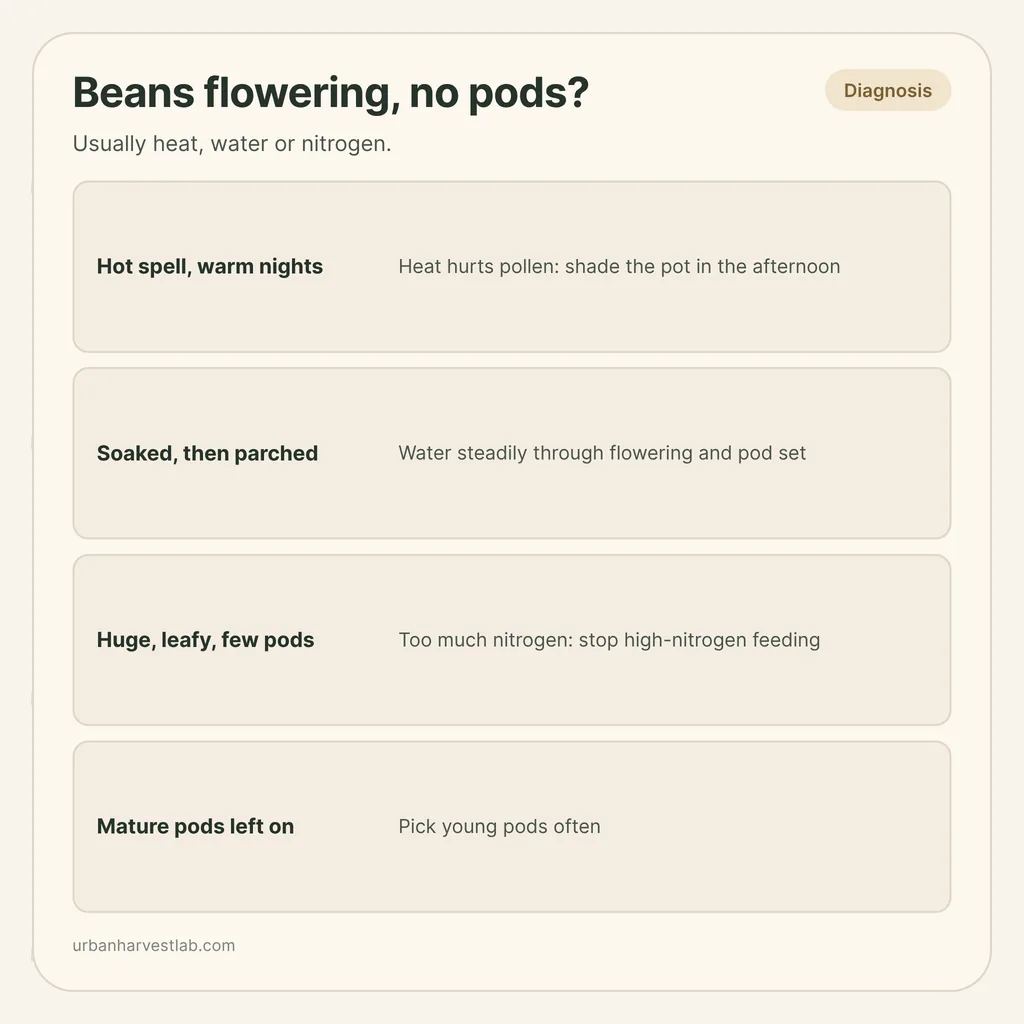
Bean plants flowering but no pods: heat, water, nitrogen or old pods
A bean plant covered in flowers and bare of pods is rarely sick. Heat, uneven watering, a nitrogen-rich mix or pods left to ripen are the usual reasons, and each has its own fix.
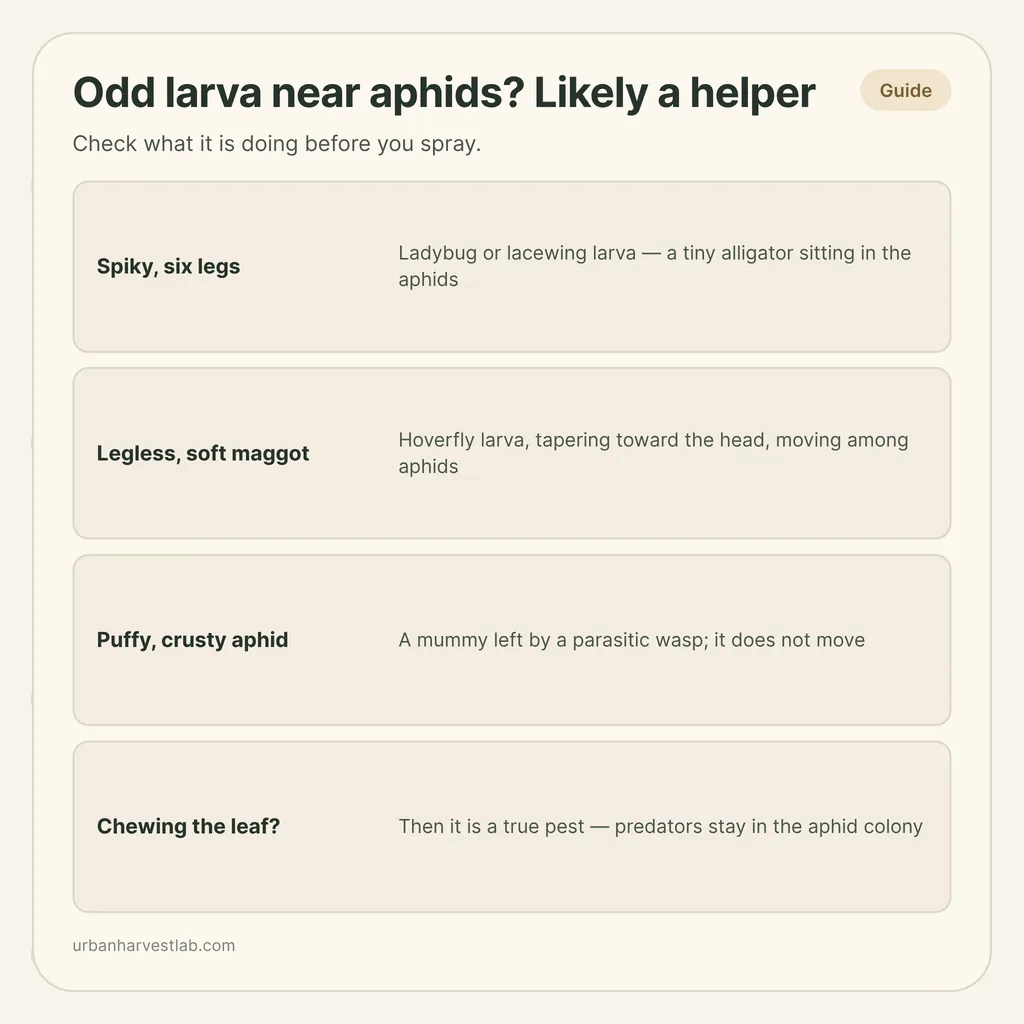
Beneficial insect larvae identification: ladybug, lacewing and hoverfly
The strange larva on your leaf is often the thing eating your aphids. Here is how to recognise ladybug, lacewing and hoverfly larvae and aphid mummies.