Troubleshoot the system before you change the inputs.
Symptoms
- Oldest leaves turn pale green to yellow while the top stays green.
- Leaves are speckled and dull, with fine webbing when mite numbers are large.
- Yellow leaves are curled or mottled in light and dark patches.
- The plant wilts or yellows and the stem base is soft or watery.
Possible causes
- Nitrogen shortage from leaching, cold, a slow start or a pH outside 6.0 to 8.0.
- Root rot in wet or poorly drained mix.
- Spider mites in hot, dry weather.
- Bean rust or a bacterial leaf spot.
- A mosaic virus carried by aphids or seed.
Quick fixes
- Note which leaves yellow first, then wash the roots free of mix and cut a nodule open.
- Check every drainage hole and let the top of the mix dry between waterings.
- Look at the underside of a leaf with a hand lens before you treat for anything.
- Remove plants showing mosaic, and sow fresh seed rather than saved seed next time.
Yellow bean leaves: which cause fits
| What you see | Likely cause | First move |
|---|---|---|
| Older, lower leaves pale green to yellow, even across the leaf, plant stunted | Nitrogen hunger | Check pH and roots, then feed lightly to the label |
| Yellow leaves, soft or water-soaked stem base, roots dying | Root rot | Lift the pot, check drainage, repot in fresh mix if the roots are mushy |
| Fine speckling, off-green leaves, hot dry spell, webbing when numbers are large | Spider mites | Hand lens on the underside, then wash the foliage with water |
| Rust-coloured pustules on the underside, yellowing around them | Bean rust | Check the underside of the leaves for pustules and separate rust from hunger |
| Curled, mottled leaves, stunted plant, yellow leaves | Mosaic virus | Remove the plant, control aphids |
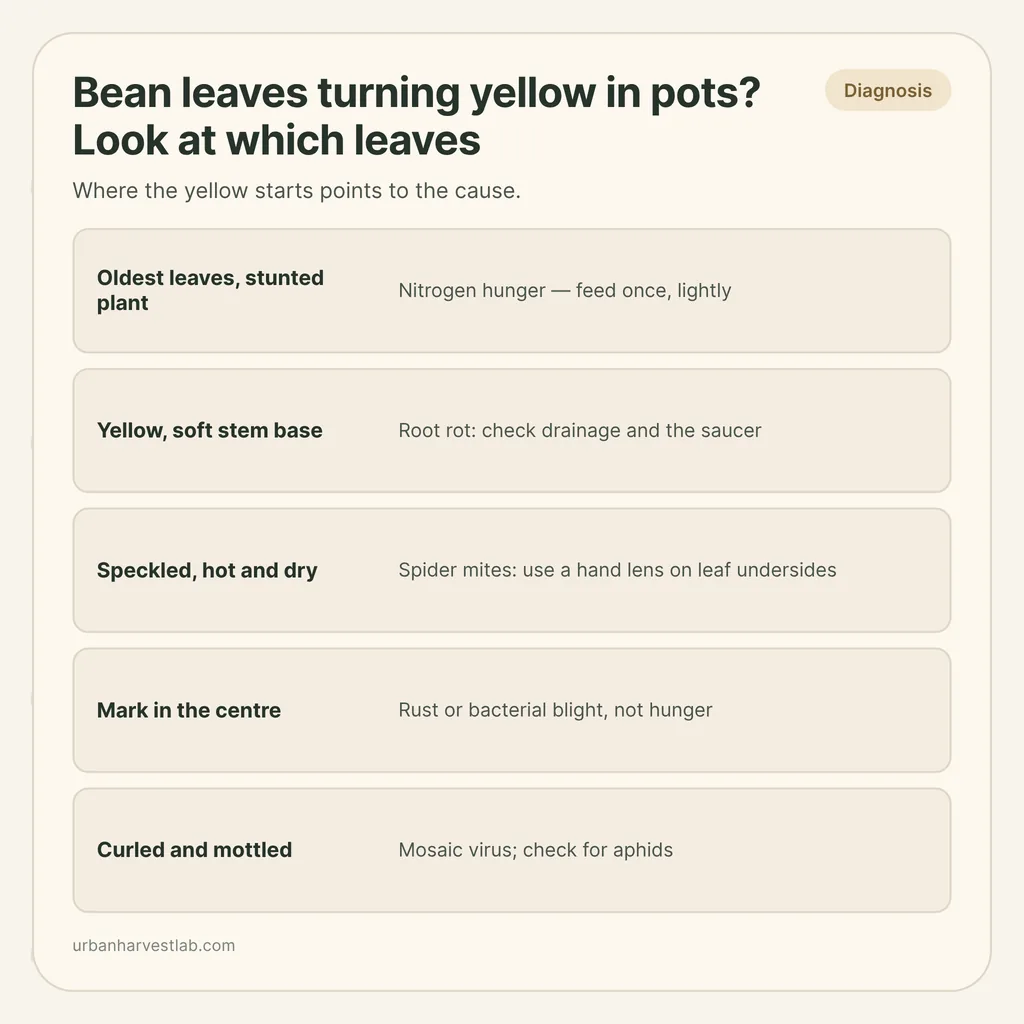
Look at which leaves are yellow. Even yellowing on the oldest, lowest leaves of a stunted plant is nitrogen hunger; yellowing with a soft stem base is root rot; fine speckling in hot, dry weather is spider mites; and curled, mottled leaves point to a virus. The roots settle most of the doubt, so be ready to tip the pot out.
For sowing, pot size and support, see growing beans in containers. If the plant is green but the flowers are dropping, that is a different problem, covered in bean plants flowering but no pods. Peas, a cool-season cousin, have their own page: pea plants turning yellow.
Older leaves first: nitrogen
UC IPM describes nitrogen deficiency in beans as older leaves pale green to yellow, with stunted plants, few flowers and poorly filled pods. It says this happens in all soils but especially in sandy soils or soils low in organic matter, and that heavy rain or irrigation can leach nitrates out. A pot is the extreme case: every watering that runs out of the bottom takes some nitrogen with it. UC IPM adds that if soil pH is outside 6.0 to 8.0, nitrogen availability may be restricted.
Beans make some of their own. The University of Maryland Extension says they fix nitrogen once a good root system is established. Montana State University Extension notes that a legume can still run short if it got off to a slow start and did not build healthy nodules early on, and that when the cause is cold, symptoms should go away once soils warm. Feeding a cold, sulking plant does not help.
Check the nodules
Wash a little mix off the roots of a sacrificial or failing plant and look for small lumps. Penn State Extension, writing about soybeans, says nodules actively fixing nitrogen are pink or red when cut open, white ones may be immature, and mushy brown ones are not fixing. Beans are a different species, so use it as a guide, not a verdict. Pink inside and still yellow suggests the bacteria are working and the plant needs something else: warmth, a feed or better drainage. Few or no nodules on a plant that is still young means waiting and warming it.
Feed, but lightly
Do not reach for the strongest bottle. Maryland says excess nitrogen delays flowering and side-dressing is usually not necessary, and Mississippi State says nitrogen-rich soils give excessive vine growth and no beans. If the older-leaf pattern is clear, feed once at the label rate with a balanced liquid vegetable fertilizer and watch the new growth. UC IPM also lists a sulfur shortage that causes uniform yellowing similar to nitrogen, and says soil or tissue tests may be needed to be precise.
Yellow with a soft stem: the roots
Clemson Extension describes bean root rots as a watery soft rot slightly above or below the soil line; the roots usually die and the leaves turn yellow. Alabama Extension describes sunken, reddish-brown lesions on the roots of young plants and lists flooding or extended drought among the stresses that make damage worse.
Lift the pot. If it is heavy days after watering, or the saucer is holding water, fix that first. Clemson’s prevention advice is to avoid poorly drained sites and plant on raised beds, which for a pot means open drainage holes and a free-draining mix. Rotate too: it says to move bean and pea to a different spot each time, which in a pot means fresh mix. Maryland’s watering advice is deep and regular in dry spells, not constant wetness. Overwatered vs underwatered helps you tell which one you have.
Speckled leaves in hot weather: spider mites
The University of Minnesota Extension lists spider mites on snap beans in summer, especially in hot, dry weather: leaves are speckled and off-green, and webbing shows when numbers are large. The mites are about 1/50 inch long and hard to see without magnification, so use a hand lens on the underside of a leaf. Iowa State describes fine speckling, then yellowing, then bronzing, and recommends washing the foliage with water. For the paper test and treatment choices, see spider mites on indoor herbs and choosing a pest treatment for plants you are going to eat.
Rust and leaf spots: yellow around a mark
Iowa State describes bean rust as small reddish-brown pustules that lead to yellowing and premature leaf drop; Clemson places them on the lower leaf surface, and Alabama says rust is most common on mature plants. Bacterial blights show as water-soaked spots turning brown with yellow halos, per Iowa State. In both cases the yellow has a mark at its centre, which separates them from hunger.
Curled and mottled: virus
University of Minnesota Extension lists bean common mosaic virus and bean yellow mosaic virus: curled, mottled leaves that may be yellow, and stunted plants. Alabama says both cut growth and yield. Clemson cautions that nutrient imbalance or herbicide injury can look alike, and says many bean viruses travel by aphids and seed. Aphids are the vector Iowa State names, so check the growing tips. The signs and handling are in mosaic virus on potted plants. Remove an infected plant promptly, as Iowa State advises, and buy fresh seed next time.
Late in the crop
A plant that has cropped for weeks may simply be finishing. Maryland gives 50 to 60 days to maturity for snap beans and 60 to 110 for pole beans from sowing, and says that keeping maturing beans picked prolongs the life of the vines. Iowa State adds that pods left to mature fully prevent new pods from forming. University of Wisconsin soybean guidance describes leaf senescence beginning on the oldest, lowest leaves and spreading upward. That is soybean, not snap bean, so use it only after the roots, mites and rust are ruled out.
Sources
- UC IPM, Dry Beans: nutrient deficiency and toxicity
- Montana State University Extension, plant nutrient deficiency symptoms
- Penn State Extension, evaluating nodulation in soybeans
- University of Maryland Extension, growing beans in a home garden
- Mississippi State University Extension, beans
- Clemson HGIC, bean and southern pea diseases
- Alabama Cooperative Extension System, common diseases of snap and lima beans
- University of Minnesota Extension, snap bean discolored leaves
- Iowa State University Extension, common problems of green beans
- University of Wisconsin, soybean growth and development
More on beans and yellow leaves
The bean growing guide, the pod-set page and the wider yellow-leaf finders.
Common questions
Why are my bean leaves turning yellow?
Check which leaves yellow first. Pale green to yellow on the older, lower leaves of a stunted plant with few flowers is the nitrogen-deficiency pattern UC IPM describes. A soft stem base and dying roots point to root rot. Fine speckling on hot, dry days means spider mites, and mottled, curled leaves suggest a virus.
Should I add nitrogen fertilizer to yellow beans?
Only if the yellowing starts on the older leaves and the roots are healthy. Beans are legumes and fix nitrogen once a good root system is established, according to the University of Maryland Extension, which also says excess nitrogen delays flowering. Mississippi State University Extension says nitrogen-rich soils give excessive vine growth and no beans.
Can yellow leaves from a virus recover?
Not by treatment. Clemson Extension says there are no recommended chemical controls for viruses, and Iowa State advises removing infected plants promptly. Many bean viruses are carried by aphids and by seed, so Clemson recommends against saving seed from year to year.
Are yellow bottom leaves on a bean plant normal?
Sometimes, late in the crop. University of Wisconsin soybean guidance describes leaf senescence starting on the oldest, lowest leaves and moving upward as the crop matures. Snap beans are a different species, so treat it as a likely parallel and rule out roots, mites and rust first.
Related guides
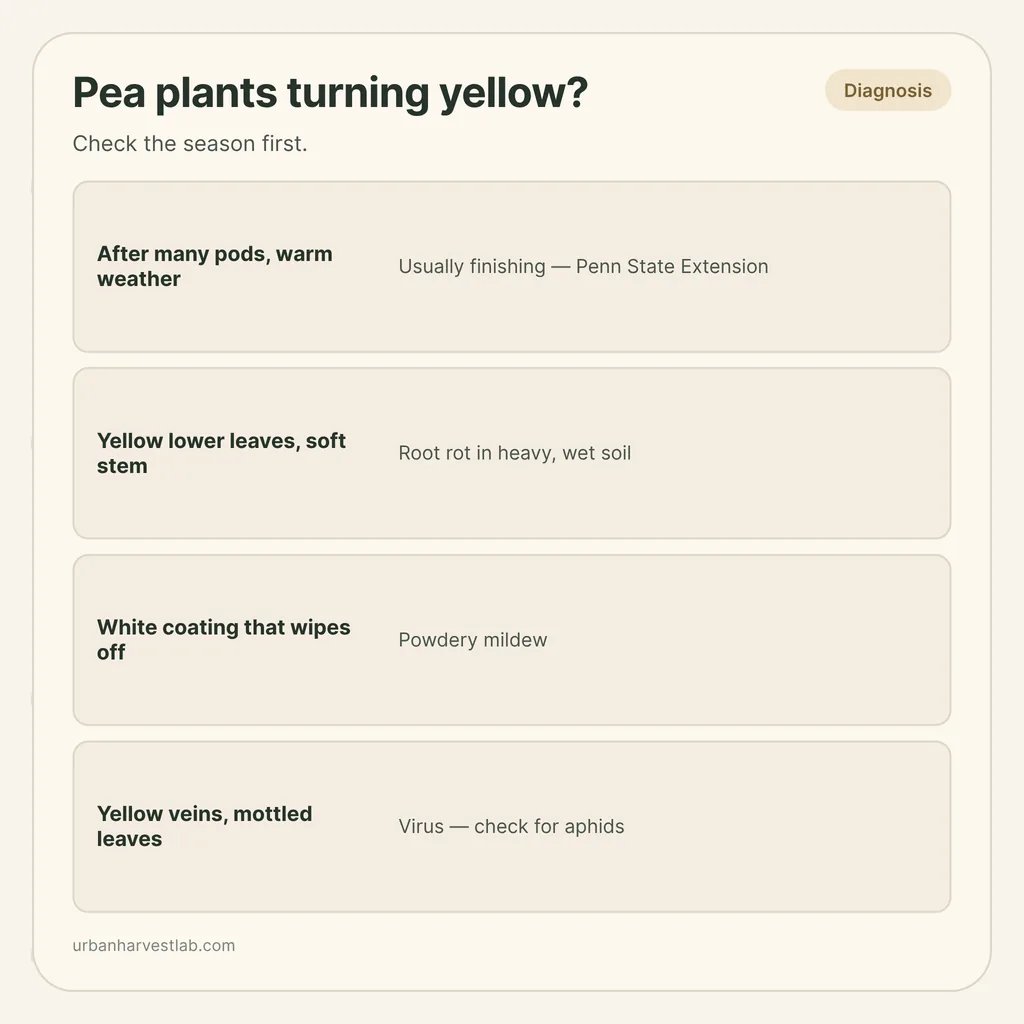
Pea plants turning yellow? Season's end, wet roots, mildew or virus
Peas yellow for ordinary reasons late in the season, but yellow lower leaves in a soggy pot, a white coating or mottled leaves point to something else.
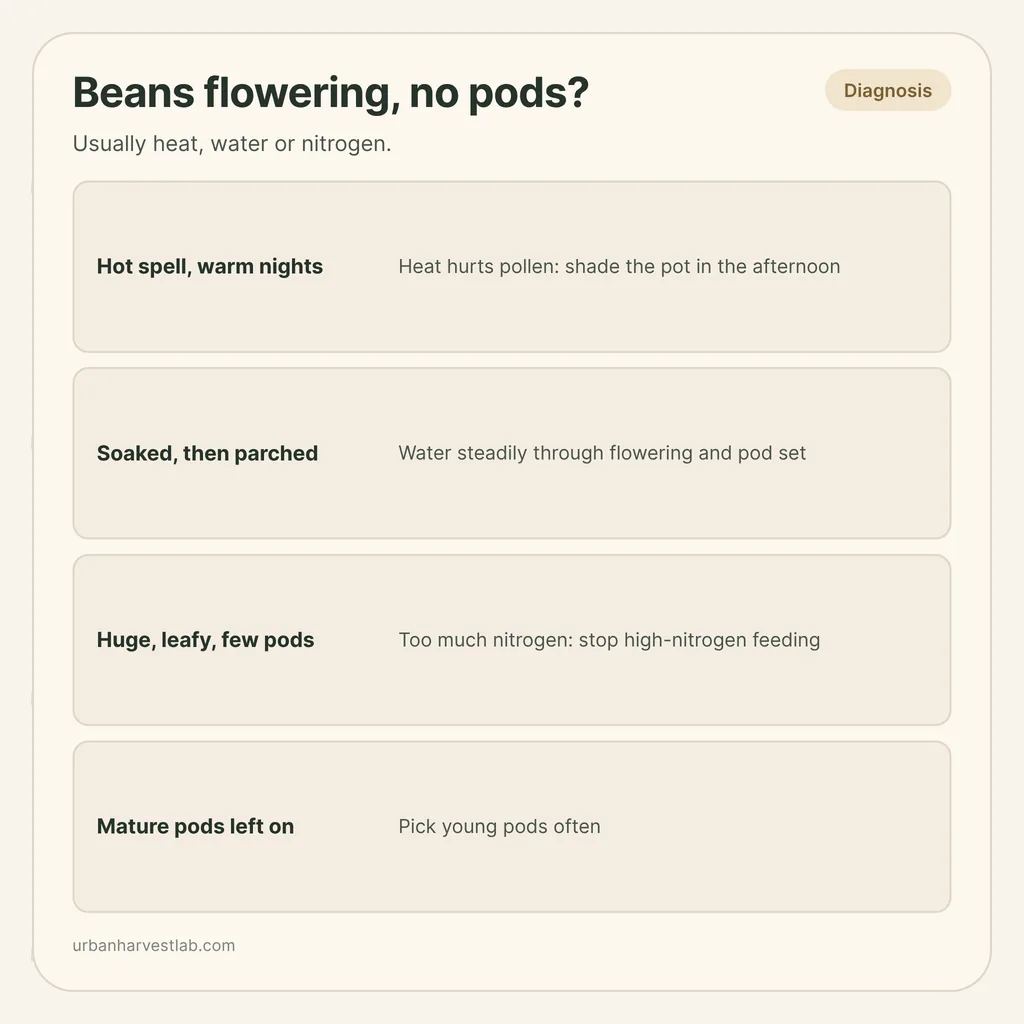
Bean plants flowering but no pods: heat, water, nitrogen or old pods
A bean plant covered in flowers and bare of pods is rarely sick. Heat, uneven watering, a nitrogen-rich mix or pods left to ripen are the usual reasons, and each has its own fix.
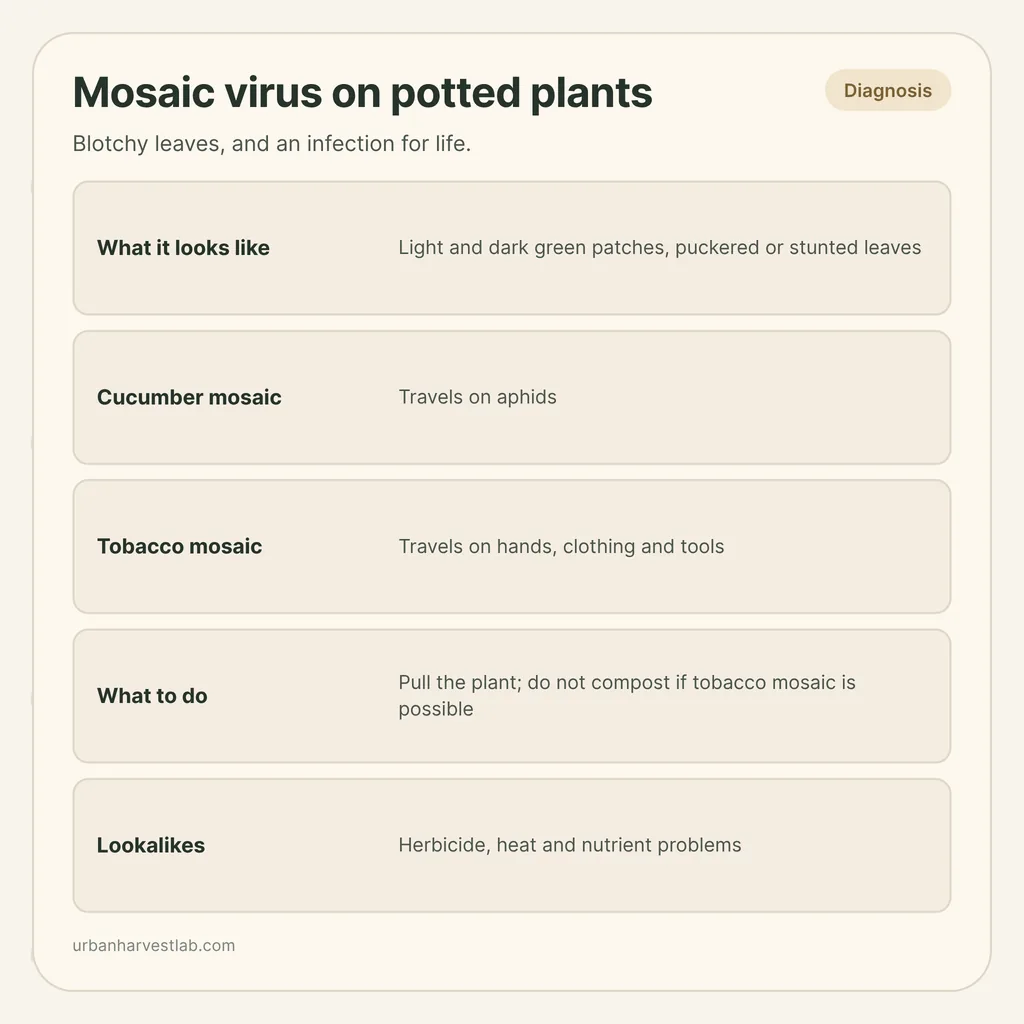
Mosaic virus on potted plants: how to spot it and what to do
Mosaic virus has no cure. Here is how to tell it from herbicide, heat and nutrient problems, how it travels between pots, and how to clean up afterwards.