
Bush beans and pole beans in containers
| Trait | Bush beans | Pole beans |
|---|---|---|
| Support | Self-standing, a couple of feet high, no trellis (Alabama Extension) | Sturdy trellis 6 to 8 feet tall (University of Maryland, Clemson) |
| Days to harvest | 50 to 60 (University of Maryland); 55 to 65 (Auburn) | 60 to 110 (University of Maryland); 70 to 80 (Auburn) |
| Pot guidance | 2 gallons (Texas A&M, University of Maryland); 2 to 3 gallons (UGA) | One plant per 5-gallon pot (Oregon State); 4 inches apart in the row |
| Harvest pattern | A burst, then restart with a new sowing | Higher yield over a longer period in less space (University of Maryland) |
| Best for | Windowsill-height pots, wind-exposed balconies, low effort | Narrow balconies with height to spare |
Grow bush beans if you want a small pot, no trellis and a quick crop; grow pole beans if you have height but little floor space and want pods over a longer stretch. Both do well in containers when you sow in place after the last frost, keep the mix evenly moist and pick young pods often. The difference is the support: bush beans stand on their own, while pole beans need a sturdy frame that you set up on day one.
If you are still choosing crops for a small outdoor space, a beginner’s apartment vegetable garden plan and the best vegetables for small balconies put beans alongside the other options.
Bush or pole: choose by the space you have
Alabama Extension puts the difference plainly: bush beans are self-standing and grow only a couple of feet high, so no trellis is required, while pole beans grow much larger and require support. University of Maryland Extension adds the trade: pole beans generally produce higher yields over a longer period in less space than bush types.
For a pot that means a simple rule. Where the limit is floor area and you have wall, railing or ceiling height to use, pole beans give more for the footprint. Where the limit is wind, weight or patience, bush beans are easier. A tall frame on a windy balcony catches a lot of air, so if yours is exposed, read how to windproof a balcony garden before committing to a 6 foot frame.
Half-runner beans sit between the two. University of Maryland Extension describes them as a snap bean with a growth habit between bush and pole, and Clemson says they produce runners about 3 feet long, are generally grown like bush beans, and may yield more on a 3- to 4-foot trellis. They suit a pot where you can offer a short frame but not a tall one.
Pot size: the sources disagree, so lean larger
Container advice for beans is not a single number.
- Texas A&M AgriLife Extension and University of Maryland Extension both give 2 gallons for bush green beans, and Texas A&M spaces plants 3 inches apart.
- UGA Fulton County Extension gives 2 to 3 gallons.
- Alabama Extension plants 3 to 4 plants in a 2.5-gallon container and warns that beans will not produce if overcrowded.
- Oregon State Extension recommends at least a 5-gallon container with one pre-sprouted seed or seedling, noting that larger containers also make it easier to keep moisture steady.
- University of Kentucky Extension asks for at least 10 inches of depth.
The small end of that range works for a compact bush bean if you water attentively. The 5-gallon end gives a pole bean room and buffers against the drying that comes with a big leafy plant on a sunny balcony. If you are unsure, take the bigger pot and fewer plants. Choose a pot with drainage holes and fresh potting mix, not garden soil.
Support for pole beans
Clemson says pole-type snap beans require a sturdy trellis, and that many homemade trellises work as long as they provide the needed support. University of Maryland Extension says trellises should be 6 to 8 feet tall and sturdy enough to withstand summer storms. Clemson describes one simple version, a teepee tripod of three wooden poles or large branches secured together at the top, with five or six seeds planted in a circle 6 to 8 inches from each pole. Oregon State spaces pole beans 4 inches apart and says to use a trellis for support.
Put the support in before you sow, so you are not pushing canes into a pot full of roots. A tripod set into the mix is only as stable as the pot, so use a heavy container, or tie the frame to a fixed point where that is allowed. How to trellis a plant without drilling a single hole covers tension poles, tripods and free-standing frames for renters. Pole beans also make a quick living screen, as edible balcony privacy screens explains.
Bush types need nothing, though a few short twigs can help a heavily podded plant stay upright after rain.
When and how to sow
Beans are tender. Clemson says not to plant them before the soil temperature is at least 60 ºF at the 4-inch depth, and that seed germinates poorly in cold soil and the plants are killed by light frost. University of Maryland Extension agrees that frost damages plant tissue. In a pot the mix warms and cools faster than ground soil, so wait for settled weather. First and last frost dates for a balcony shows how to find yours.
Sow seed straight into the final pot. Alabama Extension does not recommend transplants. Oregon State suggests pre-sprouting seed to improve success, and University of Maryland Extension notes that pre-germinating may help prevent seed rot and seed maggot problems in cool spring soil.
Depth is one place sources differ: Alabama Extension sows about 1 inch deep, while University of Maryland Extension covers seed with 1/4 to 1/2 inch of soil or compost. Anything within that span works. Keep the mix moist but not soaking until seedlings emerge.
If you sow several seeds, thin to the density your pot supports. Alabama Extension thins bush beans to 2 to 3 inches apart and pole beans to 4 to 6 inches once sprouts are 2 to 3 inches tall. In a small pot, stay within the plant-per-pot figures above.
Light, water and feeding
University of Maryland Extension says beans need at least 6 hours of direct light a day and prefer 8 to 10. A shadier balcony will give fewer pods; the best vegetables for a shady balcony lists better fits.
Watering is the main job. Alabama Extension says to keep soil consistently moist but not saturated and to avoid wetting leaves to prevent fungal disease. University of Maryland Extension says to water more frequently when pods begin to develop. Pots dry faster than beds, so check the mix with a finger rather than by the calendar; how often to water container vegetables explains how pot volume and crop stage set the interval.
On feeding, the sources lean light. University of Maryland Extension notes that beans are legumes that fix nitrogen once a good root system is established, that excess nitrogen will delay flowering, and that side-dressing is usually not necessary. Alabama Extension applies an all-purpose fertilizer (8-8-8 or 10-10-10) at planting, according to label directions, and side-dresses before first bloom. In a container with a fresh potting mix, start light and follow the label.
Heat and blossom drop
Clemson says that during hot weather above 90 ºF, blossom drop may be a problem, and that plants usually start setting more pods when daily temperatures cool. A balcony wall can add heat, so a mid-summer gap in pods is often temperature, not a failing plant. Keeping the mix evenly moist is the part you control; how to protect container plants during a heatwave has the tactics.
Harvest, and keeping pods coming
Pick snap beans while the pods are tender. Clemson says to harvest before the enlarging seed can be seen through the pod, and University of Maryland Extension says pods should break easily with a snap. Oregon State’s marker is a pod about as thick as a pencil, before it fills out. Clemson gives about 55 days from sowing to first harvest, depending on variety. Auburn gives 55 to 65 days for bush beans and 70 to 80 for pole beans, while University of Maryland Extension gives 50 to 60 days for snap beans and 60 to 110 for pole beans. Variety on the seed packet is the best guide.
Pick often. University of Maryland Extension says to keep maturing beans picked to prolong the life of the vines, and Oregon State says picking often helps the plant produce more. Look under the leaves for pods hiding there.
Bush beans crop in a burst, so staggering helps. Clemson plants in intervals of 10 to 14 days, and Alabama Extension and University of Maryland Extension both say every 2 to 3 weeks, the latter through mid-to-late July in Maryland. In pots, a second pot sown a few weeks after the first is the simplest way; succession planting in containers explains how to stagger a few pots. Peas follow the same support logic in cooler weather: see peas in containers.
Pests to watch
Oregon State names Mexican bean beetles and aphids as common pests. Check the undersides of leaves when you pick, and keep leaves dry when watering.
Sources
- University of Maryland Extension, “Growing Beans in a Home Garden”
- Alabama Cooperative Extension System, “Grow More Beans (Bush and Pole)”
- Oregon State University Extension, “Beans (Bush and Pole)”
- Oregon State University Extension, “Container Gardening Basics”
- Clemson Cooperative Extension, “Bush & Pole-Type Snap Beans”
- Texas A&M AgriLife Extension, “Vegetable Gardening in Containers” (E-545)
- UGA Fulton County Extension, “Container Gardening: Thinking Outside the Box”
- University of Kentucky Extension, Daviess County, “Vegetables Grown in Containers Improves Accessibility”
Support, scheduling and the wider balcony plan
Guides to the trellis, the sowing rhythm and the watering that bean pots depend on.
Common questions
How do you grow beans in pots?
Sow seed directly in a pot of fresh potting mix after the last frost, once the mix is at least 60 ºF (Clemson). Use a bush type in a pot of roughly 2 to 5 gallons, or a pole type in a 5-gallon pot with a trellis 6 to 8 feet tall. Keep the mix evenly moist, water more as pods form, and pick pods while they are still tender.
Are bush or pole beans better in containers?
Bush beans are better when you want no support and a small pot; they crop in a burst. Pole beans are better when you have height and little floor space, since University of Maryland Extension says they generally produce higher yields over a longer period in less space. They need a sturdy trellis 6 to 8 feet tall.
How big a pot do green beans need?
Sources differ. Texas A&M and University of Maryland Extension give 2 gallons for bush beans, UGA Fulton County Extension gives 2 to 3 gallons, Alabama Extension plants 3 to 4 in a 2.5-gallon container, and Oregon State recommends at least 5 gallons with one plant per pot. University of Kentucky Extension asks for at least 10 inches of depth.
How often do container beans produce?
Snap beans are ready about 55 days after sowing according to Clemson, with Auburn giving 55 to 65 days for bush types and 70 to 80 days for pole types. Once picking starts, harvest continues for days or weeks, longer if you pick often and sow again every 2 to 3 weeks.
Related guides
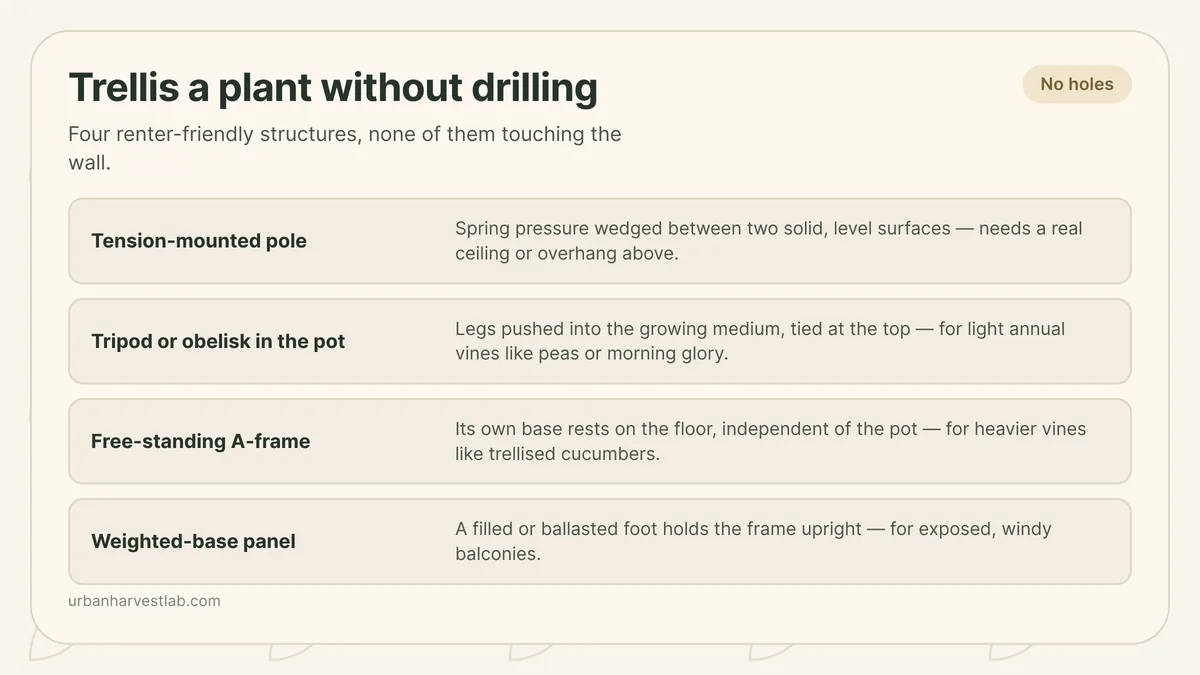
How to trellis a plant without drilling a single hole
A container has no ground to sink a post into, so a renter-friendly trellis has to get its stability from somewhere else. Four approaches do that without touching a wall, railing, or ceiling.
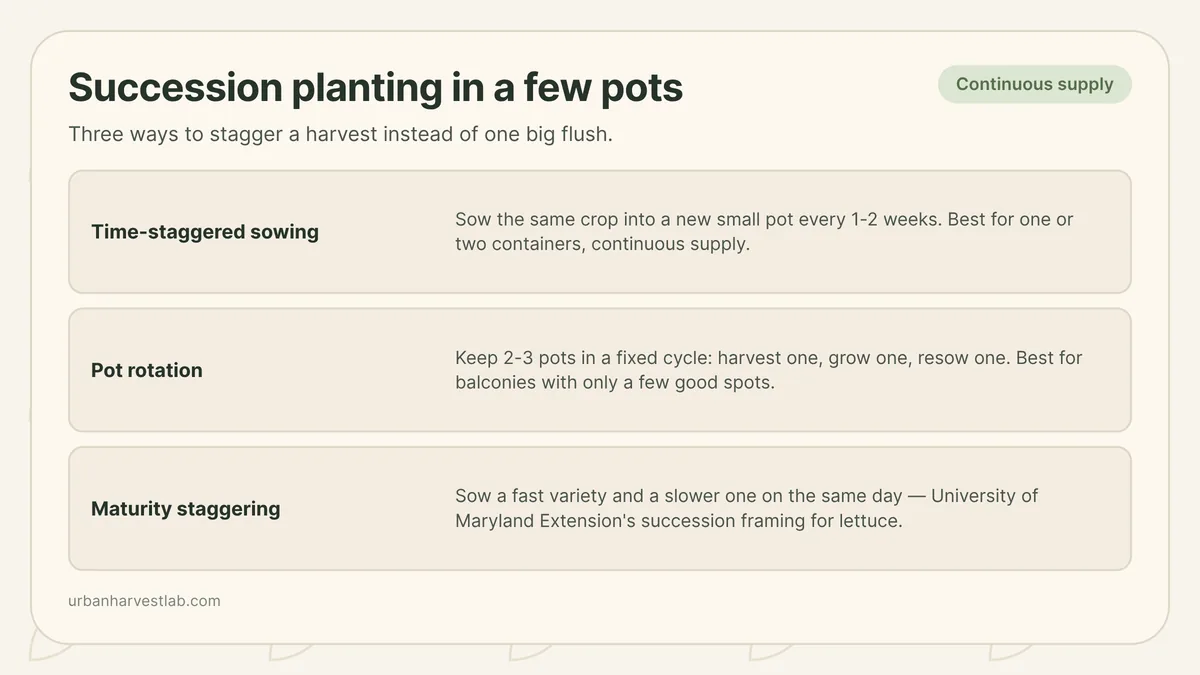
Succession planting in containers: how to stagger a harvest from a few pots
Succession planting in containers is a sowing rhythm: a few pots restarted on a schedule keep producing, where one large planting ripens together and then quits together.
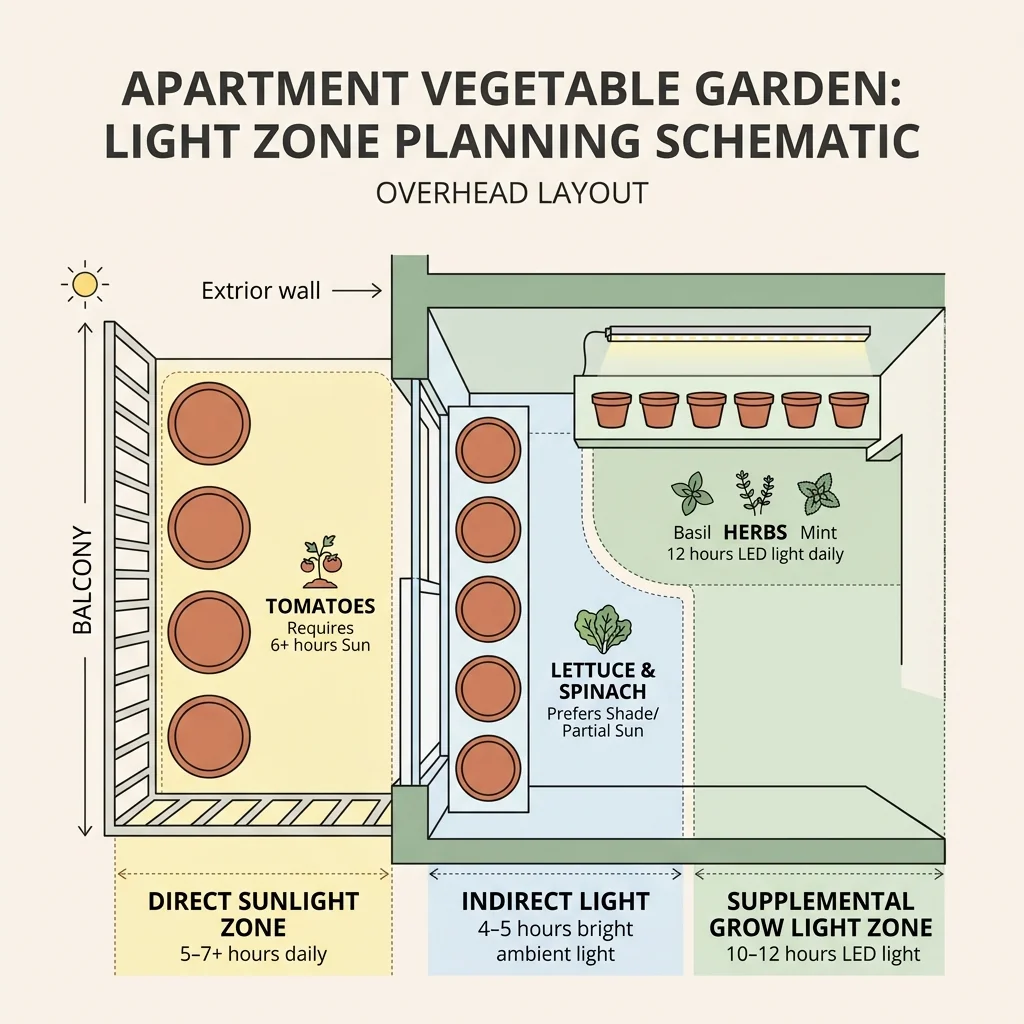
A beginner's apartment vegetable garden plan
Growing food in an apartment works when light, containers, crops, and routine are planned together. This is a simple, step-by-step plan to start from scratch.