Troubleshoot the system before you change the inputs.
Symptoms
- Dark brown, cylindrical, many-legged animals that coil into a spiral when touched, found under the pot or in damp mix.
- Sprouting seeds or seedlings that vanish or collapse in a pot with a damp, rotting surface layer.
- Small pits or gouges in strawberries that rest on the soil.
Possible causes
- A constantly damp surface with mulch or decaying plant matter gives millipedes both food and the moisture they need.
- Seedlings weakened by disease, cold or another pest are easier for millipedes to feed on.
- Large numbers can damage sprouting seeds, seedlings and fruit touching the ground.
Quick fixes
- Remove decaying leaves and mulch from the surface and let the top of the mix dry between waterings.
- Lift ripening fruit off the soil.
- Look for a second cause, such as seedling disease or another pest, before blaming millipedes alone.
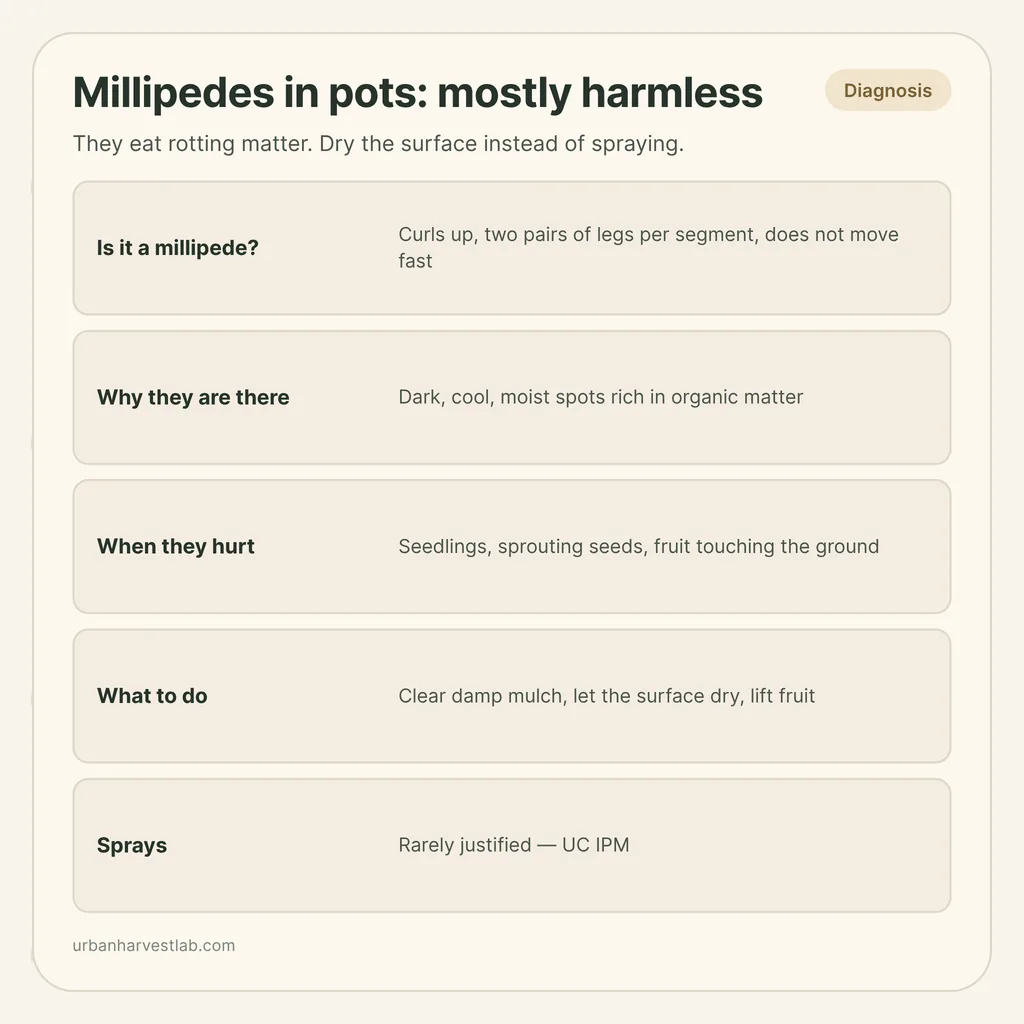
Millipedes in potted plants are mostly decomposers: they live on rotting leaves and wood, and only damage seedlings or ground-touching fruit when they become numerous. A few under a pot are no threat. If seedlings are disappearing, dry out the surface layer and check for a second culprit.
Is it really a millipede?
Colorado State describes the common ones as dark brown, 1 to 1 1/2 inches when full grown, round and elongated with many small legs, and says they tend to curl into a tight coil when dead or disturbed. Penn State adds the leg pattern: two pairs per body segment. They do not have a thousand legs, as Iowa State points out; they typically bear 80-400.
Two look-alikes cause most of the mix-ups.
| Clue | Millipede | Centipede | Wireworm |
|---|---|---|---|
| Legs per segment (UC IPM) | 2 (sometimes 4) pairs | 1 pair | 3 pairs in total |
| Movement (UC IPM) | Does not move rapidly | Moves rapidly | Stays beneath the soil surface |
| When disturbed (UC IPM) | Curls up | Does not coil | - |
| Bites (UC IPM) | No | Prone to biting | - |
| What it is (UC IPM) | Decomposer | Predator | Click beetle larva |
UC IPM also describes garden symphylans, which are white, under a quarter inch long and have 12 pairs of legs as adults. They live in damp soil and sometimes attack underground plant parts, so a pale, fast thing among damaged roots is a different problem.
Why they are in your pot
Millipedes need moisture and food, and a container can supply both. NC State says they prefer dark, cool, moist environments rich in organic matter, and its factsheet shows garden millipedes found under a pot. Penn State lists the usual hiding places: under stones, leaf mold, mulch and compost heaps.
Iowa State adds the reason they show up when it has been wet: millipedes need moist, cool conditions to avoid drying out. A saucer that stays full, a thick layer of half-rotted mulch, or a corner of old leaves behind the pots is a home.
Do they actually hurt plants?
Usually not. Colorado State says millipedes rarely feed on tender green leaves and roots, and NC State says garden millipedes feed only on decaying matter and do not harm living plants unless the soil dries out so far that they feed on roots to obtain moisture. NC State adds that they occasionally damage soft-stemmed plants in gardens and greenhouses.
UC IPM names the cases where numbers cause trouble: sprouting seeds, seedlings, and strawberries or other ripening fruit in contact with the ground. Colorado State also lists tender seedlings in greenhouses and gardens.
Iowa State gives the detail that matters for diagnosis. Millipedes will feed on decaying seeds or seedlings that have been compromised by another issue, such as environmental conditions, seedling diseases or other pests. Finding millipedes next to a dead seedling does not prove they killed it. Iowa State’s own management advice starts with checking for other potential issues. For collapsing seedlings in general, why herb seedlings die covers the usual suspects.
What to do
Colorado State says control is rarely necessary and, if required, primarily involves moisture control. The steps below follow from that.
- Clear the damp, rotting layer. UC IPM advises reducing mulch and other organic matter and avoiding excessive moisture. In a pot, that means lifting off decaying leaves and old mulch from the surface.
- Let the surface dry between waterings. Colorado State says chronic problems are associated with damp conditions and that measures taken to dry out moist areas usually are sufficient. If you cannot tell whether the pot is too wet, overwatered vs underwatered shows how to check.
- Consider a mineral surface. NC State suggests inorganic mulches such as gravel for better drainage.
- Lift fruit. Colorado State says ripening fruit should be lifted off the soil, onto mulch or other surfaces. For strawberries in pots, keep berries off the mix.
- Collect them if you want. Colorado State says millipedes can be concentrated under fruit rinds or moistened newspapers and then collected.
- Skip the sprays. UC IPM says pesticides are rarely justified for millipede control. Iowa State notes that soil residue makes contact difficult in the first place.
Handle large numbers with care. UC IPM says some species exude a liquid that can irritate skin or burn the eyes, and NC State says they secrete cyanide gas when alarmed.
Sorting them from other pot residents
Several animals share the same damp, rotting surface, and they are managed differently.
- Grey, oval, rolling-up creatures are isopods, covered in pill bugs in plant pots.
- Brown pincered insects that hide by day are earwigs.
- Tiny jumping specks and small flies at the soil surface are sorted in springtails vs fungus gnats.
Colorado State notes that pillbugs and sowbugs may also feed on tender seedlings, and that controls effective for millipedes work for them too, so drying the surface helps with the whole group.
When they wander indoors
Indoor pots sometimes bring millipedes into view. Colorado State says millipedes require high moisture and usually die in a home within a day or two, and UC IPM says those that stray indoors can be swept up or picked up and released outdoors. Penn State links migrations to cooler weather or heavy rain. A few in a pot that has been outside are a sign to check the saucer, not an infestation.
Sources
Other small creatures in pots
Damp, rotting layers in a pot attract several look-alike creatures; these guides separate them.
Common questions
Do millipedes eat the roots of potted plants?
Rarely. Colorado State says millipedes feed on rotting organic matter and rarely feed on tender green leaves and roots. NC State adds that garden millipedes do not harm living plants unless the soil dries out to the point that they feed on roots to obtain moisture.
How do I tell a millipede from a centipede?
Look at the legs and the movement. UC IPM lists one pair of legs per body segment for centipedes and two (sometimes four) pairs for millipedes, and says centipedes move rapidly and are prone to biting while millipedes are not. Millipedes curl up when disturbed; UC IPM says centipedes do not.
Are millipedes dangerous to touch?
They do not bite, but UC IPM says some species exude a defensive liquid that can irritate skin or burn the eyes, and NC State says they secrete cyanide gas when alarmed, so be careful when handling large quantities. Wash your hands afterwards.
How do I get rid of millipedes in my pots?
Remove what they live on. UC IPM says to reduce mulch and other organic matter and avoid excessive moisture in garden areas, and that pesticides are rarely justified. Colorado State says control primarily should involve moisture control because these animals are susceptible to drying.
Related guides

Pill bugs in plant pots: when they hurt seedlings and how to cut their numbers
Grey, armoured, roll-into-a-ball creatures in your potting mix are usually decomposers. Here is when they threaten seedlings, how to confirm it after dark, and what actually reduces them.

Earwigs in potted plants: harmless, helpful, or pest?
Earwigs in a pot are usually sheltering, and they eat aphids. They only earn a trap when you can show they are chewing seedlings, lettuce, or soft fruit.
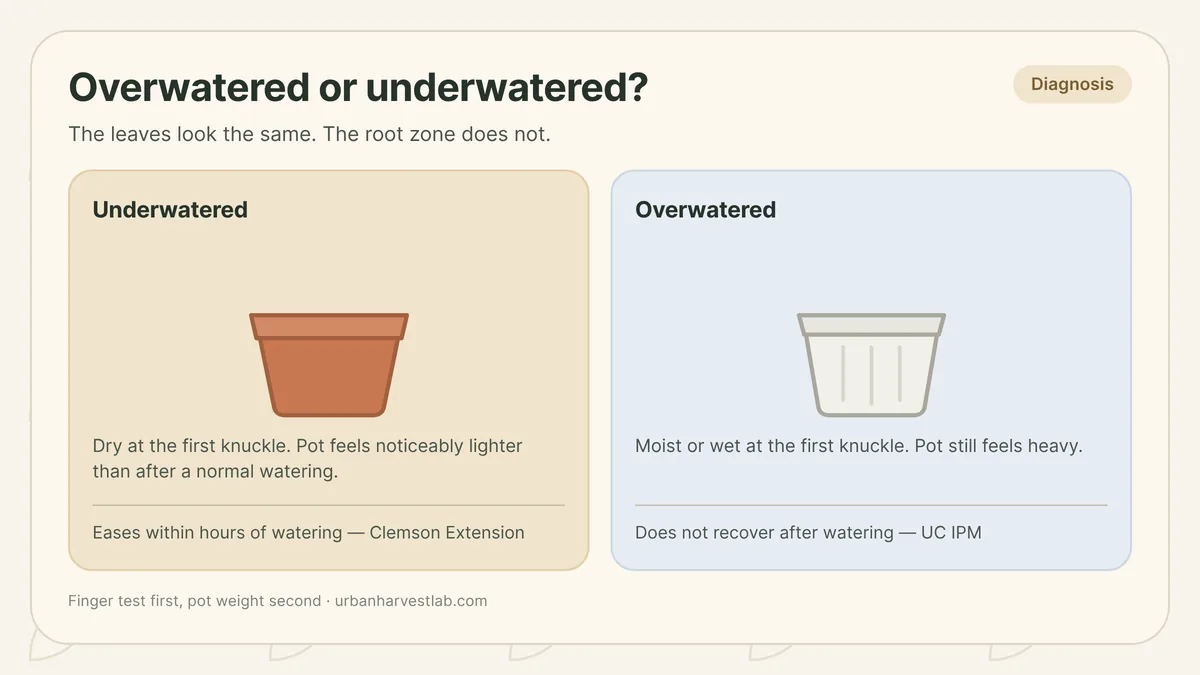
Overwatered vs underwatered: how to tell which one you have
Reading the root zone directly, with a finger test, pot weight, and how the plant responds to being watered, settles what the leaves alone cannot.