Troubleshoot the system before you change the inputs.
Symptoms
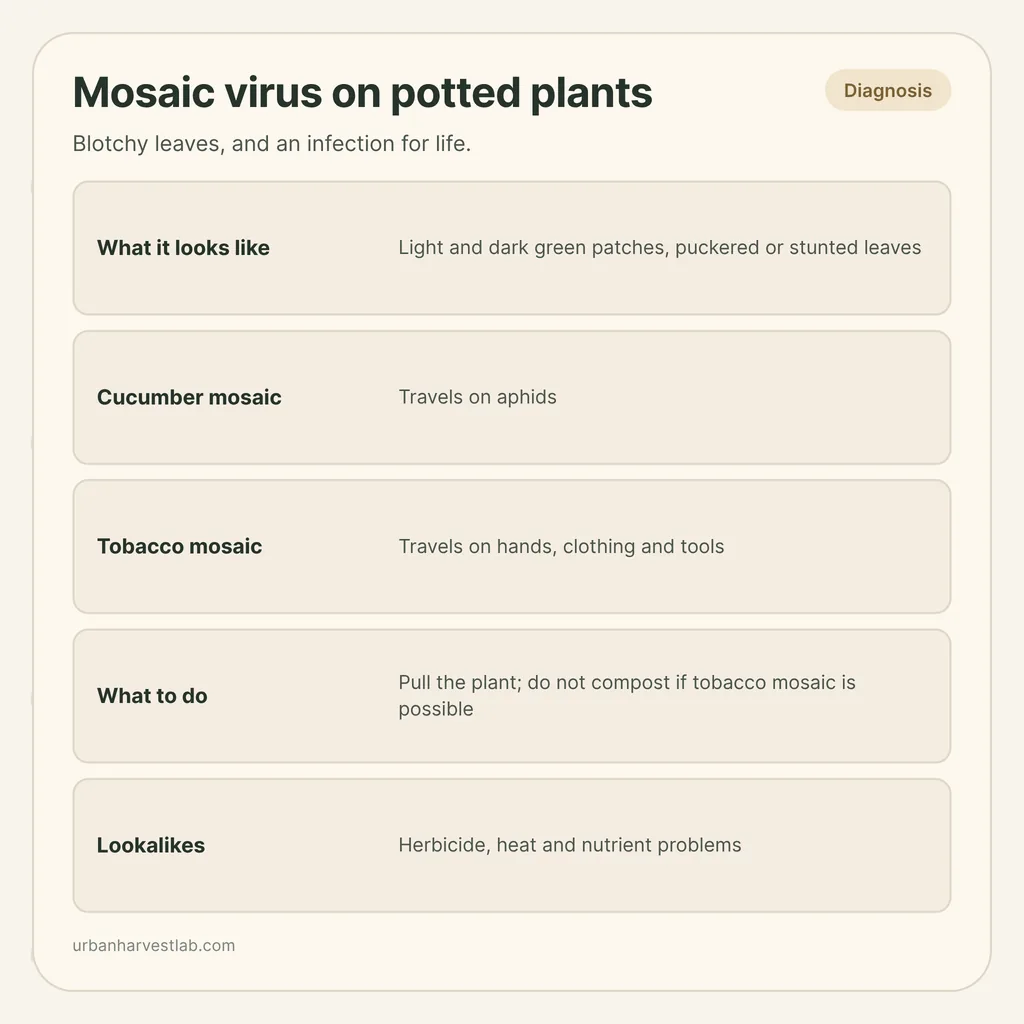
- Blotchy light and dark green or yellow patches on leaves.
- Cupped, puckered, strap-like or crinkled leaves, and a stunted plant.
- Fruit that is blotchy, ripens unevenly or is deformed.
Possible causes
- Cucumber mosaic virus or other aphid-borne viruses.
- Tobacco mosaic virus or tomato mosaic virus carried on hands, tools or infected seed.
- Lookalikes: herbicide exposure, nutrient problems, heat or insect feeding.
Quick fixes
- Isolate the plant and check for aphids on it and its neighbours.
- If the pattern fits, remove the plant and bag it.
- Wash hands and clean pruners and stakes before handling healthy plants.
Mosaic virus compared with look-alike causes
| Clue | Mosaic virus | Herbicide or heat | Nutrient problem |
|---|---|---|---|
| Leaf pattern | Blotchy light and dark patches | Twisting, cupping or curl, often without a patchwork | Yellowing or blotching tied to old or new leaves |
| Whole plant | Often stunted, gets worse over the season | May stabilise when the cause stops | Responds once the cause is corrected |
| Fruit | Blotchy, uneven or deformed | Variable | Variable |
If a tomato, cucumber or pepper has blotchy light and dark green leaves that pucker, strap or stay small, and the plant is stunted, mosaic virus is a strong suspect. There is no cure, so the usual advice is to remove the plant. What you do afterwards depends on which virus it might be, because they travel in different ways.
Curling alone is more often heat or uneven watering. If the leaves are mostly rolled rather than mottled, start with tomato leaves curling before deciding anything is a virus.
What mosaic looks like
University of Wisconsin Extension describes tobacco mosaic on leaves as “blotchy light and dark areas (called mosaic); cupping, curling, elongation (strapping), roughening, wrinkling and other growth distortions”. Fruit may be blotchy, ripen unevenly, be malformed or taste off, and whole plants are often stunted.
On cucumbers and squash, UC IPM lists mottling of light green, yellow or white areas, clearing of veins, thickening of leaves and reduced growth, with possible fruit deformity. On peppers and eggplants it lists mosaic patterns, leaf curling, fruit distortion and stunting. Cucumbers with misshapen fruit but healthy leaves are a different question, covered in misshapen cucumbers.
University of Maryland Extension says viral symptoms are usually seen first on foliage and tend to progress and worsen through the season. That is a useful clue: a nutrient or heat problem often settles once the cause is fixed, while a virus keeps going.
Rule out the lookalikes first
Wisconsin says herbicide exposure, nutrient deficiencies or toxicities, high temperature and even insect feeding can cause similar symptoms. Penn State says tobacco mosaic cannot be diagnosed on symptoms alone, and Wisconsin says proper diagnosis requires lab testing. Wisconsin adds that several viruses can hit one plant at once.
So treat the diagnosis as likely rather than certain. Before you pull a plant, ask:
- Did the distortion start on new growth after a spray, windy day or a neighbour’s lawn treatment? Herbicide is worth ruling out.
- Is the mottling a patchwork of light and dark, or just yellow veins or edges? Patchwork fits virus; yellowing in a pattern tied to leaf age fits a nutrient problem.
- Is it getting worse week by week and spreading to new leaves?
- Are there aphids, or sticky honeydew, on the plant?
If two or three answers point to virus, act. Your local extension office or plant clinic can test a sample if you want certainty.
How it gets from plant to plant
Cucumber mosaic virus and many relatives ride on aphids. UC IPM says many aphid species transmit cucumber mosaic virus and the potyviruses, and that spotted cucumber beetles carry squash mosaic virus. Wisconsin advises removing weed hosts around the garden, and UC IPM says broadleaf weeds can serve as a reservoir of viruses.
Tobacco mosaic and tomato mosaic travel by contact. Penn State says the main route is workers’ hands, clothing or tools, because handling damages leaf hairs and sap carries the virus. Sucking insects such as aphids do not spread it, according to Penn State. Wisconsin adds that tobacco products can harbor the virus, that it can survive on tools and work surfaces, and that it survives in infected plants, including viable seed, and in their debris. UC IPM lists seed and mechanical spread for some pepper viruses too.
That difference matters. If your plant has aphids on it, think cucumber mosaic. If it sits among tomatoes you tie, prune and sucker daily, and you handle tobacco products, think tobacco mosaic. Penn State says the virus is not spread in the smoke of burning tobacco; the risk is contaminated hands.
What to do with an infected plant
Spraying will not help. Penn State says no chemicals cure a virus-infected plant, UC IPM says insecticides are not a practical way to control these viruses, and Wisconsin warns they may increase aphid movement.
- Remove the plant. UC IPM’s advice for peppers is to pull up plants showing symptoms, because they will be unproductive and may spread disease to nearby healthy plants. It says the same for cucurbits.
- Bag it for tobacco mosaic. Wisconsin says to burn infected plants where allowed, or double-bag them for the landfill, and not to compost plants with tobacco mosaic. For cucumber mosaic it lists burning, deep burial or hot composting, which is hard to do in a flat. Bagging for the trash is the simplest option.
- Do not take cuttings. Penn State says cuttings from an infected plant are usually infected even if they show no symptoms.
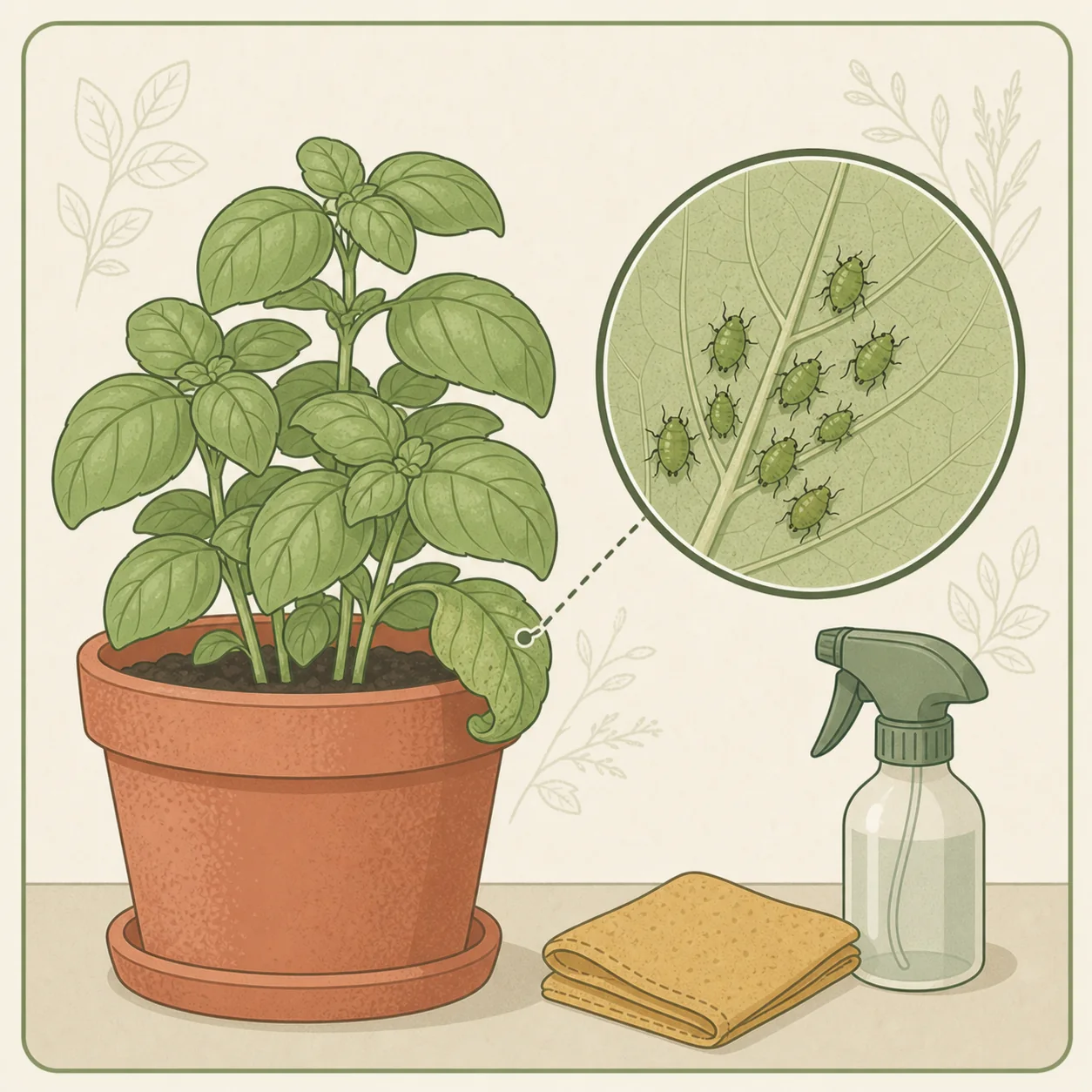
- Check neighbours. Inspect nearby plants over the next weeks. Aphids need dealing with on their own terms; see aphids on indoor herbs for the isolate-and-rinse loop.
Cleaning up your hands and tools
Wash hands with soap and water after handling an infected plant, and launder clothes you wore while disposing of it, as Wisconsin advises. For disinfecting, Wisconsin gives one recipe for tobacco mosaic: treat items for a minimum of one minute in 14 dry ounces of trisodium phosphate per gallon of water, or in a laboratory detergent mix it specifies, then rinse with plenty of water. Penn State, writing for greenhouses, says to place tools in disinfectant for at least 10 minutes and rinse with tap water, without naming the product. Wisconsin says to wash hands thoroughly with soap and water, and Penn State says to wash hands after handling infected plants or tobacco products.
Keeping it out next time
- Buy certified virus-free seed and plants, and inspect transplants for mottling before you buy, as Wisconsin advises.
- Choose resistant varieties where they exist. Wisconsin and UC IPM both say to use resistant varieties where available, and Maryland suggests tomato transplants resistant to TMV.
- Cover young plants with row cover against insects, as UC IPM and Wisconsin suggest. UC IPM also says reflective mulch may reduce or delay infection.
- Keep weeds down and minimise handling, as UC IPM advises.
- If seed saving is your plan, do not collect seed from a plant that showed these symptoms, since Wisconsin says tobacco mosaic virus survives in viable seed. See saving seeds from container plants.
Sources
Rule out the lookalikes
Curling, yellowing and distorted leaves have several causes besides virus. These guides separate them.
Common questions
Can I save a plant with mosaic virus?
No. University of Wisconsin Extension says there is no known cure for cucumber mosaic or for tobacco mosaic, and that an infected plant stays infected for life. Penn State Extension adds that no chemicals cure a virus-infected plant.
Can I eat fruit from a plant with mosaic virus?
University of Maryland Extension says that if symptoms extend to edible plant parts the whole plant should be removed and discarded, and, writing about pods such as beans, that those with minor symptoms are edible and will not cause health problems. Wisconsin notes that fruit from infected plants can be blotchy, uneven or have an off flavor.
Will spraying for aphids stop cucumber mosaic?
Extension advice is to skip it. University of Wisconsin Extension says insecticides are unlikely to act fast enough to stop aphids transmitting the virus and may make aphids move and feed more widely. UC IPM calls insecticide control of virus diseases impractical.
Can I reuse the pot and soil?
Wisconsin says tobacco mosaic virus survives in infected plants and in debris from them, and advises decontaminating anything that touched the plant, so the simplest course is to discard the potting mix with the plant rather than assume picking out fragments makes it safe, and to wash the pot before it is reused.
Related guides

Tomato leaves curling: heat, water swings, herbicide, pests, or virus
Most curling tomato leaves are a harmless response to heat or uneven watering. Twisted new growth, bronzing, or stunting points elsewhere.
Aphids on indoor herbs: identify, isolate, and control them
Aphids are manageable when you find the colony, isolate the plant, remove most insects physically, and repeat inspections through the next generation.

How to save seeds from container vegetables: tomatoes, beans and peppers
Tomatoes, peppers, beans and peas are the easiest vegetables to save seed from, as long as the variety is not an F1 hybrid. Here is how to do each one from a pot.